Health HUB for elderly people

Bálint Barna


Project Overview
This project explores the concept of a user-centered, accessible health management system for elderly users. The solution comprises a wearable ring and a tablet interface, designed to monitor key health metrics and provide critical reminders in a way that is both engaging and easy to use. This project focuses on the user experience (UX) and interface design, showcasing how thoughtful design can improve health monitoring for elderly users.
Problem Statement
Elderly people often face challenges in managing multiple health metrics and keeping up with medication, hydration, and activity goals. Traditional health management tools can be difficult to navigate and lack features that accommodate declining vision, dexterity, or memory. The goal of this project is to design an accessible and intuitive solution that empowers elderly users to stay on top of their health independently.
Key Features
• Comprehensive Health Metrics: Heart rate, blood pressure, blood sugar, sleep tracking, steps, cycling, calories, oxygen level, pH levels, and temperature.
• Daily Reminders: For food, water, and medication intake.
• Goal Setting: Users can set goals for each metric, helping them maintain control over their health.
• SOS Functionality: The system has an SOS button, which alerts a doctor or emergency contact if certain health metrics reach critical levels.
• Accessibility Features: Voice navigation and large icons make the interface easy to use, even for those with visual impairments or limited mobility.
Design Process
1. Research and User Insights
• User Needs Analysis: Secondary research and personas were created to understand the daily needs and pain points of elderly users. Key insights included the importance of simplified navigation, large readable text, and automated reminders to support memory.
• Accessibility Requirements: Design decisions were informed by accessibility guidelines, such as using high-contrast colors, large buttons, and voice commands, to make the interface inclusive.
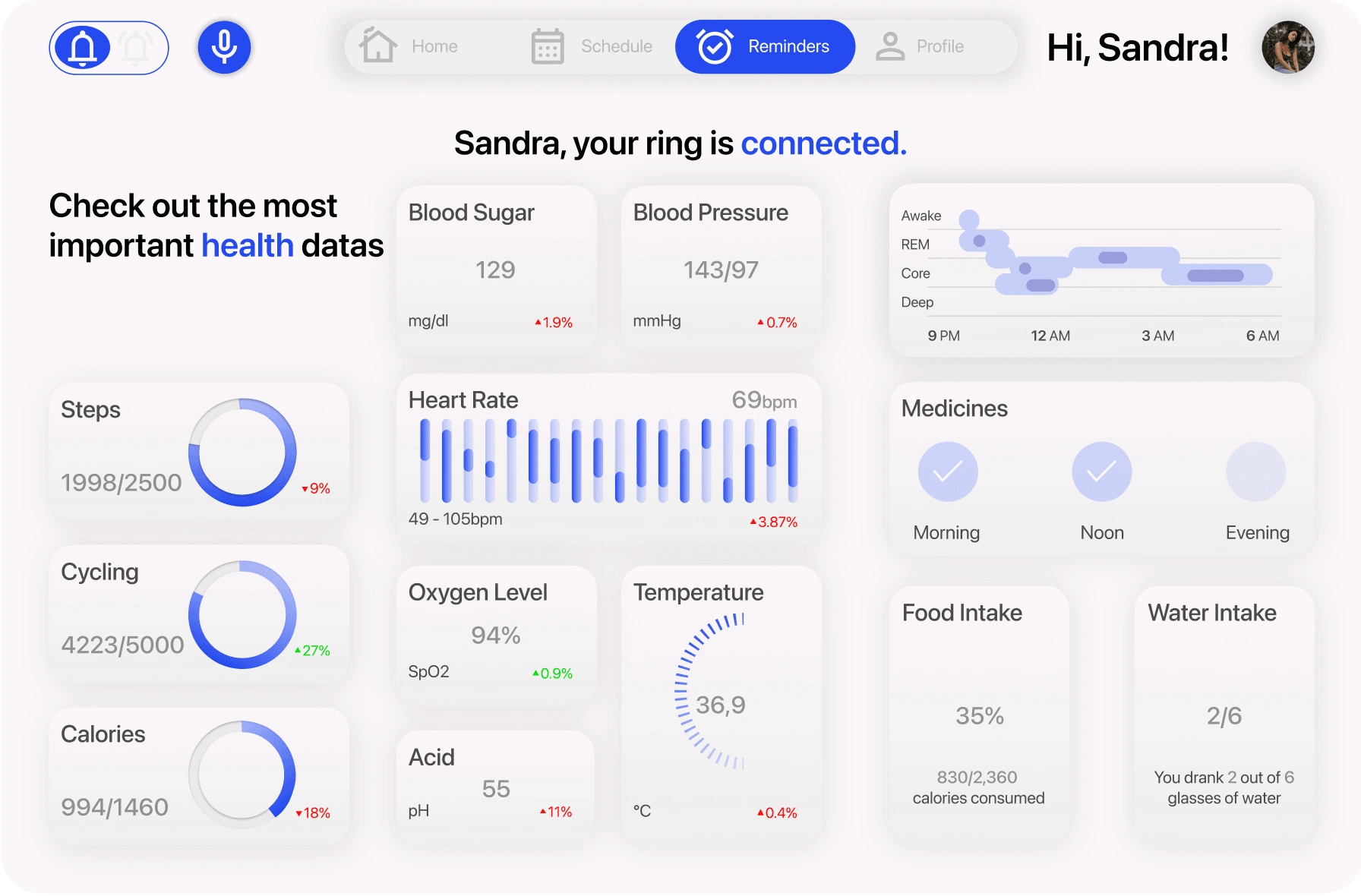
Bold blue for accent and bigger texts helps visibility for users
2. Wireframing and Prototyping
• Initial Wireframes: Low-fidelity wireframes were created to map out the structure of the tablet interface, ensuring ease of navigation and clarity in displaying health data.
• Iterative Prototyping: The design went through multiple iterations, refining the layout and color scheme based on accessibility principles and potential user feedback.
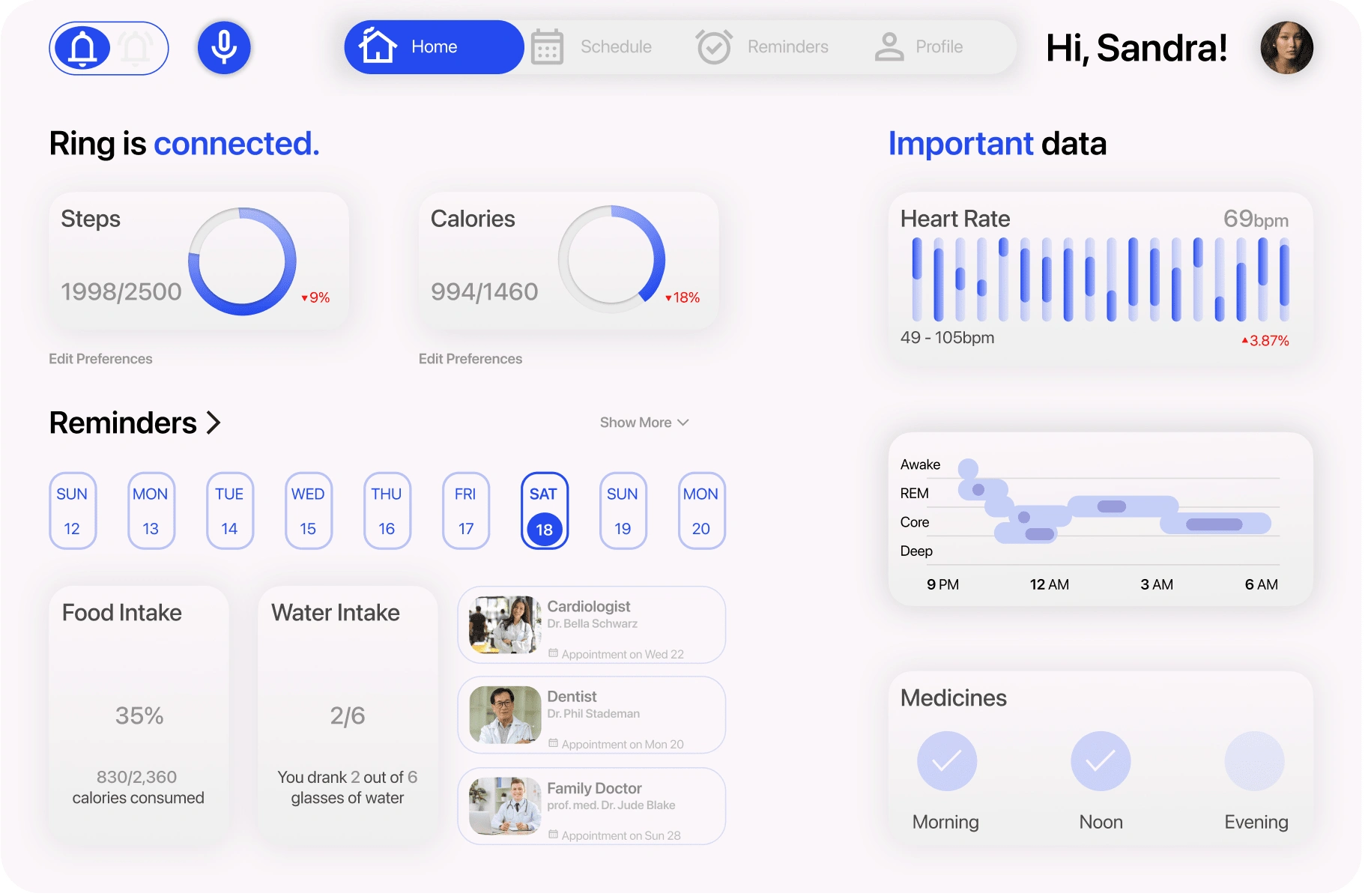
• Dashboard Layout: The dashboard displays all key health metrics in a card format, allowing users to quickly scan their health information. Metrics such as blood pressure, heart rate, and sleep are displayed prominently, with visual indicators like color-coded arrows to show whether a reading is above or below target.
• Reminder Section: A dedicated section for reminders about food, water, and medications, as well as upcoming appointments, helping users stay organized.
• Emergency Functionality: An SOS button is prominently displayed, making it easy to access in case of an emergency. Additionally, if any health metric reaches a critical level, the system automatically sends an alert to a designated healthcare provider.
• Voice Navigation: To further support accessibility, a voice-command feature was included to enable hands-free interaction with the interface, especially useful for users with limited dexterity.
Solution Overview
The solution consists of two components:
1. A Ring (Physical Component): The ring is designed to be a lightweight, wearable device that continuously measures health data such as heart rate, blood pressure, oxygen levels, and steps.
2. A Tablet Interface (Virtual Component): This is a visual dashboard that syncs with the ring, displaying health data in a clear, customizable format. The tablet provides additional functions that don’t rely on the ring, such as food and water intake tracking, medicine reminders, and appointment scheduling.
Like this project
Posted Nov 13, 2024
This project explores the concept of a user-centered, accessible health management system for elderly users.
Likes
0
Views
1