AI-Assisted Permit Coordination Interface Design

Project body
18 of 124 projects need a person. The interface's job is to show which, and why.
AI-assisted permit coordination for US construction. 4 screens, 19 states. Concept project with fictional data.
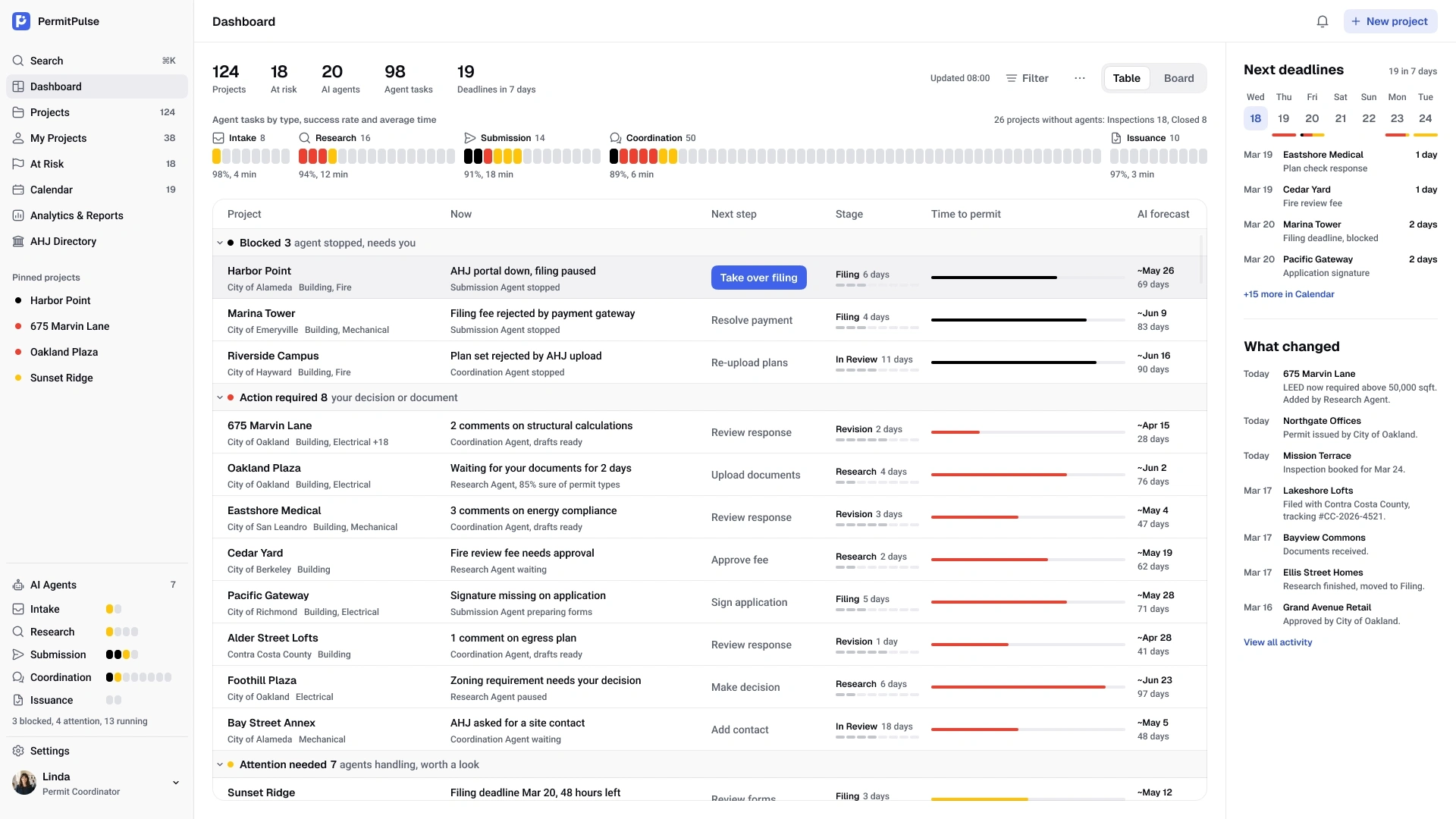
18 of 124 projects need a person, ordered by how much they need one.
The Problem
To start building in the US, you need permits from several agencies (AHJs, Authorities Having Jurisdiction). In PermitPulse, AI agents do this work and a coordinator supervises them.
The work is scattered. Every agency has its own forms, timelines and portals. One project here has 20 permits across 8 agencies.
Failures stay silent. A portal stops syncing, but the status in the table still looks fresh. Decisions get made on two-day-old data.
The agent decides, a person pays. An agent picks the permit types. If it's wrong, a person answers for it, so that person needs to see the basis.
Approving everything doesn't work either. 98 agent tasks can't become 98 Approve buttons: people burn out on confirmations.
When agents run the work, the coordinator stops watching everything and handles exceptions. So the interface's main question is: where is a person needed, and why?
The User
Linda, Permit Coordinator. Runs many projects at once and switches between them constantly. The biggest fear is missing a deadline or a permit rejection. A Construction Manager also needs an overview, but Linda is the primary role.
The Dashboard Starts With What Needs a Person
The screen's first question is what needs attention now. So the table is split into Blocked, Action required and Attention needed, and each group says what it expects from a person. Each row shows the reason, the next step, the time to permit and the forecast.
The AI summary started as a separate panel above the table. I dropped it: the same projects appeared twice, blockers looked weaker than ordinary actions, and every row had three buttons. I also removed a pipeline by stage, because it nearly repeated the Agent fleet block.
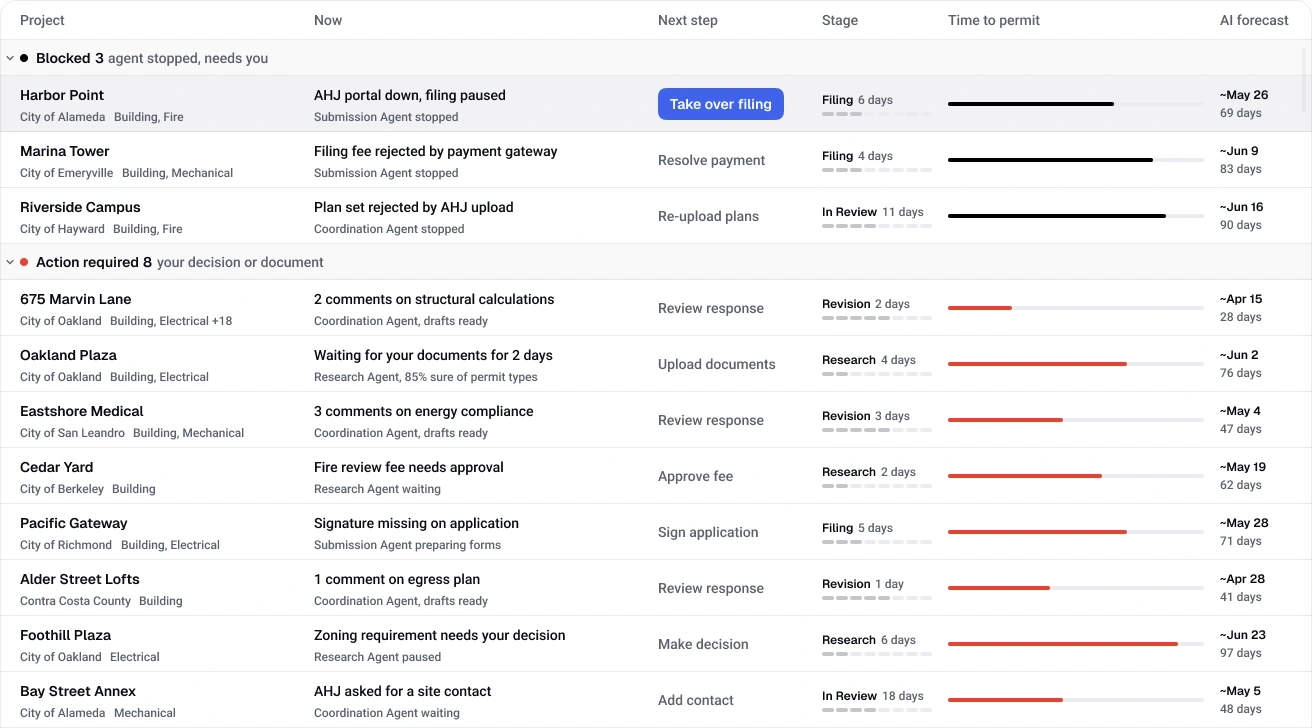
Each group says what it expects from a person. Each row names the reason and the next step.
An Agent's Decision Can Be Checked on the Same Screen
Agent steps run in one timed line: received data, scanned the portal, found the rule, matched it, decided. Below the decision is a table with the permit, status, reason and source. The Full logic and Result switch lets you see just the outcome or all the logic. No separate report to open.
I rejected a chain of cards with different widths because it read in several directions. I also rejected a purple progress line because it pulled attention to itself.
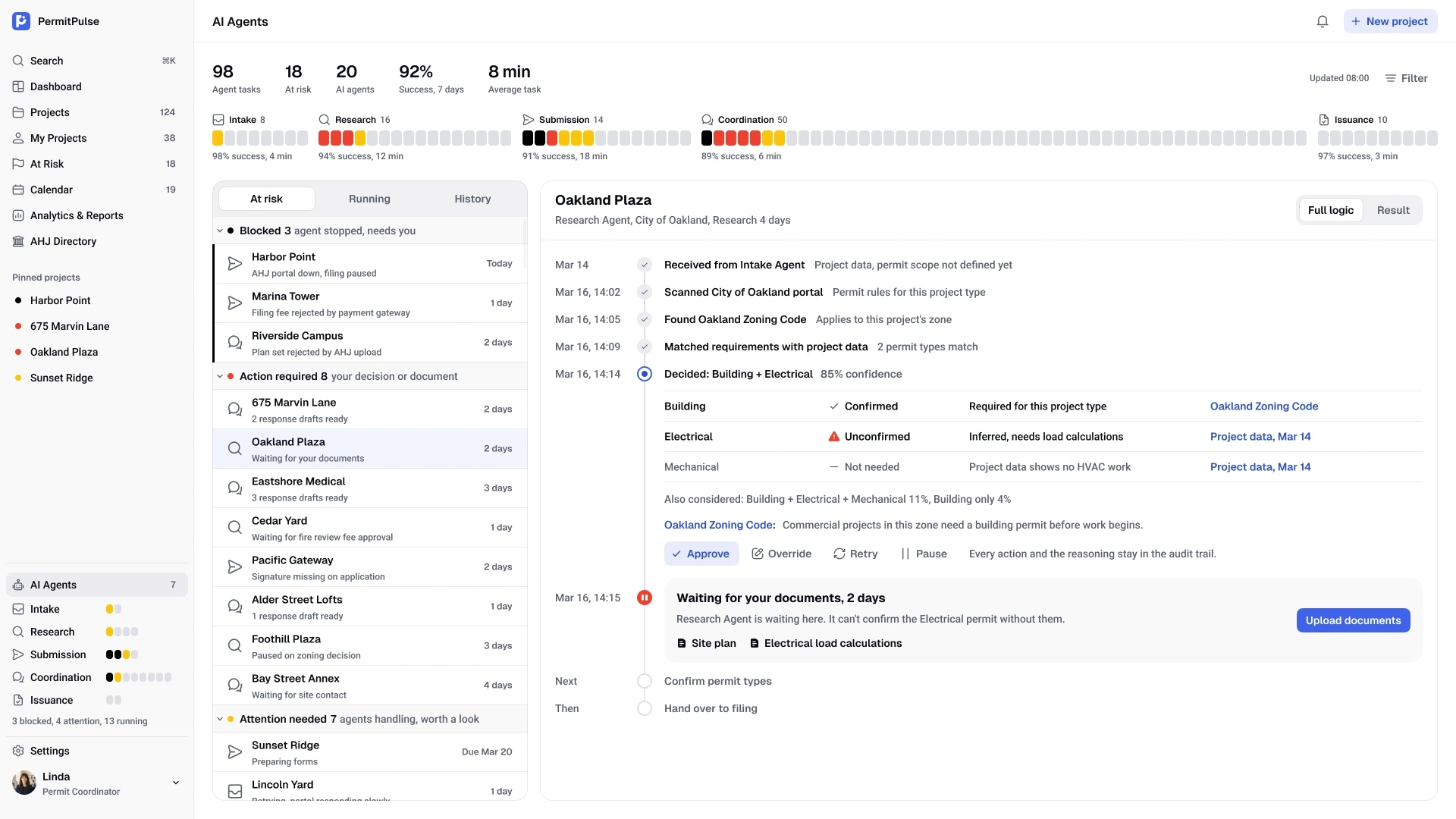
Every agent decision shows its steps, its evidence and what it's waiting for.
Disagree Next to the Agent's Reasoning
To push back, you need to see the agent's reasoning. So Override opens in the same panel, with a table of the agent's call, its reason and the person's choice. After saving, the agent's call stays in the feed, next to an Overridden by Linda step with the reason and an Undo override button.
I rejected a modal because it covered the sources and the feed and repeated data already on the screen.
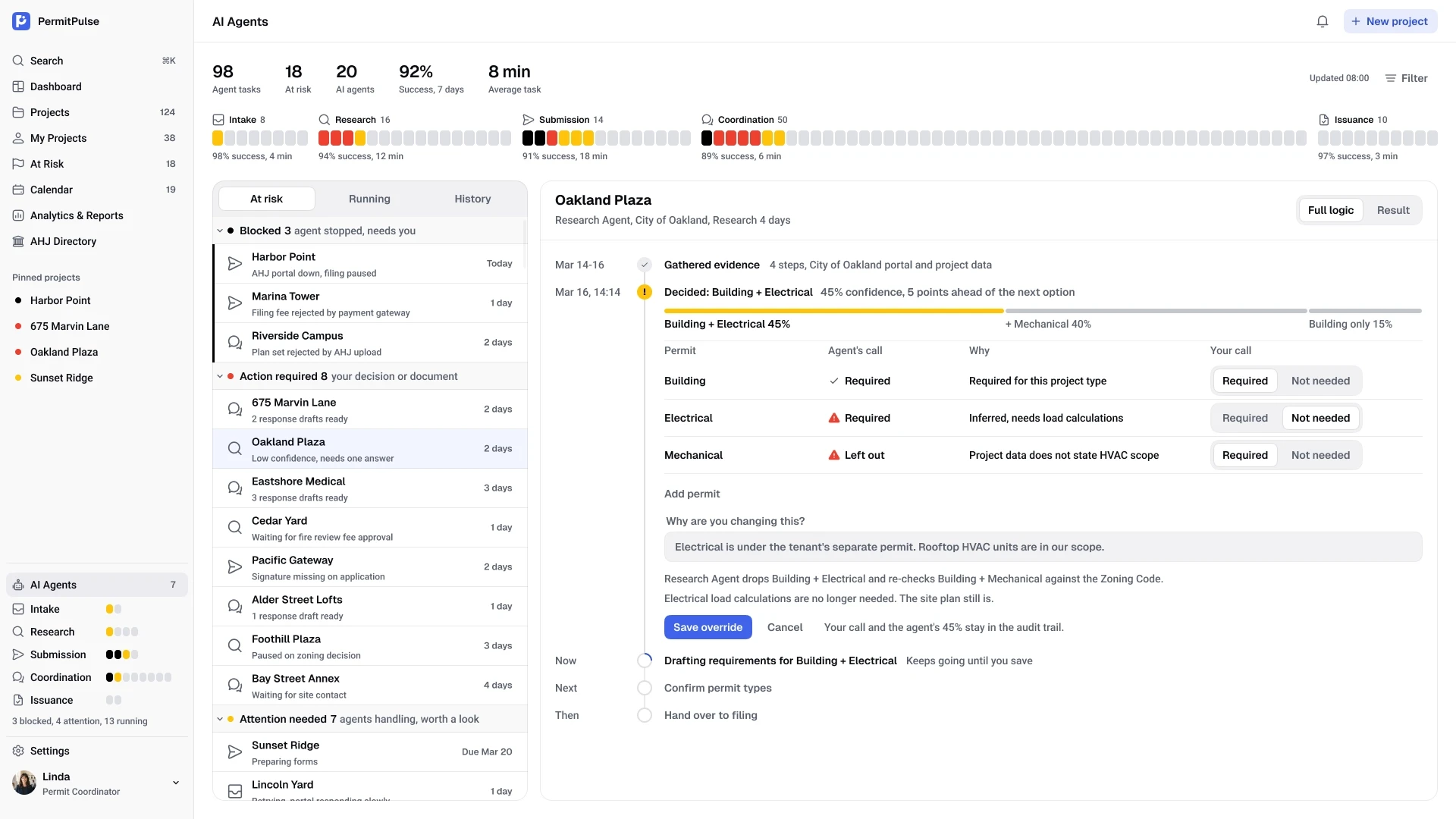
A person changes the decision while seeing the agent's reason, and explains why.
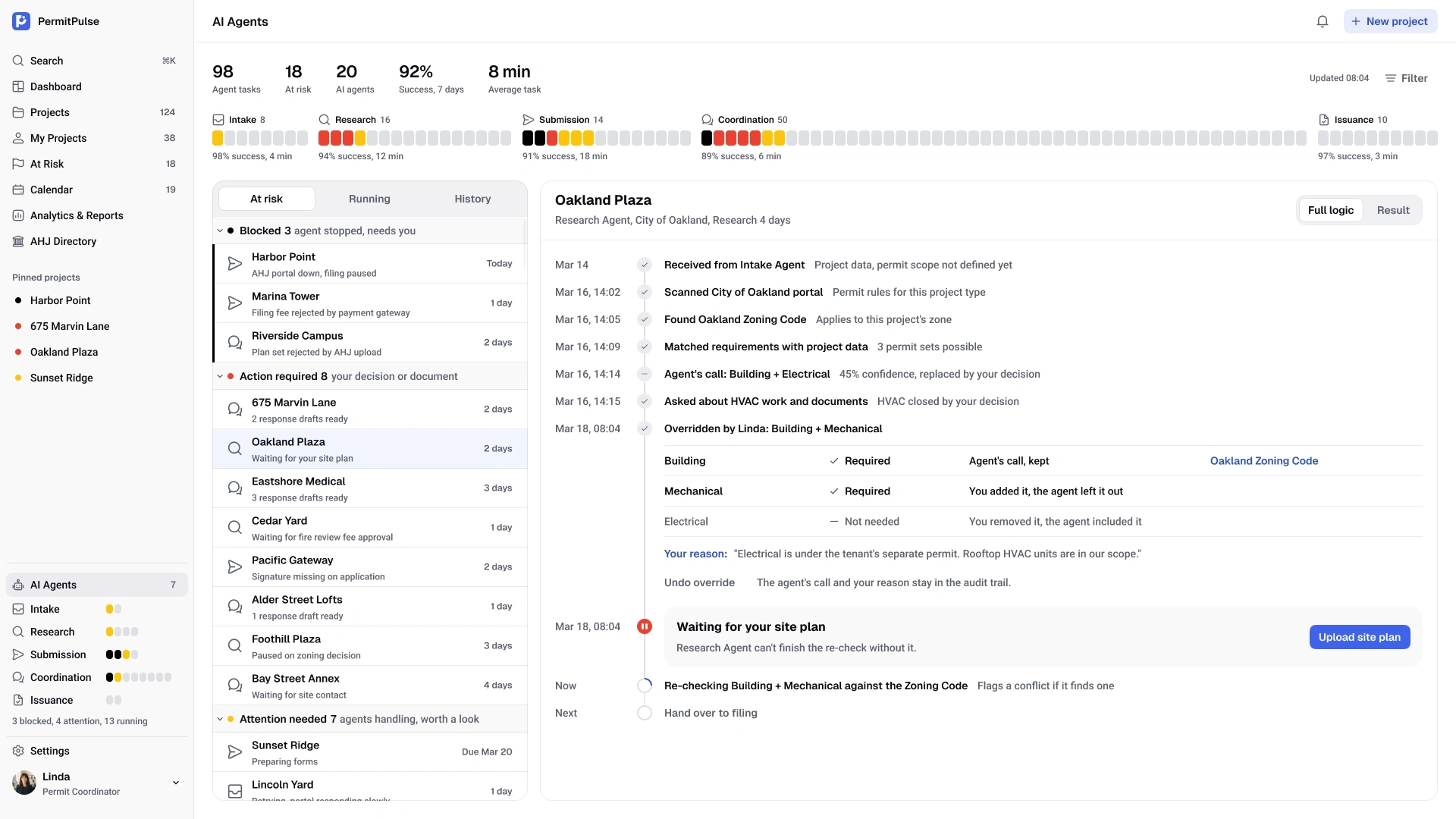
The override and its reason stay in the trail, and the agent's call doesn't disappear.
20 Permits, Read in One Pass
Permit Detail lists permits by expected date. Rows waiting on Linda stand out and carry a specific action with a due date. Above the table is the summary: the forecast and a 5, 4, 9, 2 bar. There's also a collapsed view: three or more consecutive rows that don't need Linda fold together.
This screen also shows where autonomy ends. The Coordination Agent drafts responses to the agency but doesn't send them, and the screen says so: nothing goes to the AHJ without you.
A table with stage columns took too much space and wasn't built for many permits. Groups by whose turn it was repeated the panels below. Ordering from latest to earliest conflicted with the feed. I dropped all three.
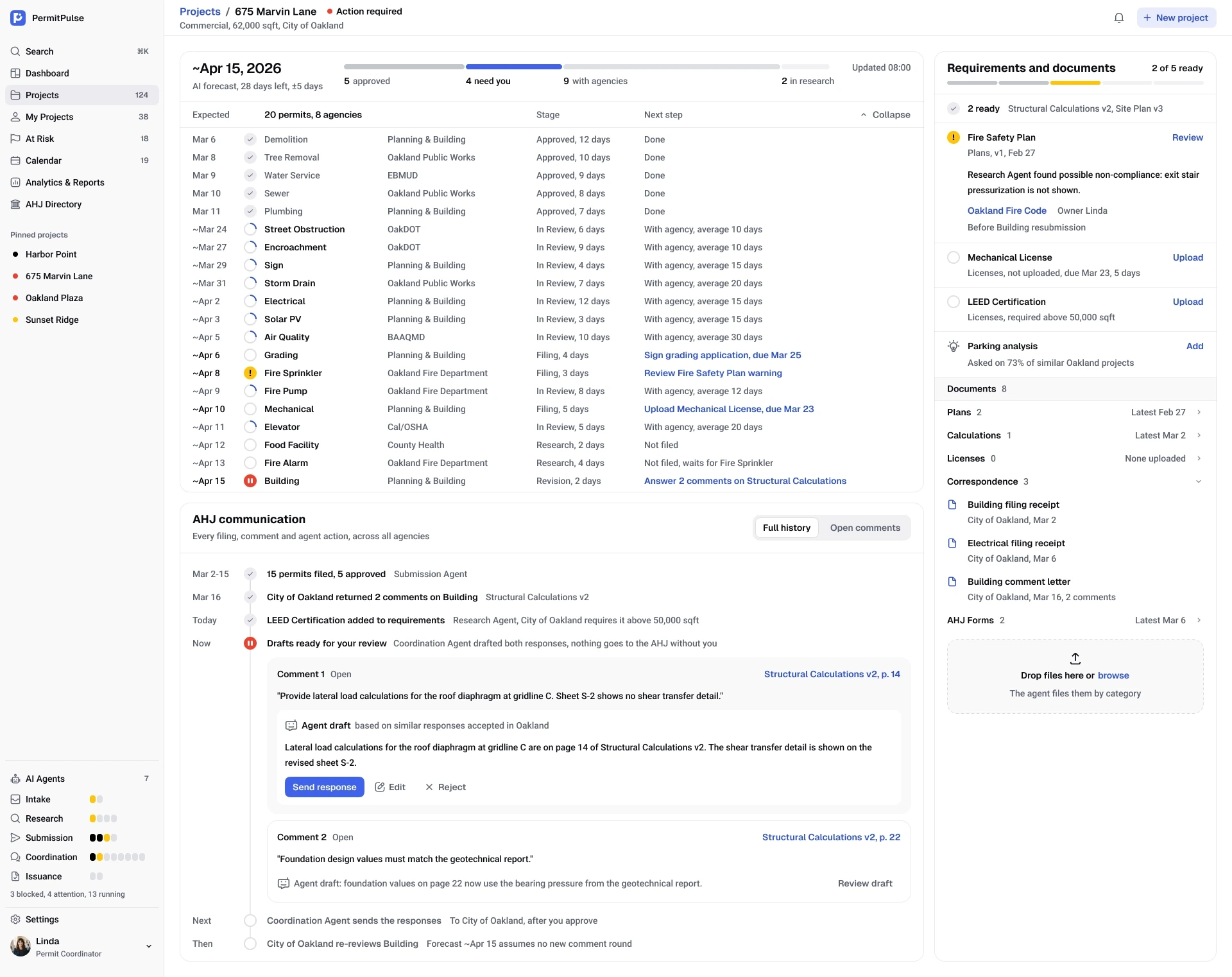
20 permits, 8 agencies: only the rows waiting on Linda carry weight.
Projects Is Built Around the Agency
The Dashboard shows what's on fire, and Projects is the catalog. A problem often belongs to the agency, not the project: when a portal goes down, all its projects suffer. So the left side is a persistent list of agencies with a risk bar and Portal down and Portal slow flags, and the right side shows the selected agency's projects by risk group.
The flat catalog had 19 identical rows with 8 columns, and the eye slid past them. I also passed on the Stage matrix and Agency scorecard options.
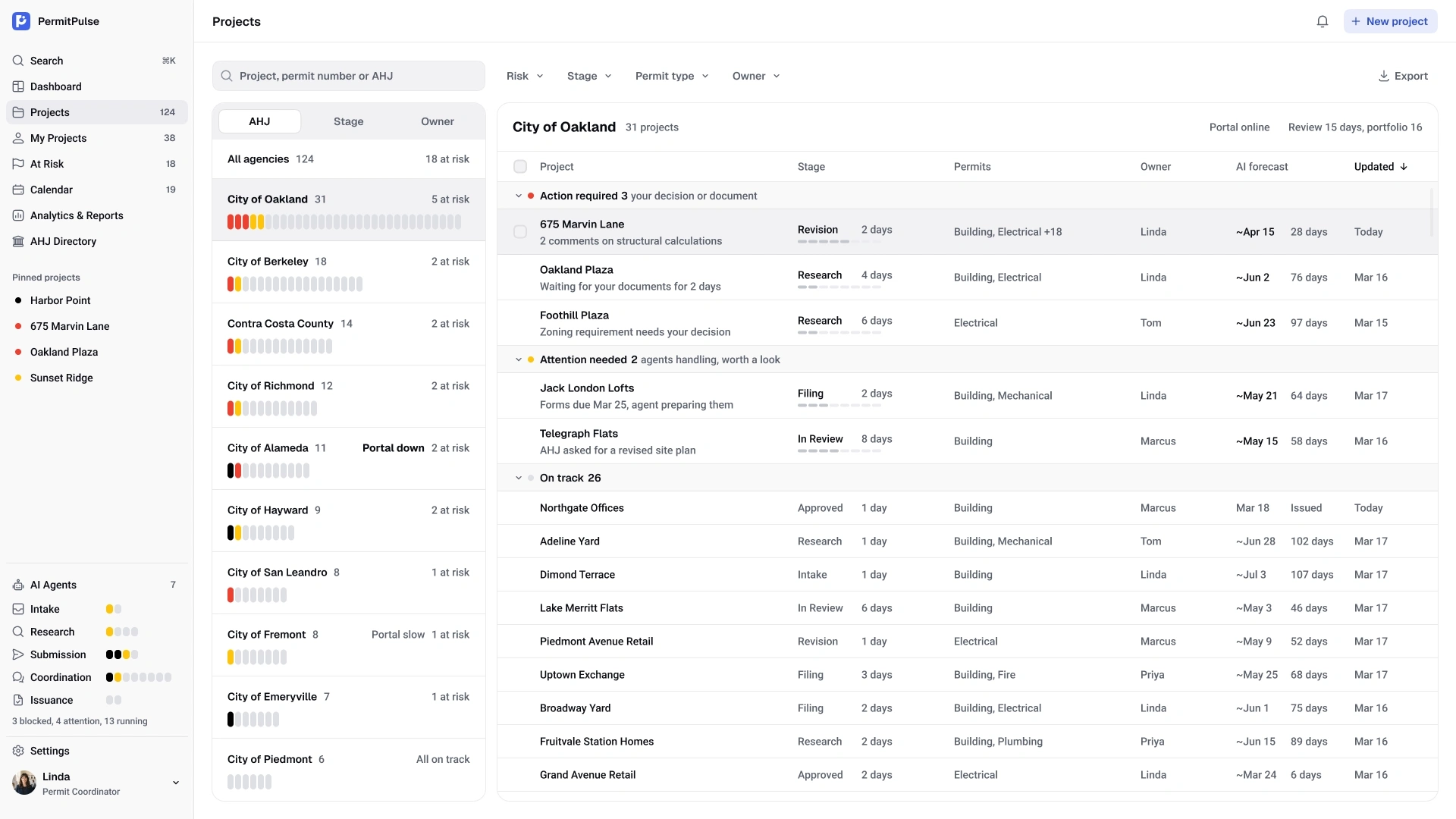
When a portal goes down, the agency is the unit of the problem.
When Something Goes Wrong
The main flow shows the work when everything is fine. These are 6 of the 19 states: failures, agent doubts and conflicts.
The Agent Stopped Halfway
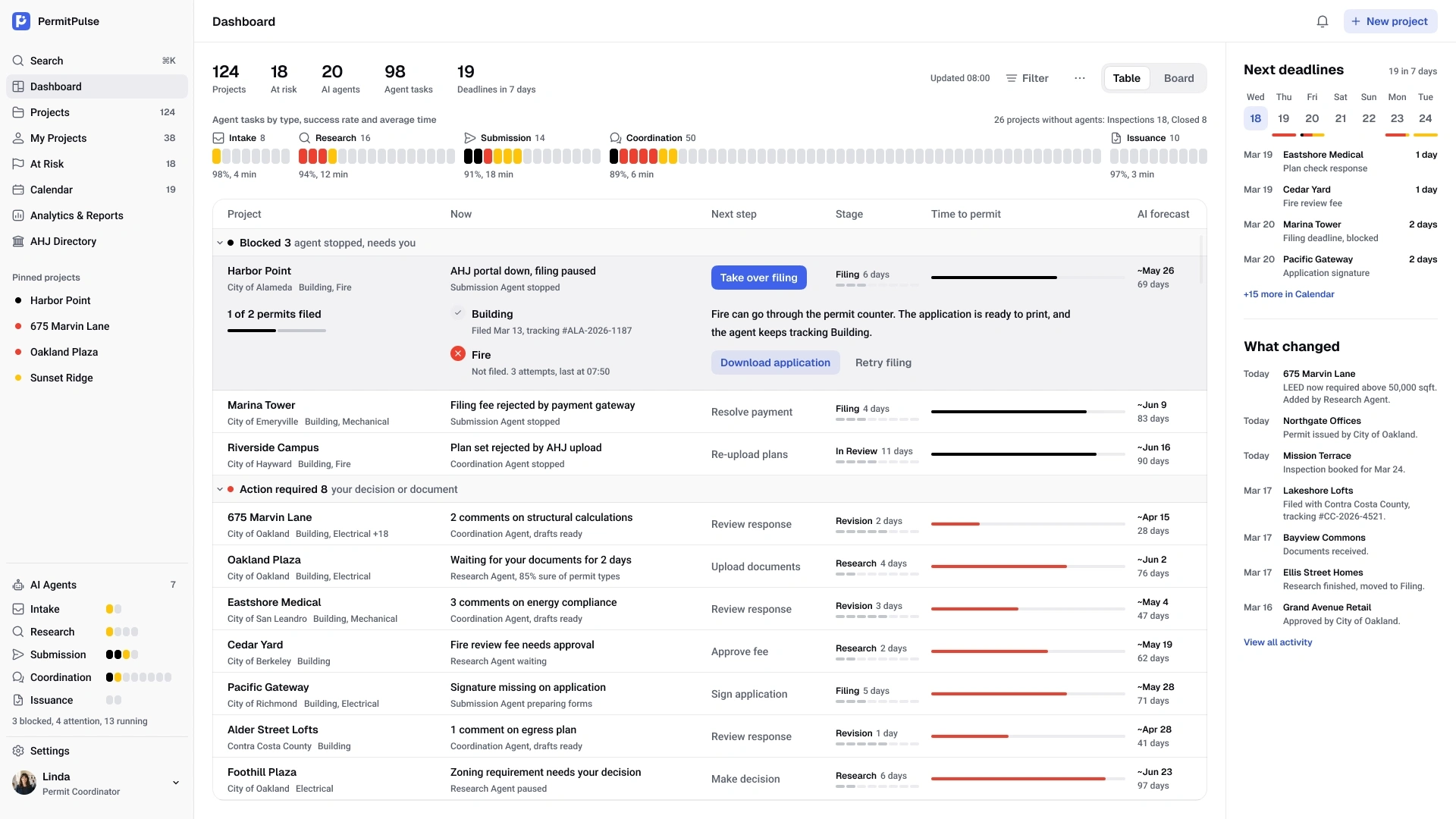
Building filed, Fire not, 3 attempts failed. The agent reports what it finished, where it stopped and what it hands over.
The Data Is Stale
I rejected the Attention rail option because it pushed the right column and cut off the feed.
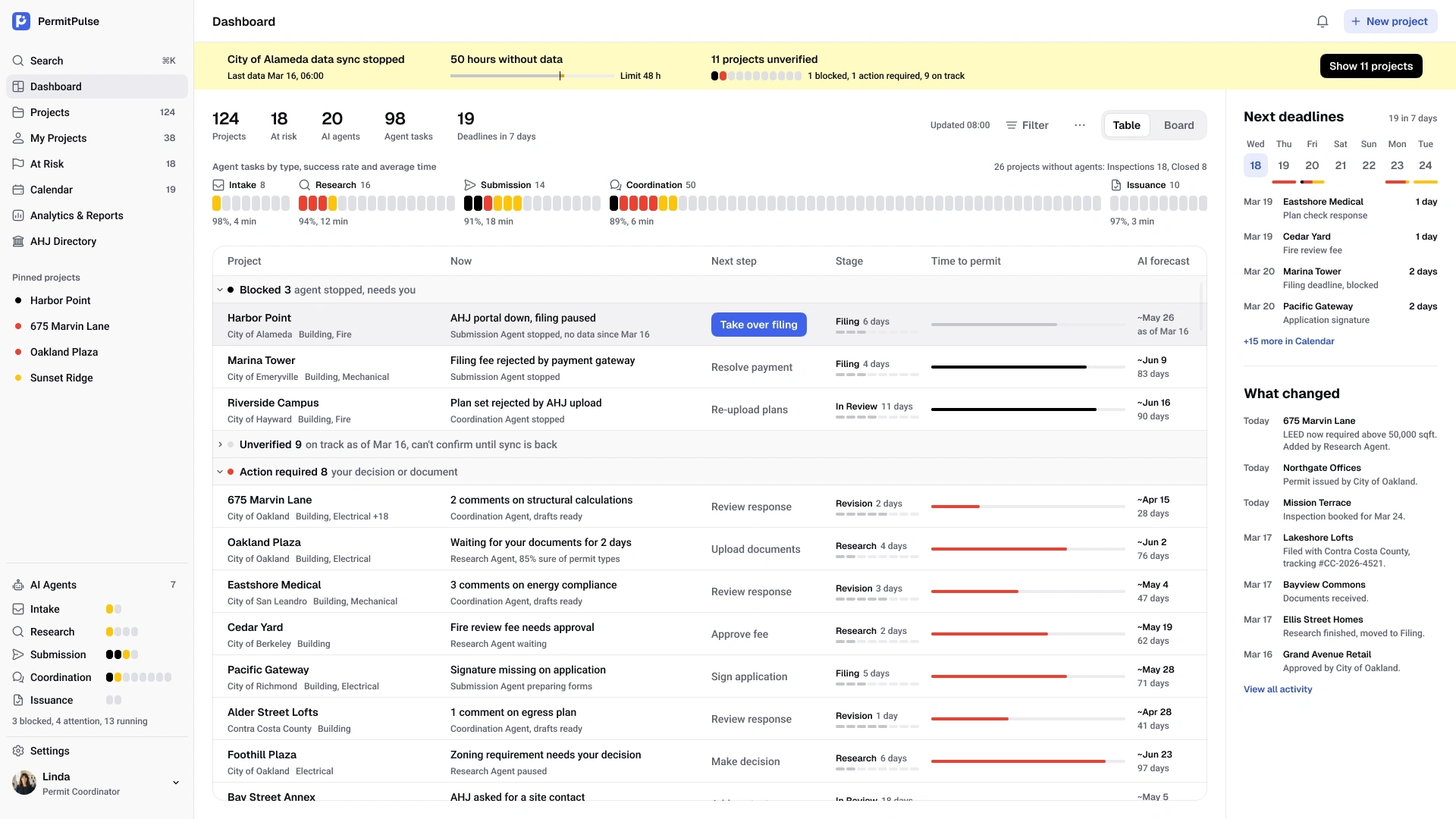
Old data never looks fresh: 50 hours without sync against a 48-hour limit, and 11 projects marked unverified.
The Agent Isn't Sure
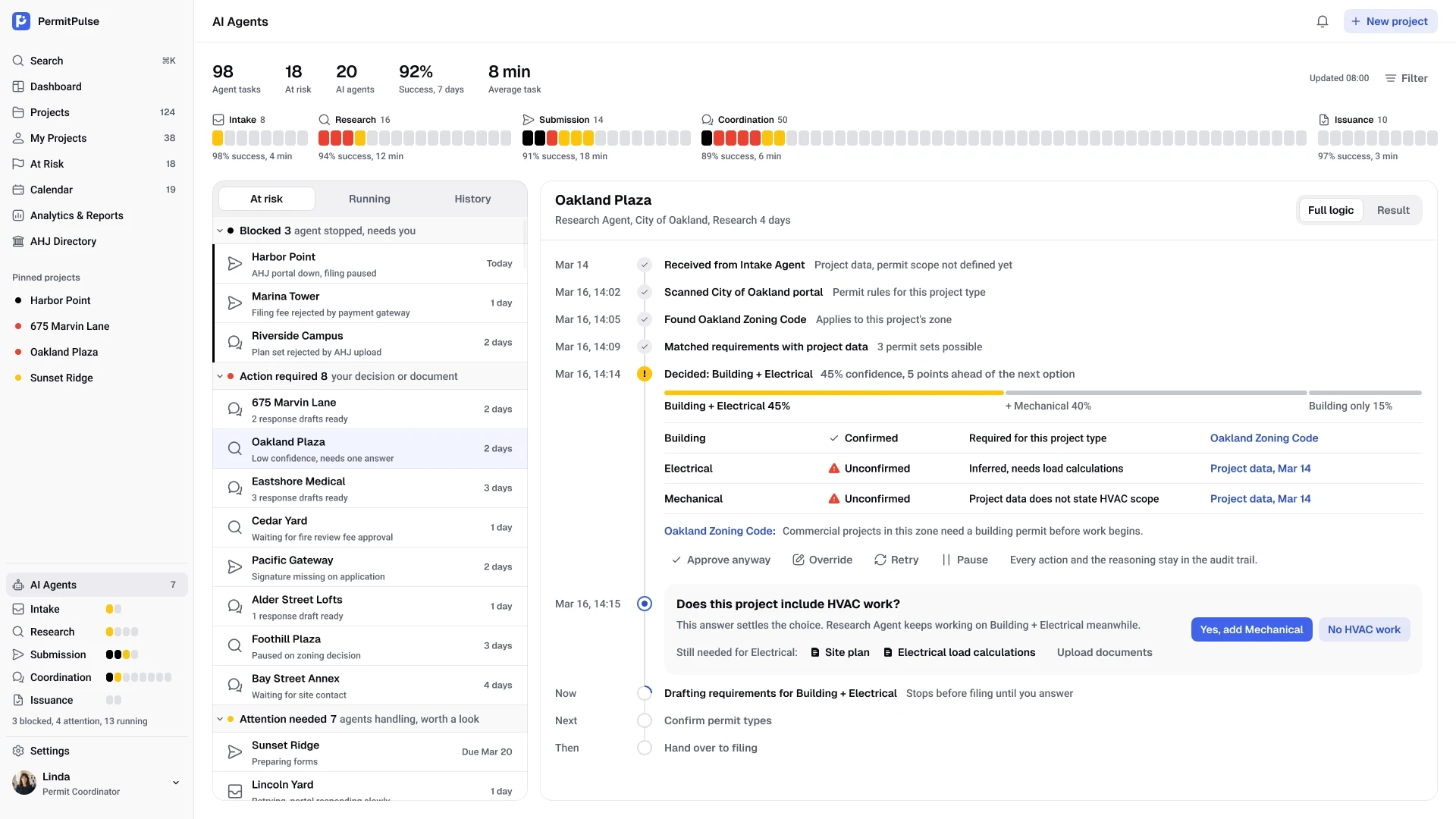
At 45% the agent asks one question instead of guessing.
14 Comments at Once
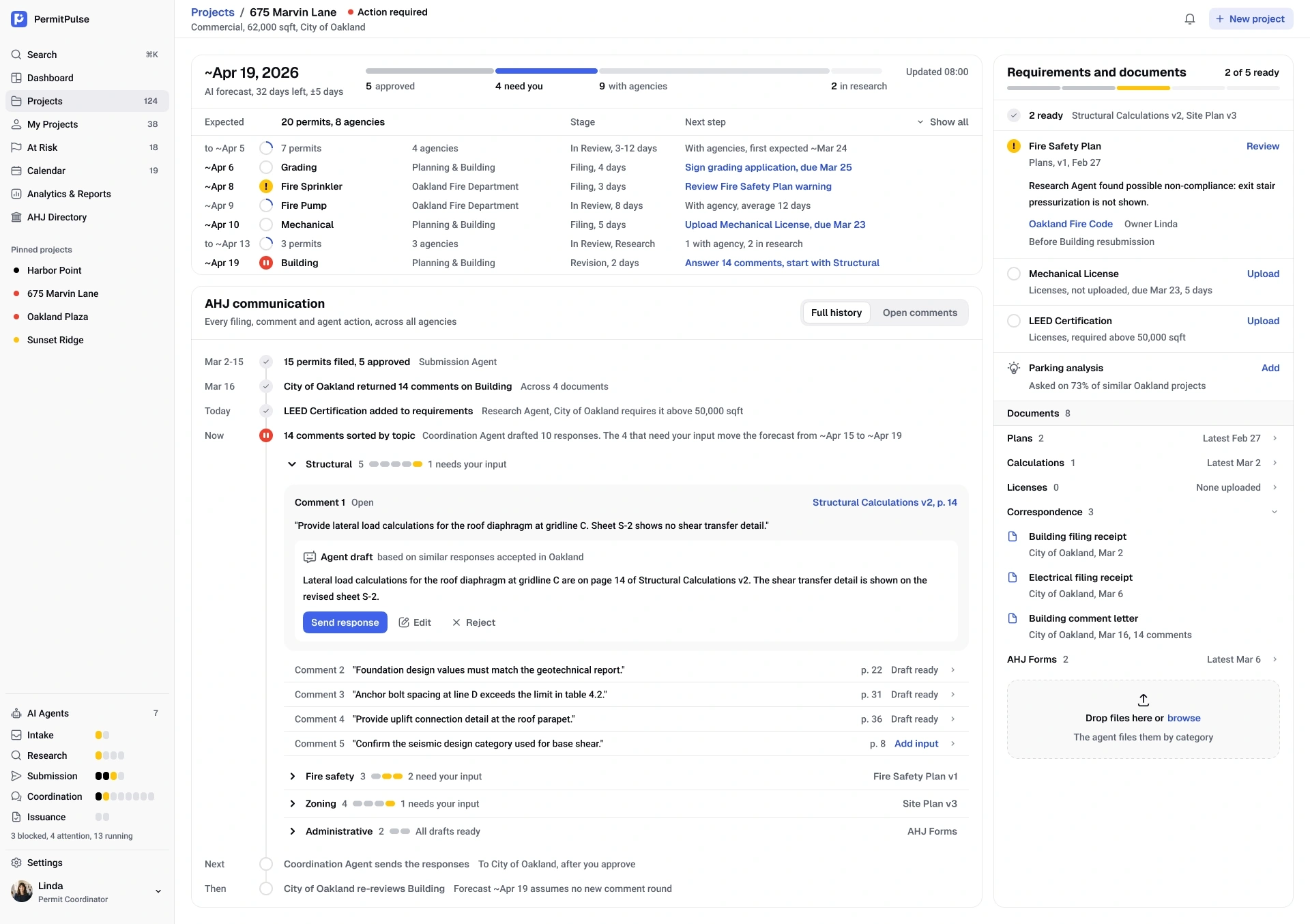
14 comments become 10 drafts to review and 4 questions to answer, and the forecast moves from April 15 to April 19.
The Agency Is Late
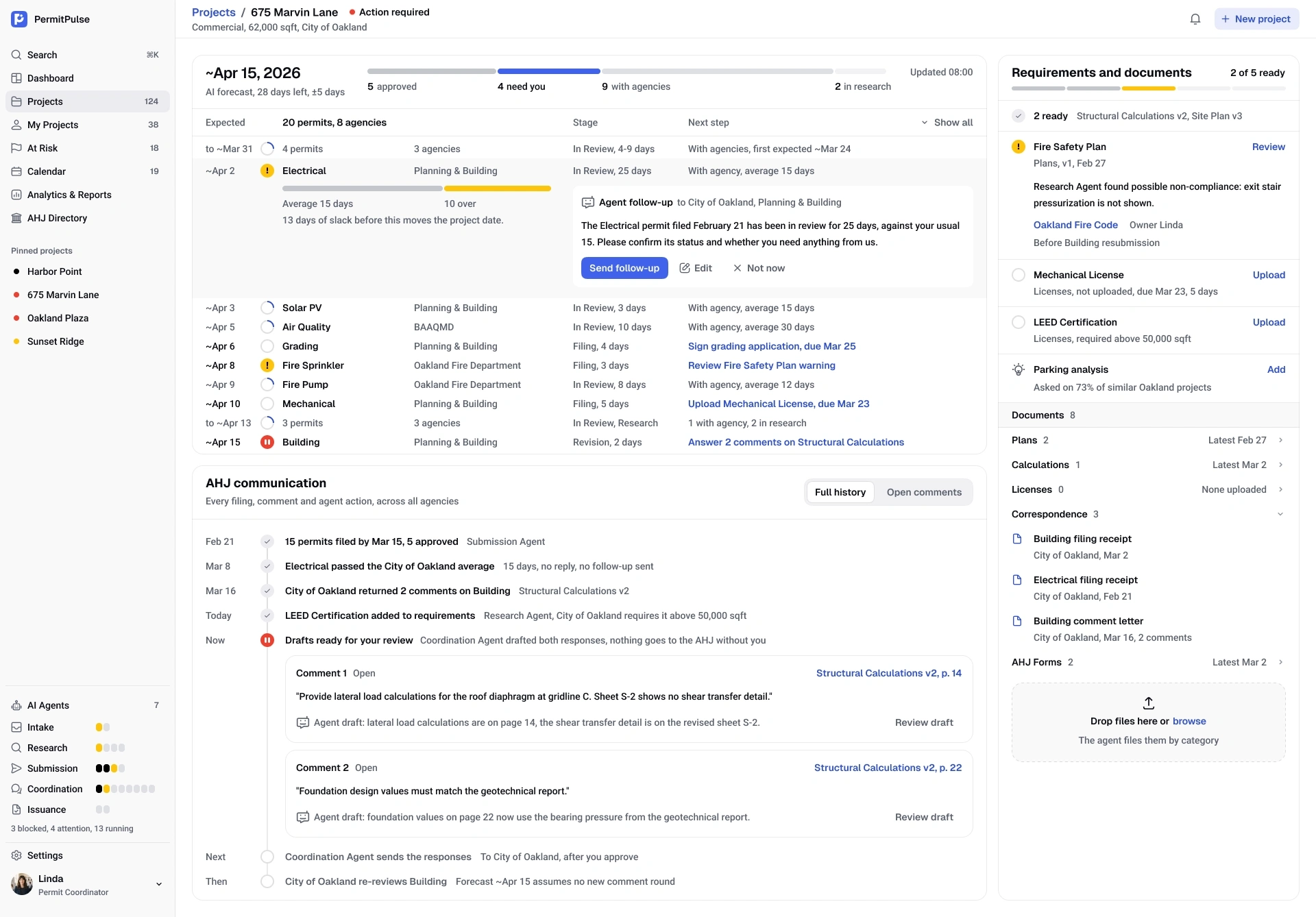
25 days against a 15-day average: the delay is drawn on a bar, next to 13 days of slack and one action, Send follow-up.
One File Uploaded Twice
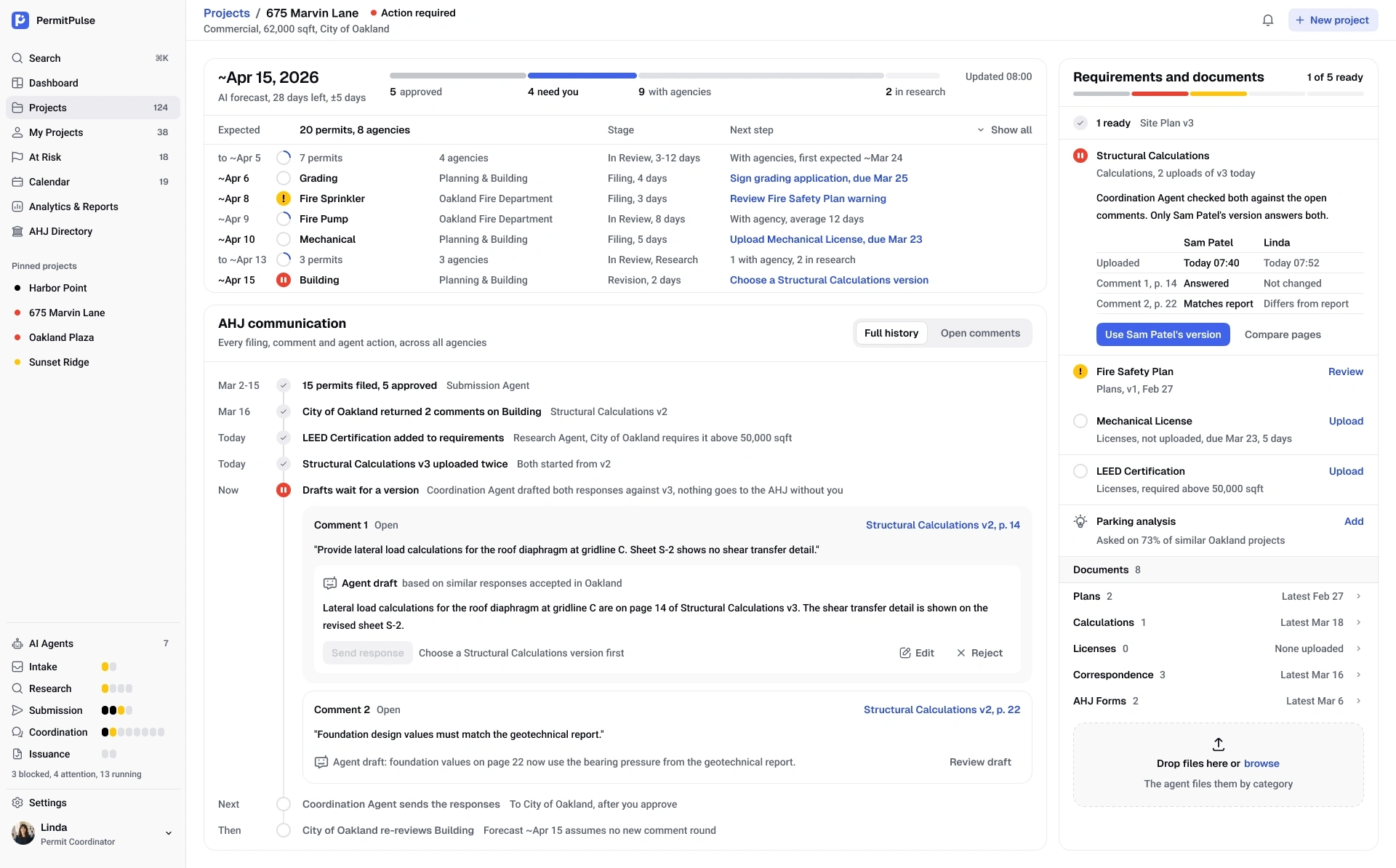
The blocked button says why it's blocked before anyone clicks it.
All the Logic on One Map
Of 124 projects, 18 need a person and the other 106 stay with the agents. The map shows the decisions Linda makes in each case and where they lead.
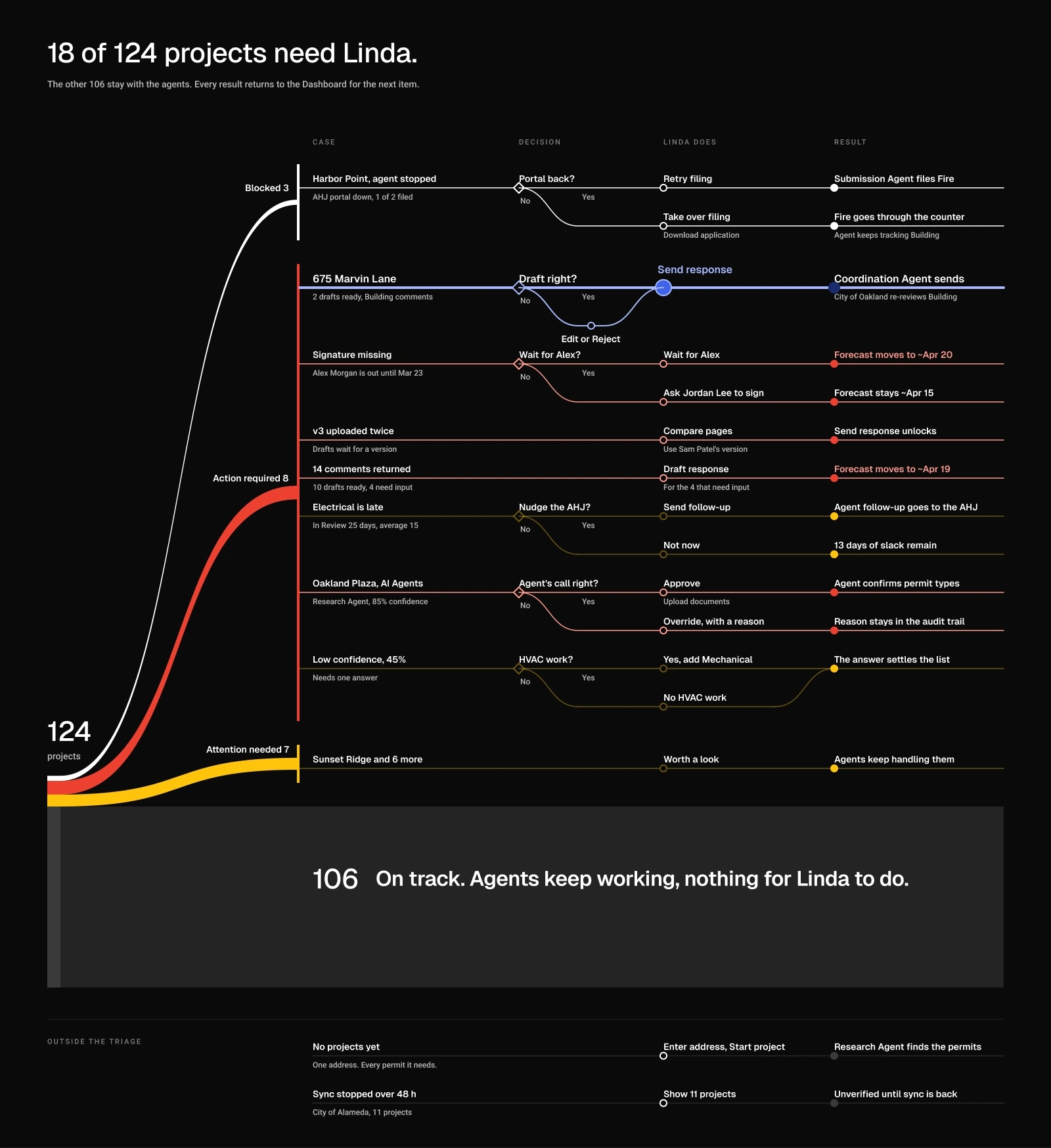
Every result returns to the Dashboard for the next item.
Boundaries
This is a concept project, not a shipped product. PermitPulse, its projects, data and the Linda persona, including the photo, are fictional. Agencies and code references are illustrative. It is inspired by public descriptions of AI permitting products such as PermitFlow, and has no affiliation with that company.
No user research was done. Decisions are based on workflow analysis, and there are no post-launch metrics.
What's Next
Test the model with real coordinators: what counts as a blocker, and what data freshness limit is honest.
Decide which actions an agent takes on its own, which a person confirms, and who sets that line.
Build an agency profile: real timelines against official ones, common comments, new rules and affected projects.
Add bulk actions to Projects: select projects and apply one decision.
Design an overview for the Construction Manager.
Work out on-site use: Tablet and mobile.
0 likes · 0 views · Nov 6, 2026
Designed an AI-driven interface for permit management in US construction.