SMI Continuity Layer for AI-Built Applications

Kevin Blackburn


Overview
Symbolic Memory Infrastructure, or SMI, is a patent pending continuity-layer concept and prototype designed to address one of the most important challenges emerging in AI-assisted software development: project drift.
As AI-built applications evolve through prompts, refactors, agents, integrations, UI revisions, and model changes, they can begin to lose alignment with the original product intent. Features may change unexpectedly, workflows may fragment, and the system may require repeated context rebuilding before meaningful progress can continue.
SMI was created as a framework to help AI-assisted projects preserve context, reduce drift, and maintain architectural continuity over time.
The goal is simple:
Before an AI system changes an application, it should understand what the application is supposed to remain.
This project combines software architecture, AI workflow strategy, continuity modeling, symbolic anchors, prototype interface design, and a whitepaper-backed implementation path for future API development.
The Problem
AI-assisted development tools are powerful, but they often struggle with long-term continuity.
During rapid development, common issues include:
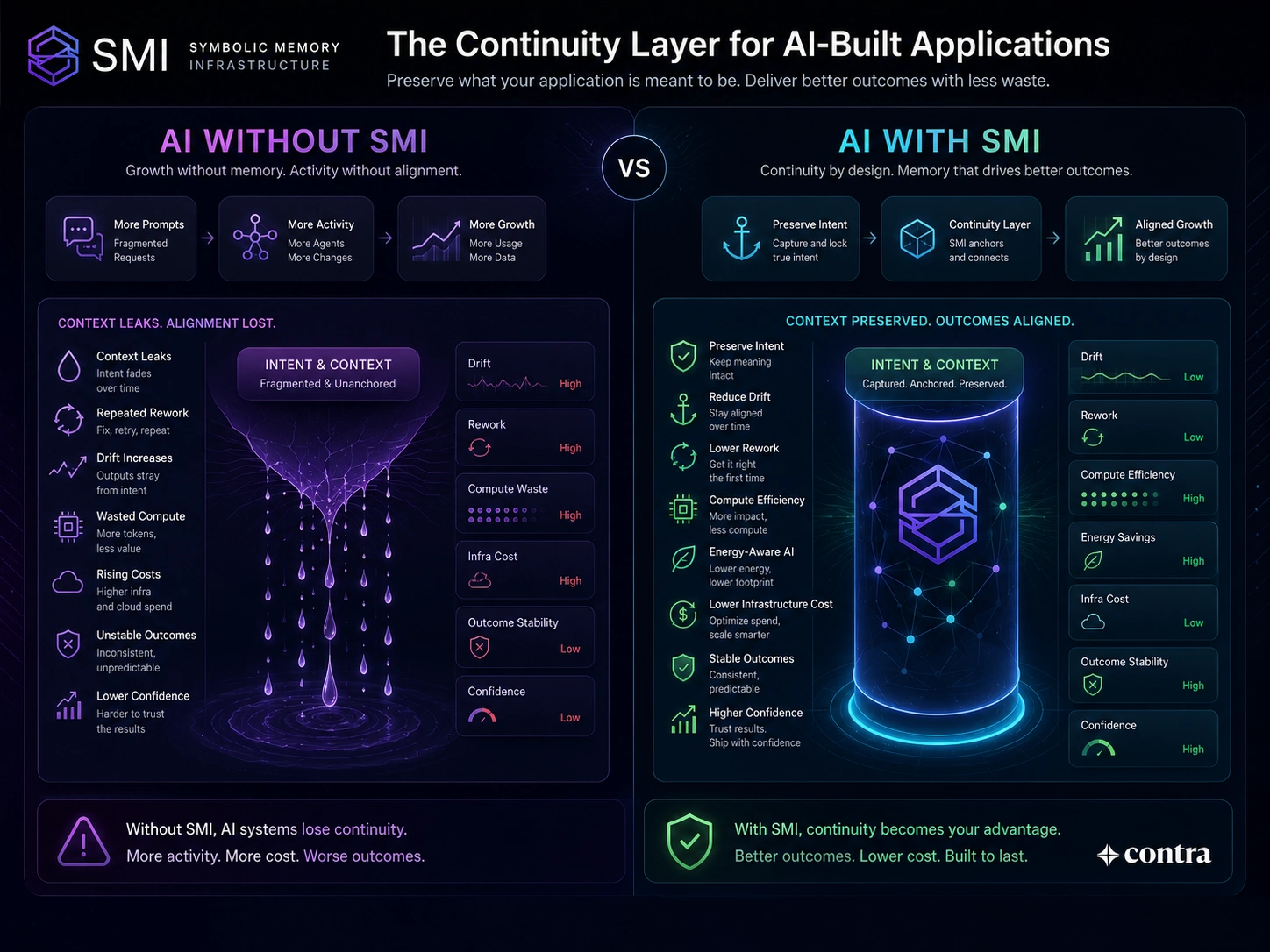
Repeating the same product context across prompts
AI forgetting prior architectural decisions
UI and business logic drifting from the original intent
Refactors fixing one area while breaking another
Agents or AI tools operating without shared project memory
Difficulty preserving role-based workflows across iterations
Increased compute use due to redundant prompts and repeated corrections
Loss of confidence when the project no longer behaves like the product owner intended
AI Prompt context is distorted, drifts and creates rework without SMI.
These problems become more significant as a project moves from prototype to MVP, then toward production readiness.
The more complex the app becomes, the more valuable continuity becomes.
The Solution
SMI introduces a structured continuity layer that can sit between AI development tools, the application, and the project owner’s intended product architecture.
Instead of treating every AI request as isolated, SMI is designed to preserve a stable reference layer containing:
Product intent
System architecture
User roles
Workflow logic
Feature relationships
Business rules
Refactor history
Symbolic anchors
Continuity scores
Drift warnings
Recommended correction paths
The concept is designed to help AI-built systems remain aligned across time, prompts, model changes, and development phases.
Prototype System
AI Prompt context is maintained, efficient and creative work gets deployed.
The supporting prototype uses a dashboard-style interface to demonstrate how the continuity layer could be visualized and operationalized.
Prototype modules include:
Continuity Score
A high-level indicator showing how aligned the current system state is with the intended product structure.
Drift Detection
A monitoring concept that identifies when new changes may conflict with the original architecture, user flow, or business logic.
Symbolic Anchors
Stable reference points that preserve the meaning, purpose, and relationship patterns of the project.
Harmony Map / Continuity Graph
A visual map of relationships between system components, showing how different modules depend on or influence each other.
Pulse Monitor
A system-state visualization that reflects coherence, change readiness, or stability.
Refactor Guidance
A recommendation layer designed to suggest safer, more aligned refactor paths.
Event / Echo Logs
A running history of important changes, detected patterns, and continuity-related events.
Technical Direction
The future implementation path for SMI is API-first.
A practical SMI engine could expose endpoints such as:
A future response could include:
Benchmark Findings and Evaluation Criteria
This project is currently positioned as a conceptual framework and prototype, so the benchmark criteria are designed as evaluation targets rather than final production claims.
Potential benchmark areas include:
1. Prompt Repetition Reduction
Measure whether SMI reduces how often project owners need to restate product goals, architecture, or workflow rules.
Test criteria:
Compare number of repeated context prompts required with and without SMI-supported continuity context.
Target outcome:
Reduced repeated prompt reconstruction and improved session-to-session alignment.
2. Drift Detection Accuracy
Measure whether SMI can identify when a proposed change conflicts with preserved product intent or architecture.
Test criteria:
Introduce controlled changes that alter routing, permissions, business rules, or UI hierarchy and evaluate whether the system flags misalignment.
Target outcome:
Earlier detection of architectural or workflow drift.
3. Refactor Stability
Measure whether continuity-guided refactors produce fewer regressions than unguided AI refactors.
Test criteria:
Run before/after tests on app structure, feature behavior, role-based access, and workflow completion.
Target outcome:
More stable refactors with fewer broken dependencies.
4. Compute Efficiency and Rework Reduction
Measure whether preserved context reduces redundant model calls, correction cycles, and repeated development attempts.
Test criteria:
Track number of prompts, revisions, regenerated files, and failed correction loops.
Target outcome:
Lower rework, fewer unnecessary processing cycles, and more efficient AI-assisted development.
5. Continuity Across Model or Tool Changes
Measure whether core project intent remains stable when switching between AI tools, sessions, or model versions.
Test criteria:
Provide preserved SMI context to different AI development environments and compare resulting output alignment.
Target outcome:
More consistent outputs across tool changes and model transitions.
Impact
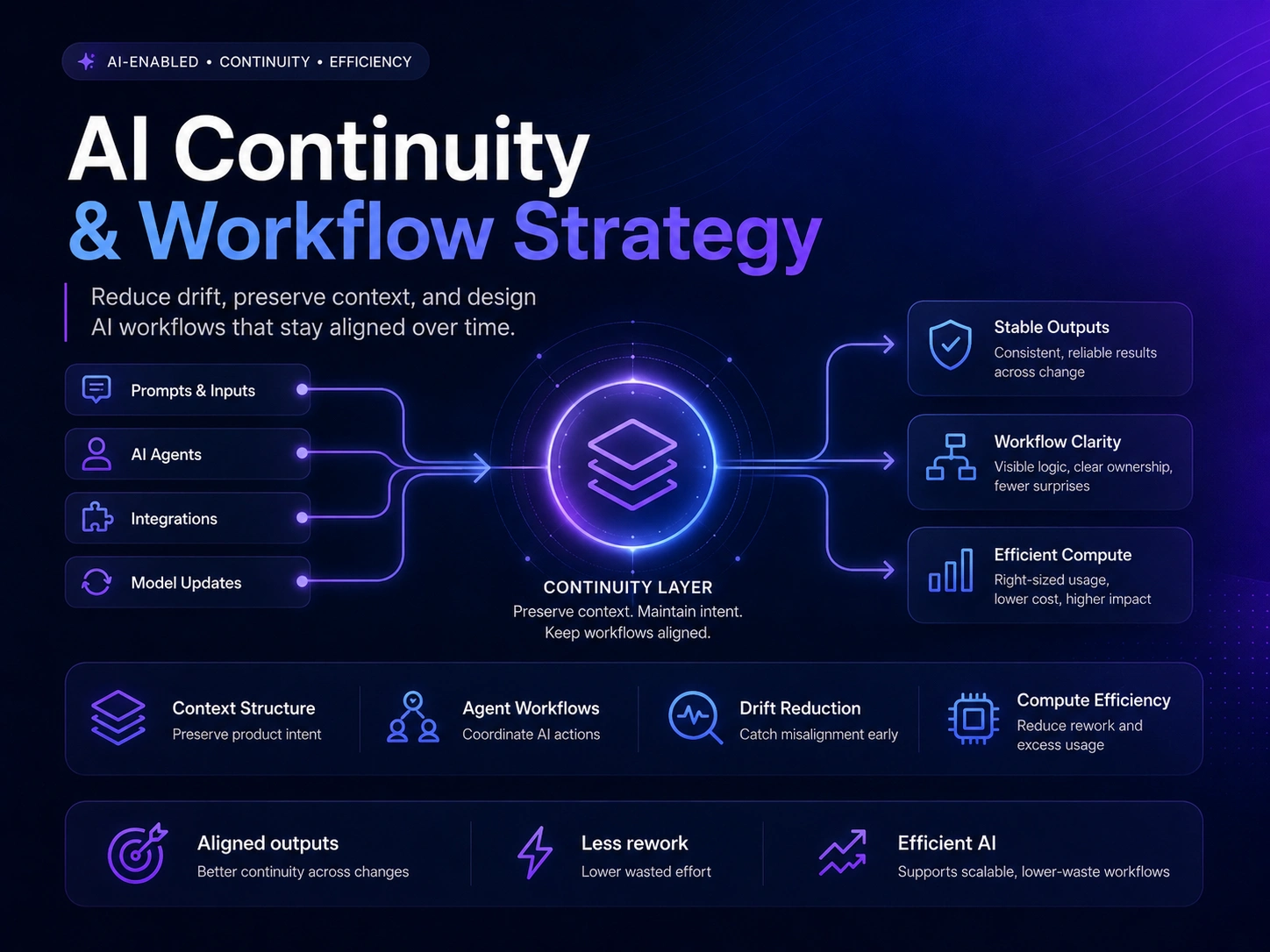
SMI is designed to support:
Reduced AI workflow drift
Better preservation of project intent
More stable refactors
Cleaner handoff between tools, teams, and AI agents
Lower rework
Improved compute efficiency
Stronger auditability of AI-assisted changes
More scalable AI-built application workflows
The broader impact is not just faster software development. It is more trustworthy software development in environments where AI is helping build, modify, and maintain increasingly complex systems.
My Role
My role included:
Concept development
Framework architecture
Whitepaper development
Continuity model design
Prototype dashboard direction
AI workflow strategy
Systems thinking
Future API planning
Positioning the framework for practical use in AI-built applications
This project reflects my larger focus as a software architect: helping AI-assisted development move beyond speed alone and toward stability, continuity, context preservation, and scalable outcomes.
See full Whitepaper
Like this project
Posted May 18, 2026
Continuity framework for AI-built apps that reduces drift, preserves context, cuts rework, and supports more efficient compute usage.