Case Study Cards

Josue Perez
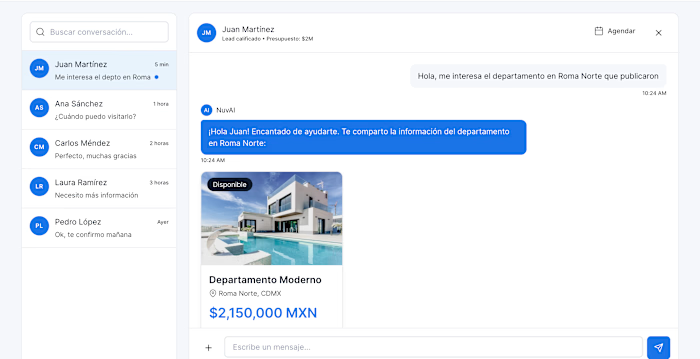
Real Estate · WhatsApp Agent · Consent Architecture
NuvAI
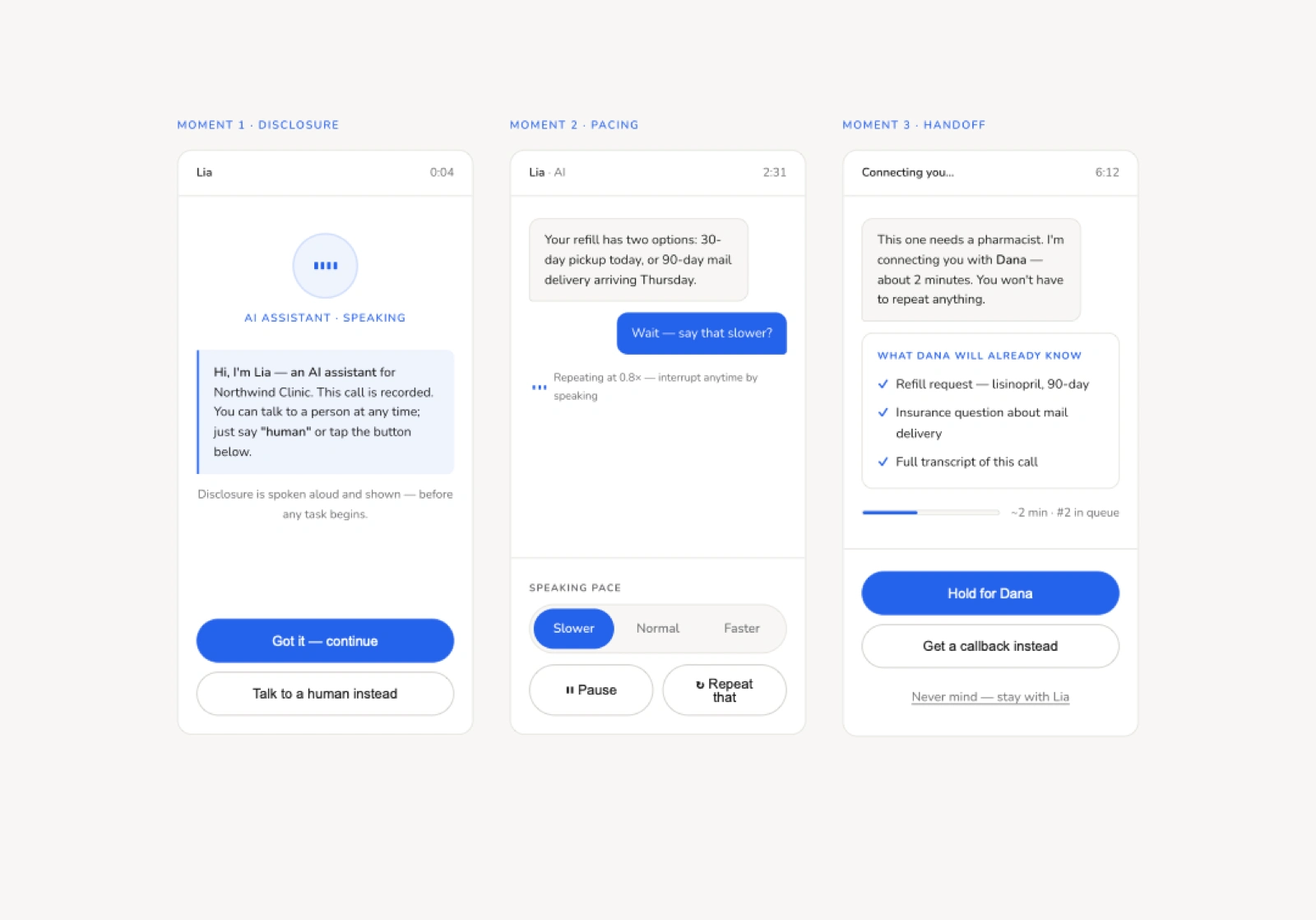
Consent UX for a real estate WhatsApp agent — the disclosure gate, conversation pacing, and human handoff architecture that determine whether users trust an AI acting on their behalf. Voice is an active exploration. Designed against the finding that users surrender control to systems they can't interrogate.
Disclosure is a gate
Shown and acknowledged before any task begins — not a buried notice or a toast.
Pacing is consent
The user controls the rhythm: step back, repeat, slow down — always available, never assumed.
Handoff shows its cargo
The agent tells the human what it already knows — "you won't repeat yourself," made explicit.
Outcome: in round-2 testing, 8 of 8 participants identified the AI unprompted and used at least one pacing control without instruction.
Disclosure gate · in-call UI
Mobility · High-fidelity prototype, Torino
Community Ride
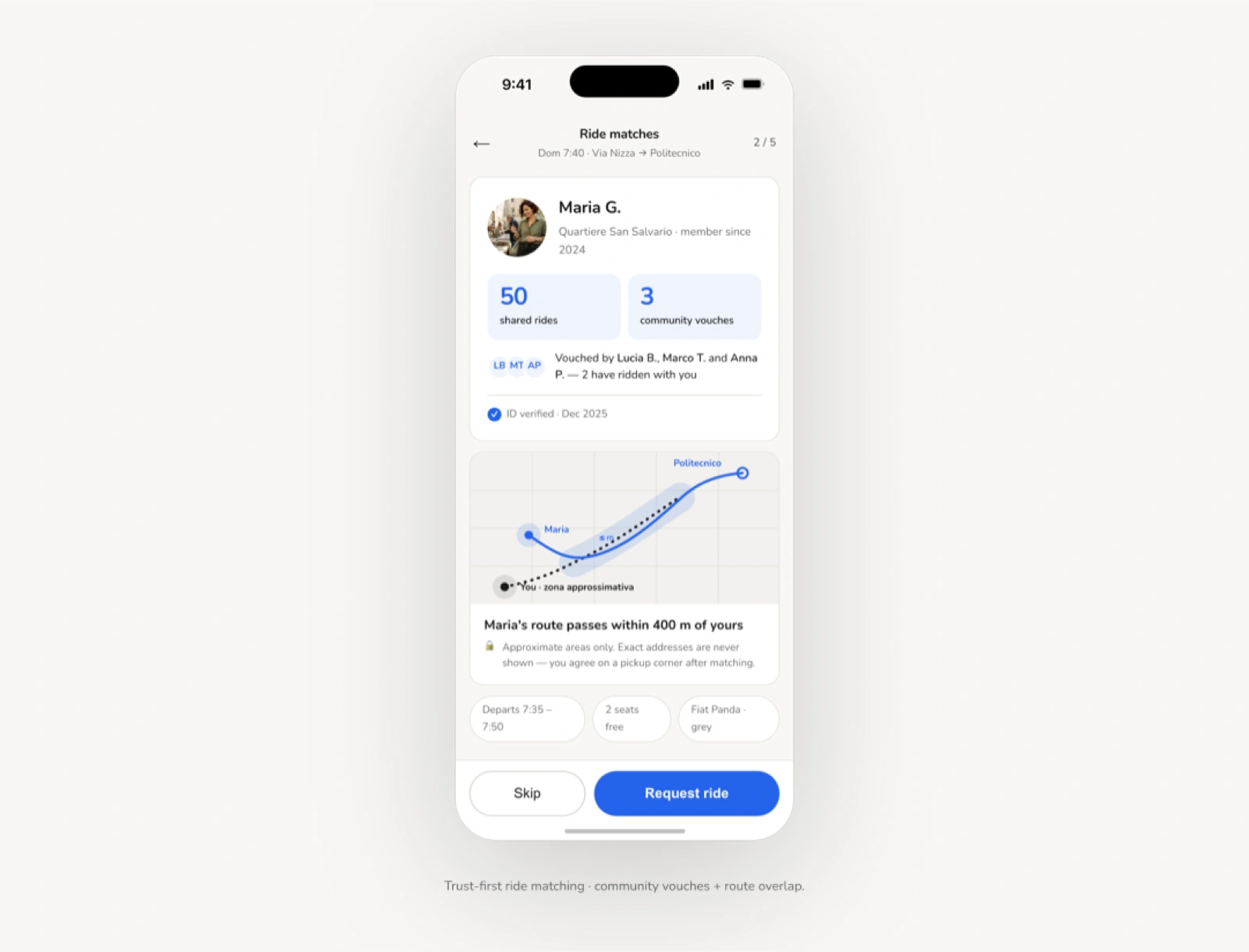
Trust-first ride matching for a Torino carpooling concept. The design leads with "50 rides + 3 community vouches" over any verification badge, and pairs it with privacy-preserving route matching.
Social proof leads
Rides + vouches as headline stats; ID verification demoted to a footnote line.
Vouchers are people
Named neighbors, with "2 have ridden with you" — trust is traceable, not a number.
Overlap, not addresses
"Passes within 400 m of yours" on an abstract map; exact homes never shown.
Scope: a complete bilingual prototype — 33 screens, 28 components, and a 61-token design system, built around a social-proof-first trust hierarchy.
Match profile · route overlap map
Research ops · Behavioral science instrument
Voice Agent Behavior Lab
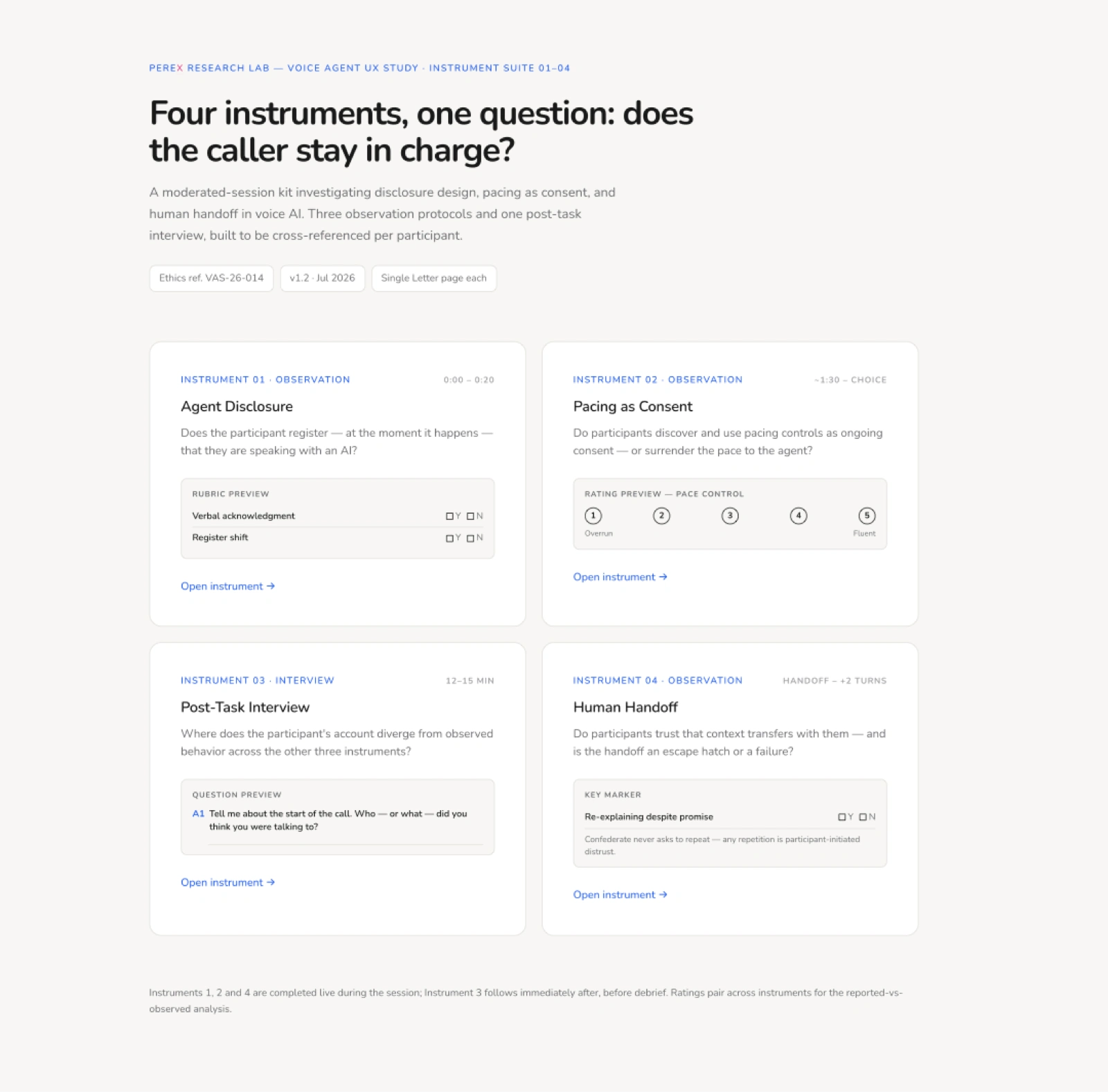
A four-instrument session kit for studying disclosure, pacing-as-consent, and human handoff in voice AI: three structured observation protocols plus a post-task interview, designed to be cross-referenced per participant on paper, mid-session.
Observe before probing
No questions during task windows; probes live only in the interview instrument.
Behavior beats self-report
Researcher ratings pair with participant claims to quantify the awareness gap.
Anchored scales only
Every 5-point rating carries a behavioral anchor at each point — no unmoored numbers.
Outcome: 42 sessions run by 3 researchers with 91% inter-rater agreement; the reported-vs-observed gap became the study's headline finding.
Instrument 1 of 4 · observation rubric
Like this project
Posted Jul 14, 2026
Consent-focused disclosure and pacing UX for a real-estate WhatsApp agent; conversation-first approach to handoff and trust.