Press-Sense

Josue Perez

adaptive · private
This page adapts to your reading rhythm — pace, pauses, curiosity. It runs entirely in your browser: nothing is tracked or stored.
right now the lattice is assembling on its own.
The Concept
Press-Sense started from a single question: what would a digital environment look like if it behaved like a room rather than an interface? Not a screen you navigate. Not a tool you operate. A space you inhabit — that changes when you're in it, remembers where you've been, and has its own slow internal life whether you're there or not.
The result is a browser-based generative environment with nine atmospheric modes (Night, Snowfall, Sediment, Bioluminescent, Vespers, Ember, Dawn, Observatory, Bloom), a presence system that tracks how and whether you're here, a memory layer that accumulates over a session, and an autonomous climate system that gives the room weather of its own.
The brief I held myself to throughout: feel alive without feeling intelligent. Alive means the room has moods, weather, history. Intelligent would mean it predicts, optimizes, or recognizes you. V1 through V3 maintain this line as an architectural constraint, not a design goal.
Live environment
The full V3 build — switch modes with the toolbar at the bottom. Hold your cursor still and feel the room settle toward you.
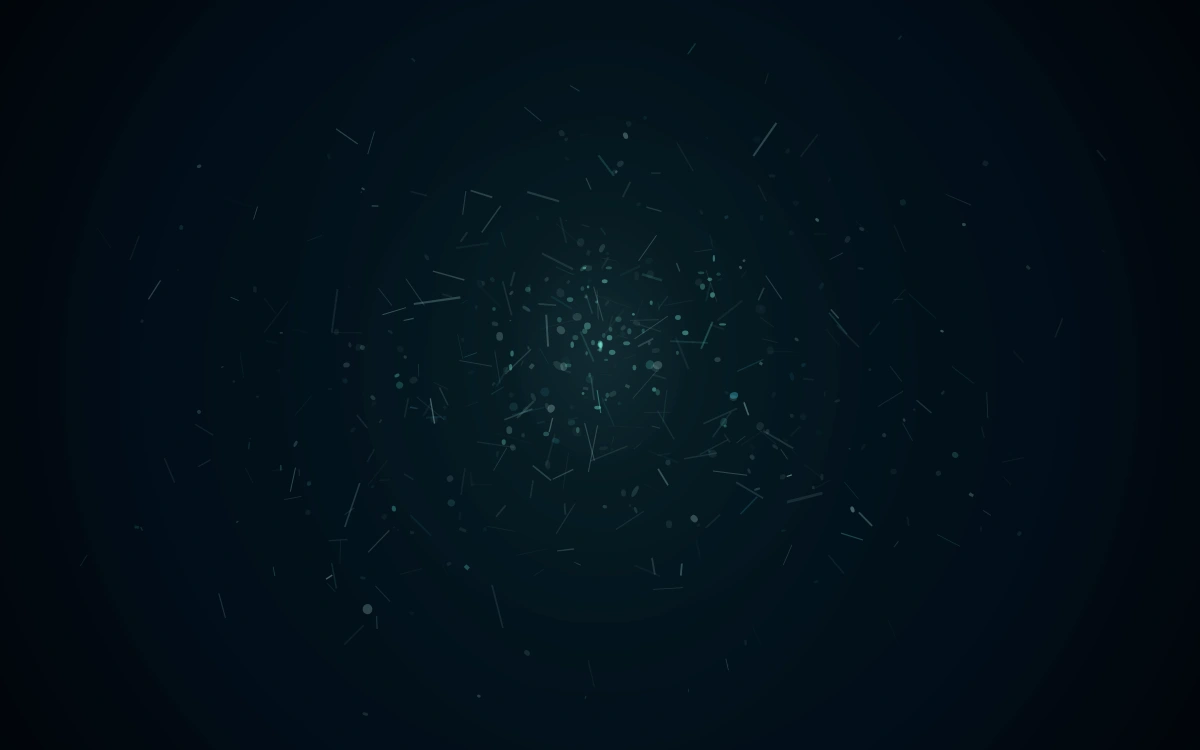
Bioluminescent mode — highest presence energy
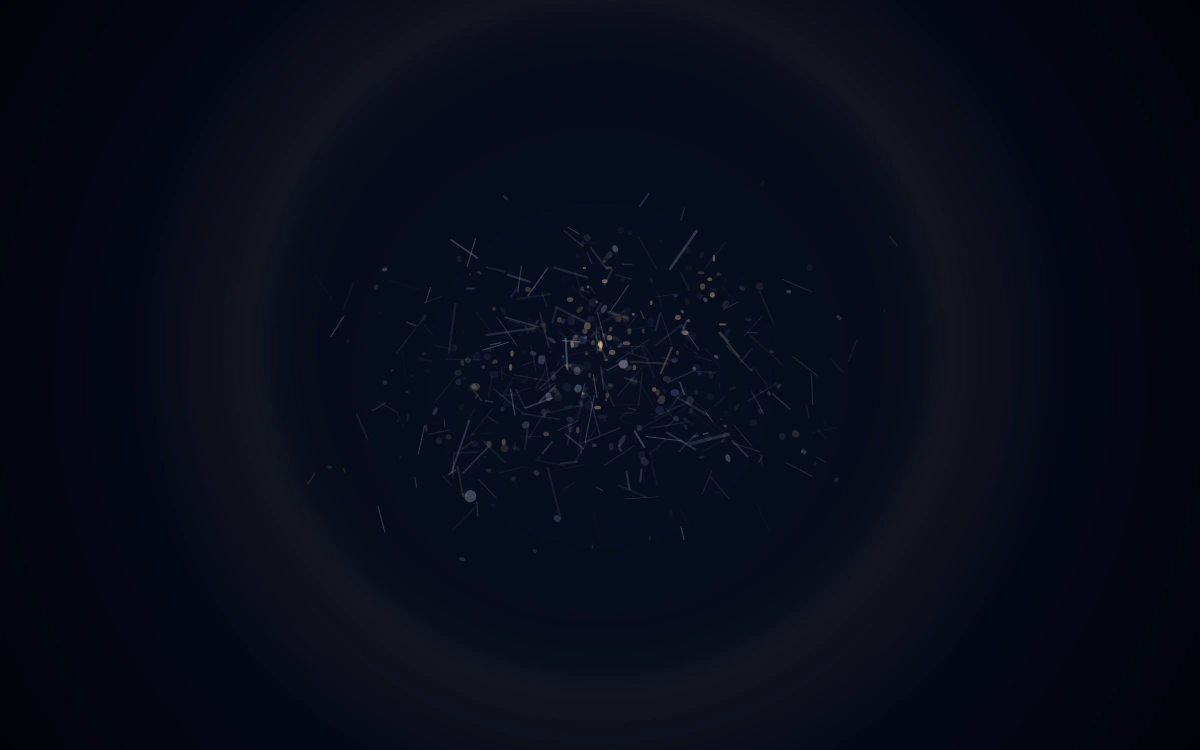
Observatory mode — concentric emergence shape
V1 — The Foundation
The initial submission version established the core architecture: a fragment field with continuous state (fragments persist, never reset between modes), a presence system with asymmetric decay (presence dims quickly when you leave, returns slowly when you're back), a significance grid that accumulates where your cursor dwells, and a mode toolbar as the only explicit UI.
The fragment field → significance → emergence pipeline is the engine: attention accumulates, and at peak significance, an "emergence" blooms — a visible acknowledgment of where the room noticed you. This is not gamification; it's atmospheric feedback.
V1 got continuity and tone exactly right. The transition model was the showpiece: per-frame lerp across every scalar simultaneously, no cross-fade, no rebuild, all persistent state carried through. Switching modes feels like the room changing its mind, not reloading.
V2 — Four Critical Improvements
A full design review of V1 identified four gaps between what was built and the promise of an "attentive environment." V2 addressed each:
A. Environmental intelligence — give the room weather, not a brain
Three long-period autonomous oscillators (periods of minutes, incommensurate so they never visibly repeat) modulate the room's global energy — emergence cadence, breath rate, walker energy. You feel that "sometimes the room is more wakeful," without knowing why. This is alive, not intelligent: the room has no model of you.
B. Environmental personality — motion grammar, not color palette
V1 had nine modes that were largely the same behavior in different paint. V2 re-tempers the modes with grammar knobs that change how fragments move: flow field scale and strength, emergence shape (vertical shaft for Vespers, horizontal band for Dawn, concentric rings for Observatory), cadence regularity, and shimmer character. With color removed, you could still name the mode from motion alone. That became the design test.
C. Environmental continuity — never reset the permanent thing
Fragment positions store normalized (0–1) and reproject on resize, rather than rebuilding. A window resize stretches the room instead of regenerating it. The fragment you were watching is still the fragment you were watching — the single worst continuity break in V1, resolved structurally.
D. Environmental memory — a patina you can feel
A very-low-resolution, long-half-life accumulation layer biases fragment density and base alpha over the session. After a long sit, the room has developed faint texture in the regions of your attention — a sense of history that is structural, not pictorial. It's the difference between a guestbook and a worn path. Minute 40 feels different from minute 2.
E. Environmental interaction — the room responds to stillness
V1 responded only to motion. V2 adds stillness as a first-class input: when the cursor holds still, ambient warmth gathers gently toward the point, breath deepens slightly, emergence becomes more likely nearby. Move, and it releases. This is the missing evocative interaction in almost every ambient system — being still and feeling the room settle toward you.
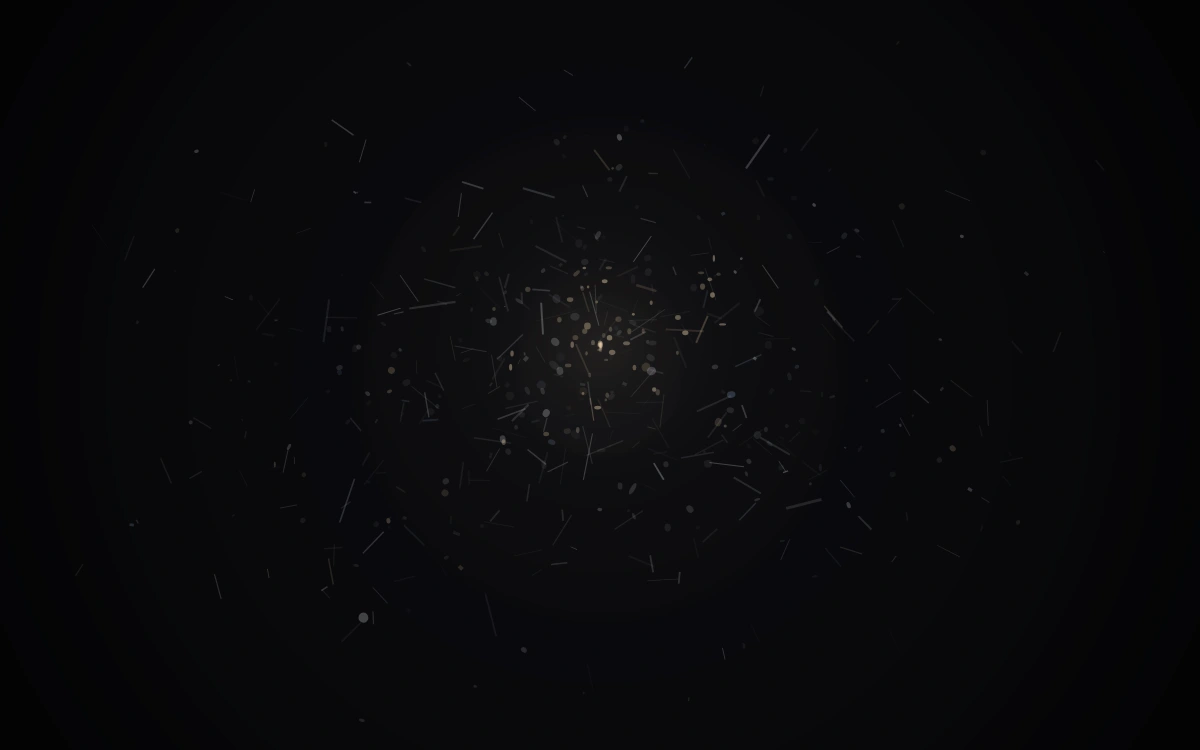
Night mode — minimum energy, pure black field
V3 — The Curvature Layer
V3 adds a single spatial concept: when a still presence dwells, space curves toward it — and where space curves, the room's clock slows. One scalar (k) bends both space and time. k is zero unless someone is still.
This is not a fisheye lens laid over the image (which would distort the whole frame). Only the fragment field is warped; background, vignette, and light stay flat. You perceive curved space without seeing a warped photo. A tangential swirl alongside the radial pull makes it read as space is curved rather than I am being sucked in.
The V3 design test: would the curvature exist for an empty room? No — k resolves to 0 with no still presence. An unwatched room is flat Euclidean space at normal time. The curvature is earned, not decorative. This is the cleanest line between "attentive environment" and "pretty art": art runs regardless of you; the environment only does this because of you.
Design Principles (standing constraints)
No dashboards, no settings panel, no analytics, no gamification, no productivity framing. The only UI is the mode toolbar.
No surveillance. Nothing stored that could profile. Memory is spatial and aggregate — the room remembers places, never people.
Every system must cross the perceptual floor. A behavior that cannot be perceived is, environmentally, not happening. This rule eliminated several V1 features that were real in code and absent in experience.
Alive, not intelligent. The room has weather, moods, and history. It does not have a model of you, a prediction about you, or a goal for you.
prefers-reduced-motion supported. The environment breathes at lower amplitude rather than freezing — it remains an environment rather than an inert graphic.
Outcome
A fully implemented, iteratively designed generative environment — two complete design-review cycles with specific architectural improvements at each, a working React codebase, and a clear design philosophy that distinguishes this from generative art, screensavers, or visualizers.
The project is the clearest demonstration of my environmental design thinking: the ability to hold a constraint ("alive without intelligent") rigorously across multiple iterations, to name what's missing in specific technical terms, and to implement the fix rather than redescribing the aspiration.
Reflection
The V2 review identified twelve behaviors that were "real in code and absent in experience" — below the perceptual floor. Writing that review taught me something I'll carry into every project: the gap between "it's implemented" and "it can be felt" is vast, and closing it requires checking each system against a single question: what would someone actually notice?
The curvature layer in V3 is the most philosophically precise thing in the project: a mechanism that exists only in response to a person's presence, that makes no mark when no one is there, and that warps the room's own physics rather than the appearance of the room. That's not a design feature. It's a design stance — about what attention does to a space.
Continue reading
Like this project
Posted Jul 14, 2026
A browser-based generative ambient environment with nine modes, presence/memory layers, and iterative V1→V3 design improvements focused on 'alive, not intelligent.'
Likes
0
Views
4
Timeline
Jan 1, 2025 - Jun 30, 2025