Voice Agent Behavior Lab

Josue Perez

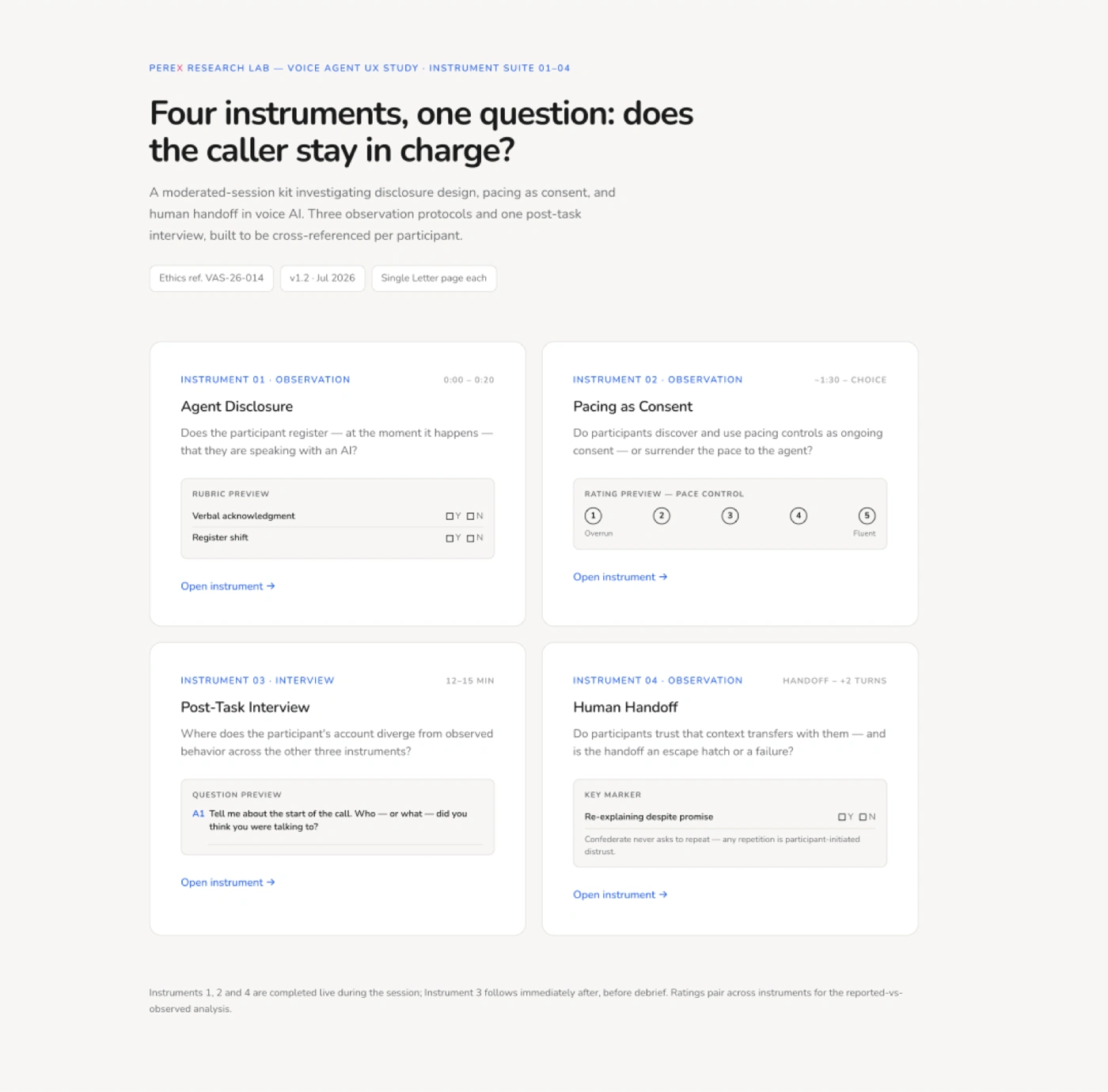
Status: research-instrument concept and reusable study framework. No completed multi-participant study is claimed in this public case study.
The Research Problem
Voice interactions disappear as they happen. Without a consistent capture structure, researchers can record transcripts yet still miss pacing, interruption, repair, disclosure, hesitation, and the moment trust changes.
The Voice Agent Behavior Lab is a structured instrument suite for documenting those behaviors consistently across sessions.
Instrument Suite
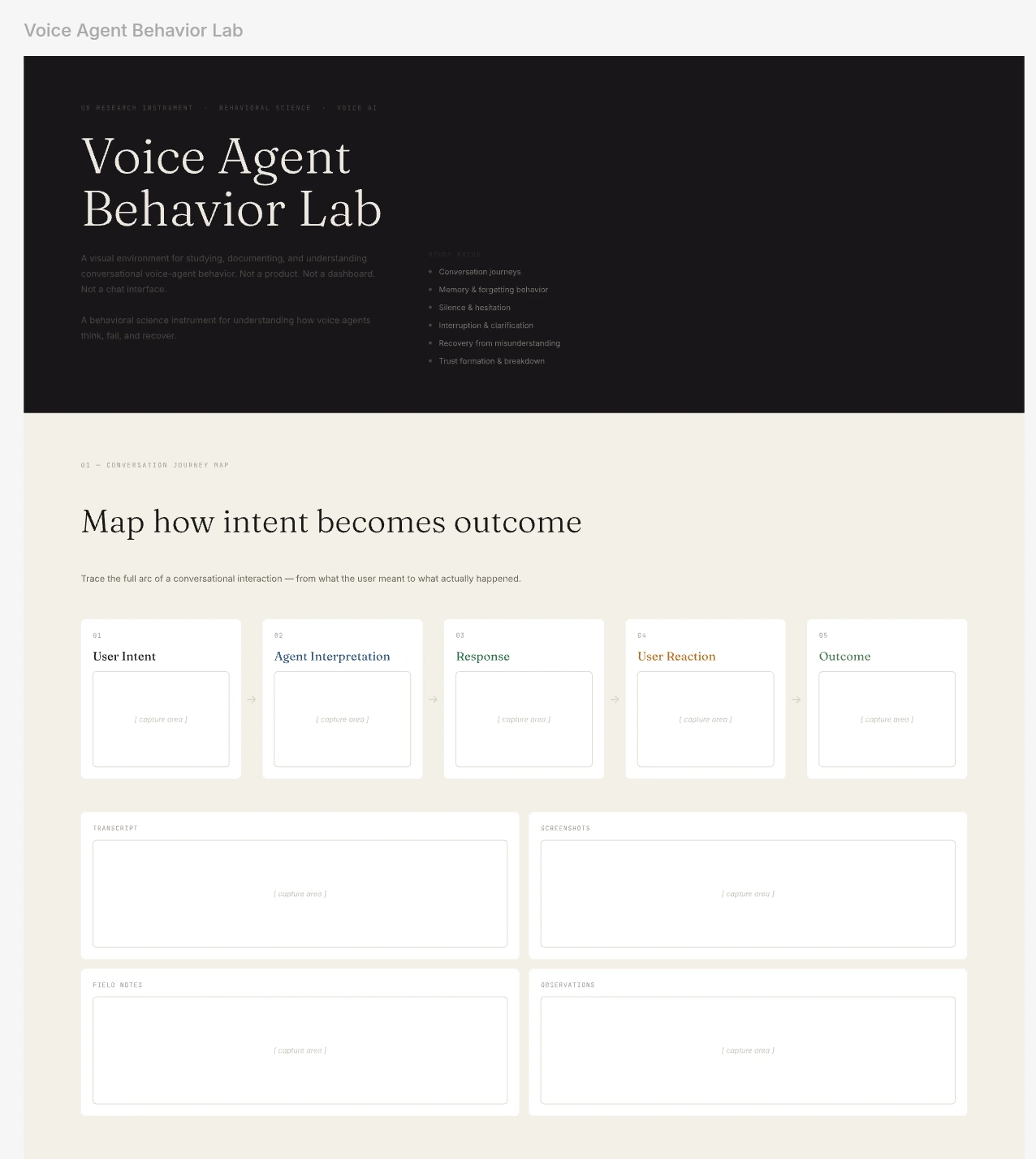
Voice Agent Behavior Lab research frame
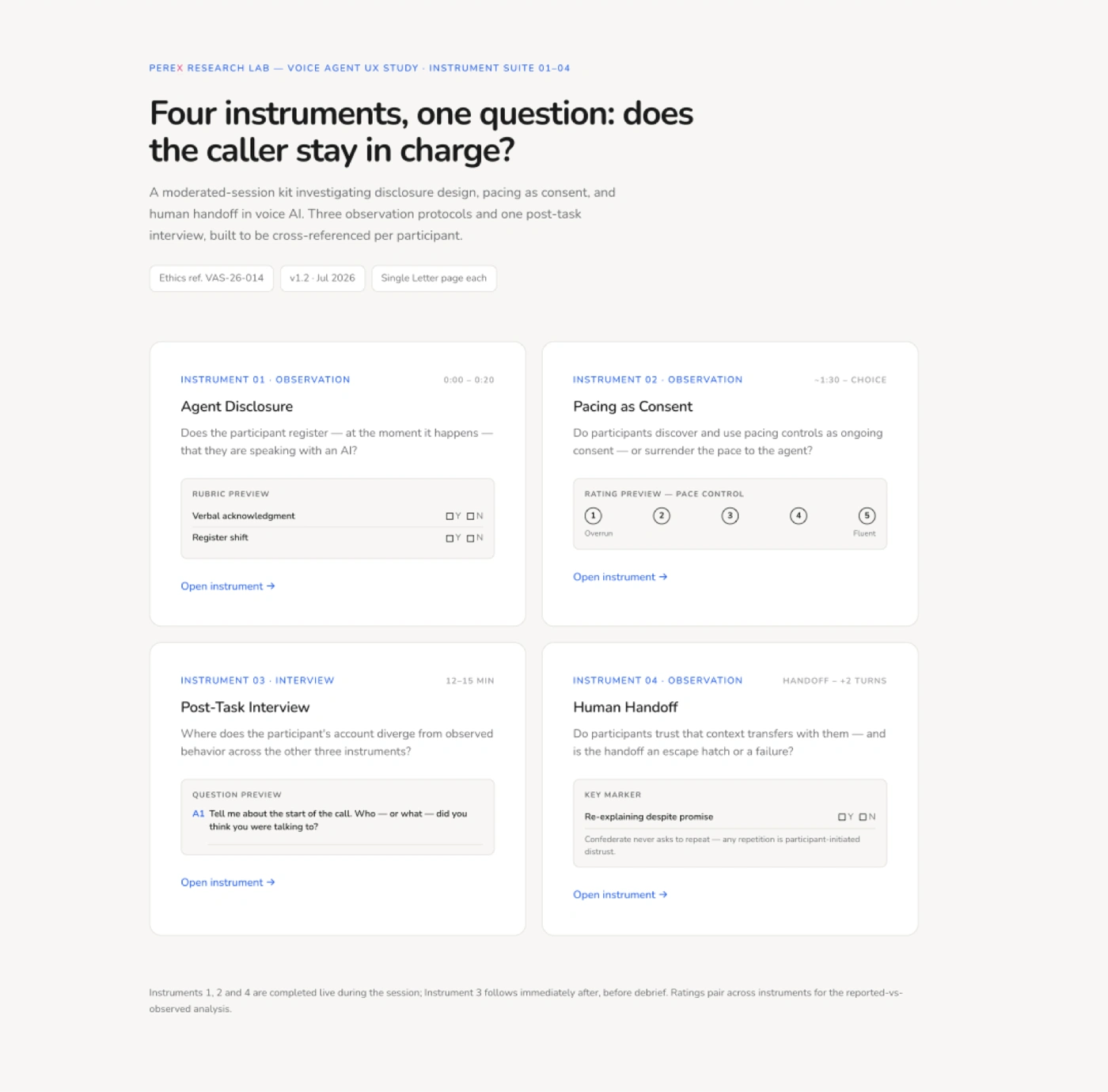
Voice-agent research instruments
The suite is organized around four connected instruments:
Conversation Journey Map
Disclosure and pacing observation
Post-task interview
Human-handoff and recovery rubric
Together they connect what the participant intended, what the agent interpreted, how the system responded, how the participant reacted, and what outcome followed.
Behavioral Dimensions
Conversation journey and intent alignment
Memory and forgetting behavior
Silence and hesitation
Interruption and clarification
Recovery from misunderstanding
Trust formation and breakdown
AI disclosure and human handoff
Design Decisions
Research instrument—not monitoring product
The Lab supports structured qualitative observation. It is not presented as an automated analytics dashboard or as a deployed research platform.
Intent-to-outcome as the spine
The primary map follows User intent → Agent interpretation → Response → User reaction → Outcome, making breakdowns easier to trace across the interaction.
Observable behavior and self-report stay separate
The framework records what participants do separately from what they later say they felt. Any relationship between those records must be established through actual research—not assumed in advance.
What NuvAI applies, the Lab investigates
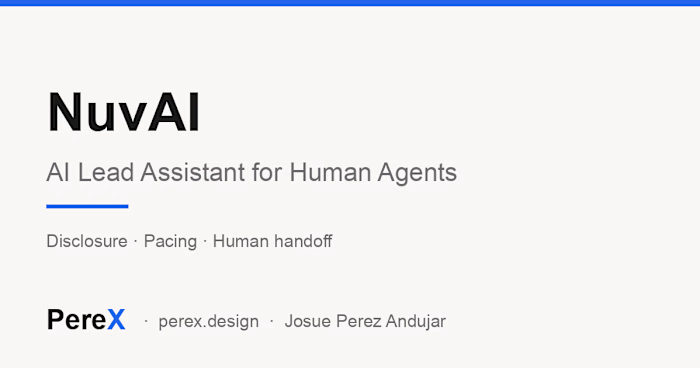
NuvAI is the product context. The Lab is a reusable research framework for testing disclosure, pacing, recovery, and handoff hypotheses.
Next Validation Step
Run a documented pilot with a defined participant group, protocol, consent process, coding rubric, and researcher-calibration procedure. Quantitative findings should only be published after the study records and analysis support them.
Like this project
Posted Jul 14, 2026
A structured research instrument suite (Conversation Journey Map + three capture instruments) for rigorous, cross-referenced study of voice-agent behavior.
Likes
0
Views
10