In a World of Algorithms-Followers, We Need More People Like Him

SHOHANUR RAHMAN


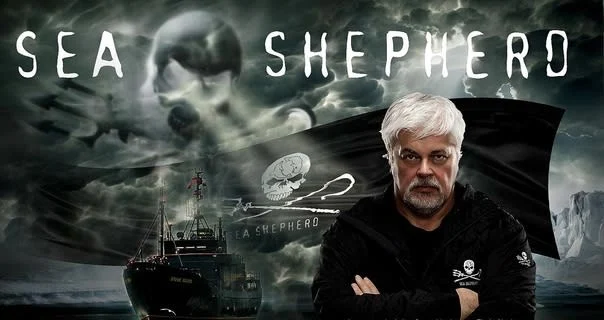
In a World of Algorithms, Personal Glory and Likes, We Need More People Like Him
8 min read
·
Jun 3, 2025
Nowadays, influence is measured by the number of Instagram followers, YouTube views or social media likes and follows. But imagine a world without any of those or any multimillion-dollar companies. There is only solitude and a steady determination: to save the whales of the sea from destruction. The man who turned this impossible imagination into reality is ‘Captain Paul Watson.’
I heard about him in a documentary by ‘Dhruv Rathee’ (an Indian YouTuber). I was very enthusiastic that I decided to write about him. Let’s dive deep into this in my first written piece of content.
Childhood Encounters that Shaped a Legacy
He was born on December 2, 1950, in Toronto, Ontario, Canada. Since his father was cruel and he lost his mother at a young age, he had a miserable childhood. But he had a big interest in animals since childhood. He even had a pet wild beaver. One day it got trapped and killed in the nearby jungle. Then he started to destroy the remaining animal traps in the jungle. He also saved the birds, ducks, and deer from being hunted down by the hunters.
Interestingly, all this happened when he was only nine years old. Then at 16 years of age, he ran away from home to Vancouver city because of his father’s growing up cruelty. There he met with many environmental activists. In 1970, they established a committee named ‘Don’t make a wave’. The Committee used to protest against nuclear testing on the island of US named Amchitka.
Earlier in 1965, a nuclear test had been conducted there. Which cost thousands of marine lives. So, they were protesting hard against this kind of destruction. But they failed to stop that because of cheating of the government. Although they failed, the movement got the limelight and publicity, so that the US government had to cancel the upcoming nuclear tests. So overall, the committee succeeded and later in 1972, they founded the ‘Greenpeace Organization.’ And our beloved Paul Watson was one of the founding members.
The Incident that Drove Him to Commit to Saving the Whales
Paul Watson came to know that whales are very intelligent by Paul Sponge, a Canadian biologist. Paul Sponge discovered that whales can think and can also manipulate humans with their answers if they want. They’re very emotional, kind and helpful. Even though they’ve got their own language, culture and social networking. It means that they’re way more clever than human thoughts of that time.
But those great huge creatures were being hunted by fishing ships using big explosive harpoons in almost all over the world. Against this, Greenpeace started a campaign named ‘Save the Whales’ in 1975. Using rubber boats (Zodiac), they went near the fishing ships and requested the hunters not to hunt whales. Paul Watson was the frontliner of this campaign, knowing the intelligence of whales. Then the game-changing day came.
That day, Paul Watson and his team were approaching a fishing ship when a whale was attacked and killed in front of their eyes. Another whale came and tried to attack the man who was deploying harpoons. That whale was also attacked from point-blank range. Paul Watson was right beside the injured whale, which was sinking. Watson interviewed about the incident and said that the wounded whale could do any harm to them or kill them if it wanted, cause it was right beside their boat. But it didn’t do anything till the last moments. Paul looked into its eyes and saw understanding in the time of its death. As if the whale understood the difference between those who are saving and killing them. These moments totally changed Watson’s life; he found the purpose of his life.
Later he knew that whale bodies were used to make oil, which was used to make ballistic missiles. He described it as one kind of stupidity, which is, and made the decision to dedicate his life to the whales and other sea-lives.
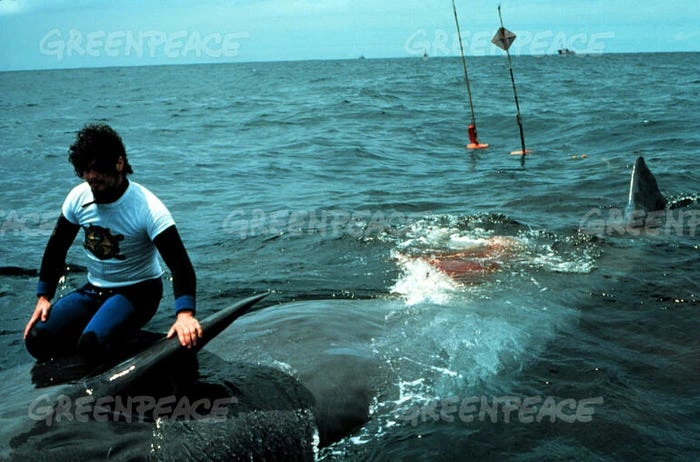
Captain Paul Watson on a harpooned baby whale. Showing it's enormous size.
Going to War for the Wonderful Sea Creatures
In 1976, in a Sea-Seals saving movement, Paul Watson lost his patience and made a proactive move. Which cost him his post at Greenpeace. Because Greenpeace introduced themselves as a non-violent organization. On the other hand, Paul realized that these soft protests won’t work anymore; they need to be proactive and violent if needed. With this thought, he made his own ‘Sea Shepherd Conservation Society’ in June 1977.
Watson made many violent movements with his organization. They had a big ship also named Sea Shepherd. They sank many whale-hunting ships by crashing with their ship. Initially, it was their signature style.
In 1986, Paul and his team fully destroyed a whale meat processing factory located in Iceland. They also sank two of Iceland’s four whaling ships by opening their seacocks.
In 2006, they went to Antarctica’s Ross Ocean to interfere with the Japanese whaling ships. This time, they threw harmless, bad-smelling acid and smoke bombs into those ships and entangled ropes in their propellers. They even put an expensive ship (The Ady Gil) in front of a Japanese ship to stop them, but they couldn’t. It broke Ady Gil into two parts. But Sea Shepherd didn’t retreat. Their interference ran till 2017 and stopped when Japan started to use advanced technology.
Literally, there was a war between Captain Paul Watson and all the whaling industries. They also had 40+ campaigns worldwide from Antarctica to Africa. As well as direct confrontations with illegal shark finners and toxic dumpers.
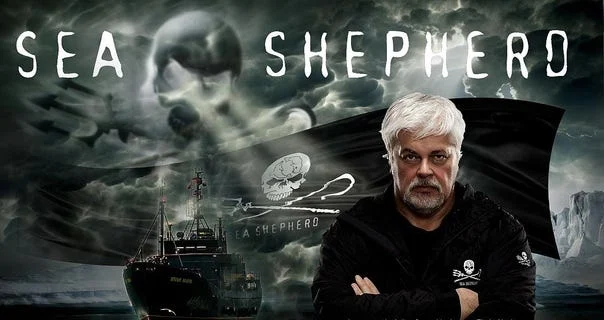
Costs of being Violent (Savior actually)
Watson was criticized for his tactics. Sea Shepherd was declared a pirate organization. Whalers called him an eco-terrorist and even some environmental activists considered him as an extremist. Many newspapers described his actions as terrorist attacks. He had been chased by governments, sued by corporations and hunted on land and sea.
He was prohibited from traveling to many countries, as well as his motherland. He was arrested and jailed several times. He had to stay in the ocean for many days to avoid being arrested. Even Interpol issued a red notice against Paul. We know which gets issued for just serious crimes.
He had to resign from the head post of his own organization. Later he was also removed from it for claiming that they are not proactive anymore. Then he founded another organization named ‘Captain Paul Watson Foundation’. Again he started his journey to stop the Japanese and got arrested for the last time till now on 21st July, 2024. But the man never stopped. He is alive (74 years old) and planning something new to save the whales.
Were the Gentle Giants Worth Fighting for?
To maintain the marine biodiversity and ecosystem, whales are essential, inevitable. They play a crucial role in fighting climate change. They capture and maintain a large amount of carbon of the atmosphere. They control marine food web as the topper of marine food chain.
Even their poop has a huge impact on global atmosphere. It helps stimulate the growth of phytoplankton and other sea plants with its nutrients. Phytoplankton are the base of marine food chain. Which is responsible for absorbing and releasing half of the world’s atmospheric carbon dioxide and oxygen. It means that where there are more whales, there are more phytoplankton and healthier atmosphere.
So, if we lose the whales, we lose the oceans. If we lose the oceans, we lose Earth. Watson understood this long before the mainstream did. He considered whaling as murder. And the whales were worth his many sacrifices.
Overall Results of Paul’s Heroic
Paul claimed that they directly saved more than 6000 whales during their campaigns without physically harming any humans. Hunters could hunt lower than half of their target because of their actions.
In some cases, they even won legally. In 2014, the International Court of Justice granted some restrictions on Japan’s whaling. Their activism had turned whaling — once considered normal — into a global ethical issue. The ‘Whale Wars’ TV show aired on Animal Planet showed Watson and his colleagues’ actions, struggles, and dedication. This dramatically increased awareness of illegal whaling and helped build a generation of ocean-conscious youth.
Paul succeeded in saving many species of whales that were endangered and on the verge of extinction. Like WSA & Walvis Bay’s Humpback whales, Southern Hemisphere Blue Whales, Western Grey Whales, Fin Whales, California Current & Hawaiian Islands’ Sperm Whales etc. As well as he saved some other marine creatures like Dolphins, Sharks, Sea Seals, Bluefin Tunas etc.
What He Teaches Us — What Can We Do?
We may not be able to chase whaling ships through the oceans. But we can still:
Speak up when silence is easier.
Take responsibility even when no one is watching.
Fight for a cause greater than yourself.
Can follow this: Quiet strength — Bold heart — Changing tides.
Whether we’re environmentalists or not, Watson’s story holds universal lessons:
Purpose over popularity.
Conviction over comfort.
Doing the hard thing when the easy path is not effective.
Real change is rarely convenient, but always necessary.
From Watson’s life, we can also learn that heroism isn’t loud, but it is deliberate.
In a generation afraid of discomfort, he chose to be uncomfortable every day, for the sake of something greater. Small acts- Lasting waves- Endless stories.
Why We Need More People Like Him
Watson had lived in exile. But you won’t hear him complain. Because he had never been in it for praise, only for a great purpose. We obviously need this type of person for whom complacency is greater than personal glory. If everyone ran for praise, it would be a threat to mankind. We need more Paul Watsons because the world doesn’t just need more tech geniuses, viral storytellers, or data wizards. It needs people who care deeply, quietly, persistently.
We already have known that how a single person can make a big impact on marine life. So, we need this kind of selfless people in every sector who can change the system for a better world. Who will think beyond mainstream and would go to war for others. This digital, emotionless world needs those heroes badly.
Conclusion: The Legacy that Doesn’t Fit into a Hashtag
In a world increasingly addicted to reels, memes and some meaningless outrages, somewhere in the oceans, Paul Watson’s legacy swims freely. He may never trend. He may never win the Nobel Prize. But because of him, some species are still alive.
That’s what makes him different from us. That’s a legacy. Made up with presence, not pixels. We need more people like him. Or maybe we just need to be more like him.
{This piece is a tribute to Captain Paul Watson and others who fight for the voiceless animals, without any expectations of praise and who change the world with their selfless act.}
Like this project
Posted Jul 9, 2025
This is a tribute to Captain Paul Watson's marine conservation efforts. The man dedicated his whole life to save the whales. Actually, he is saving the world.
Likes
0
Views
6
Timeline
Jun 1, 2025 - Jun 3, 2025