City vs. Village: A Personal Reflection

SHOHANUR RAHMAN


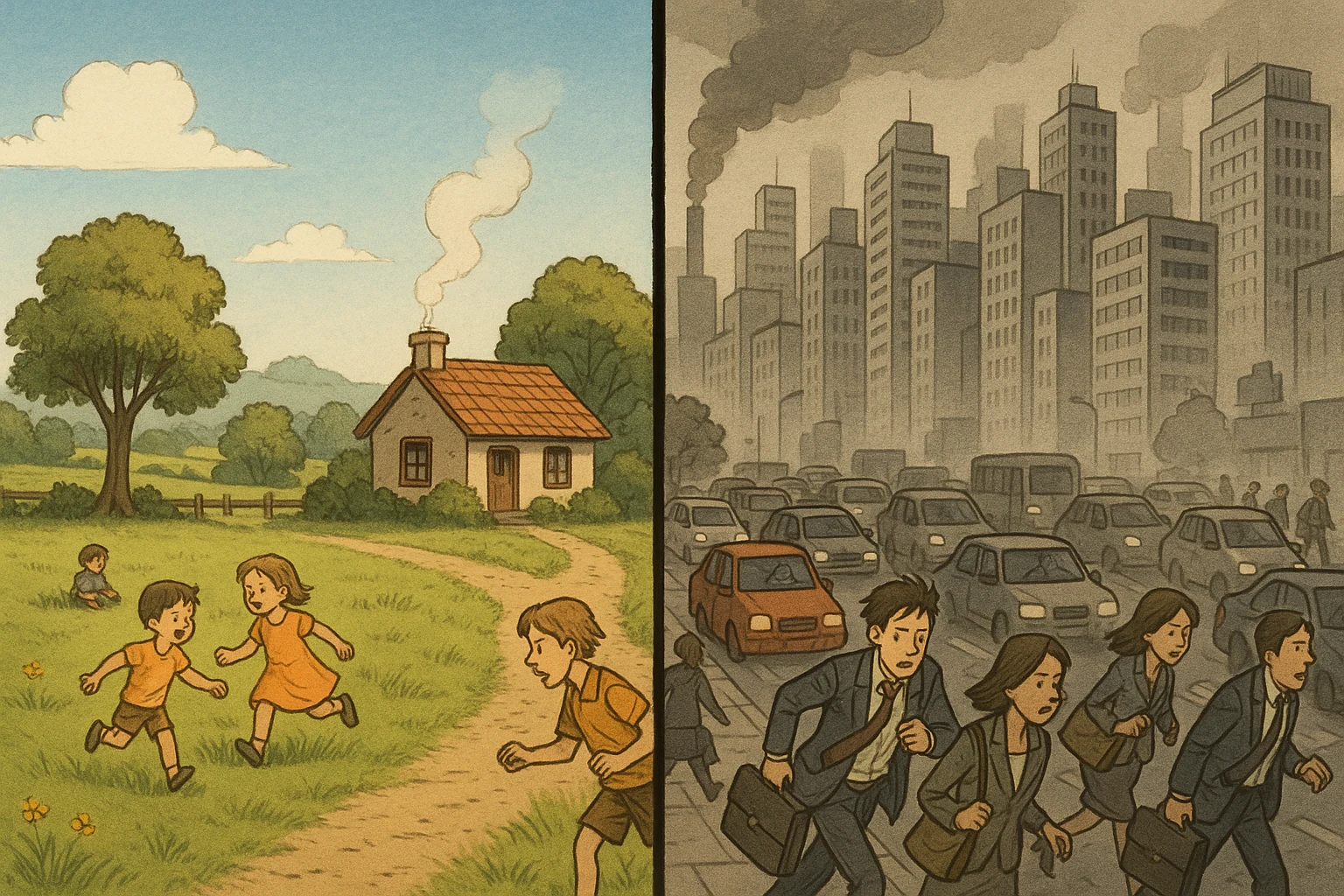
If it weren’t for Survival, Would Anyone Truly Choose the City?
8 min read
·
2 days ago
In this world of artificiality, the real beauty, joy and feeling lie in the real being. Yet we often or mostly run after that artificial- sometimes out of curiosity, sometimes for exploration, and sometimes out of sheer compulsion. Nowhere is this artificiality more concentrated than in the city.
The city is a place of glowing lights, towering buildings, never-sleeping roads, a stage to showcase ambition and strength, offering endless opportunities. But behind its dazzling skyline, there is a hollow feeling, a realization that, for many like me, the city is not a true home. My home is where life unfolds slowly, where seasons guide our days, neighbors are family, and the earth itself feels alive. That place is the village. City is a place where I came to survive, to work, to earn.
I will share my reflections on the colorful, artificial nature of city life and the genuine, rooted spirit of village life in this article. I write from the perspective of someone whose background is shaped by a village and semi-urban area, now compelled to remain in the city to make a living.
The First Encounter with the City
After passing 12th grade, I had to leave my home to find a job so I could continue my studies and meet my expenses. This is the beginning of almost every student who dreams of higher education but belongs to a middle-class family in a village like mine. Many people eventually have to move to the city after a certain age to earn a living. Some of them also go abroad.
I can still remember the day I arrived in the city. My village is located near semi-urban areas. So I was already a bit aware of the hustle and bustle of the city. Though the pace and busyness of people, cars, hawkers and the entire environment made my head spin. Yet I was amazed that the urgency felt exciting. I thought, this is what progress looks like. I was determined to blend in, to become part of the machinery that made the city powerful.
My suitcase was small, but my hopes were enormous. I found a 10-hour job and managed to get admission to a university. I was very happy that amidst the chaos of the city, I was also finding my way and moving forward. I stayed focused on my job and my studies. I thought I had arrived at a place of endless possibilities.
But in a matter of a few weeks, all these thoughts started to fade away. I found everyone to be strangers. There were hardly any friendly faces. Everyone was busy with their own business, working like robots. A daily routine which left no room for emotion, light-hearted gossip, or any real relaxation. The buildings that had first looked magnificent soon felt like walls, hemming me in on every side. I missed my family a lot. Even cried at midnight at first.
I am not saying that the city has no friends or sources of entertainment. But the first impression of a village guy in the city feels like this in most cases. People take time to adjust and overcome these feelings. I too slowly overcame those obstacles, found my footing and learned to navigate this new world, day by day. Luckily, my cousin and brother-in-law lived nearby and they helped me a lot. Otherwise, it would have been much more difficult for me than it already was. That was an advantage I had, which many others don’t usually get.
Remembering The Village Life I Left Behind
I used to wake up in the morning to the sound of chirping birds. The crowing of roosters was like an alarm. The fresh air and gentle breeze were a perfect way to start the day. We had our own land where we grew organic vegetables and fruits. We used to catch fresh fish from the ponds, canals and streams, take bath and swim in clear water of the river.
I had a gang full of cousins and friends. We often raided jungles and forests in search of juicy fruits like mangoes, black plum, jujube etc. The real fun happened when the owner chased us while we were stealing them. We would run around looking at each other and laughing. Besides the household work and school times, our days overflowed with boundless mischief and carefree joy. There was no time to feel depressed.
The afternoon was a golden time in village. Neighbors would visit each other’s houses, passing their leisure time with pleasantries. There is a wide-open yard in every house to chill, play games and do household work. Sometimes we younger ones joined the elders in visiting, but most of the time we played in the yard or the nearby school playground. That’s the thing I missed most in the city. Seeing children playing in tiny places while walking on the road still haunts me and reminds me of my wonderful childhood.
Another thing I missed most is my mother’s cooking. The food in the mess wasn’t ideal in taste or hygiene. Spending money would get expensive food, but it’s nothing compared to mother’s cook.
My village was not wealthy. But it was rich in other ways — community, belonging, rhythm. There was a sense that no one was ever truly alone. If someone fell sick, neighbors gathered without needing an invitation. If there was a wedding, everyone contributed what they could, and no one felt left out. It is impossible to fully explain to someone who has never known such a place why the city can feel so sterile by comparison. The city has convenience and money, but it has no roots. Everything is temporary.
The Incident that Made Me Think- City isn’t Ideal for Living
There was a secluded place on the way to my office. It was underneath a flyover, a bit dark and a few steps away from the walkway. One day, I was walking past it and saw a boy crying there. He was begging for his phone from a scary man who held a sharp knife and was laughing madly. The phone wasn’t very expensive, but it contained the contact number of his employer. I understood that the man was a hijacker and drug addict. And the boy was from a remote village, arrived here at a very young age to earn for his family and he desperately needed that phone.
Tears welled up in my eyes as I saw the incident and I went to help the boy. But I couldn’t go much closer or do anything useful. Because the man was clearly unstable and armed. So I started to ask for help from the passersby. But no one was ready or had a little time to care for an unknown poor boy. Everyone was too busy, hurrying through that area for their own concerns.
What more could I do? At last, I called the emergency security personnel and headed towards the office, cursing myself and this city with a tearful & angry heart. I closed my eyes and thought about how this situation would have unfolded in my village. Would this happen there? Would anyone ignore a person in danger? A big no — everyone would have rushed at once to help the boy. That day I realized the harsh reality of the city.
The City: A Place of Transactions, Crowds, and Pollution
With time, I realized that the city is not built for living. It is built for working. Every interaction is transactional. Here no one is close to anyone without some form of self-interest. It isn’t easy to get even a second of time from someone without an exchange. Choosing friends is also tough because most of them turn out to be companions only for good times and fade away during difficulties.
From the moment people wake up in the morning until they go to sleep at night, everyone is busy calculating what they have earned and what they have lost. There is no time or space to think about one’s own tastes or desires — what bothers me, what I enjoy. In most cases, city life leaves no room for such thoughts. Everyone must focus only on survival.
Beyond all this, most South-Asian cities are extremely dirty and overcrowded. There is no pleasure in walking down the streets because of the constant pushing of people and the potholed sidewalks. Nor is there comfort in riding in cars due to the endless traffic jams. A huge number of people live in inhumane conditions in roadside & railway station slums, which have become havens for drugs and crime. The safety of life is at great risk there.
The air in these cities is heavily polluted, unfit for breathing. Many food suppliers do not maintain hygiene standards. Because of the pressure of overpopulation, people fill up drains and sewers to build shops, houses. As a result, waterlogging occurs during rainy days, which lasts for a long time. Most of the big factories are built in cities, which are the biggest culprits in urban environmental pollution. The standard of living in South Asian cities seems to be declining day by day.
The Necessity of the City
Despite all this, cities are inevitable for a country. A country is governed with the city at its center. The rulers usually live in the capital cities. Immobilizing the capital means immobilizing the entire country. Ultimately, cities are the powerhouse of a nation. Trade, commerce, transportation, and other services play a major role in the economy of a country, all of which depend on cities. Even though emotions are not always valued here, millions of people like me have gotten the opportunity to make a living for themselves and their families. The ladder to climb up in life is difficult to find in the village.
The city gives us lifelong experiences and teaches us to understand the meaning of life. It teaches us to value what we have in the present. Despite its flaws, the city taught me to value what I had and showed me that home is not just a roof — it’s a feeling, a connection. Maybe I wouldn’t have gained this realization if I hadn’t left my village. It also taught me resilience. I learned to navigate its chaos, to carve out small spaces of peace, to find moments of joy even among the noise. And from the city, I got the philosophy that has stayed with me ever since:
Small acts — Lasting waves — Endless stories.
Conclusion: The Dream of Going Back
Although I am now well settled in Dhaka city with my little family — my wife and a child. I desperately want to go back to where I belong. I have my big family still living there. My child is being deprived of a vibrant childhood, which I had. I feel like a guest when I visit home only a few times a year. I still cry when it’s time to leave again.
I know it is not so simple. The village cannot offer the same income. It cannot always provide the opportunities I need. But in my dreams, I am back there, tending to a garden, greeting neighbors, living in a way that feels true. I hope that one day, I will no longer have to choose survival over belonging. I can return to the place that still holds a part of me.
And I think many of us can relate to this dream who have left the heavens of earth just for their existence. I am grateful for what the city has given me: the ability to provide, to learn, to grow. But I will never pretend that it has replaced what I left behind.
Like this project
Posted Jul 9, 2025
This article shows the artificiality of cities and the genuine spirit of villages. Let's explore why city is inevitable but not ideal for living but village is.
Likes
0
Views
10
Timeline
Jul 6, 2025 - Jul 7, 2025