Titan Urban Transportation

Aakifa Baig
Titan Urban Transportation
My Role
As the UX lead, I collaborated with stakeholders and engineers to simplify onboarding, ride management, and communication flows. I delivered research, wireframes, prototypes, and UI design that streamlined driver operations and improved efficiency, reducing onboarding time and enhancing service quality.
Overview
As a UI/UX designer, I collaborated with Titan Urban, a technology company specializing in ground transportation services for business travelers. My focus was on improving the driver experience within their mobile app, addressing key pain points to make the system more intuitive and efficient. Through user research, prototyping, and iterative design, I developed a solution that streamlined driver interactions, from onboarding to completing rides.
Confidential Work Access
Due to confidentiality, detailed Figma screens and flows are not displayed publicly. A private view-only Figma file can be shared upon request.
IT'S NOT A LIMO, IT'S A TITAN
About the company
Titan Urban is a technology company that enables business travelers to easily book black cars and taxis via a mobile app. They prioritize delivering a safe, clean, and reliable travel experience, ensuring that business travelers receive the high-quality service they expect.
Project Goal
The primary objective was to enhance the driver experience by simplifying the booking and ride management processes. We aimed to create an intuitive platform that allowed drivers to efficiently manage their schedules, communicate with guests, and complete rides with minimal friction.
Problem Statement
Titan Urban identified several critical issues with the existing driver app:
Complicated Onboarding Process: New drivers found it challenging to navigate the onboarding process, leading to delays in starting their work.
Inefficient Ride Management: The system for managing and completing rides was cumbersome, resulting in delays and inconsistencies in service delivery.
Poor Communication Tools: Drivers had limited tools for communicating with guests, especially in areas with poor network coverage, which often led to misunderstandings.
Solution
1. User Research and Problem Framing
Understanding User Needs: We began by conducting user research to understand the pain points of both guests and drivers. This informed the user flows and the overall design strategy.
Personas and Scenarios: Developed user personas and scenarios to guide the design process, ensuring that the solution addressed the needs of all stakeholders.
2. Design Process
Wireframing and Prototyping: I created wireframes and interactive prototypes to map out the user journey, focusing on reducing the steps required for drivers to complete essential tasks like logging in, managing rides, and communicating with guests.
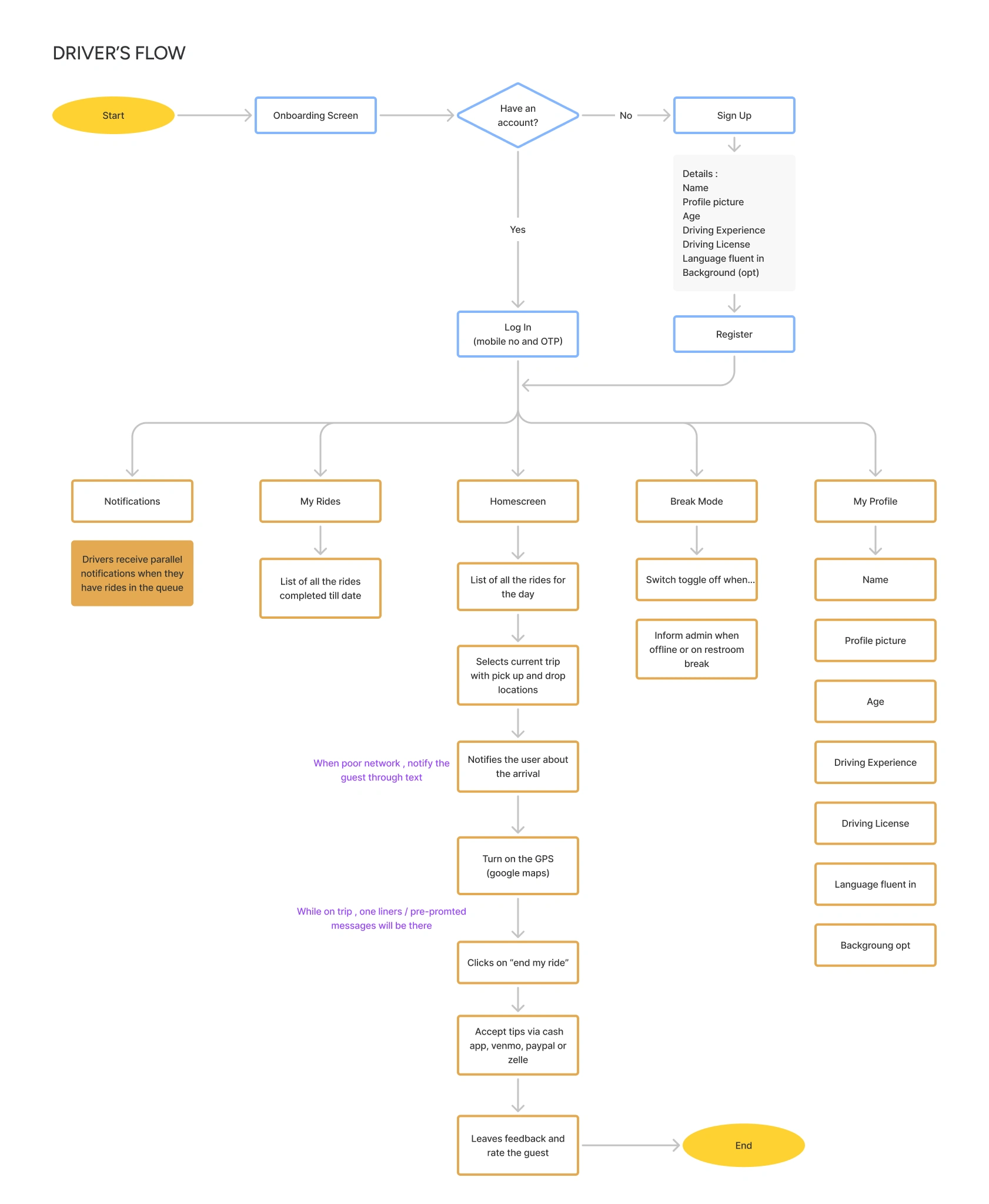
User Flows: The user flow diagram illustrates the steps a driver takes, from onboarding to completing a ride. The design simplifies the process, making it easier for drivers to manage their schedules and interact with guests.
Key flows include:
Onboarding and Login: A streamlined process that allows drivers to sign up or log in quickly, with minimal steps.
Ride Management: A central dashboard where drivers can view all scheduled rides, select the current trip, and manage it from start to finish.
Communication Tools: Integrated tools for notifying guests about arrivals and handling network issues with pre-promoted messages.
Visual Design: The app's visual design was updated to align with Titan Urban's brand identity, focusing on clear navigation, easy-to-read fonts, and a clean layout that prioritized usability.
3. Key Features Implemented
Simplified Onboarding: The onboarding process was redesigned to be more intuitive, with clear instructions and a reduced number of steps. This allowed new drivers to start working more quickly.
Efficient Ride Management: A new driver management system was implemented, allowing drivers to manage their rides more effectively. This included features like real-time ride tracking and easy access to trip details.
Mobile Application Enhancements: Enhanced the mobile app with real-time ride tracking, allowing drivers to manage their rides more effectively. The app also enabled drivers to select their vehicles and provide feedback on rides.
Impact and Results
Reduced Onboarding Time: The new onboarding process significantly reduced the time it took for drivers to get started, leading to a faster ramp-up for new hires.
Increased Efficiency: The streamlined ride management system improved drivers' ability to manage their schedules and complete rides on time, resulting in better service delivery.
Positive Feedback: Drivers reported higher satisfaction with the new app, citing the improved usability and communication tools as major benefits.
Conclusion
This project demonstrated my ability to design user-centered solutions that address real-world challenges. By focusing on the drivers' needs and streamlining the app's functionality, we were able to enhance the overall efficiency of Titan Urban's service. The project reinforced the importance of thorough user research, iterative design, and cross-functional collaboration in creating effective digital products.
Like this project
Posted Jun 4, 2026
Enhanced driver experience in a mobile app by streamlining onboarding and ride management processes.
Likes
0
Views
0
Tags