Shop Floor Management Educational Game

Kuntay Kunt


Shop Floor Management Game for Marketing
Simple, no-login-required web-based game to simulate shop floor management. The game educates shop floor employees and management on effective shop floor operations, pricing strategies, and delivery time management.
The objective is to maximize profit within a one-hour gameplay session by managing quotation requests, bidding, manufacturing, and delivering parts while optimizing machine usage and operation sequences.
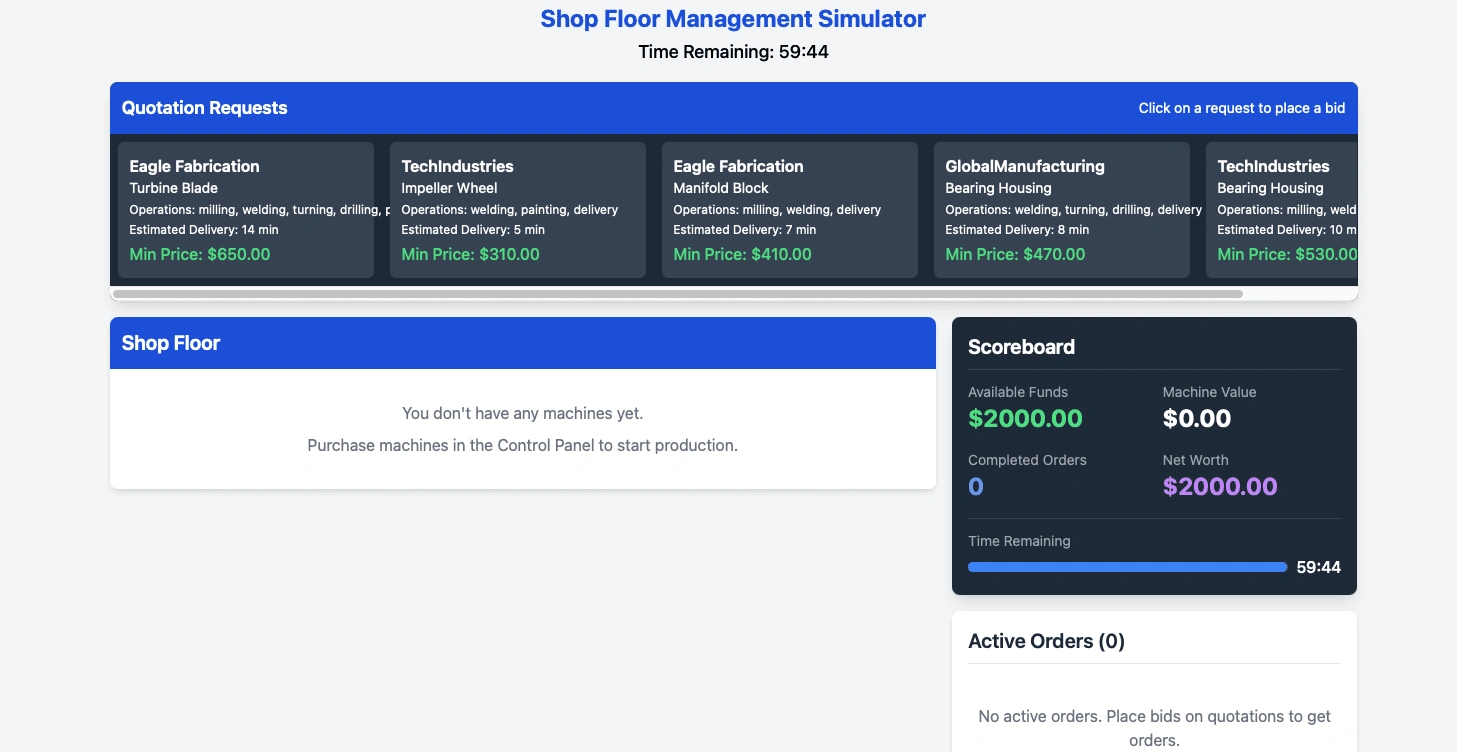
Simple Interface
Game Features
1. Quotation Requests
Display: A ticker-style header at the top of the screen shows a continuous flow of quotation requests, similar to a stock market ticker.
Content: Each request includes:
Client name.
Part name to manufacture.
Required operations (one or more of: welding, milling, turning, drilling, assembly, quality inspection, painting, delivery).
Interaction:
Players can select a quotation and place a bid (price) and delivery time.
Bids are randomly accepted or rejected by the system based on a hidden probability (e.g., higher bids or faster delivery times increase acceptance chance).
Accepted bids move to the "Orders" section.
2. Orders Section
Displays all accepted orders with:
Client name, part name, required operations, bid price, and delivery deadline.
Orders are processed by purchasing raw materials and assigning operations to machines.
3. Shop Floor
Visualization:
Displays machines as the player purchases or builds them (e.g., welding machine, milling machine).
Visual indicators (e.g., green light, animation) show when a machine is actively working on a task.
Machine Management:
Players purchase machines to enable specific operations.
Each machine can handle one operation at a time.
Machines have a processing time for each operation (e.g., welding takes 2 minutes, milling takes 3 minutes).
Operation Flow:
Players assign operations to available machines in the correct sequence (e.g., milling before assembly).
Operations must follow the sequence specified in the order.
4. Manufacturing Process
Raw Materials:
Players purchase raw materials for each order (fixed cost per part, e.g., $100 per part).
Operation Assignment:
Players manually assign each operation to an available machine.
If a required machine is unavailable, the player must purchase it.
Completion:
Once all operations are completed, the part moves to delivery.
5. Delivery and Rework
Delivery:
Completed parts are delivered to the client, earning the bid price as revenue.
Rework:
Randomly, clients may reject a delivered part and request rework (e.g., 10% chance).
Rework requires repeating one or more operations, delaying delivery and incurring additional costs (e.g., 50% of original material cost).
Penalties:
Late deliveries reduce revenue (e.g., 10% penalty per minute past deadline).
6. Game Objective
Maximize profit within a one-hour gameplay session.
Profit = Total revenue from delivered orders - Costs (raw materials, machine purchases, rework).
Display a running profit/loss and time remaining.
7. User Interface
Header: Ticker for quotation requests with a "Bid" button for each.
Orders Section: List of active orders with operation status.
Shop Floor: Visual grid of machines with status indicators (idle, working).
Control Panel:
Purchase raw materials.
Purchase machines.
Assign operations to machines.
Scoreboard: Shows current profit, time remaining, and number of orders completed.
Minimalist Design: Clean, intuitive, and responsive for desktop and tablet use.
8. Technical Requirements
Platform: Web-based, no login required.
Technology: Use HTML, JavaScript, and CSS (consider a framework like p5.js for animations or React for UI).
Libraries: Use Tailwind CSS for styling if using React.
Randomization: Implement random acceptance of bids and rework requests using JavaScript’s random number generator.
Timer: One-hour game duration with a visible countdown.
Persistence: No data persistence; game resets on page refresh.
9. Game Mechanics
Pricing:
Raw materials: $100 per part.
Machine costs: Welding ($500), Milling ($700), Turning ($600), Drilling ($400), Assembly ($300), Quality Inspection ($200), Painting ($200), Delivery ($100).
Operation times: Welding (2 min), Milling (3 min), Turning (2.5 min), Drilling (1.5 min), Assembly (2 min), Quality Inspection (1 min), Painting (1.5 min), Delivery (0.5 min).
Bid Acceptance:
Higher bids and shorter delivery times increase acceptance probability (e.g., 70% base chance + 5% per $100 above minimum bid, +5% for delivery under 10 minutes).
Rework Probability: 10% chance per delivery.
Revenue: Bid price minus penalties for late delivery or rework costs.
10. Educational Goals
Teach shop floor employees and management about:
Operation sequencing and machine utilization.
Balancing cost, pricing, and delivery time.
Impact of rework and delays on profitability.
Provide a fun, interactive way to understand shop floor dynamics.
Platform: Web-based, no login required, hosted on Netlify
Development: Built using Bolt.new for rapid prototyping and deployment.
The main purpose of the idea is to push sales through gamification on manufacturing teams and new comers.
Like this project
Posted May 1, 2025
Created a web-based game for shop floor management education.