Internal Sales Enablement Platform

Derek Darby


Case Study
Internal Sales Enablement Platform
Redesigning internal product knowledge architecture to improve sales efficiency and create a more scalable enablement foundation.
Internal B2B Platform
Sales Enablement & Knowledge Management
Innovation Refunds
B2B SaaS Startup
Lead UX Designer & Product Lead
Product Strategy
System Design
Research & Delivery
Summary
The Need
Sales teams lacked a reliable way to access accurate product knowledge. Information lived across disconnected documents, email threads, and file repositories, creating friction and inconsistency in live conversations.
What I Led
Led the redesign of an internal sales enablement platform, transforming scattered content into a structured, governed knowledge system aligned to real sales workflows.
How it Worked
Defined content architecture, ownership models, and interaction patterns that made information easier to find, trust, and maintain without requiring formal training.
Impact
Established a unified enablement foundation that improved sales efficiency, reduced duplication, and supported scalable growth across products and teams.
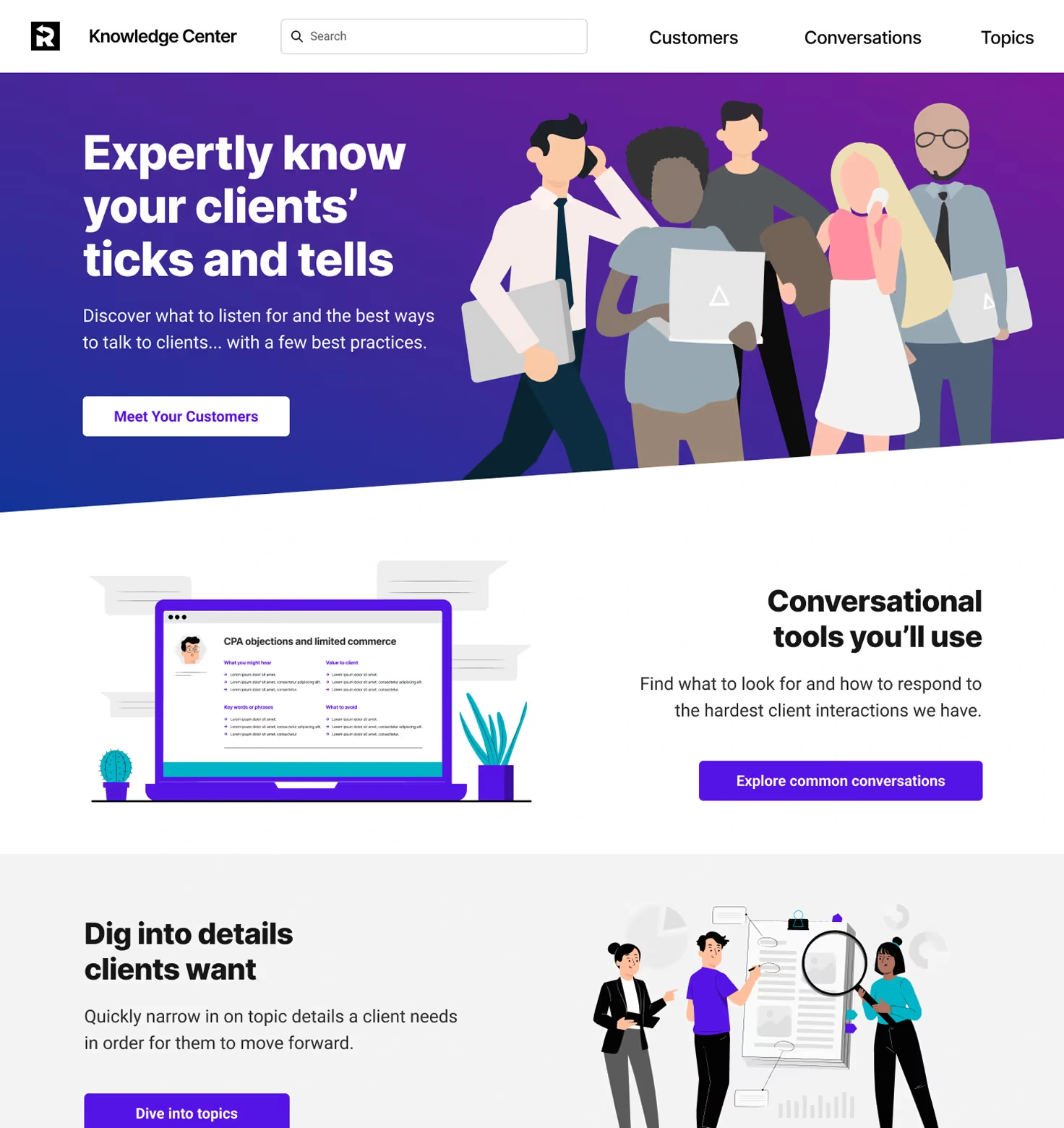

Customers Overview (Mobile) 1
Unified sales knowledge platform designed to support real-world go-to-market workflows.
Context
This project redesigned an internal sales enablement platform used by go-to-market teams to access product knowledge, positioning, and support materials.
Before the redesign, critical information was spread across disconnected documents, email threads, and file repositories. Sales representatives often relied on forwarded attachments and tribal knowledge to prepare for customer conversations.
As the organization grew, this fragmentation slowed sales conversations, reduced confidence, and increased maintenance overhead. The opportunity was to replace a loose collection of content with a structured, governed system aligned to real sales workflows.
Business Stakes
Sales performance depended on fast access to accurate, current information. The platform needed to reduce friction in live customer conversations while lowering the maintenance burden on marketing and product teams.
Success required improving speed and confidence without disrupting active sales cycles.
Team
Cross-functional team spanning Marketing, Sales, Operations, Account Representatives, and Engineering.
I partnered closely with sales leadership and frontline representatives to align the system to real workflows while coordinating with engineering to support long-term maintainability.
Constraints
Internal platform serving diverse roles and usage patterns
Fragmented legacy content with unclear ownership
High expectations for adoption without formal training
Content changes during active sales cycles
Need to balance delivery speed with scalability
Impact Snapshot
Launched a unified internal enablement foundation
Improved speed and confidence in accessing sales materials
Reduced duplication and inconsistency across content sources
Established a scalable structure for future product and messaging growth
Overview
My Role & Scope
The Problem
Discovery & Insights
Framing the Strategy
Experience Design & Execution
Delivery Leadership
Validation & Outcomes
Strategic Impact & Learnings
My Role & Scope
I served as Lead UX Designer and Product Lead, owning end-to-end work across discovery, system design, and delivery for an internal sales enablement platform.
This was a consultative sales environment for an ERC tax credit service, where eligibility, value, and risk varied by company profile, payroll structure, industry, and pandemic impact. Sales conversations required scenario-based reasoning rather than a fixed product narrative.
I led primary research with experienced sales professionals to understand how they prepared, evaluated fit, handled objections, and explained tradeoffs in real time. Because there was no pre-existing product team for this effort, I assembled and led a cross-functional group spanning sales SMEs, engineering, and operations. In addition to design ownership, I shaped priorities, scope, and execution as the effective product manager and project lead.
Key Leadership Contribution: Translated a high-complexity consultative sales process into a structured, reusable system that improved speed, accuracy, and confidence while aligning sales execution with business and engineering constraints.
What I Owned
Direct research with top-performing sales team members to understand real deal flows, objections, and decision logic
Synthesis of fragmented, experience-based knowledge into a coherent information model
Definition of system structure, taxonomy, and content relationships
Product direction, prioritization, and delivery sequencing
Interaction design supporting fast lookup, context switching, and in-call usage
Cross-functional coordination across sales, engineering, operations, and external partners
Validation of usefulness through ongoing sales feedback and iteration
Designing for a High-Complexity Sales Motion
The challenge was not information scarcity, but the nature of the sales process. Each prospect introduced a different mix of eligibility rules, financial impact, risk considerations, and external dependencies. Answers were rarely binary, and value had to be explained differently by audience and context.
Rather than treating this as a documentation problem, I designed a system that supported reasoning under pressure. The platform needed to help reps move quickly between scenarios, surface the right context at the right moment, and maintain consistent guidance without oversimplifying the work.
The goal was to replace tribal knowledge with a shared system teams could trust, turning implicit expertise into reusable structure.
The Problem
Problem System
Symptoms: Reps wasted time searching, relied on tribal knowledge, and used outdated attachments in live conversations.
Drivers: Information lived across email threads, docs, and ad hoc files with unclear ownership and no governance.
Constraints: Diverse usage patterns, constant content change, and high adoption expectations without training.
Result: Slower cycles, inconsistent messaging, and higher internal support burden.
Knowledge Trapped in People, Not Systems
Critical product and sales knowledge lived in inboxes, slide decks, chat threads, and personal documents rather than a shared system. Experienced reps developed effective shortcuts over time, but that knowledge was difficult to transfer. Newer team members relied on shadowing or interrupting SMEs, creating bottlenecks and reinforcing dependence on a few individuals.
As the organization grew, the lack of a reliable source of truth made messaging harder to maintain and scale.
Tools Built for Documentation, Not Selling
Existing tools were optimized for static reference, not live conversation support. Reps needed to pivot quickly based on questions, objections, and use cases, but the systems forced linear navigation and broad searching. Finding the right answer in the moment was often slower than relying on memory or improvisation.
As a result, teams worked around the tools rather than through them.
A System Problem, Not a Content Problem
At first glance, this looked like a content organization issue. Discovery showed the deeper problem was how knowledge was used. Sales conversations were dynamic, situational, and nonlinear, so guidance had to adapt continuously based on client context and the direction of the discussion.
Reorganizing static content would not solve the problem. The system needed to reflect how sales teams reasoned in real conversations, not just how information was stored.
What the Solution Had to Reconcile
A viable approach needed to balance:
Structured knowledge without scripting conversations
Consistency without removing individual sales judgment
Speed in live conversations without sacrificing accuracy
Scalability without centralizing control in a few experts
The challenge was to make tacit expertise explicit while still feeling natural to use. That reframed the effort from documentation cleanup to system design.
Discovery & Insight
Grounding the Problem in Real Sales and Customer Reality
Discovery focused on how sales teams learned, retained, and reused knowledge, and how customers experienced that information in live conversations. The existing system relied heavily on tribal knowledge, outdated documents, and long email threads that were difficult to search, update, or trust.
I led discovery across internal sales teams and customers, synthesizing qualitative and quantitative inputs into a shared view of where breakdowns occurred and why the current system was failing to scale.
Research Approach
Discovery combined multiple inputs to confirm patterns rather than rely on isolated anecdotes. I partnered with a specialized research firm to conduct moderated customer interviews while remaining hands-on in planning, live sessions, and synthesis. In parallel, I led large-scale surveys to understand demographics, motivations, and behavioral differences across small business owners and more entrepreneurial operators.
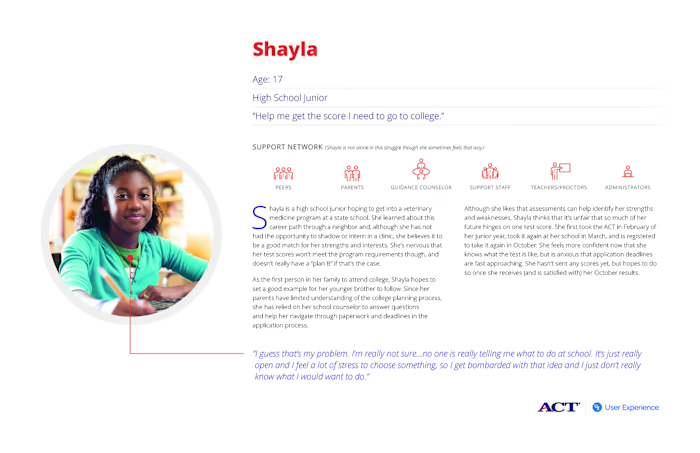
Interviews started broad to surface themes, then narrowed into deeper sessions with selected participants and internal SMEs to validate assumptions and separate edge cases from core needs. Personas were derived from customer research and extensive sales team input, then reviewed with sales to ensure they reflected real objections, decision dynamics, and conversation flow.
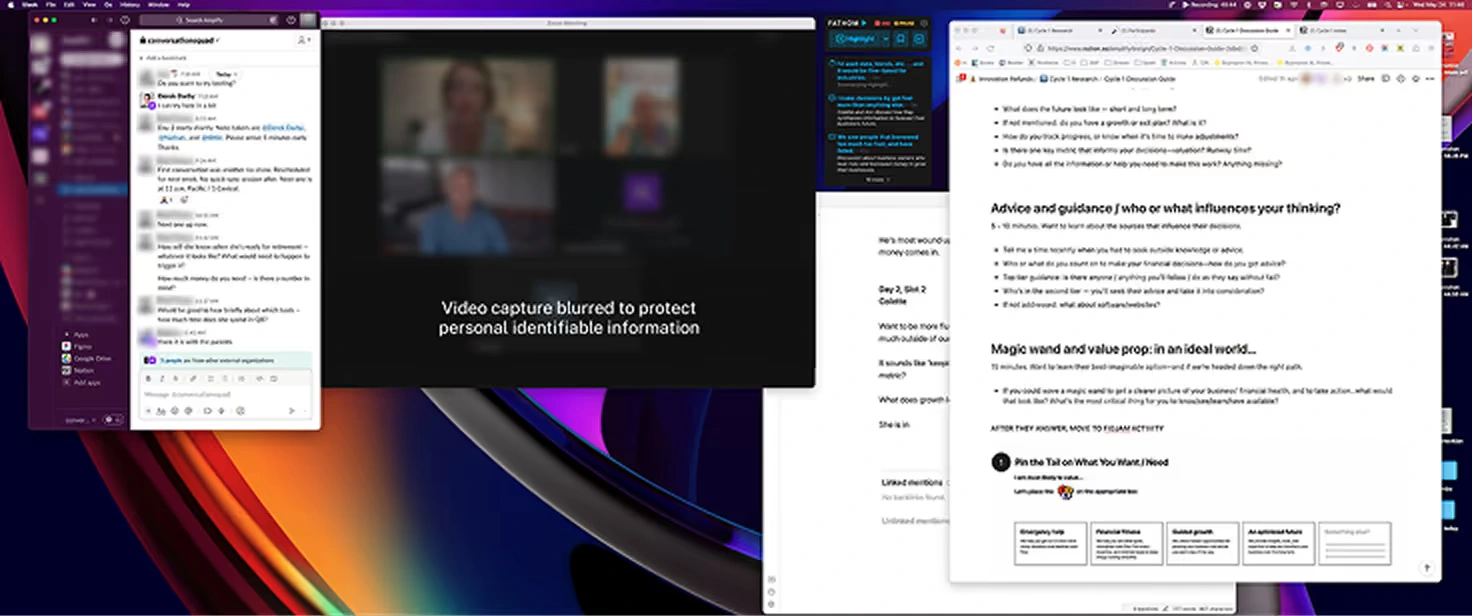
Different Buyer Mindsets in the Same Sales Funnel
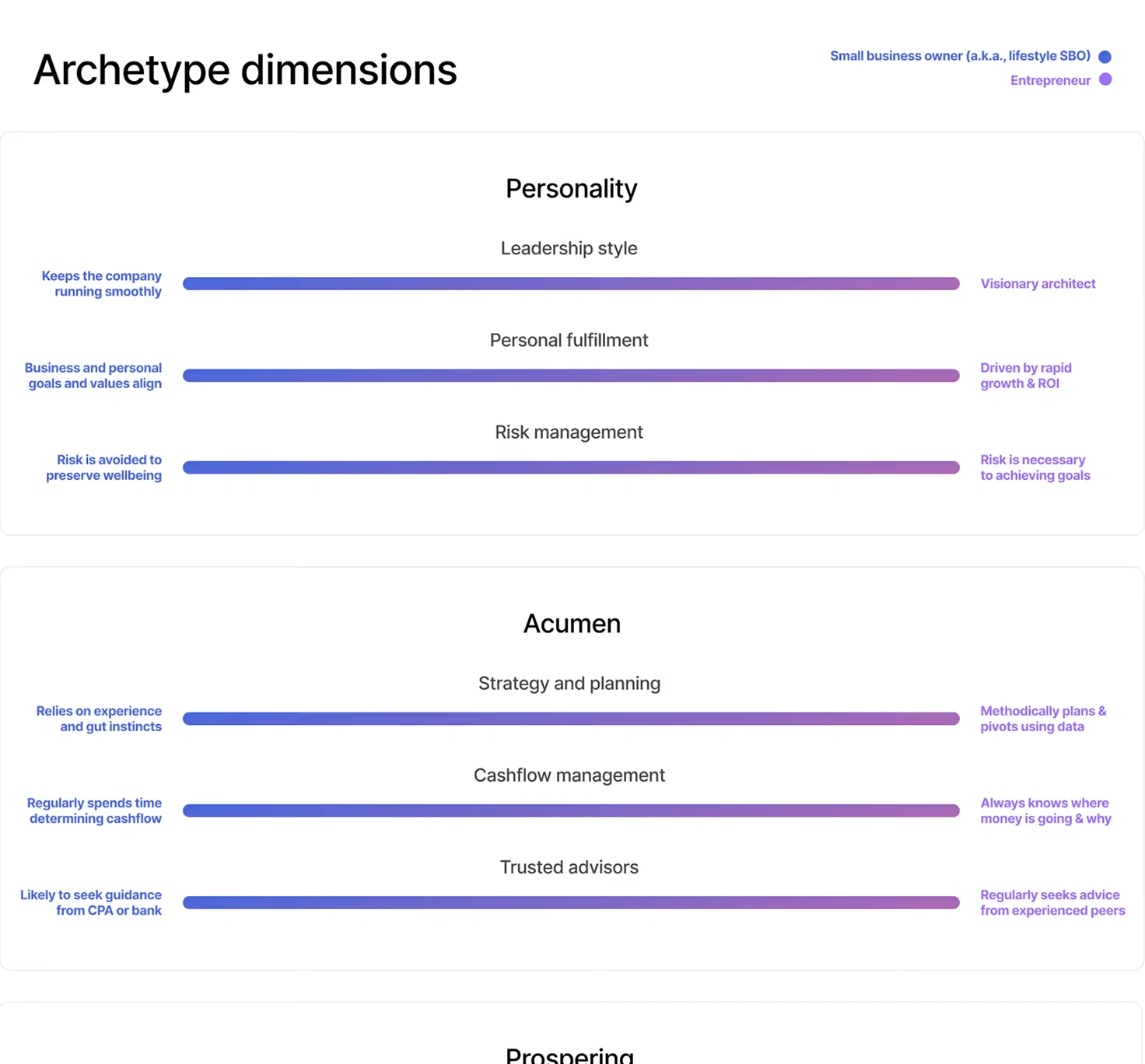
One key insight was the behavioral difference between compliance-oriented small business owners and more entrepreneurial operators, even at similar company sizes.
SBOs prioritized certainty, documentation, and validation before moving forward.
Entrepreneurs optimized for speed, upside, and strategic advantage, often tolerating more ambiguity.
A single fixed narrative failed both groups, either slowing entrepreneurs or overwhelming more compliance-oriented buyers. To make that distinction actionable, I mapped key behavioral dimensions across both archetypes so guidance could adapt by audience without fragmenting messaging across reps.
Turning Sales Knowledge Into Structure
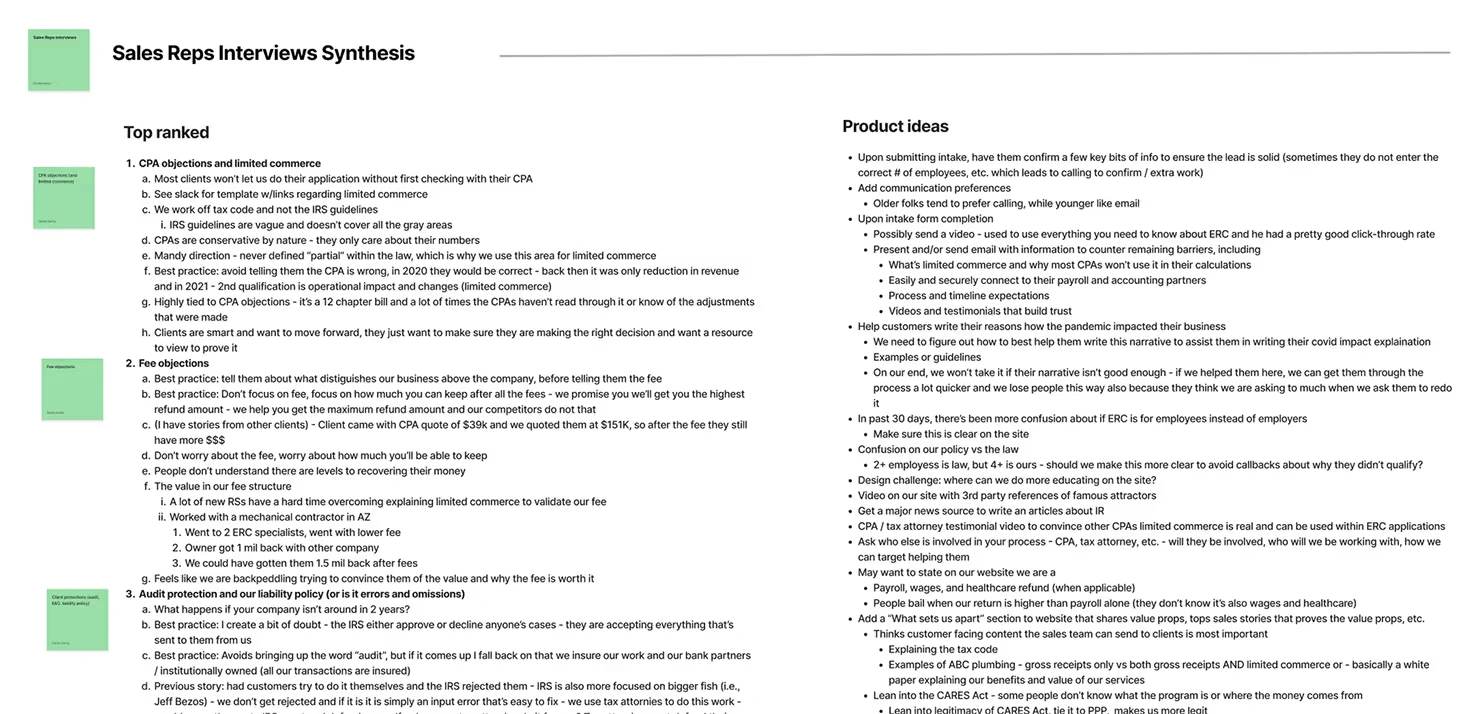
Sales teams held deep experience-based knowledge about objections, explanations, and successful framing, but much of it lived in conversations, personal notes, and memory.
I synthesized interview data, call insights, FAQs, and survey findings into structured themes that reflected how reps reasoned through complex deals.
Synthesis focused on:
Common objections and how they evolved during conversations
Language patterns that built trust versus increased friction
Where reps improvised due to missing or outdated guidance
Information customers repeatedly asked for but could not easily find
Personas and themes were validated with sales and used as working tools that directly informed content structure, language, and prioritization.
From Insight to Direction
Discovery clarified that the core problem was not a lack of content, but a lack of structure, context, and confidence. Information existed, but it was fragmented, inconsistent, and difficult to apply in real conversations.
Any solution would need to:
Make expert knowledge easy to access and reuse without oversimplifying it
Support different customer mindsets without forcing reps to improvise
Keep relevant context visible during live conversations
Evolve as products, policies, and messaging changed
These insights directly shaped how the system was framed, organized, and designed in later phases.
Framing the Strategy
From Disconnected Knowledge to a Shared System
Discovery made it clear that the core problem was not missing information, but fragmentation. The strategy needed to shift the organization from tribal knowledge to a shared, living system that made expertise easier to access, trust, and maintain.
System Model
Goal: Make sales knowledge fast to find, easy to trust, and simple to maintain.
Inputs: Product knowledge, messaging, assets, and enablement updates.
Core interactions: Search, browse by use case or audience, save, and share.
Governance: Ownership, review cadence, versioning, and visibility rules.
Outcome: Faster preparation and more consistent conversations at scale.
Strategic Goals
The strategy centered on four goals:
Create a single source of truth
Meet users where decisions were made
Scale expertise without scaling headcount
Support both internal and external use cases
Guardrails That Shaped the Solution
The strategy was shaped by a few core guardrails:
Speed mattered more than perfection during live conversations
Information had to be trustworthy enough to reduce follow-up and objections
Content needed clear ownership and governance to stay current
The system had to support different personas without splitting into separate tools
This led to a clear direction: build a knowledge system that turned sales expertise into explicit, reusable guidance integrated into how the organization already worked.
Experience Design & Execution
Designing for Real Conversations, Not Documentation
The experience was designed around how sales and support teams think, speak, and respond in live customer conversations, not how knowledge is traditionally documented.
Rather than forcing users to interpret dense ERC rules on the fly, the system surfaced clear guidance at the moment of need so teams could respond with more confidence and consistency.
Customer Archetypes as the Primary Entry Point
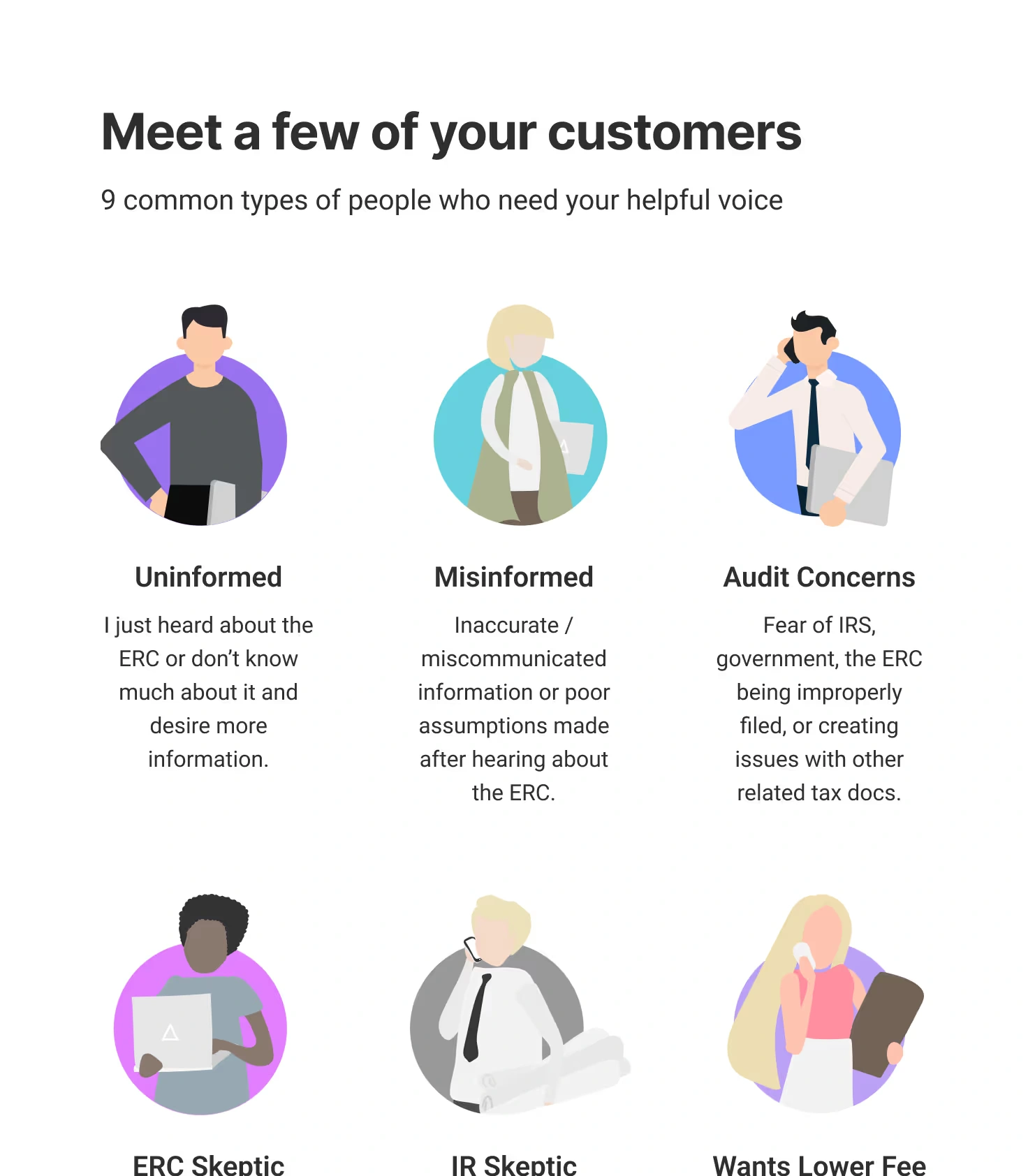
Instead of organizing content by policy or regulation, the experience was anchored around nine customer archetypes reflecting common mindsets in ERC conversations.
Each archetype captured:
What customers typically said
What they were worried about
What information moved them forward
This let teams quickly recognize who they were talking to and tailor their response without searching or guessing.
Impact: Faster onboarding, fewer stalled calls, and more consistent messaging across the organization.
Conversations as Reusable Interaction Models
Common customer discussions were treated as repeatable conversation patterns rather than one-off scripts or FAQs.
Each conversation included:
Common objections or questions
Emotional context
Clear guidance on how to respond
Links to related conversations and supporting content
This reduced reliance on tribal knowledge while preserving human judgment in delivery.
Common customer objections
Progressive Disclosure for Speed and Depth
The experience supported different levels of urgency and expertise without overwhelming the user:
High-level overviews for quick orientation
Conversation-level guidance for live calls
Deeper detail when credibility, compliance, or edge cases mattered
This helped the system work during live calls, async follow-up, and internal prep.
Archetype page
A Scalable Knowledge System, Not a Static Tool
Beyond the interface, the system was designed to support:
Clear navigation across Customers, Conversations, Topics, FAQs, and Tools
Content governance and updates
Future analytics, feedback loops, and AI-assisted support
The result was a durable foundation that could scale while maintaining trust, accuracy, and consistency.
Mobile Readiness
Mobile support was considered for real-world usage during live calls and quick lookups without sacrificing clarity or hierarchy.
Mobile Designs
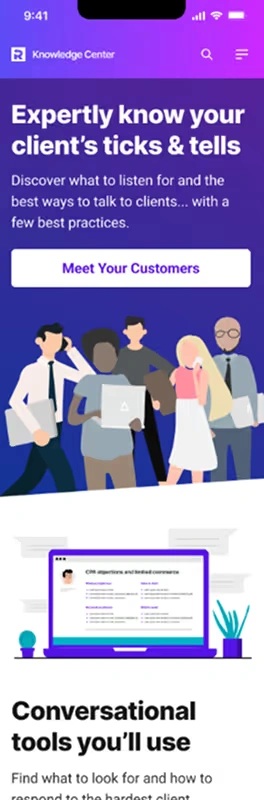
Customers Overview (Mobile) 1
Customers - Uniformed (Mobile) 1
Conversations Overview (Mobile) 1
Conversations - CPA Objections (Mobile) 1
Delivery Leadership
This work required more than research and design. It required turning scattered knowledge across emails and static documents into a shipped system with real adoption.
Because no formal product team existed for this initiative, I led delivery end to end. I assembled a cross-functional team, aligned priorities, created the phased rollout plan, and coordinated execution with engineering while keeping sales and operations engaged throughout.
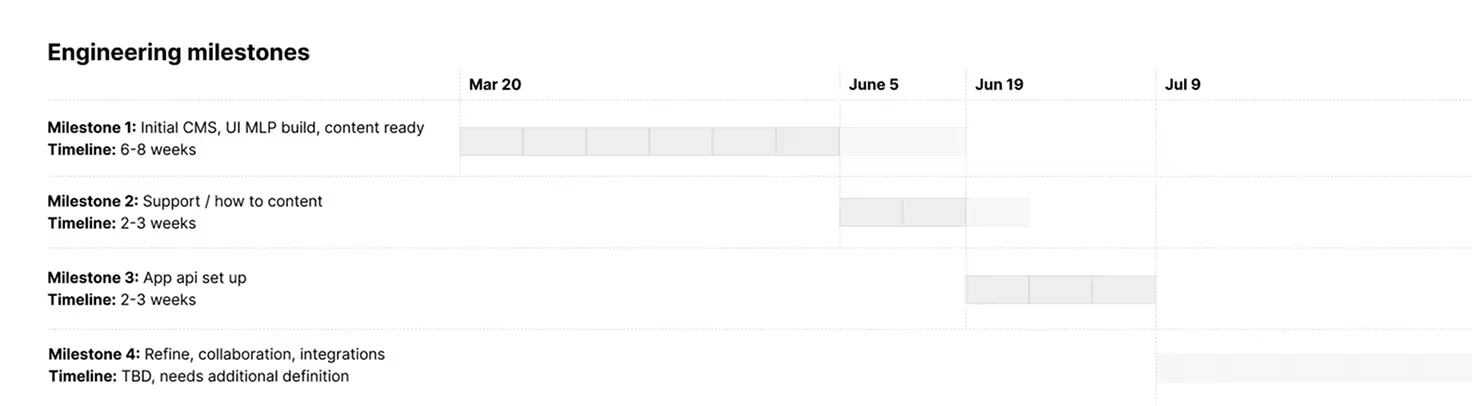
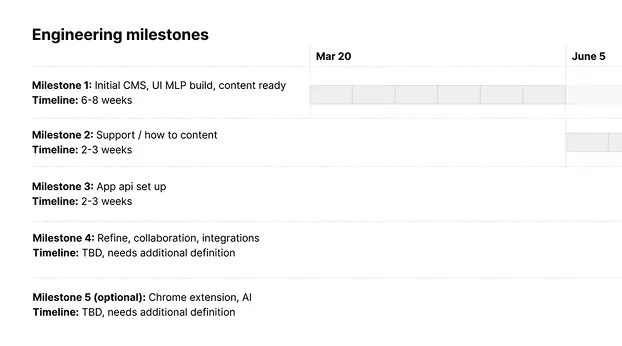
A phased delivery plan used to sequence build milestones and manage scope, ensuring the knowledge platform shipped usable value early while scaling governance, content types, and integrations over time.
Delivery was structured as milestones so usable value could ship early while the system scaled in parallel. Early phases focused on the core CMS, information model, and first release for internal use. Later phases expanded content types, refined interaction patterns, and introduced integration and automation opportunities.
This phased approach reduced delivery risk, contained scope, and allowed the platform to improve without disrupting active sales cycles.
Validation & Outcomes
Validation Through Real-World Scenarios
Validation focused on realism: could the system support live conversations under time pressure?
We ran working sessions with sales, account representatives, and internal SMEs to test whether the structure reduced ambiguity, supported scenario-based navigation, and enabled confident responses without relying on tribal knowledge. Feedback led to refinements in labeling, structure, and retrieval patterns while confirming that the core interaction model matched how teams actually sold.
Internal Validation and Readiness
Concepts and flows were reviewed iteratively with sales leadership, operations partners, and engineering stakeholders to ensure the system was viable within organizational and technical constraints.
Reviews focused on:
Accuracy and consistency of guidance across customer scenarios
Clarity of content ownership and update workflows
Feasibility of maintaining content without creating bottlenecks
Alignment with CMS capabilities and engineering milestones
Validation confirmed that the information model matched how sales teams reasoned about objections, questions, and trust-building moments. Refinements were made to labeling and hierarchy, but the underlying system design remained intact.
Strategic Impact
The work resulted in:
A production-ready information architecture and interaction model
A clear roadmap aligned with engineering capacity
A scalable framework for turning expert knowledge into repeatable guidance
Organizational alignment around how customer conversations should be supported
More broadly, the project created a reusable model for structuring complex, high-risk information and aligning sales, operations, and engineering around a shared system.
Customer & Business Impact
Improved sales efficiency by reducing time spent searching for materials, answers, and approvals
Increased confidence in live conversations through clearer, more current, and more trusted content
Reduced cognitive load for new and tenured reps by organizing tools, content, and workflows around real sales tasks
Platform & Organizational Impact
Created a single source of truth across sales, marketing, product, and leadership, reducing duplication and conflicting guidance
Enabled faster updates to messaging, assets, and enablement materials without disrupting sales workflows
Established a scalable information architecture that could support growth in products, regions, and sales motions without increasing complexity
Leadership Learnings
Internal platforms succeed or fail based on adoption, not features.
This work reinforced that effective enablement systems require:
Designing around how teams actually work under pressure, not how organizations wish they worked
Balancing flexibility with governance so information stays usable as it scales
Making accuracy, recency, and ownership visible so teams can trust what they find
Leading this effort required aligning stakeholders with competing priorities and shifting the conversation from “more content” to clearer decisions and faster execution.
The result was an internal product that supported revenue outcomes indirectly by helping people do their jobs with less friction and more confidence.
Applying This Approach Elsewhere
Interested in how this approach translates to other complex platforms?
[View Another Case Study
Let’s Connect
The easiest way to reach me is on LinkedIn. For more detailed inquiries, you can also use the contact form.
Like this project
Posted Apr 11, 2026
Redesigned an internal sales enablement platform to enhance knowledge access and sales efficiency in a B2B SaaS environment.
Likes
0
Views
8