Unified ACT Experience

Derek Darby


Case Study
Unified ACT Experience
Led cross-functional discovery and platform vision work to reframe ACT from disconnected products into a unified, longitudinal learner experience.
Education Ecosystem Transformation
Longitudinal platform vision
Client: ACT, Inc.
Industry: EdTech
Role: Director of UX
Skills: Experience Strategy, Systems Modeling, Cross-Product Alignment
Summary
The Need
Students, parents, and educators experienced ACT as disconnected products and decision points rather than a coherent journey from assessment to postsecondary and career planning.
What I Led
Led the UX team in cross-functional discovery, ecosystem modeling, and experience vision work to define how ACT’s products could operate as a unified learner platform.
How It Worked
Reframed the effort from improving a single portal to designing the strategic experience layer tying identity, recommendations, diagnostics, and product pathways together across time.
Impact
Aligned leadership around a longitudinal platform vision, exposed key integration dependencies, and shifted planning conversations from isolated product improvements to learner continuity.
Context
This work focused on redefining ACT’s growing ecosystem of assessments, prep tools, diagnostics, and planning products as a more coherent learner experience rather than a set of disconnected offerings.
ACT had built meaningful capabilities across students, parents, counselors, educators, institutions, and workforce pathways, but many products evolved independently. Separate roadmaps, fragmented identity systems, inconsistent metadata, and uneven coordination made the broader experience feel patchwork and made next steps less clear for users.
Business Stakes
ACT’s portfolio already contained the ingredients for deeper learner engagement, but fragmentation limited continuity, cross-product value, and strategic coherence. Success required a unifying experience vision that could guide roadmap decisions, surface platform dependencies, and reposition ACT from assessment events to a more longitudinal learner relationship.
Team
UX, Product Leadership, Enterprise Architecture, ACTNext, Research, and cross-product stakeholders across MyACT, Companion, Marketplace, Pathfinder, and related ACT entities.
Constraints
Fragmented product ownership and independently evolving roadmaps
37+ systems and no unified enterprise identity model
Multiple personas spanning students, parents, counselors, educators, and institutions
Need to align long-term platform thinking with near-term product realities
Impact Snapshot
Aligned leadership around a unified learner platform vision
Shifted planning discussions from product silos to learner journeys
Influenced roadmap thinking across MyACT and adjacent ACT products
Reframed ACT’s value from isolated testing moments to longitudinal learner support.
Overview
My Role & Scope
The Problem
Discovery & Insights
Framing the Strategy
Experience Vision & Execution
Validation & Strategic Impact
Strategic Impact & Learnings
My Role & Scope
I served as Director of UX, leading the UX team and shaping the experience vision across a fragmented portfolio of ACT products. My role extended beyond interface design into ecosystem discovery, systems modeling, cross-product alignment, and experience strategy.
Working across product leadership, research, enterprise architecture, and adjacent ACT entities, I helped reframe the effort from improving a single signed-in experience to defining a more coherent learner platform over time. This included identifying structural blockers, shaping the experience narrative, and aligning teams around a more unified direction.
What I Owned
Cross-functional discovery across products, personas, and learner journeys
UX team leadership and experience strategy direction
Ecosystem and systems modeling across ACT entities
Strategic reframing from product silo thinking to learner continuity
Alignment artifacts and concept work used to guide leadership discussion and roadmap thinking
Leading Through Ecosystem Complexity
ACT’s ecosystem was shaped by fragmented identity systems, uneven tagging standards, independently evolving roadmaps, and competing organizational priorities. I worked across product, architecture, research, and leadership to clarify what was structurally blocking continuity and guide the conversation toward a more unified experience strategy. That meant aligning teams around shared models and helping the organization think beyond local product optimization toward a longer-term learner platform vision.
The Problem
Problem System
Symptoms: Students, families, and educators experienced ACT through disconnected products, unclear next steps, and fragmented decision support.
Drivers: Independent product roadmaps, fragmented identity systems, inconsistent tagging, and weak cross-product integration.
Constraints: Multiple personas, life-stage transitions, organizational silos, and no unified experience layer.
Result: ACT’s broader value was obscured, learner continuity broke down, and platform-level retention potential remained under-realized.
Fragmented Products, Fragmented Meaning
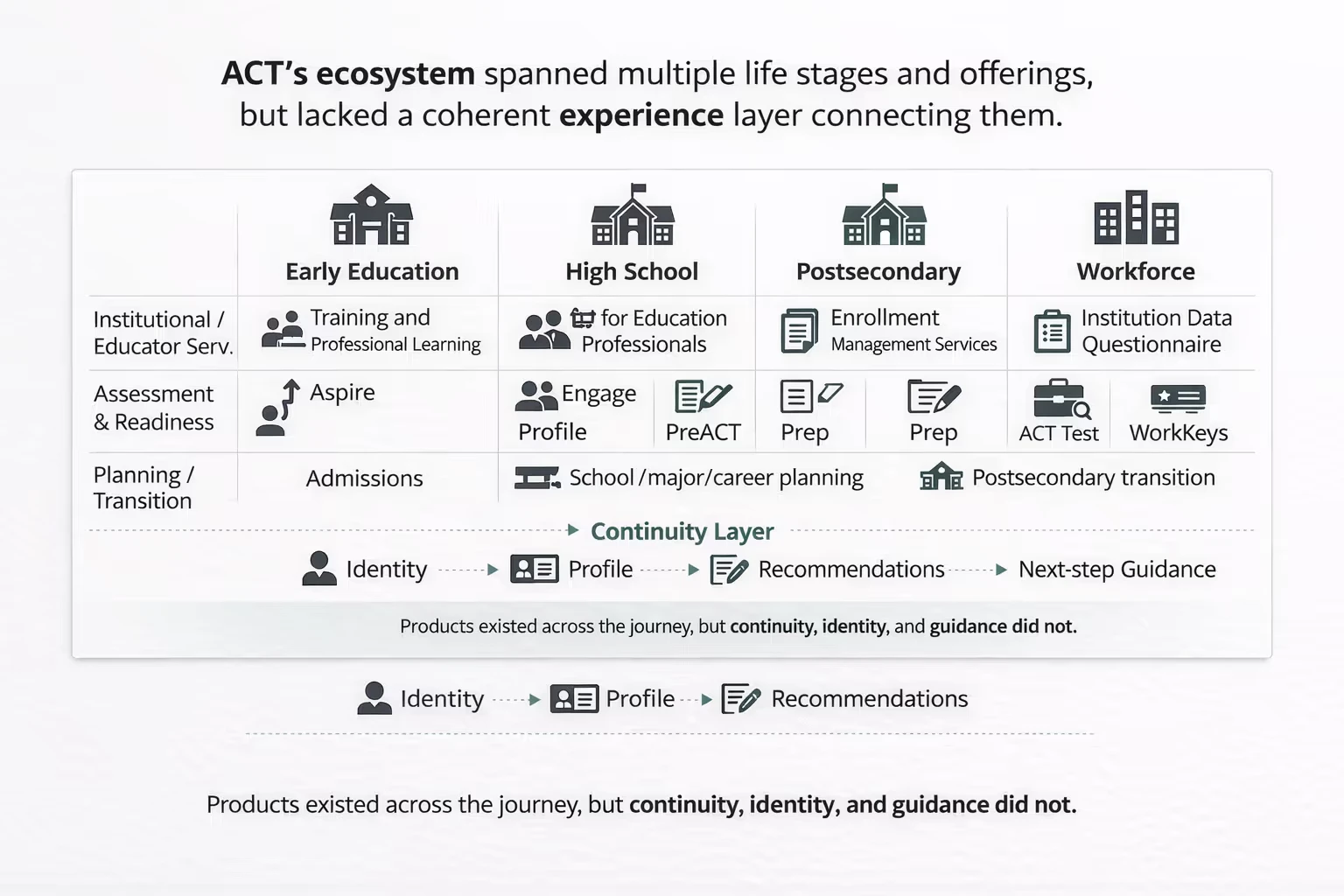
ACT had built a broad portfolio of assessments, prep tools, diagnostics, reporting systems, and planning products across students, parents, counselors, educators, institutions, and workforce pathways. But these offerings evolved more as separate products than as a connected learner experience.
A Platform Problem, Not a Portal Problem
At first glance, the challenge could have been framed as a MyACT redesign. But discovery showed the issue was structural, not interface-deep.
Identity systems were fragmented. Product roadmaps were optimized locally. Tagging standards and diagnostics were inconsistent. Recommendations, pathways, and actions were not connected by a shared experience layer.
Without addressing that structural fragmentation, interface-level improvements would remain partial and difficult to scale.
Discovery & Insights
Discovery Focused on Continuity, Not Just Usability
Discovery began with a broader question than how to improve MyACT. The more important question was how ACT’s products should connect over time so learners, families, and educators could make better decisions with more continuity and less confusion.
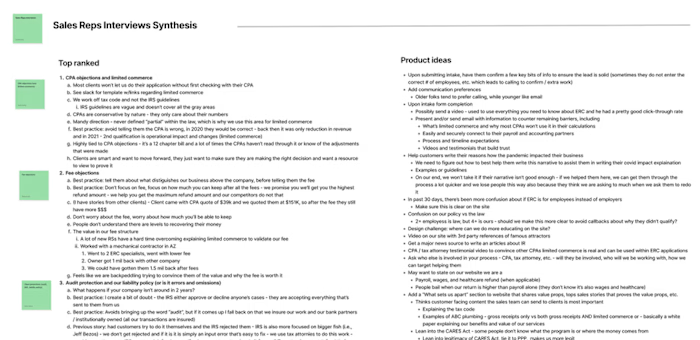
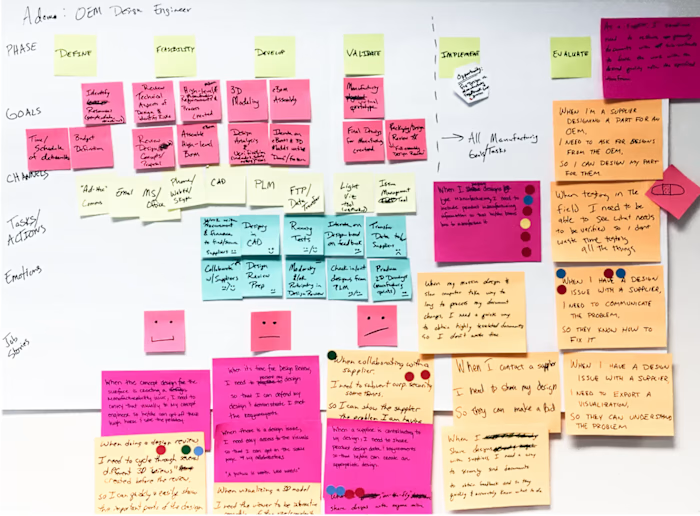
To answer that, the work combined ecosystem mapping, persona development, journey modeling, concept exploration, and cross-functional alignment across product, research, and architecture stakeholders. This shifted discovery away from isolated usability issues and toward where the ecosystem was breaking down across identity, transitions, recommendations, and decision support.
What Emerged
Several patterns became clear across the research and systems work:
Learners experienced ACT as disconnected moments rather than a coherent journey
Different personas needed different kinds of guidance, but the ecosystem lacked shared continuity
Important data and product capabilities existed, but were not integrated into meaningful next steps
Organizational fragmentation was as much a design challenge as interface fragmentation
The unmet need was structural clarity across life stages, not simply better screens
These findings made it clear that ACT’s future value depended on designing continuity across products, personas, and transitions.
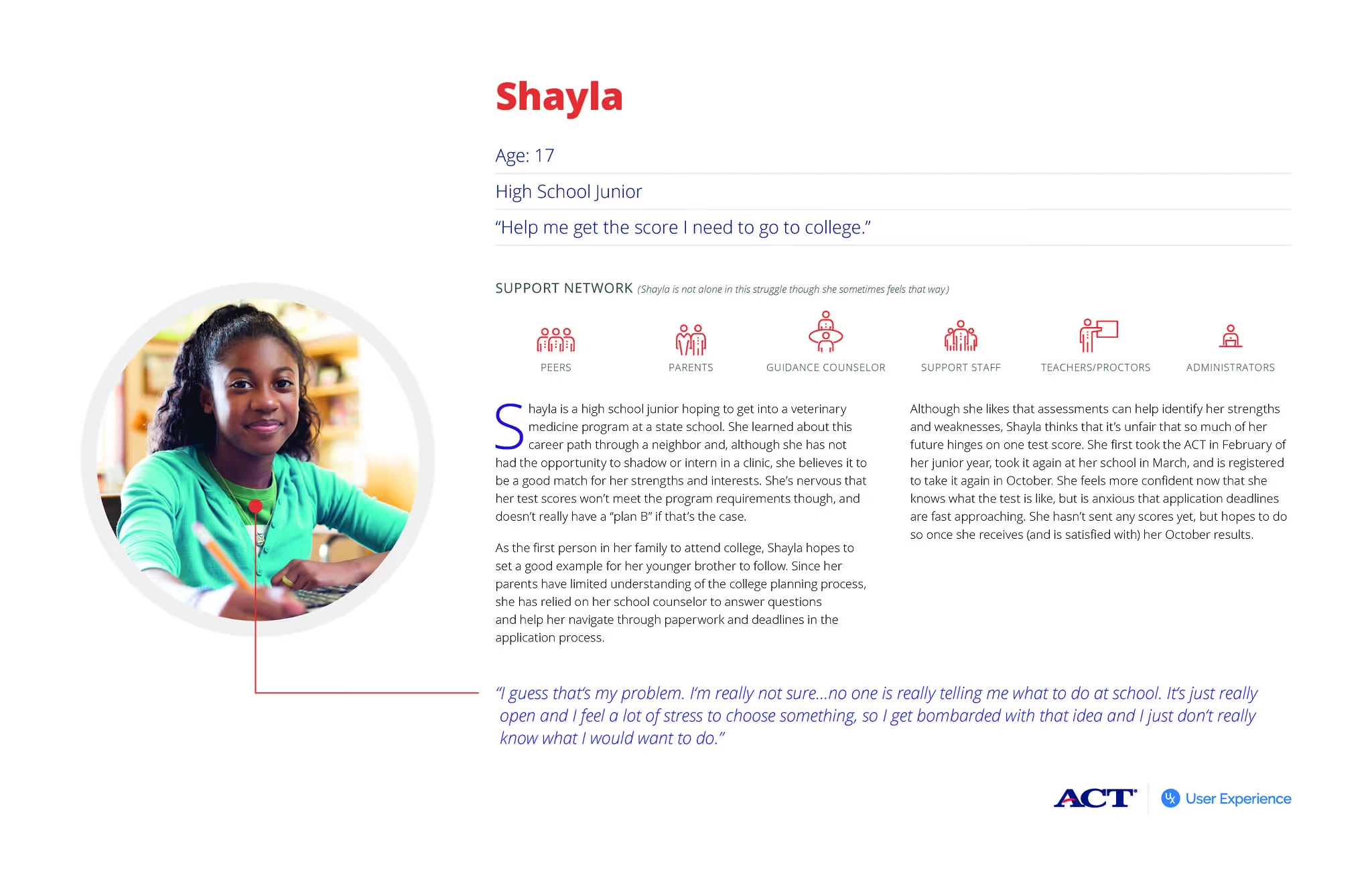
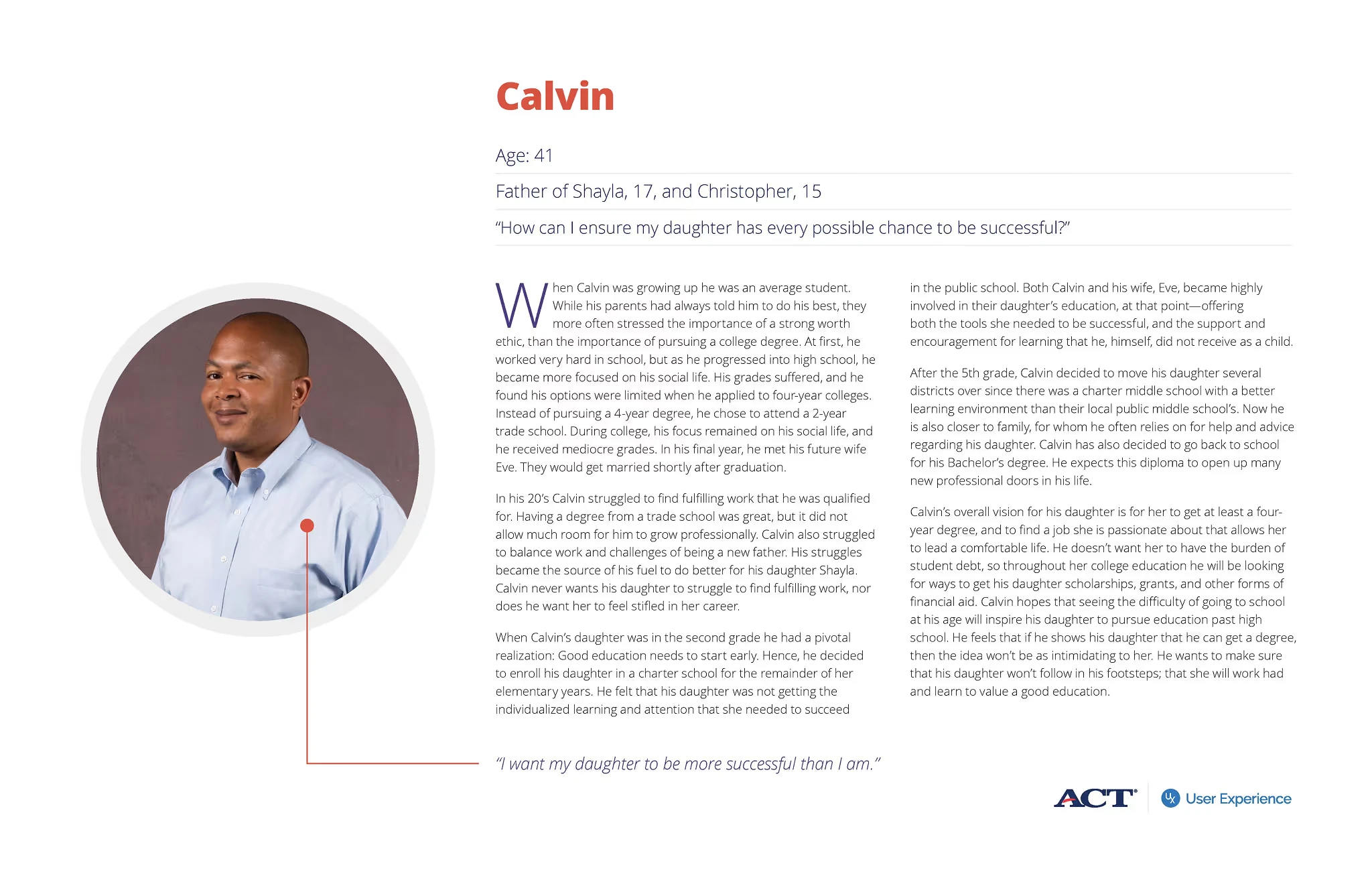
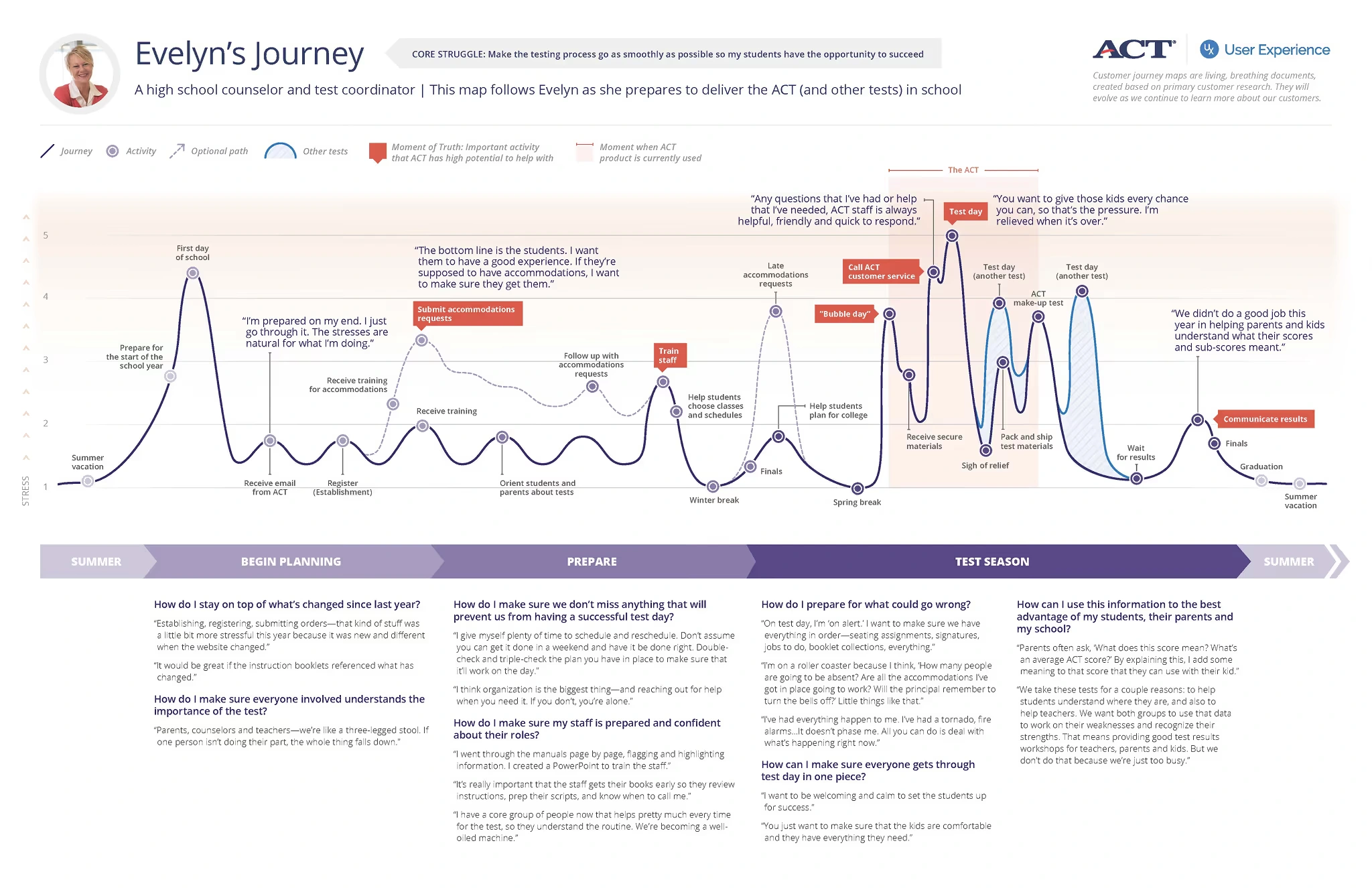
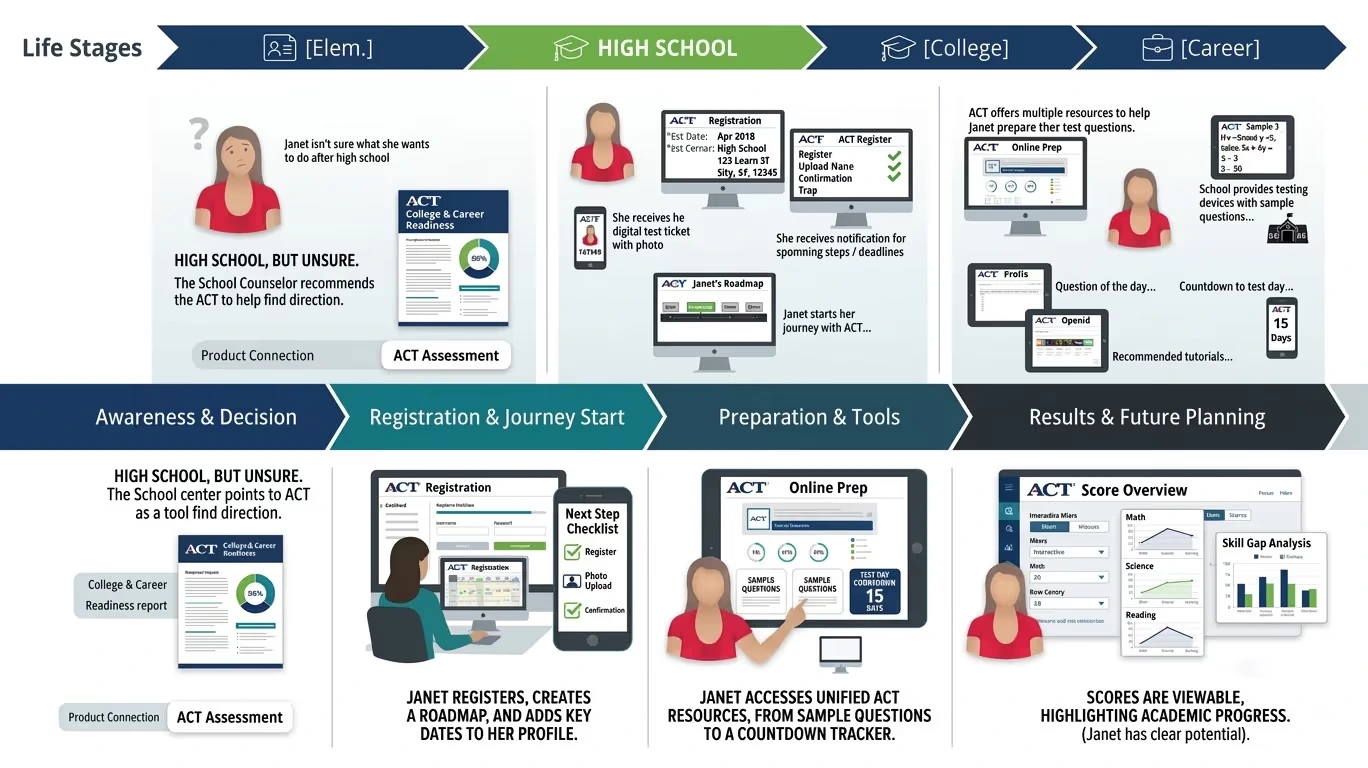
Multi-Persona Journeys Revealed the Real Scope
The persona and journey work exposed how fragmented the experience felt across very different users. High school students, parents, counselors, adult learners, and institutional stakeholders each encountered different slices of ACT, but none experienced a clear path through the ecosystem.
That insight showed that solving for a single persona or product would not be enough. The work needed a broader experience model that could adapt across actors, roles, and life stages while still feeling coherent.
Framing the Strategy
Reframing the Work
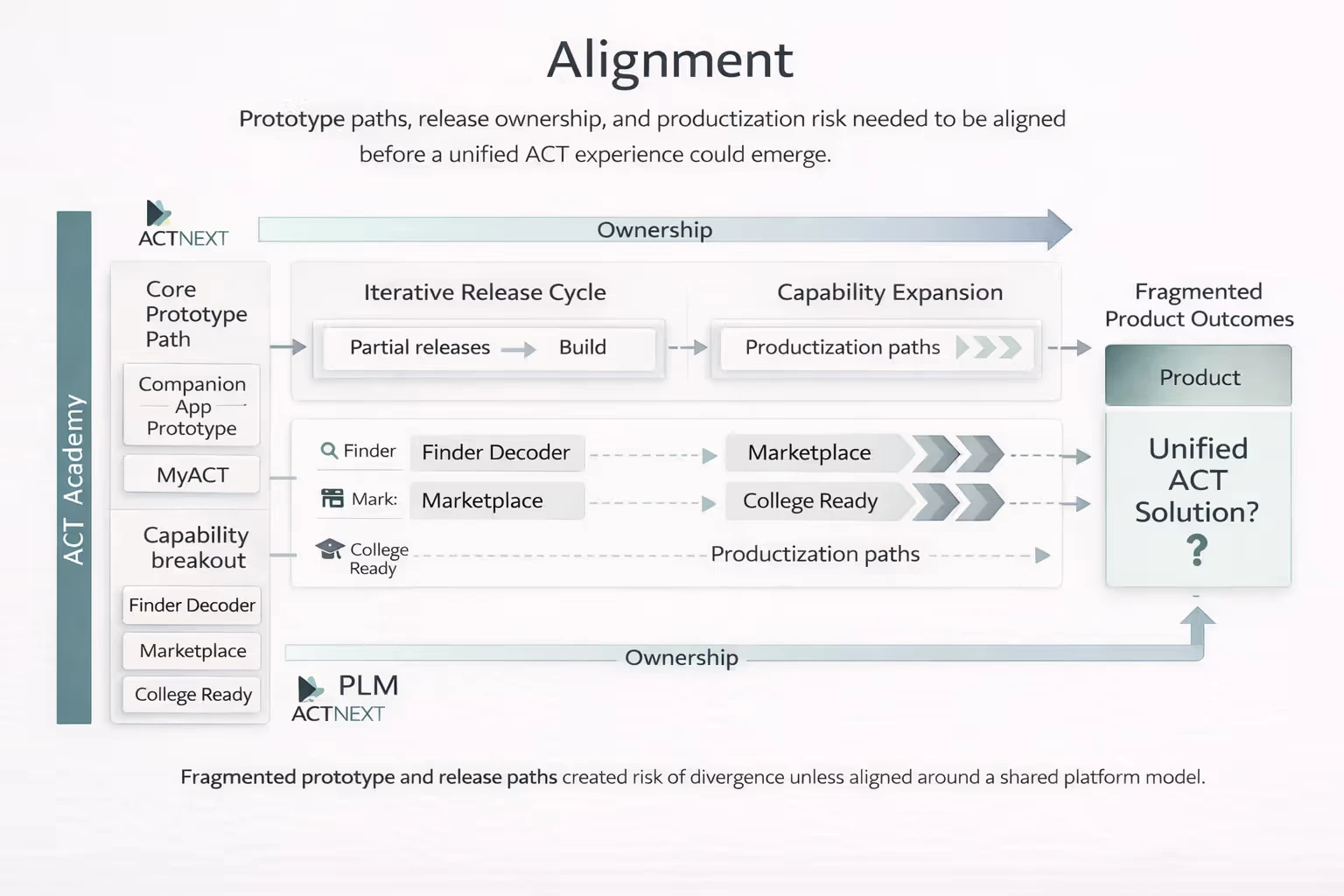
The work was reframed from improving a signed-in ACT portal to defining how ACT’s products could function as a more unified learner experience over time.
Rather than treating the effort as a portal redesign or feature expansion, the strategy focused on the experience layer that could connect identity, recommendations, diagnostics, exploration, and action across products and life stages. This shifted the conversation from isolated enhancements to the structural decisions required to create continuity.
System Model
Goal: Connect assessment, planning, and next-step decisions into a more continuous learner journey.
Inputs: Identity, profile data, scores, interests, skills, and life-stage context.
Core interactions: Recommendations, pathway exploration, prep, score interpretation, and planning across schools, majors, and careers.
Support layer: Parents, counselors, educators, and institutions influencing key decisions along the way.
Designing the Experience Layer
The strategic concept was a unified, modular experience that could adapt to different personas while maintaining continuity across the ACT ecosystem.
Core principles included:
One longitudinal identity across life stages
Contextual recommendations based on profile, diagnostics, and goals
Cross-product integration across prep, planning, reporting, and exploration
Dynamic pathways that help users see meaningful next steps
A platform model that could support present needs and future evolution
This established a more coherent direction for the experience.
A Strategic Shift in How ACT Could Think About Retention
The strategy also changed the retention conversation. Rather than viewing retention primarily through test-cycle events, the work repositioned value around longer-term learner engagement.
This was one of the most important shifts in the work: moving from product silos to learner journeys as the organizing model.
Experience Vision & Execution
Designing for Continuity, Not Isolated Moments
With the strategic direction defined, the work shifted from ecosystem framing into experience modeling. The goal was not to improve a portal in isolation, but to define how ACT could support learners across connected moments in planning, testing, results, and next-step decisions.
The Experience Model
The concept centered on a personalized signed-in environment that could adapt to a learner’s goals, profile, and stage in the journey.
Core behaviors included:
Surfacing recommendations based on profile, scores, and interests
Connecting schools, majors, and careers in a more navigable planning model
Helping learners interpret results in the context of future decisions
Creating continuity across ACT.org, planning tools, assessments, and adjacent products
Supporting more personalized entry points instead of one-size-fits-all navigation
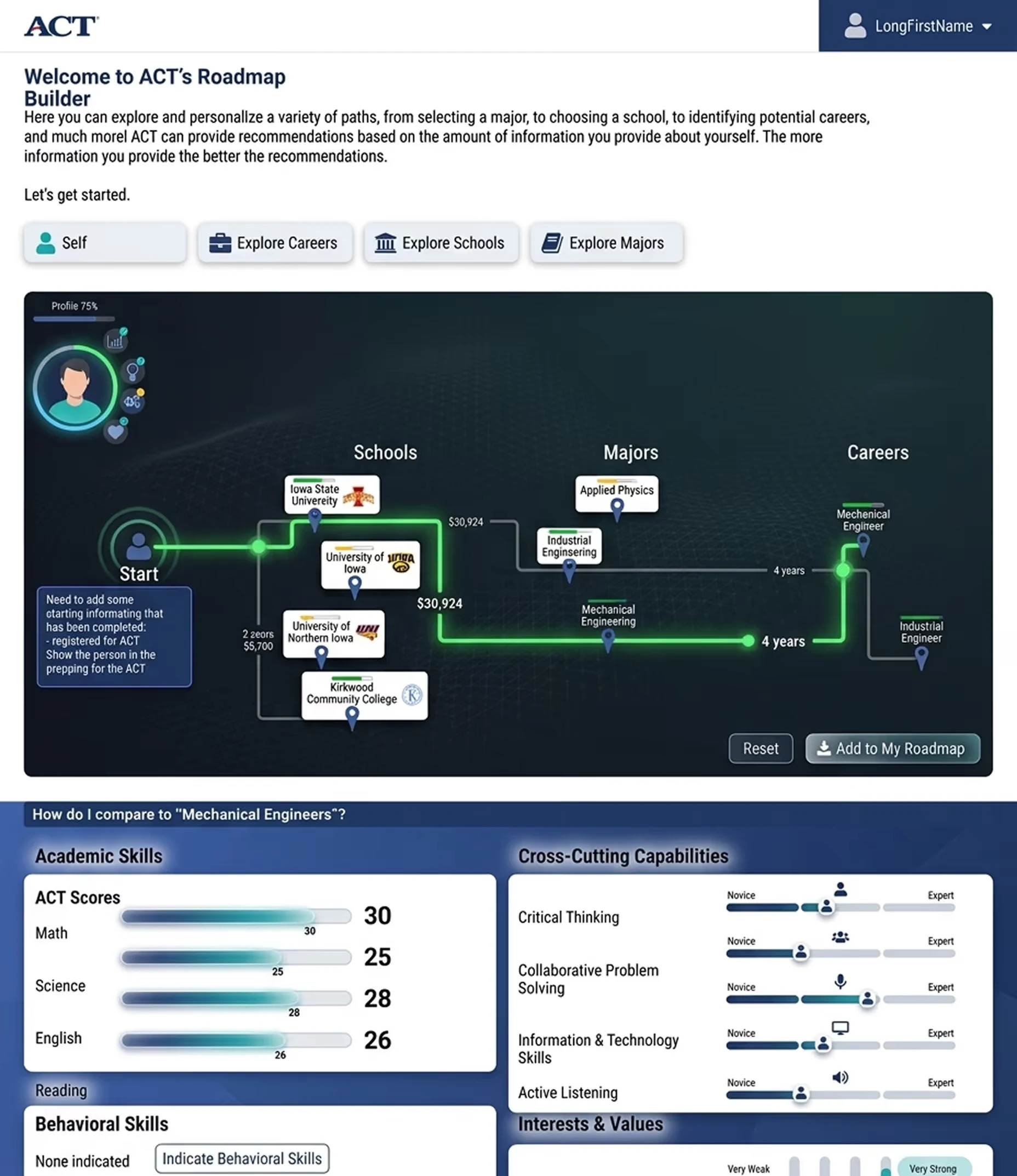
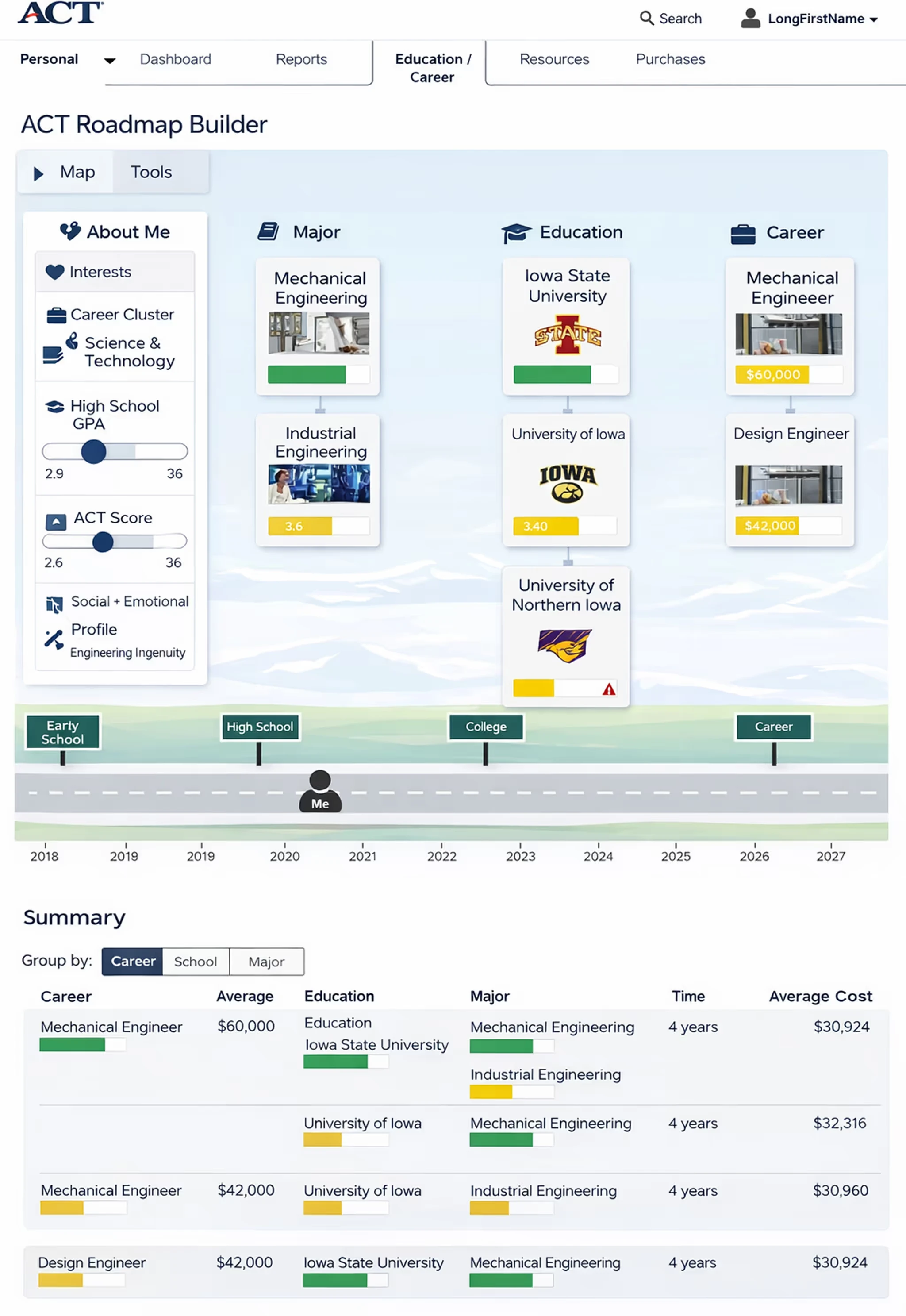
Roadmap Builder as a Planning Concept
One of the strongest directions was the Roadmap Builder, which translated the broader ecosystem strategy into a more tangible planning experience.
Instead of presenting education and career decisions as isolated choices, the concept connected learner inputs, majors, schools, and career paths into a visible pathway model. This made the strategy easier to understand and gave stakeholders a clearer view of how continuity could be expressed through interaction design.
From System Concept to Product Direction
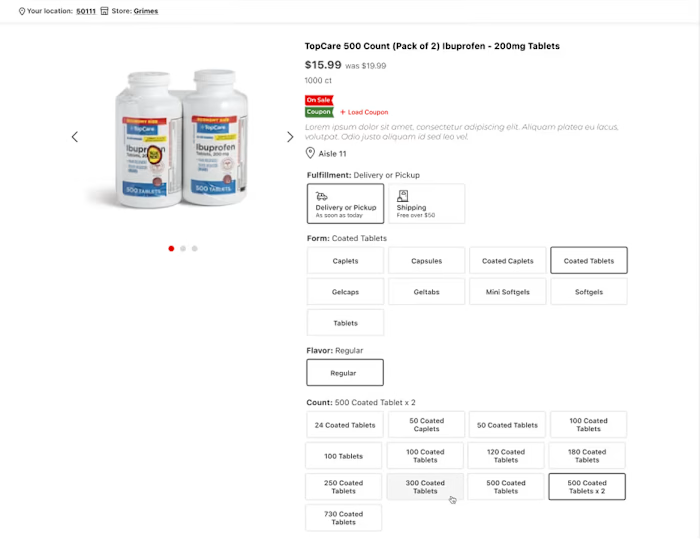
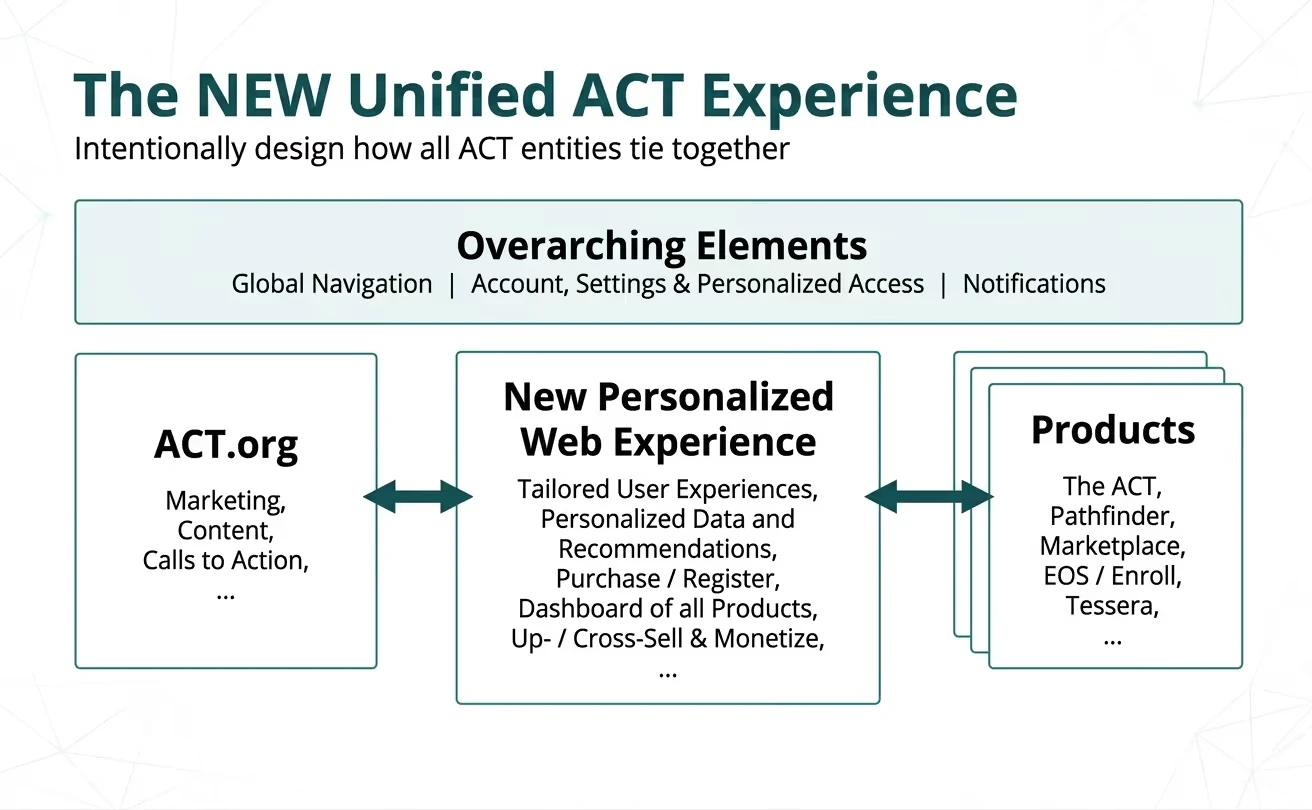
A key question was how the signed-in experience should relate to ACT.org and the broader product portfolio. The direction positioned the personalized web experience as a connective layer, helping unify navigation, account context, recommendations, notifications, and shared access patterns across products.
Rather than consolidating everything into a single product, the goal was to create coherence across independently evolving parts of the ecosystem. The higher-fidelity concept made that direction more concrete by showing how the shared experience layer could begin to resolve into a product experience that stakeholders could evaluate more directly.
Outcome of the Design Approach
The work produced:
A clearer model for learner continuity across planning, testing, results, and next-step decisions
A personalized web experience concept connecting ACT.org, planning tools, and adjacent products
More concrete interaction patterns for recommendations, pathway exploration, and guidance
A stronger shared reference point for product, architecture, and leadership alignment
A more tangible vision for moving from separate product moments toward a connected learner platform
Validation & Strategic Impact
Validation Focused on Strategic Direction
Because this initiative operated at the platform and ecosystem level, validation focused less on isolated usability findings and more on whether the direction made structural sense across products, personas, and organizational constraints.
The work was pressure-tested through cross-functional discussion, concept reviews, journey modeling, and alignment with product, architecture, and adjacent teams. The core question was whether the experience model could credibly support a broader learner relationship over time.
What Validation Reinforced
The work made ecosystem fragmentation visible in a way teams could act on.
It reinforced that:
Continuity required more than improving a single surface
Identity and access were foundational, not secondary
Recommendations and pathways needed to connect across products
Roadmap decisions had to be evaluated against the broader learner journey
Strategic and Organizational Impact
Although the work was strategic and phased, it still produced meaningful outcomes.
It helped:
Align stakeholders around a more unified ACT experience vision
Shift conversations from product silos to learner continuity
Identify dependencies across identity, tagging, and integration
Clarify how ACT.org, personalization, and adjacent products could connect
Influence roadmap thinking across planning, companion experiences, and related offerings
Most importantly, it changed the level of the conversation. Instead of asking how to improve individual product moments, teams could begin asking how ACT should work as an ecosystem.
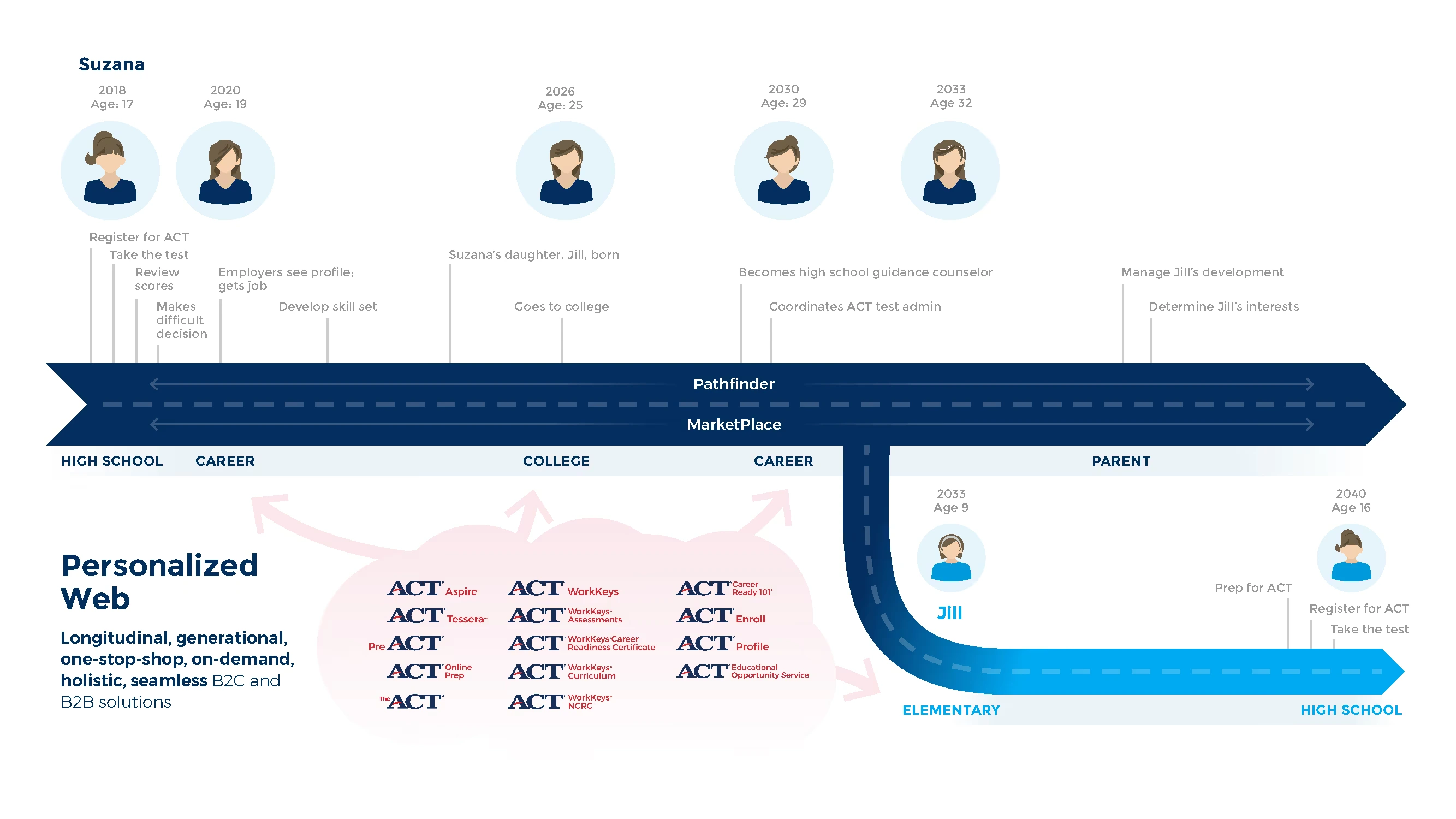
Reframing Retention and Engagement
The opportunity was no longer just to support a student through a single test event, but to build a longer-term relationship through planning, recommendations, and transitions across life stages.
That reframing mattered because it tied product direction more closely to learner value over time, rather than short-cycle transactional engagement.
Strategic Impact & Learnings
Ecosystem value must be designed, not assumed
Identity and access are strategic UX concerns
Platform strategy needs tangible experience concepts
Organizational alignment is part of the design problem
Longitudinal engagement creates a stronger product frame
Applying This Approach Elsewhere
Interested in how this approach translates to other complex platforms?
View Another Case Study →
Let’s Connect
The easiest way to reach me is on LinkedIn. For more detailed inquiries, you can also use the contact form.
Like this project
Posted Apr 11, 2026
Led UX design to create a unified ACT learner experience across products.
Likes
0
Views
15