3D Modeling Cloud Collaboration Platform

Derek Darby


Case Study
3D Modeling Cloud Collaboration Platform
Translating complex CAD workflows into secure, scalable interaction patterns for distributed engineering teams.
0→1 B2B Platform
3D Modeling Collaboration & Review
Vertex
Manufacturing & Engineering SaaS
Lead UX Designer
Product Strategy
System Design
Research & Delivery
Summary
The Need
Engineering teams lacked a scalable way to collaborate around large, complex 3D assemblies without slow file transfers, fragmented review processes, or local performance limitations.
What I Led
Defined and designed a cloud-based collaboration platform enabling secure, high-performance interaction with detailed 3D models across distributed teams.
How it Worked
Translated complex CAD workflows into intuitive review, annotation, and sharing patterns optimized for cloud delivery and enterprise security constraints.
Impact
Established the MVP foundation for a new enterprise platform and validated core interaction models that shaped subsequent product direction.
Context
This project focused on defining a collaborative 3D modeling platform for large engineering and manufacturing organizations. Prospective customers and target accounts included companies such as Rockwell Collins, John Deere, Vermeer, and Caterpillar.
These teams worked with complex assemblies containing thousands of components. Existing collaboration workflows relied on slow file transfers, static screenshots, or in-person reviews, creating bottlenecks across internal teams and external vendors.
The opportunity was to enable secure collaboration directly in the cloud, allowing teams to review, annotate, and make decisions without downloading full models locally.
Business Stakes
The product needed to prove that complex 3D collaboration could work securely and reliably in a cloud environment. Success required demonstrating enterprise viability, reducing review bottlenecks, and building confidence among highly risk-averse engineering organizations.
Failure would reinforce skepticism around cloud-based 3D workflows and limit expansion into large manufacturing accounts.
Team
Product Management, Engineering, and domain SMEs across engineering and manufacturing.
I partnered closely with product and engineering to translate specialized CAD workflows into scalable cloud-based interaction models.
Constraints
Limited user access during stealth-mode development
Performance constraints of rendering large 3D assemblies in-browser
Strict enterprise security and IP protection requirements
Cloud architecture feasibility challenges
High uncertainty around product-market fit
Impact Snapshot
Shipped MVP foundation enabling real-time model review and annotation
Replaced the need for full CAD downloads in collaboration and review workflows
Validated core interaction patterns with enterprise engineering teams
Informed roadmap direction for subsequent platform expansion
Overview
My Role & Scope
The Problem
Discovery & Insights
Framing the Strategy
Experience Design & Execution
Validation & Outcomes
Strategic Impact & Learnings
My Role & Scope
I served as Lead UX Designer and sole designer during the product’s first year, owning end-to-end work across discovery, interaction and system design, and delivery.
In a stealth startup environment with limited user access, I partnered closely with product and engineering to define the problem space, translate feasibility and security constraints into design direction, and establish the foundational interaction model for a cloud-based platform. As the company grew, these patterns became the basis for later product expansion and pivots.
Key Leadership Contribution: Defined the core interaction and system model enabling fast, secure, role-aware collaboration around complex 3D assemblies, aligning product, engineering, and business constraints into a shared foundation for scalable development.
What I Owned
Problem framing and opportunity definition for a new 3D collaboration paradigm
Discovery and synthesis across product, engineering, and internal domain SMEs
Interaction and system design for a cloud-based 3D modeling and collaboration platform
Facilitation of cross-functional working sessions and a focused design sprint
Validation through internal SME review, QA collaboration, and later moderated usability testing
Designing Without Precedent
This work had no clear benchmarks. In a stealth startup building a novel platform, collaboration, performance, and usability assumptions had to be tested alongside technical exploration.
I worked closely with product and engineering to make evolving constraints actionable, align the team around shared mental models, and iterate toward a solution that balanced feasibility, security, and adoption.
The Problem
Problem System
Symptoms: Slow review cycles, disconnected feedback, and inconsistent decisions across teams and vendors.
Root causes: Collaboration depended on exports and workarounds instead of shared context anchored to the model.
Constraints: Large-model performance limits and strict security and IP protection requirements.
Result: Collaboration failed at the moments of review and feedback when decisions needed to be made.
Fragmented Collaboration Around Complex 3D Systems
Engineering teams relied on complex 3D assemblies to make critical decisions, but collaboration broke down during review and feedback.
Teams shared large files through legacy tools, emailed screenshots, or relied on meetings to explain changes that were hard to reference later. Feedback lived outside the model context, forcing people to translate intent across tools and viewpoints.
The result was slower decisions, more rework, and weaker shared understanding across teams and vendors.
Tools Built for Individuals, Not Teams
Most existing tools were optimized for individual authoring, not shared decision-making. Opening full assemblies was slow even on high-end machines, and stakeholders who only needed to review still had to load entire models.
Vendors and non-engineering partners often lacked access, creating bottlenecks and translation errors. Instead of enabling collaboration, the toolchain reinforced silos.
A Shared Context Problem, Not Just a Feature Gap
At first glance, the problem looked like missing collaboration features. Discovery showed the deeper issue was shared context. Teams needed a way to build shared understanding around complex systems without forcing everyone into the same tools, workflows, or performance constraints.
Any solution had to reconcile:
High-fidelity 3D complexity with lightweight interaction
Fast iteration with enterprise-grade security
Individual workflows with shared decision-making
What Was at Risk
Without a new approach, decisions would remain slow, rework would increase, and sensitive data would be either overshared or withheld.
Most importantly, the barrier to enterprise adoption would stay too high for the platform to scale. This was a systemic collaboration failure limiting speed, trust, and adoption.
Discovery & Insight
Grounding the Problem in Real Work
With limited early access to external users, discovery focused on building a shared understanding of how engineers actually collaborated around 3D models.
I worked closely with product, engineering, and an experienced design engineer SME to synthesize domain knowledge across end-to-end design and manufacturing workflows, collaboration handoffs between OEMs and suppliers, and the realities of security, performance, and tooling in enterprise environments.
This work was less about validating a single hypothesis and more about reducing risk before committing to a specific interaction model.
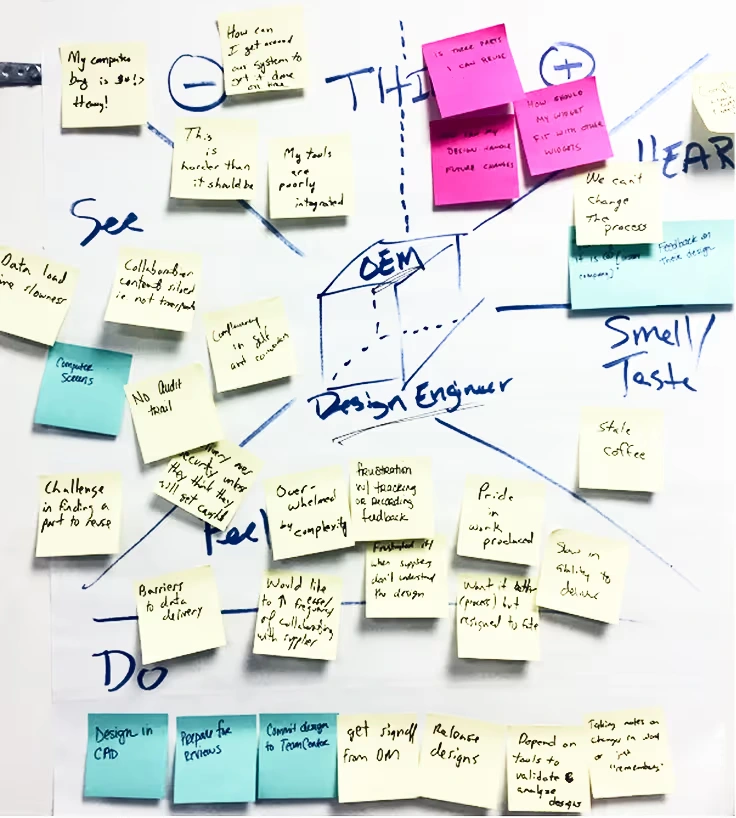
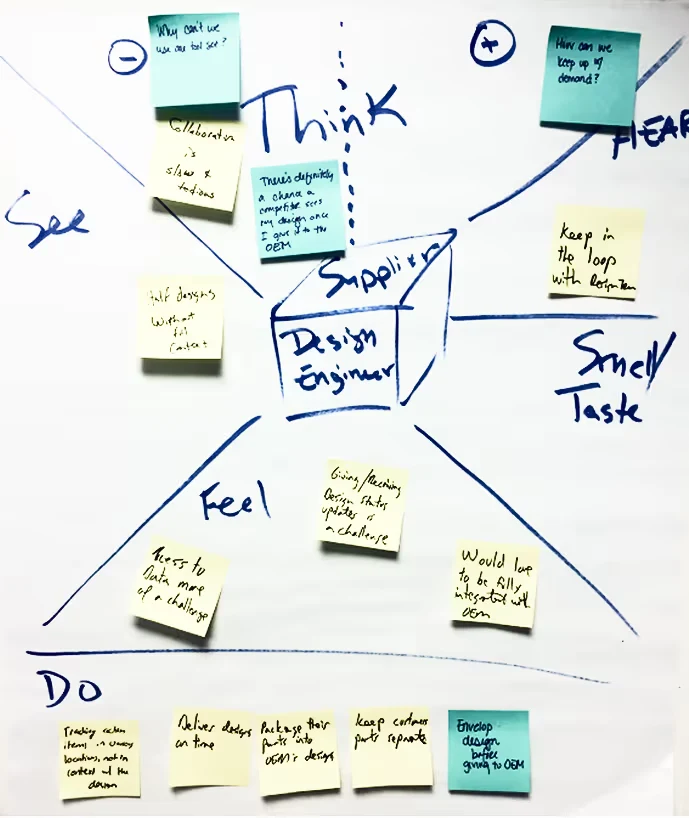
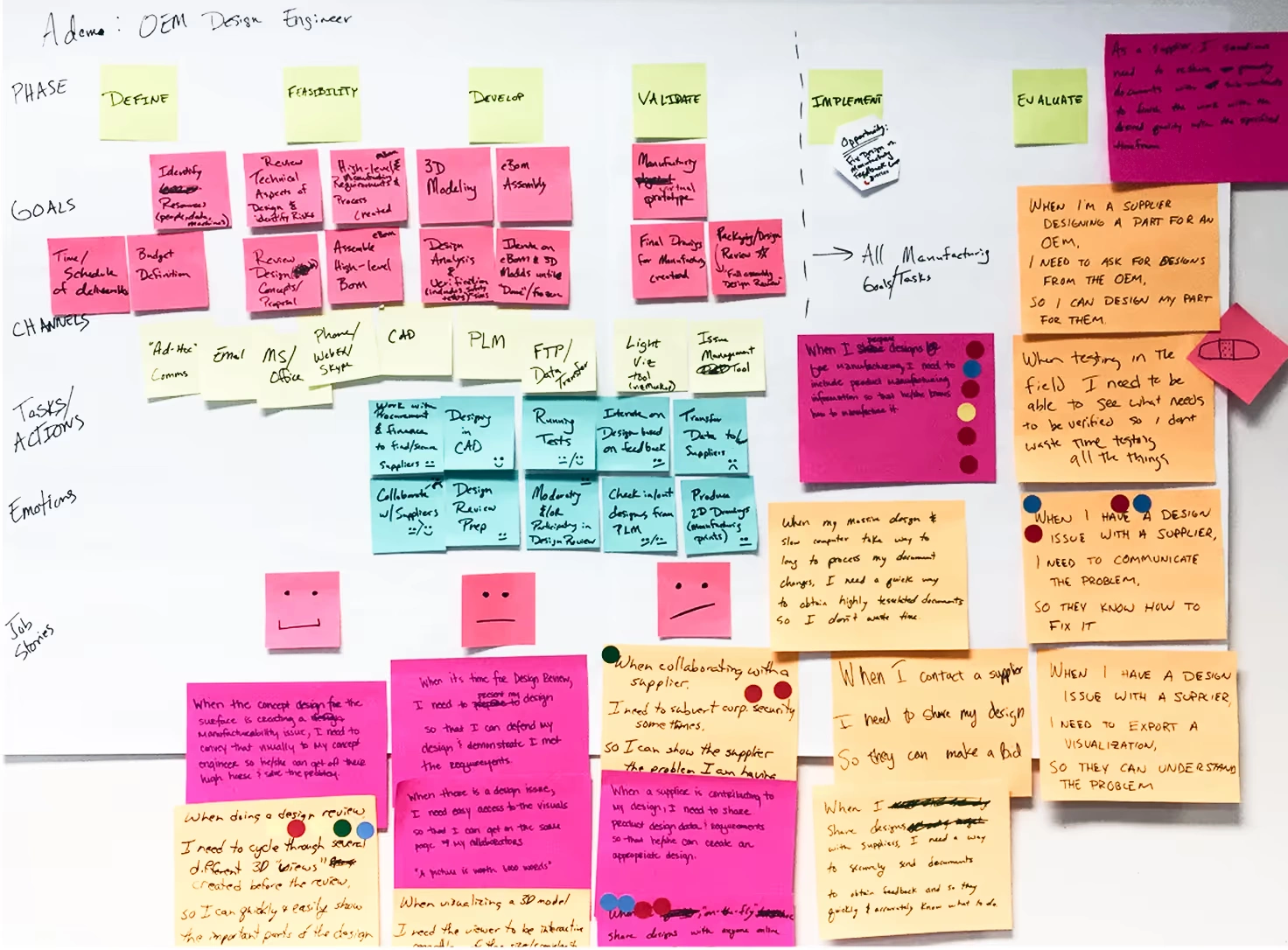
These empathy maps captured how OEM and supplier design engineers experienced collaboration across complex 3D workflows, including cognitive load, tool fragmentation, coordination challenges with internal and external teams, challenges of contributing feedback with limited access to full models, incomplete context, and strict IP constraints.
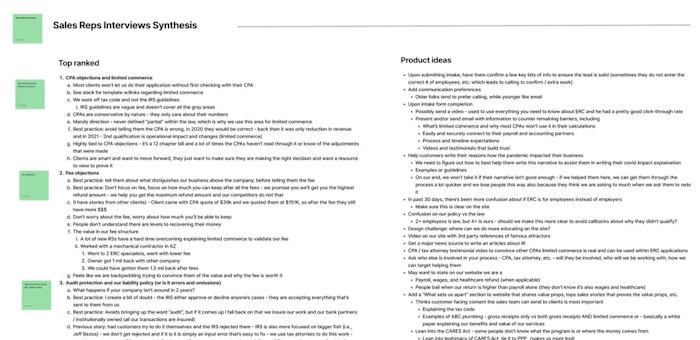
This journey map and problem statements visualized the end-to-end collaboration process across design, review, feedback, and iteration, making breakdowns and delays visible across handoffs, as well as specific issues that we could view as opportunities to solve for in our designs.
Design Sprint as a Synthesis Engine
To move from ambiguity to direction, I facilitated a focused design sprint with product, engineering, and the SME.
The sprint helped the team:
Map OEM and supplier perspectives separately
Identify where collaboration broke down across review, feedback, and iteration
Explore multiple collaboration concepts quickly
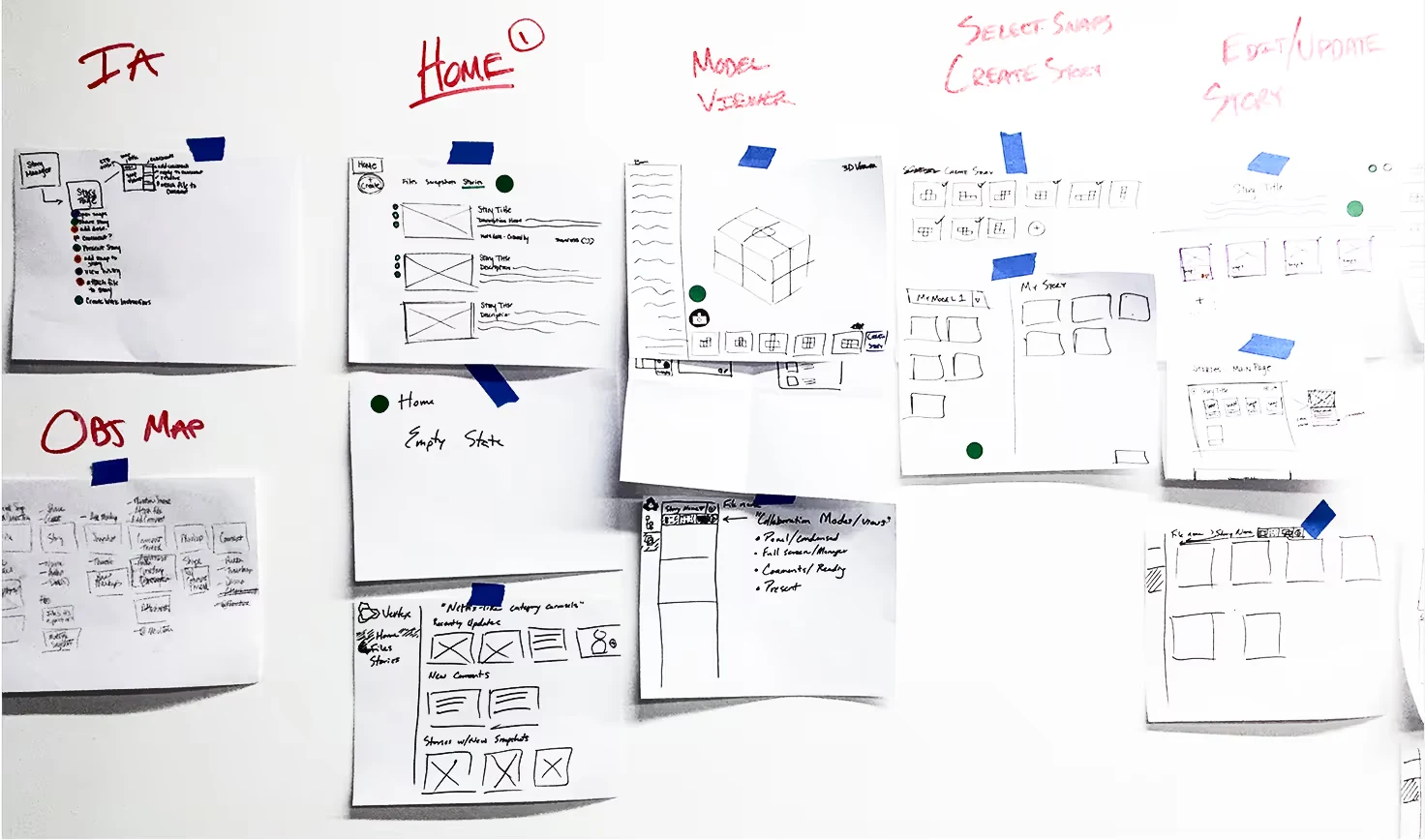
Translate the strongest directions into low-fidelity flows for discussion and refinement
This created alignment across disciplines and established a concrete starting point for experience design grounded in domain reality rather than assumption.
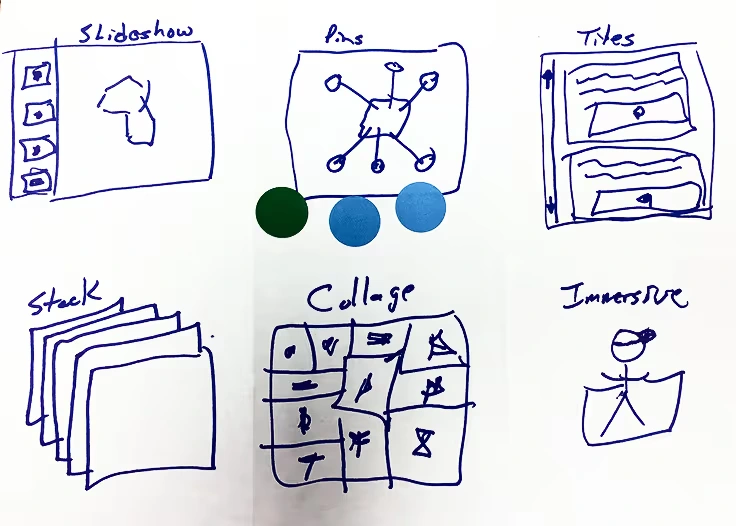
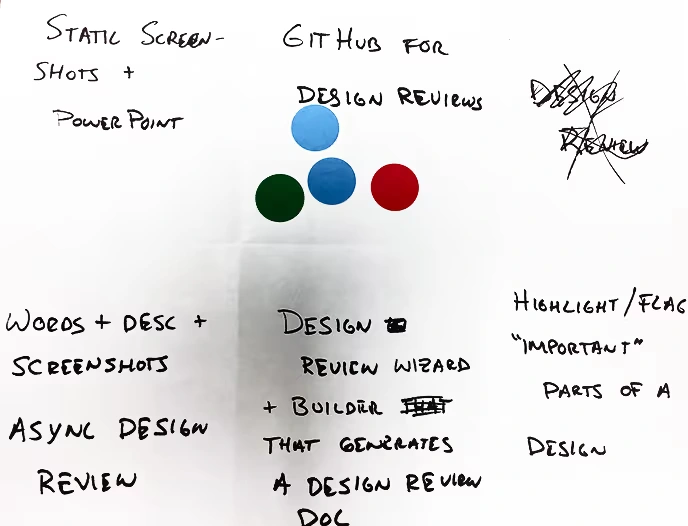
Rapid six-up ideation was used to explore multiple collaboration concepts in parallel before narrowing to the most promising directions.
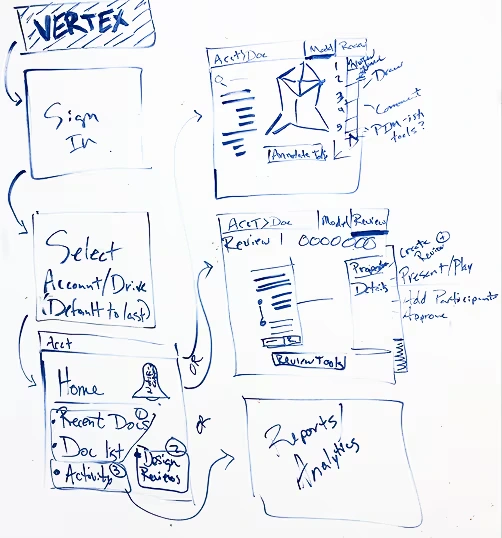
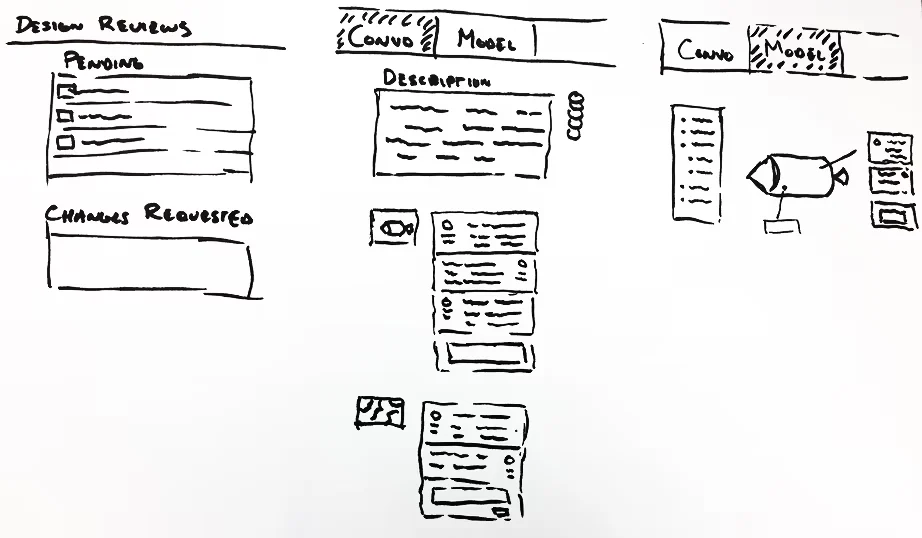
Low-fidelity paper prototypes translated early concepts into concrete interaction flows that could be discussed, refined, and validated with stakeholders.
Learning from Existing Tools and Paradigms
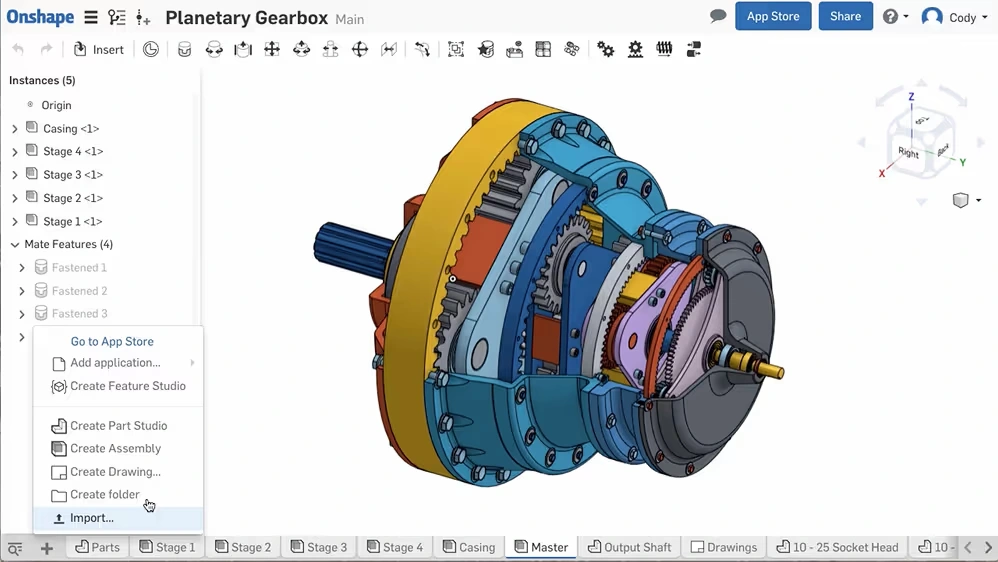
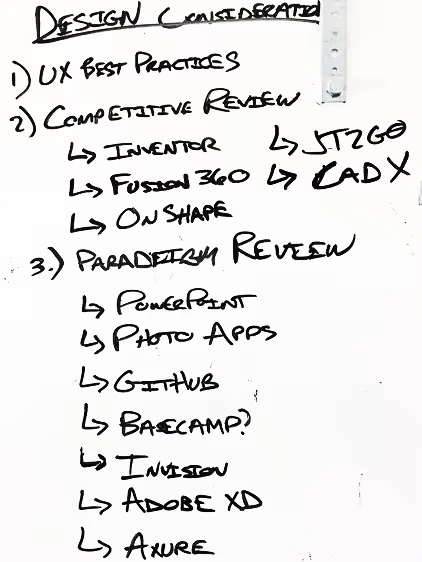
In parallel, I reviewed both direct CAD tools and adjacent collaboration paradigms to understand where existing solutions succeeded and where they fell short.
This included CAD platforms such as Inventor, Fusion 360, Onshape, JT2Go, and CADX, alongside adjacent paradigms such as PowerPoint, photo markup tools, GitHub, Basecamp, and InVision / Axure.
The goal was not to replicate CAD depth, but to understand where collaboration was being forced into tools not designed for it, which patterns were already familiar and effective, and which could be adapted safely.
This reinforced that collaboration was happening around models, not within them, often through screenshots, static documents, and disconnected conversations.
What Emerged
Across discovery, several insights became clear:
Collaboration broke down during review and feedback, not creation
Security and performance shaped behavior as much as usability
Different roles needed different views of the same model
Existing tools optimized for individuals, not shared understanding
These findings directly shaped the interaction model and platform direction that followed.
Framing the Strategy
Reframing the Work
Discovery showed the core problem was missing shared context during review and feedback.
Existing workflows forced teams to export models, capture static screenshots, and reconcile feedback across disconnected tools. That removed spatial context, slowed decisions, and increased risk, especially with external suppliers.
The strategy was to anchor collaboration to the model so discussion, context, and decisions stayed connected to the work. The goal became designing a system that supported shared understanding across roles, disciplines, and access boundaries.
System Model
Goal: Keep discussion, context, and decisions anchored to the model.
Inputs: Large CAD assemblies, enterprise security constraints.
Core interactions: View, isolate, measure, annotate, compare.
Collaboration layer: Comments, mentions, review states.
Governance: Permissions, sharing, auditability.
Why 3D Collaboration Is Uniquely Hard
Collaboration in 3D is mediated through 2D inputs, while meaning lives in a spatial environment that changes with camera angle, zoom, and orientation. There is no single stable surface, so feedback can lose intent over time.
The challenge is compounded by role differences across engineers, reviewers, and external partners. Collaboration patterns therefore had to bind 2D input to 3D context while remaining understandable across audiences and over time.
Strategic Intent
The strategy was guided by four goals:
Keep context attached to feedback
Comments and annotations needed to stay anchored to specific views, parts, or moments in the model.
Support collaboration without exposing full IP
Suppliers and external partners needed meaningful participation without broad access to sensitive data.
Balance power with approachability
Engineers needed depth and control, while other collaborators needed ways to engage without deep CAD expertise.
Enable both synchronous and asynchronous workflows
Teams needed to collaborate live when necessary and leave structured feedback that could be reviewed later.
These goals provided clear guardrails for experience design and prevented the solution from drifting toward familiar but ineffective patterns.
Intentional Tradeoffs
Working within a stealth startup environment required focus and restraint.
The strategy prioritized:
Core collaboration workflows over exhaustive feature parity
Flexible interaction models over rigid processes
A strong system foundation before deeper edge-case optimization
This allowed the product to move forward with clarity while remaining adaptable as technical and organizational constraints evolved.
Experience Design & Execution
With the strategy defined, the focus shifted to designing an experience that enabled collaboration around complex 3D assemblies without overwhelming users or compromising performance, security, or clarity.
Rather than designing isolated features, I focused on establishing a coherent interaction model for exploration, discussion, and decision-making across roles and contexts. This created a reusable framework that could support future workflows and collaboration modes without redesigning the experience from scratch.
Designing for Collaborative Workflows, Not Just Viewing
Early design work centered on how users collaborated around models, not just how they inspected them.
The experience was structured around three core activities:
Explore: Navigate and inspect large assemblies efficiently
Collaborate: Share, comment, annotate, and discuss specific parts in context
Present: Capture, sequence, and communicate insights without exporting full models
This kept interaction decisions grounded in real workflows rather than tool-centric patterns.
Interaction Model and System Structure
To support these workflows, I designed a system that separated model interaction, commentary, and narrative storytelling while keeping them tightly connected.
Key design decisions included:
A persistent 3D model viewer as the shared source of truth
Contextual commenting anchored to parts, views, or snapshots
Lightweight markup tools that did not alter the underlying model
A clear distinction between working sessions and curated stories
This allowed teams to move fluidly between exploration and communication without duplicating effort or breaking context.
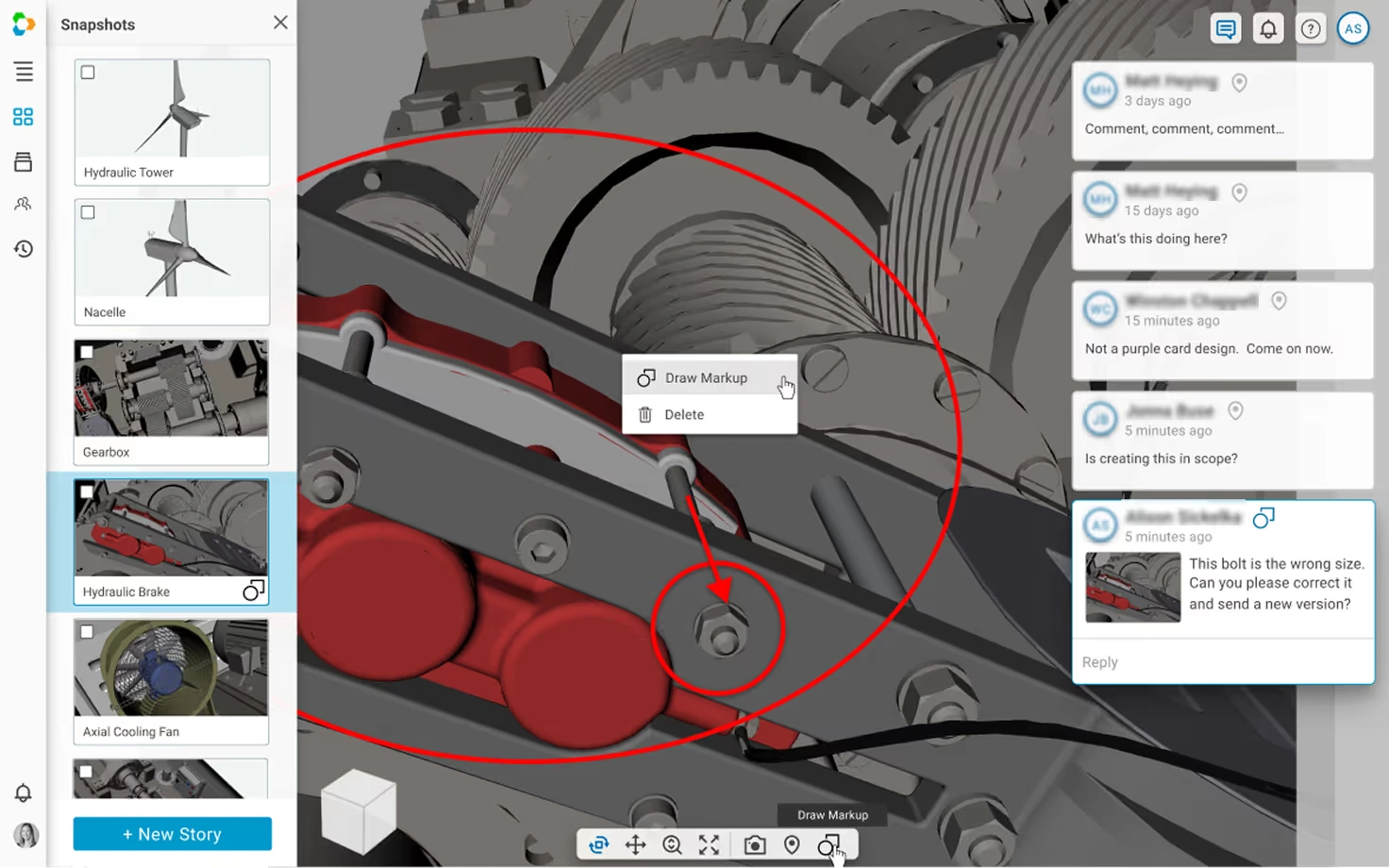
A detailed 3D model view showing in-context comments and markups, illustrating how feedback could be anchored directly to geometry rather than separated into external documents.
Stories as a Shared Communication Layer
One of the most important concepts was Stories, a way to curate and communicate decisions.
Stories allowed users to:
Capture snapshots of relevant model states
Annotate and draw directly on those views
Sequence snapshots into a narrative
Discuss changes asynchronously without opening full assemblies
This reduced reliance on external tools and made collaboration more accessible to non-CAD specialists while preserving engineering accuracy.
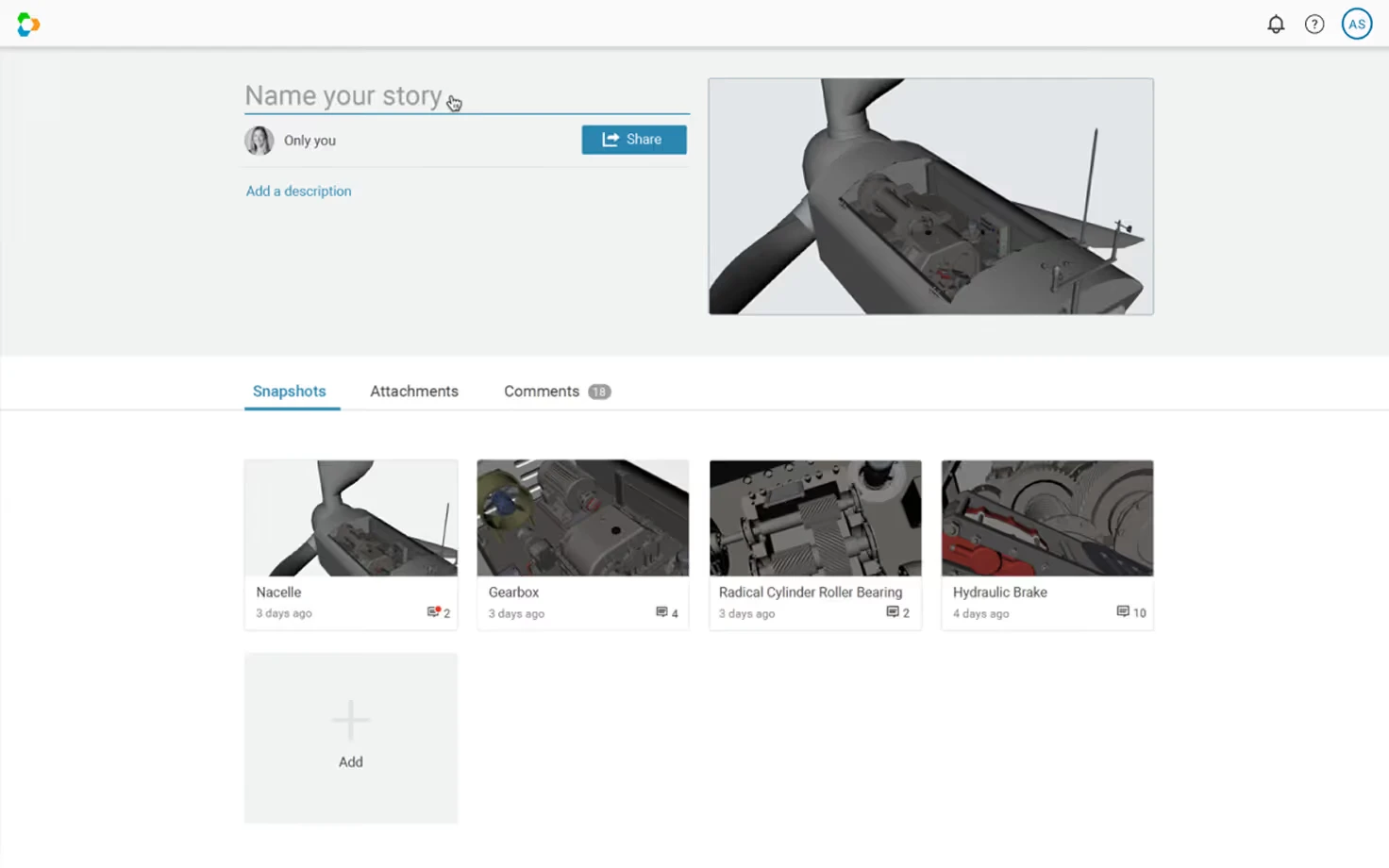
A story overview showing multiple snapshots tied to a single design narrative, enabling reviewers to understand context, progression, and intent at a glance.
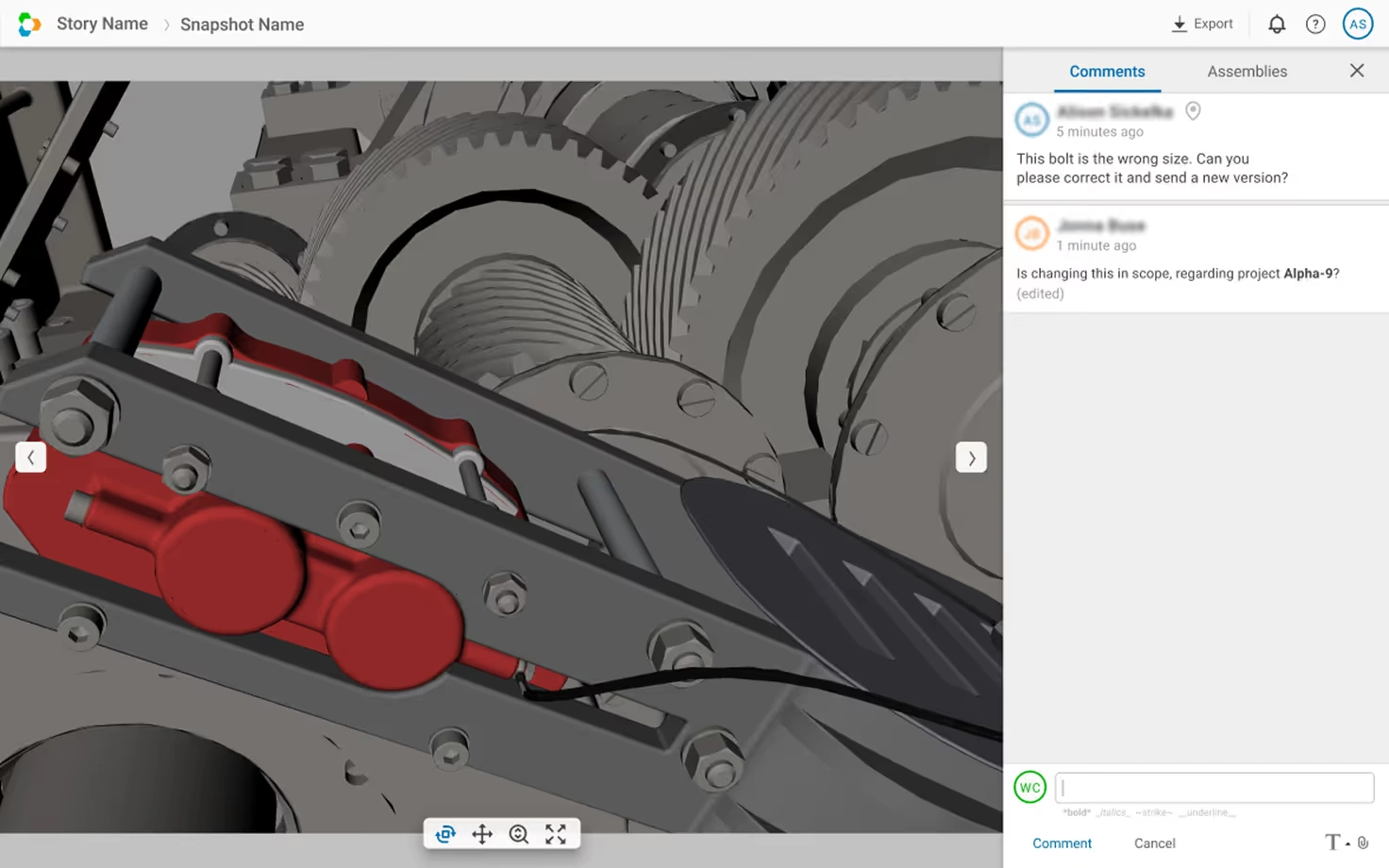
An individual snapshot view with threaded comments and visual annotations, supporting precise, asynchronous feedback without requiring live meetings.
Supporting Real-Time Collaboration
To support synchronous work, the experience included lightweight collaboration features that mirrored how teams already worked together.
These included:
Inviting users directly into a shared model
Following another participant’s view during walkthroughs
Screen sharing for live reviews without exporting files
The goal was not to replace meeting tools, but to make model-based collaboration faster and more precise.
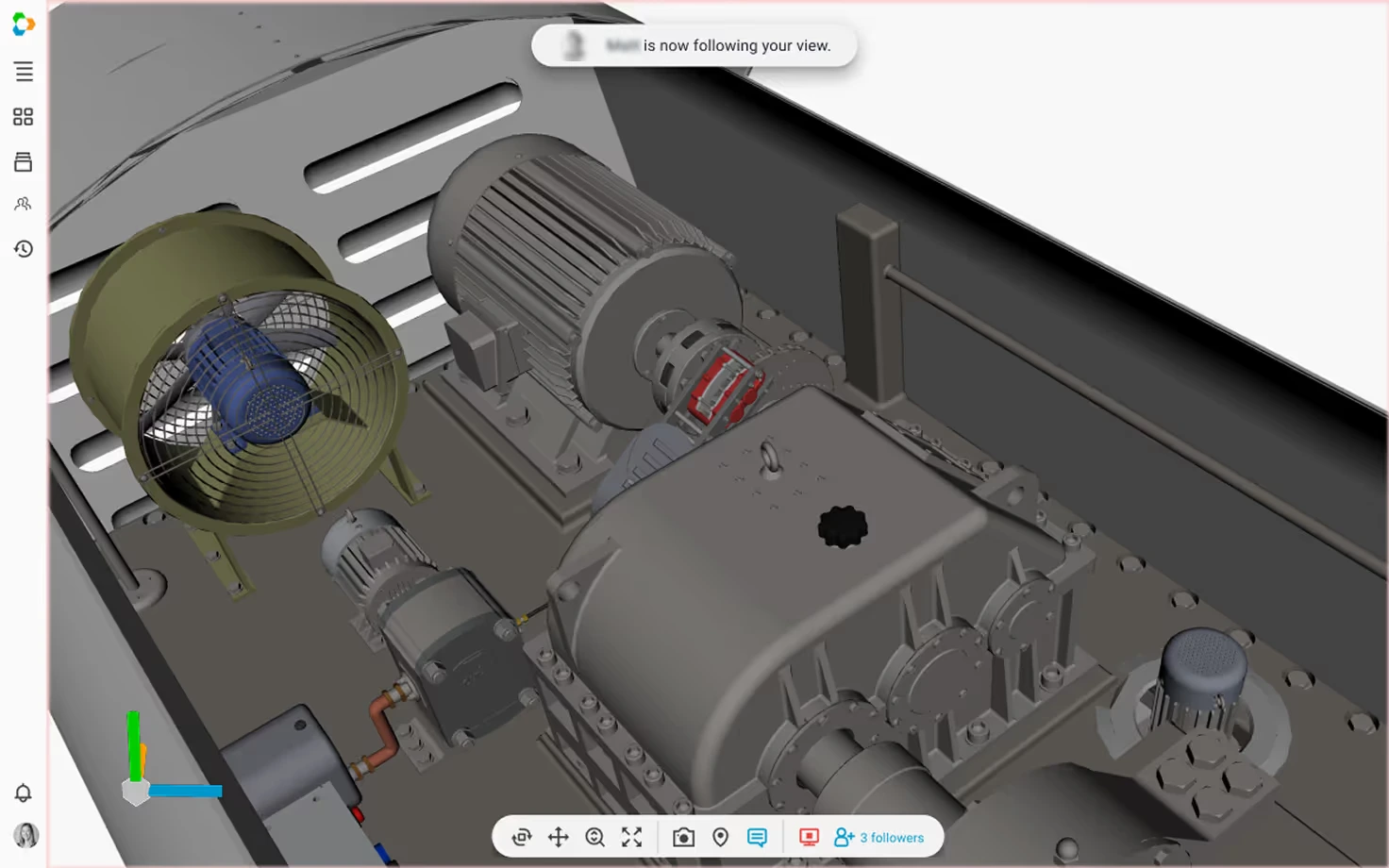
A real-time collaboration state where one user follows another’s view, enabling guided walkthroughs and shared understanding during reviews.
Design Evolution and Refinement
Throughout execution, I iterated closely with product and engineering to balance usability, performance, and feasibility.
This included:
Refining interaction density to avoid visual overload
Adjusting tool placement based on usage patterns
Stress-testing workflows with large, complex assemblies
The result was an experience that remained responsive and understandable under heavy technical constraints.
Validation & Outcomes
Validation Through Internal and External Signal
With the core interaction model, collaboration workflows, and system structure in place, validation focused on whether the experience aligned with real-world engineering collaboration needs without disrupting existing design processes.
Validation occurred across two tracks: internal stakeholder review and external directional exposure.
Internal Validation: Product, Engineering, and SME Review
Concepts and flows were reviewed iteratively with product leadership, engineering partners, and a senior design engineer SME with deep CAD and manufacturing experience.
These reviews focused on:
Whether the collaboration model reflected real design-review behavior
Feasibility of real-time and asynchronous workflows
Alignment with CAD/PLM constraints and enterprise security requirements
Clarity of roles, permissions, and ownership in shared models
Feedback reinforced that the system-level approach, including snapshots, stories, markup, and role-aware collaboration, mapped well to existing workflows while reducing friction from file-based handoffs and fragmented tools. Validation led to refinements in details without changing the core interaction model.
External Validation: Directional Exposure via mHUB
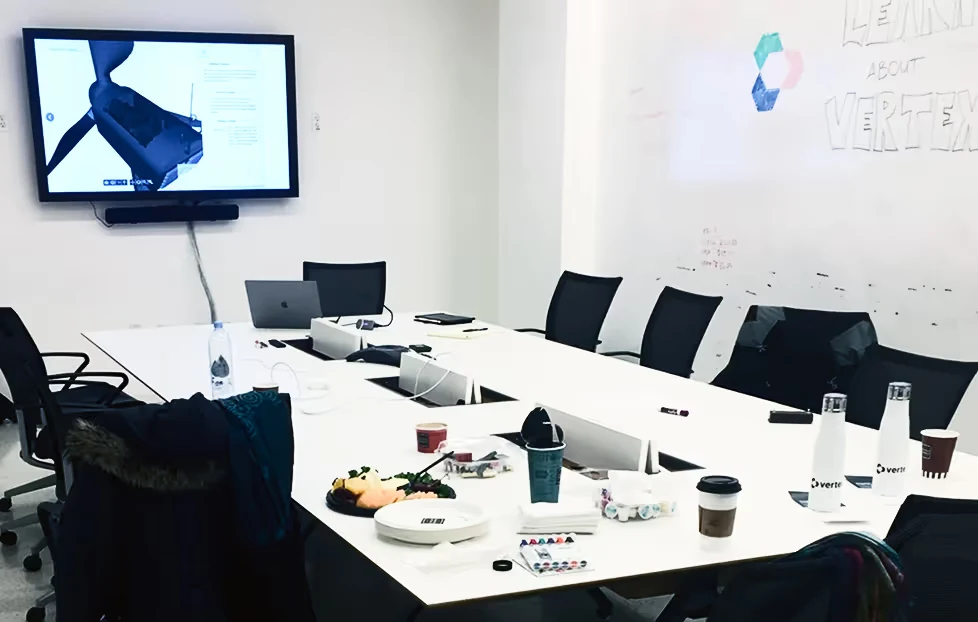
To pressure-test early concepts outside the immediate team, selected designs were shared in facilitated sessions at mHUB with design and engineering practitioners experienced in complex systems and collaborative workflows.
These sessions provided directional validation for:
Stories as a shared communication layer
Snapshots for focused, contextual feedback
Real-time collaboration and follow-view interactions
The balance between visual fidelity and lightweight participation
Feedback was largely affirming, with minor refinements to labeling, affordances, and interaction clarity while the foundational system structure remained intact.
Outcomes and Confidence Gained
Validation gave the team:
Confidence that the collaboration model aligned with real-world workflows
Confirmation that the experience reduced ambiguity during design review
A shared understanding across product, design, and engineering of how the system could scale
A stable interaction foundation for future product evolution and adjacent use cases
The result was a strong, extensible baseline for secure, role-aware collaboration around complex 3D assemblies.
User Interviews & Usability Testing
Strategic Impact & Learnings
Customer & Business Impact
Enabled teams to collaborate on complex 3D models without relying on brittle, file-based workflows
Reduced friction in reviewing, annotating, and iterating across roles with different levels of technical expertise
Improved clarity and confidence in shared decision-making by making model state, context, and intent more visible to collaborators
Platform & Organizational Impact
Established a scalable interaction foundation for real-time collaboration that could support future features without fragmenting the experience
Reduced ambiguity across product, design, and engineering by aligning teams around shared system models and interaction rules
Improved delivery velocity by identifying constraints early and designing within technical realities rather than around them
Leadership Learnings
Designing collaboration systems requires treating shared understanding as a first-class design outcome, not a byproduct of interface design.
In this environment, success depended less on visual polish and more on:
Defining clear interaction contracts between users and the system
Making system state explicit to prevent misinterpretation and rework
Balancing user needs, performance constraints, and engineering feasibility without creating brittle edge cases
This work reinforced that durable collaboration experiences are built through system clarity, early alignment, and disciplined tradeoff decisions, especially as products scale in complexity and usage.
Applying This Approach Elsewhere
Interested in how this approach translates to other complex platforms?
Let’s Connect
The easiest way to reach me is on LinkedIn. For more detailed inquiries, you can also use the contact form.
Like this project
Posted Apr 11, 2026
Cloud platform for collaboration on complex 3D models, enhancing team workflows and security.