TechFoundry IMS — AI Procurement and Fulfillment in Seven Demos

Zahid Hussain
Verified


TechFoundry IMS connects purchase order intake, vendor ordering, shipments, client shipping, and invoice reconciliation in one operational workflow. These
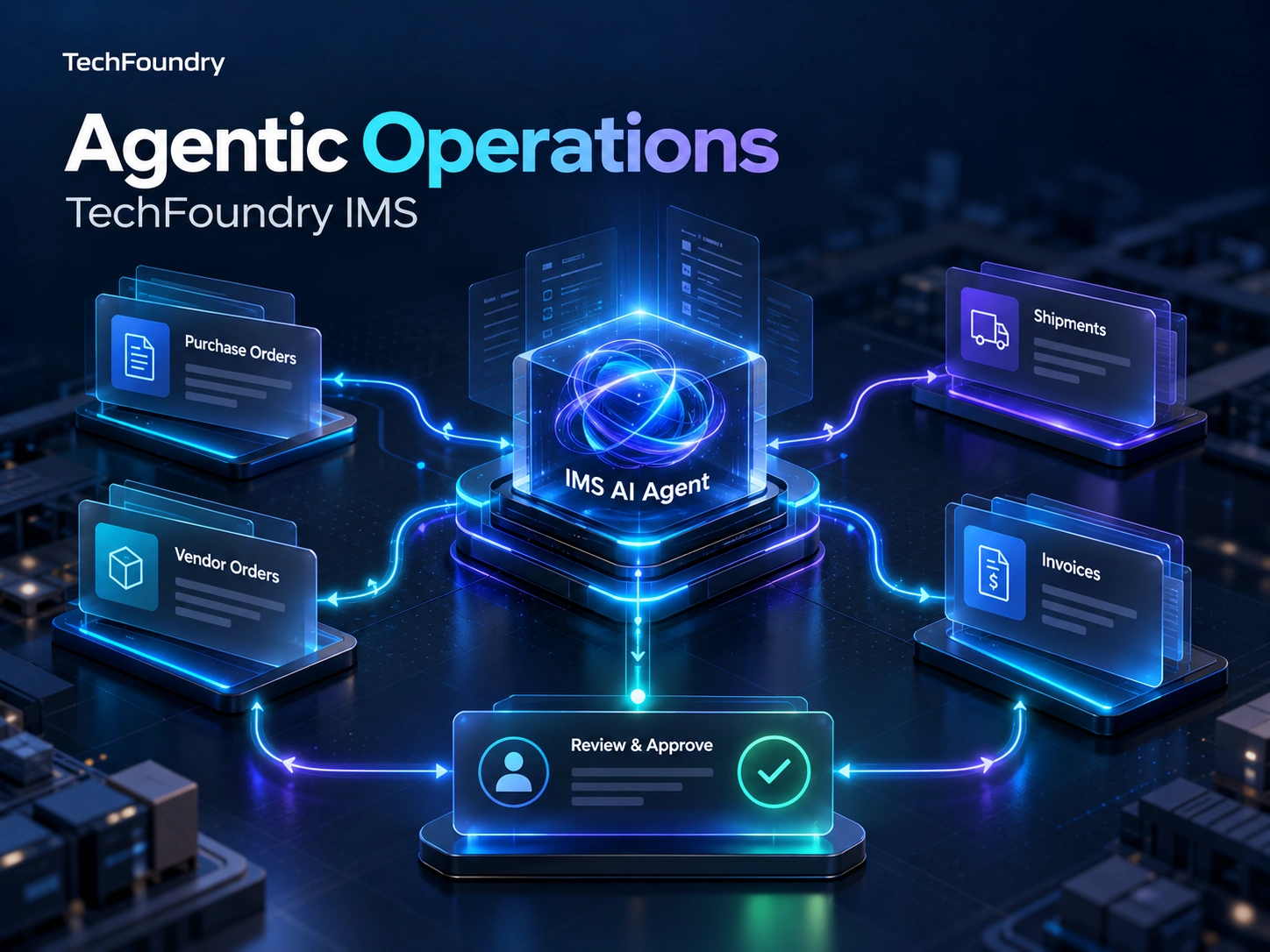
seven demos show how document processing, AI assistance, validation, and shipping integrations work together.
My role
I led engineering and architecture as part of the TechFoundry team, including the AI order-intake workflow, multi-tenant permissions, and the operational and financial modules.
The operational problem
A purchase order starts a chain of work. Parts need to match the catalog, vendor orders need the right quantities and dates, packing slips need to become shipment records, and invoices need to agree with what was ordered and received. Separate tools force people to carry the same information between tasks.
What we built
IMS connects these stages so information captured at one step supports the next. PO lines populate vendor orders, packing slips supply shipment details, received boxes support client shipping, and order and receipt quantities provide context for reconciliation. The AI assistant waits for approval in the overview demo, while unmatched catalog parts enter a review workflow before fulfillment continues.
Technology and tech stack
Frontend: Next.js and React.
Backend: Node.js services.
Database: PostgreSQL.
Cloud: AWS.
AI: Anthropic Claude for order intake and reporting / anomaly detection.
Integrations: email intake, PDF document processing, and UPS rates, labels, and tracking.
Architecture: multi-tenant SaaS, role-based access control, and deterministic SAP equipment / part matching with administrator-managed mappings.
What the platform demonstrates
Information captured at one stage supports the next. Purchase-order lines feed vendor orders, packing slips provide shipment data, received boxes support outbound shipping, and invoices can be checked against orders and receipts. Review points keep catalog exceptions visible and let users approve the AI assistant’s prepared changes.
AI agent overview
The assistant follows one conversation from a client purchase-order PDF through vendor ordering, shipment creation from a packing slip, and invoice filing. The user reviews and approves the prepared changes.
This gives the team a conversational way to work across several operational tasks, with a visible approval point before prepared changes are applied.
PO intake
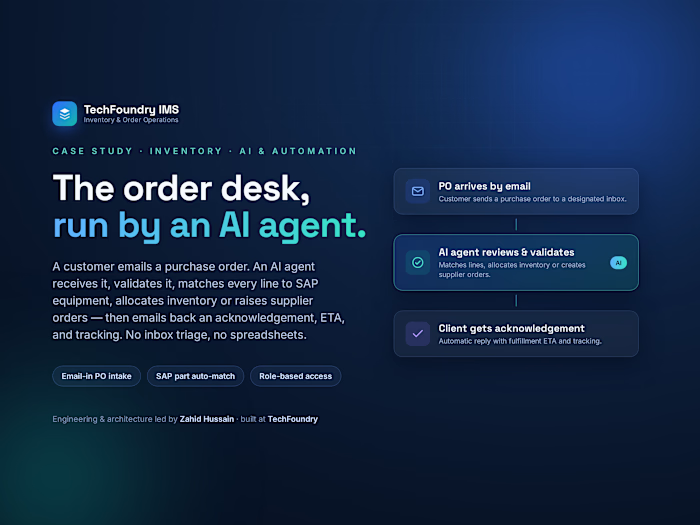
IMS reads a purchase order received by email, matches its line items to the catalog, registers the order, and sends an acknowledgment to the client.
The incoming document becomes an operational record and a client response. Those captured order details provide the starting point for vendor ordering and fulfillment.
PO conflicts
When a purchase-order part does not match the catalog, IMS flags the line as a conflict. The team can inspect the unresolved part, search the catalog, and link the correct item before fulfillment proceeds.
Exception handling is part of the workflow. Ambiguous matches become a visible review task so people can apply judgment before the order moves forward.
Vendor orders
IMS populates vendor-order lines and quantities from a client purchase order. The user reviews delivery dates and scheduling warnings, activates the order, and notifies the vendor. Planning stays connected to procurement, with warehouse delivery or direct-to-client shipping options.
Vendor ordering builds on information already captured at intake. Delivery-date checks and notifications remain connected to the purchase order and its fulfillment plan.
Vendor shipments
A packing-slip PDF becomes a shipment record. IMS matches boxes, parts, quantities, and weights to the vendor order. Adding courier and tracking details activates the shipment and connects the incoming vendor document to goods in transit.
The vendor document becomes structured shipment data that the team can review against the order. Box-level information and courier tracking carry that context into the receiving workflow.
Client shipping
IMS reuses received box details for a shipment from the warehouse to the client. The team can compare live UPS rates, create shipping labels, and track each box without rebuilding the shipment information in a separate tool.
The outbound workflow carries forward the box information established during receiving. Rate selection, labels, and tracking stay connected to the same fulfillment record.
Invoice reconciliation
IMS reads vendor-invoice lines and prices, displays amounts in USD and CAD, and compares ordered, received, and invoiced quantities. Prices and totals can be masked during screen sharing so teams can discuss the workflow without displaying financial amounts.
Conclusion
TechFoundry IMS makes the case for practical AI: technology built around real operational work. These seven demos show AI helping teams read business documents, prepare orders, resolve catalog exceptions, coordinate shipments, and reconcile invoices within one connected workflow.
Useful agentic AI needs reliable integrations, clear validation, and human review where judgment matters. IMS brings those elements together so AI assistance can become part of everyday operations. This is TechFoundry’s approach to practical AI development: start with a concrete business problem, build around the people doing the work, and evaluate success through measurable operational improvements.
Let’s build your agentic AI workflow
Looking for agentic AI development? Reach out to TechFoundry—we’d love to work with you. Whether you need AI agents, document automation, or software that connects your business workflows, we can help turn your idea into a working solution.
Book a free initial consultation with me on Contra. Let’s discuss your workflow, explore where practical AI can help, and identify the right starting point for your project.
Like this project
Posted Oct 29, 2026
Engineered an AI-assisted workflow connecting purchase orders, vendor orders, shipping, and invoice reconciliation. Explore the stack and seven demos.
Likes
0
Views
7
Clients
TechFoundry