DIEM — Health & Wellness App Product Development

Brad von Sprecken


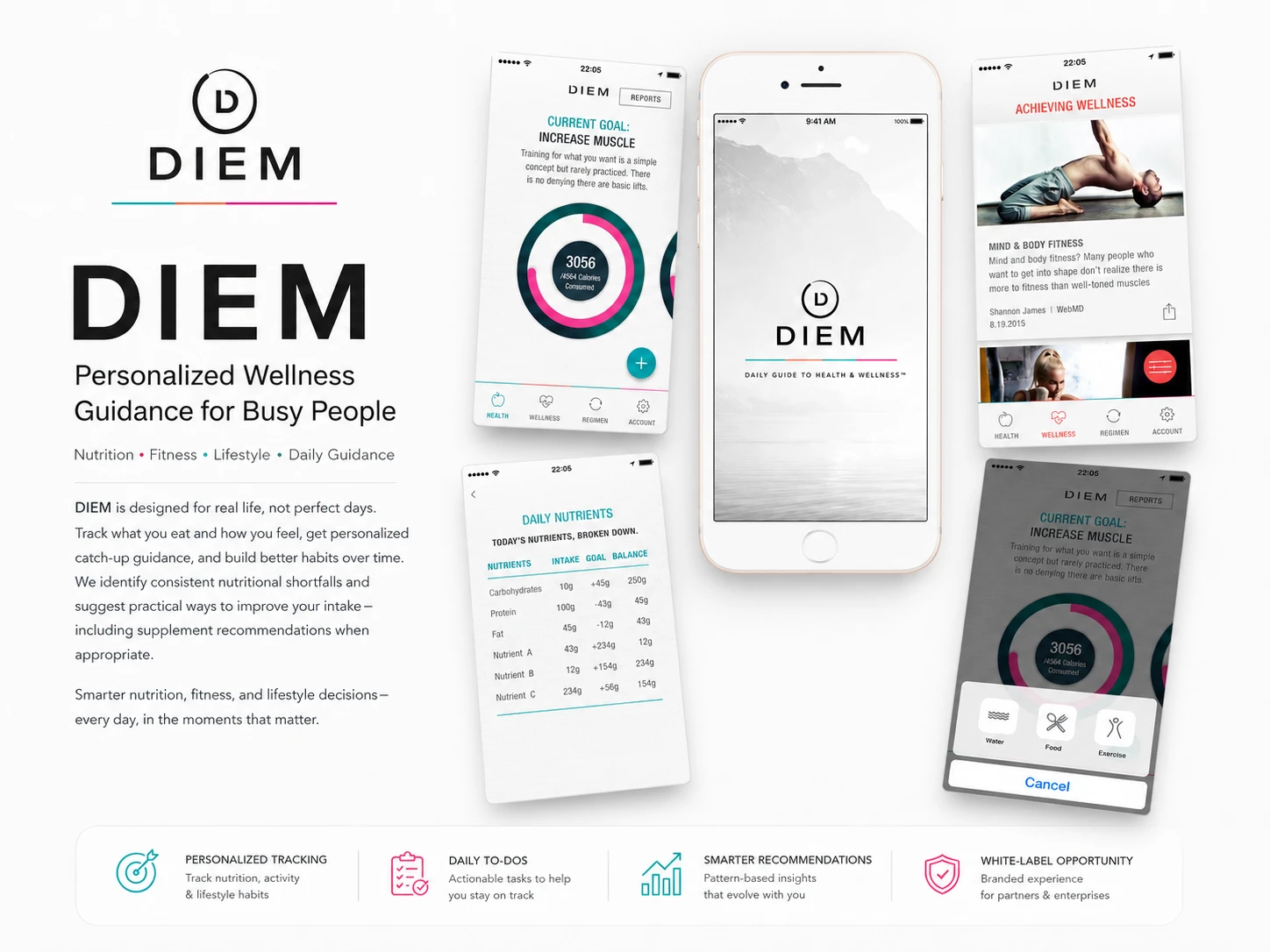
DIEM — A Guide to Better Health & Wellness
I founded and led the development of DIEM, a multi-year mobile health and wellness platform designed to bring nutrition, fitness, lifestyle guidance and community into one personalized experience.
DIEM was created around a simple idea: most people know they should eat better, exercise more and take better care of themselves, but real life gets in the way.
The goal was not to build another calorie counter or workout app. The goal was to create a system that could understand the individual, understand what they had actually done that day, and help them make better decisions with the time and opportunities they still had.
My involvement extended across the entire project—from the original concept and business model through product strategy, functionality, UX, professional content development, testing, branding, marketing and commercialization.
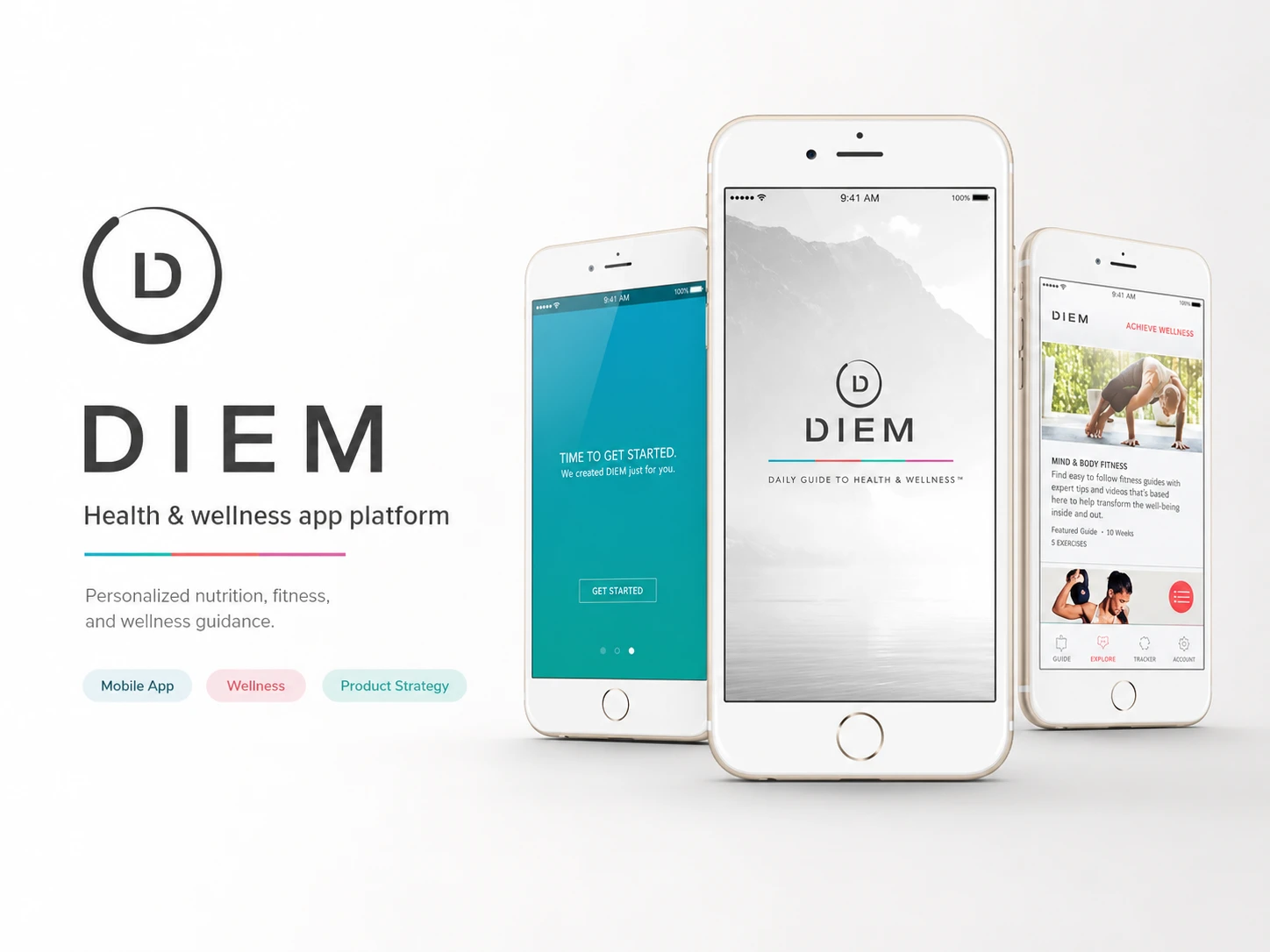
DIEM was built as a personalized health and wellness platform, combining nutrition, fitness, lifestyle guidance and daily recommendations into one connected experience tailored to each user.
Built for Busy People
DIEM was designed for people who don't always have the time to plan perfect meals, prepare healthy food every day or follow an ideal wellness routine.
Someone might leave for work early, grab lunch wherever they can, miss a planned workout or realize late in the day that their nutrition hasn't been very balanced.
Instead of treating the day as a failure, DIEM was designed to help the user make the next best decision.
The platform would track the user's activity, food and nutrition against their individual goals and provide practical guidance based on what was still achievable that day.
That was a major part of the philosophy behind DIEM:
You don't have to have a perfect day to make today healthier.
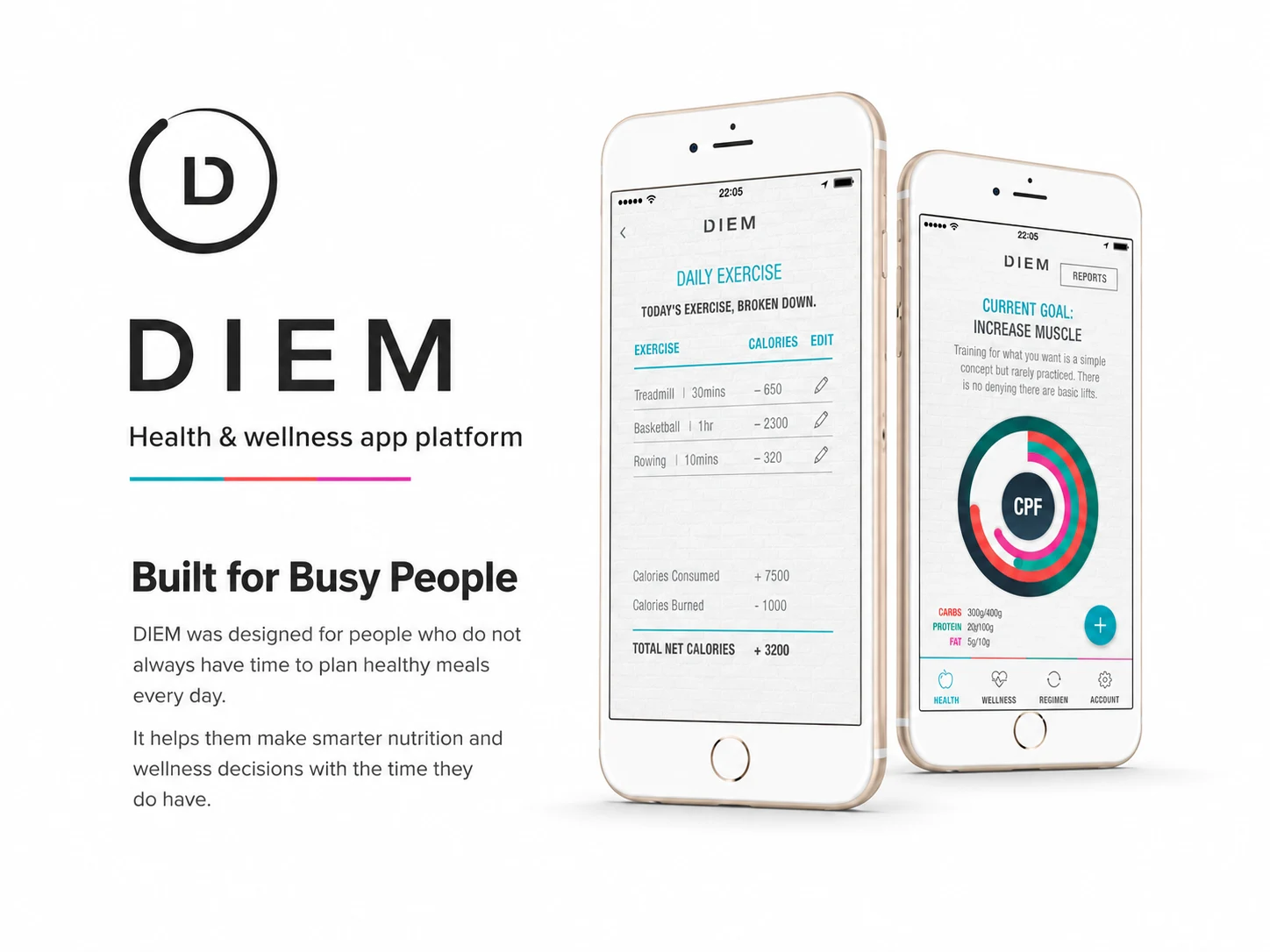
DIEM connected daily exercise tracking with personalized health goals, helping users see how activity, calories and nutrition worked together toward their individual wellness targets.
Personalization From the Beginning
DIEM was designed to create a different experience for different people.
Personalization could take into account information such as:
Age and other profile information
Health and wellness goals
Current activity level
Nutrition
Exercise
Health conditions
Allergies
Lifestyle information
Ongoing user activity and behavior
Users could choose goals including:
Lose Weight • Get Fit • Get Healthy • Tone • Gain Weight • Maintain
That information helped determine the user's regimen, daily priorities, nutrition targets, exercise guidance and wellness recommendations.
The platform was organized around four interconnected areas:
Nutrition • Fitness • Lifestyle • Community
The objective was to look at the person more completely instead of treating nutrition, exercise and wellness as unrelated pieces.
Daily Regimen & Actionable Guidance
A major DIEM feature was the personalized daily regimen.
Instead of simply showing users charts and numbers, DIEM was designed to turn their information into practical daily actions.
Depending on the individual, regimen items could include things such as:
Water intake
Exercise
Calories and macronutrients
Added sugar
Fiber
Calcium
Other nutrition and wellness priorities
The user could see what they had accomplished, what still needed attention and where they stood throughout the day.
This was intended to make a complicated amount of health information much easier to act on.
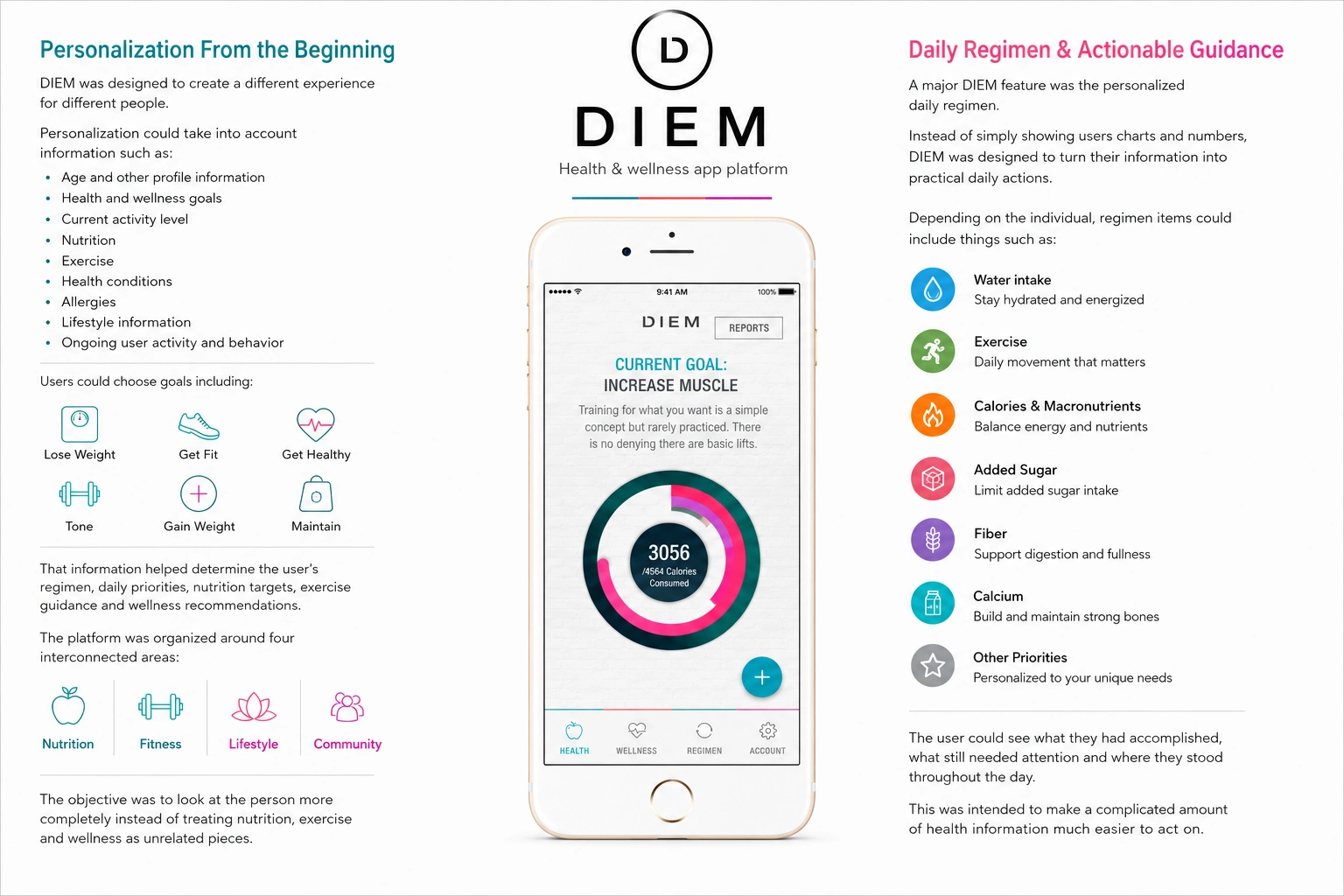
DIEM personalized each user’s experience from the start, combining individual goals, activity, nutrition, health information and daily behavior to create practical, actionable guidance throughout the day.
Daily Catch-Up Guidance
This was one of the most important parts of the DIEM concept.
DIEM wasn't supposed to simply tell someone at the end of the day that they failed to hit a nutrition target.
It was designed to recognize the problem while there was still time to do something about it.
For example, if the system recognized that the user was still significantly low in a particular vitamin, mineral or nutrient later in the day, DIEM could provide guidance along the lines of:
It's not too late to catch up.
It could then suggest foods that contained the nutrient the user was missing so they had an opportunity to bring their nutrition closer to target before the day ended.
The same philosophy could apply across nutrition, hydration, exercise and other wellness goals.
Instead of simply recording behavior, DIEM was designed to help change the outcome of the day.
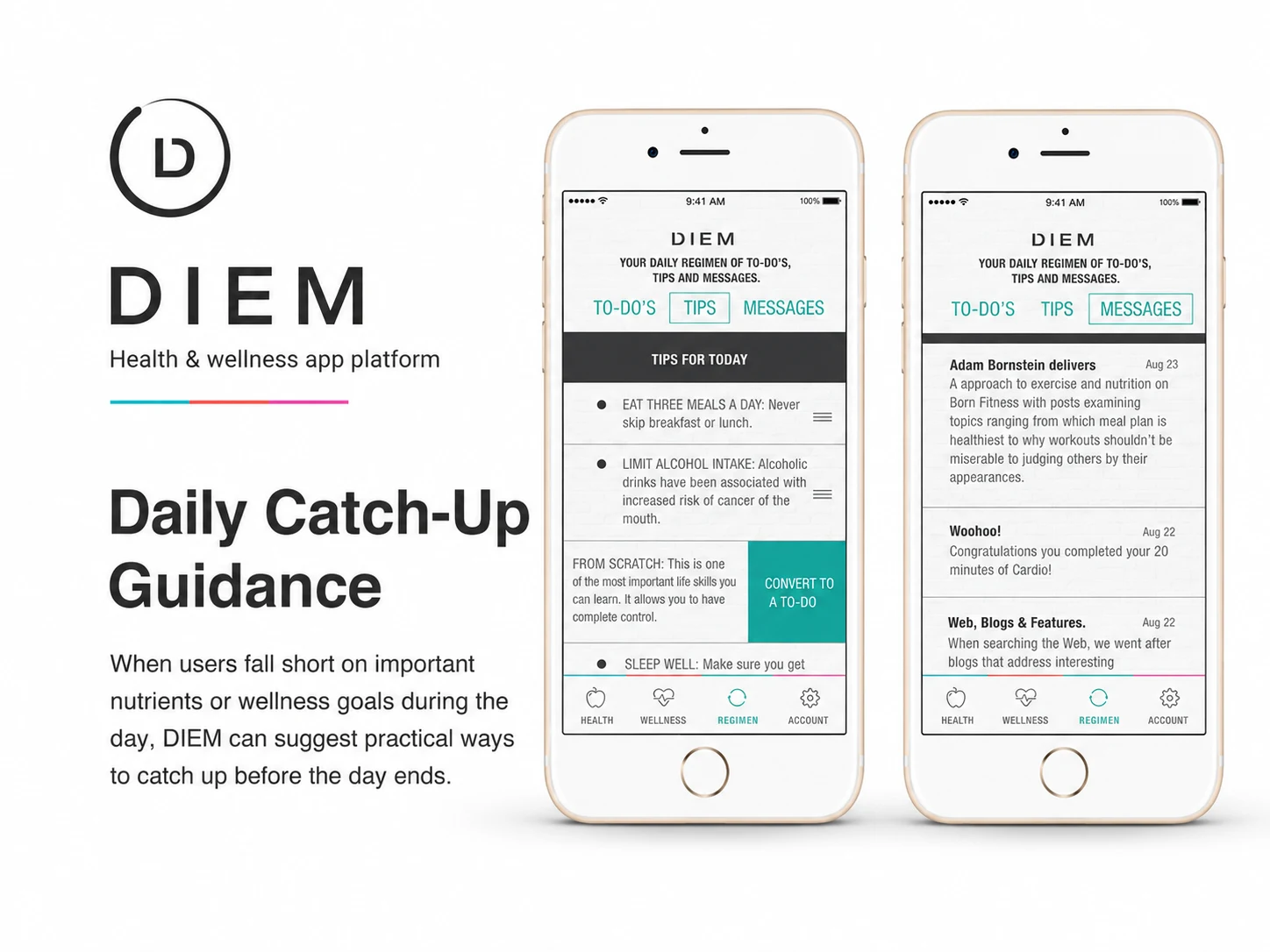
DIEM’s daily regimen used personalized tips and messages to help users recognize what still needed attention and make practical adjustments before the day was over.
Pattern Recognition & Smarter Recommendations
The concept went beyond a single day.
Over time, DIEM was intended to recognize patterns in the user's behavior and nutrition.
If someone was consistently low in a particular nutrient—not just once, but repeatedly—the system could identify that trend and provide a more useful recommendation.
For example:
Rather than continually telling someone to eat more foods containing a particular nutrient, DIEM could recognize that getting enough of it through food was consistently difficult for that person.
At that point, the system could suggest that the user consider a relevant supplement rather than continuing to struggle to meet the target through diet alone.
That created a much more practical form of personalization.
The idea was for DIEM to learn from what the user was actually doing and adjust the guidance accordingly instead of delivering the same generic advice to everyone.
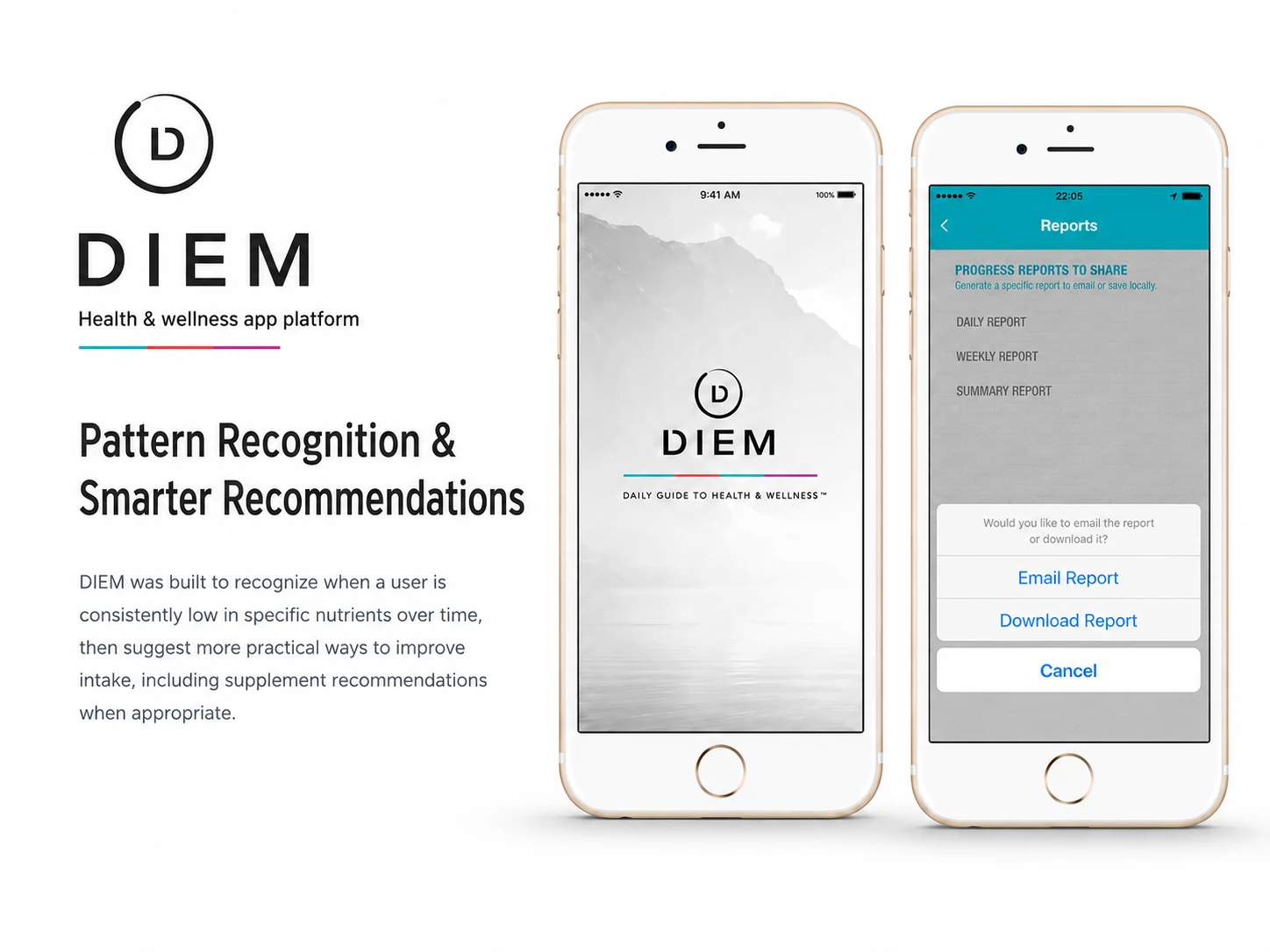
DIEM’s reporting tools made it easy for users to review, download and share their progress, turning daily health and wellness data into information they could actually use over time.
Nutrition Tracking
Nutrition was a major part of DIEM, but the goal went far beyond simply counting calories. The platform was designed to understand what a user actually ate, what nutrients that food provided, how it compared with their individual daily targets, and what they were still missing.
Users could search for foods, select previously entered items, manually add foods, scan product barcodes to pull nutritional information, and use image/photo-based input to help identify or record what they were eating. Once a food was entered, DIEM could break it down beyond calories into carbohydrates, protein, fat, vitamins, minerals and other individual nutrients so the system had a much more complete picture of the user’s nutrition.
That information was then compared with the user’s personalized goals and used throughout the platform. DIEM could show what had already been consumed, what remained for the day, where the user was falling short, and where they may have exceeded a target.
Most importantly, the data was not collected just to produce charts. It fed directly into the user’s daily regimen, catch-up guidance and longer-term recommendations. If DIEM recognized that someone was low in a particular nutrient, it could use that information to suggest foods that might help them catch up before the day ended. If the same deficiency continued over time, the platform could identify the pattern and provide more practical long-term guidance.
The objective was to turn everyday food tracking into something much more useful: understand what the user ate, understand what their body still needed, and help them make a better next decision.
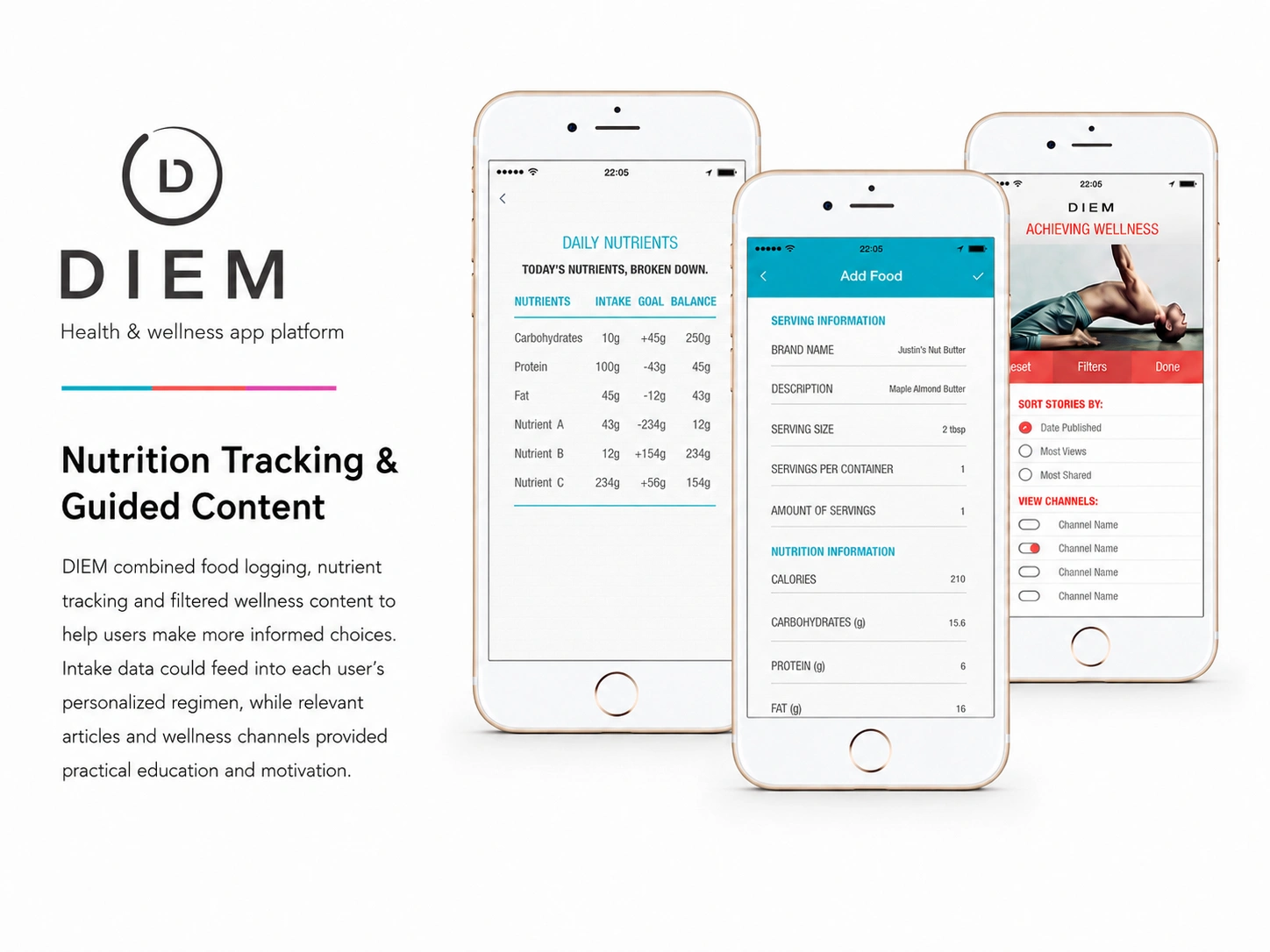
DIEM made food tracking practical by letting users search foods, scan barcodes or capture food information, then break each item down into calories, macronutrients and individual nutrients that fed directly into their personalized daily guidance.
Fitness & Activity
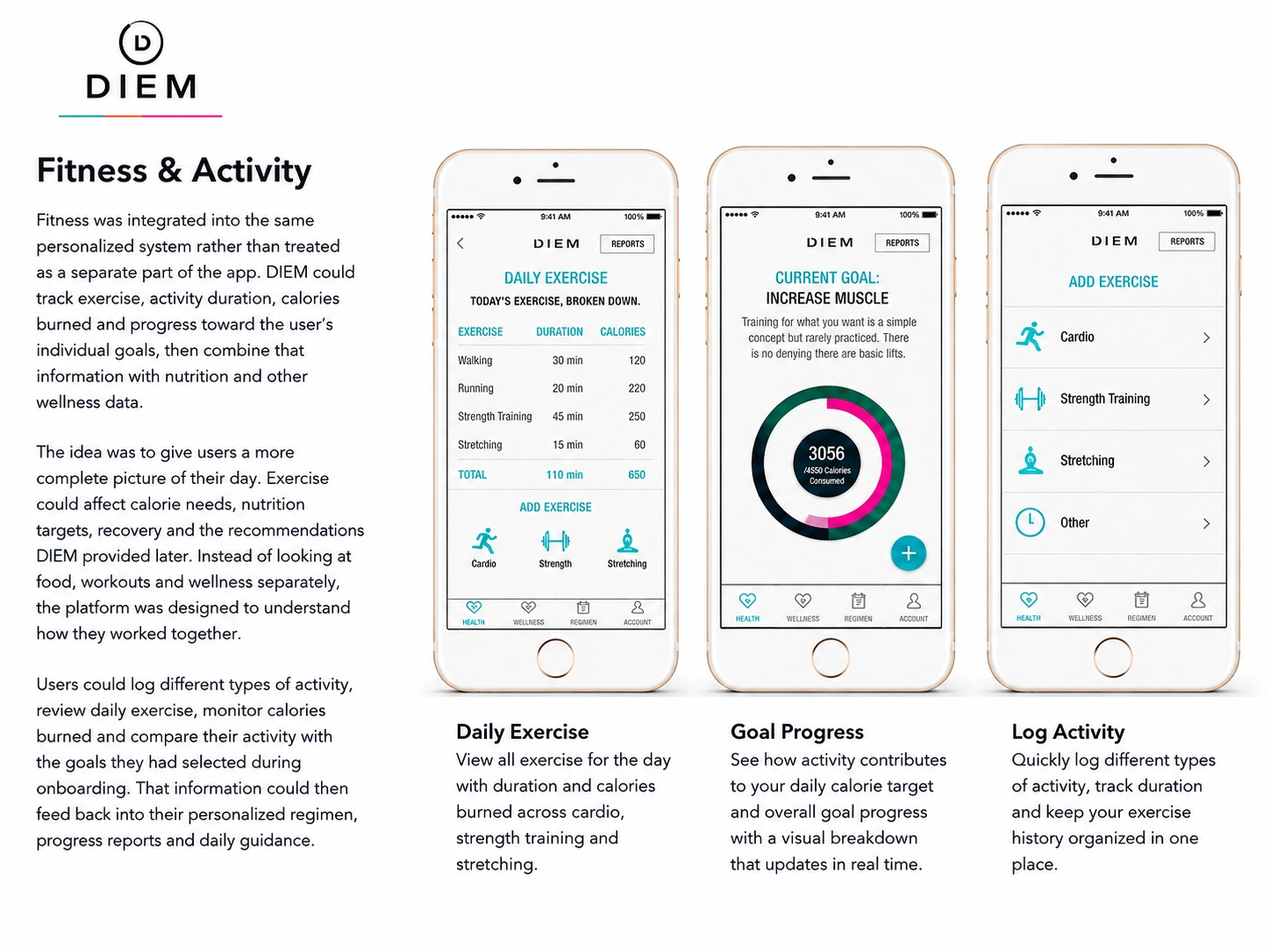
Fitness was integrated into the same personalized system as nutrition and wellness rather than treated as a separate workout tracker. DIEM could track exercise, activity duration, calories burned and progress toward the user’s individual goals, but the calculations behind that information were designed to be specific to the person using the app.
We developed formulas and business logic that could take into account factors such as the user’s age, sex, height, weight, body size, health and wellness goals, health conditions, normal activity level, type of job and day-to-day lifestyle. The objective was to produce exercise and calorie-burn information that was more relevant to that individual instead of relying entirely on generic exercise databases that often apply the same assumptions to everyone.
That personalized information could then work together with the nutrition side of DIEM. Exercise and daily activity could affect calorie needs, nutrition targets, recovery, regimen items and the recommendations the user received later in the day. DIEM was designed to look at what the person ate, how active they were, what their goals were and what their body still needed as parts of one connected system.
Fitness guidance also went beyond formal workouts. DIEM could deliver practical activity suggestions throughout the day based on the user's lifestyle, goals and circumstances. A user might receive a simple suggestion such as:
Take the stairs at work today instead of the elevator.
Park toward the back of the parking lot when you go to lunch and get a few extra minutes of walking.
Take a short walk before heading back to work.
These were deliberately small, achievable actions. DIEM was built around the reality that busy people may not always have time for a full workout, but they can still make choices throughout the day that move them in the right direction.
Users could also log different types of exercise, review their daily activity, monitor estimated calories burned and compare their progress with the goals they selected during onboarding. That information then fed back into their personalized regimen, daily tips, progress reports and longer-term recommendations.
The goal was not simply to record exercise. It was to create a fitness system formulated around the individual and then use that information to help them make better decisions throughout the day.
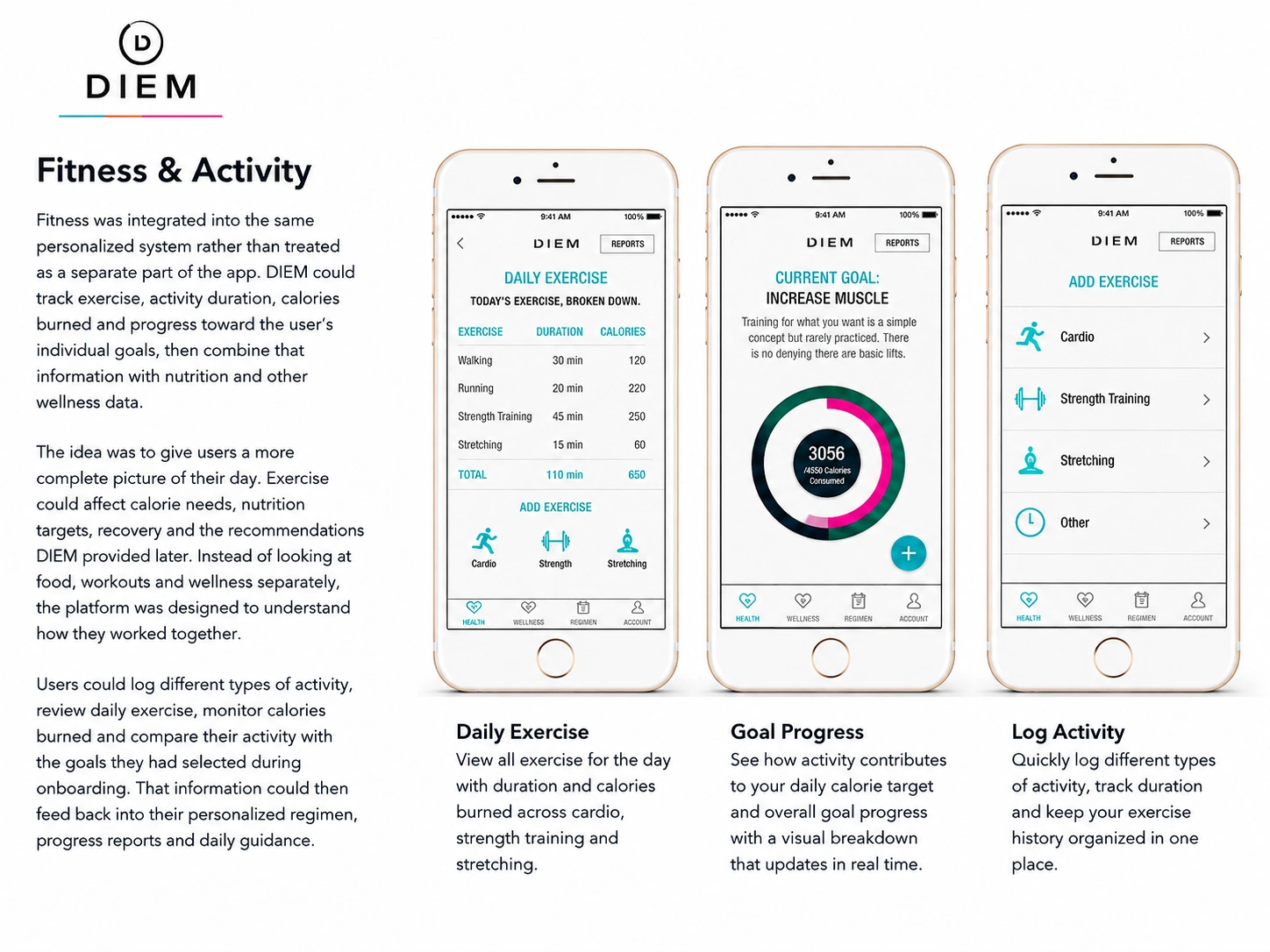
DIEM personalized fitness around the individual, using factors such as age, sex, weight, goals, health conditions, activity level and lifestyle to calculate more relevant exercise guidance, calorie burn and practical daily activity recommendations.
Progress Reports & Professional Sharing
DIEM was designed to turn everything a user recorded—nutrition, exercise, progress and daily regimen activity—into useful information they could review over time instead of leaving it scattered throughout the app.
Users could generate daily, weekly and summary reports showing their nutrition, exercise, food entries, progress and other key wellness information. Reports could be saved, downloaded or emailed, making it easy to keep a personal record or share progress with someone helping manage their health or fitness goals.
An important part of the larger DIEM concept was the professional side of the platform. Trainers, coaches, dietitians and healthcare professionals could potentially review a client's information through a professional portal, follow progress between appointments, communicate with the user and provide additional guidance or tips.
That created a connection between what happened in a person's everyday life and the professional helping them. Instead of relying only on what someone could remember during an appointment or training session, DIEM could provide a much clearer picture of what they were eating, how active they were, where they were struggling and how their habits were changing over time.
The goal was to make DIEM useful not only as a daily wellness app, but as a shared platform for ongoing accountability, coaching and better-informed decisions.
DIEM turned daily nutrition, exercise and wellness activity into progress reports users could review, download or share with trainers, coaches and healthcare professionals for better ongoing guidance and accountability.
White-Label, Partnerships & Business Model
DIEM was designed from the beginning to become more than a single consumer wellness app. The same personalization engine, nutrition and fitness logic, regimen system, content platform and reporting tools could be adapted into white-label programs for employers, health organizations, insurance programs, fitness companies, trainers, coaches and other strategic partners.
A partner could offer DIEM under its own brand while still using the underlying technology and personalization system. That created a path to recurring licensing revenue without having to build an entirely different platform for every client. An employer, for example, could use a branded version as part of a corporate wellness program, while a fitness organization could use the same underlying platform to support its members and professionals.
DIEM also created opportunities for carefully integrated commerce and strategic product partnerships. Because the system could recognize patterns in a user's nutrition over time, it could first recommend practical food choices and, when appropriate, identify situations where a supplement might be worth considering. That opened the door to partnerships with established supplement companies and the ability to offer relevant products directly through the platform based on an actual identified user need rather than generic advertising.
The professional side of DIEM expanded the model further. Trainers, coaches, dietitians and healthcare professionals could potentially use the platform to follow clients between appointments, review progress, communicate with users and provide additional guidance. This created potential revenue through professional subscriptions, enterprise licensing, white-label deployments, corporate wellness programs, strategic partnerships, sponsored professional content and integrated ecommerce.
The larger business opportunity was the ability to use one core technology platform across multiple markets and revenue channels while keeping the central DIEM experience intact: understand the individual, recognize what they need, and deliver practical personalized guidance that helps them make better decisions in real life.
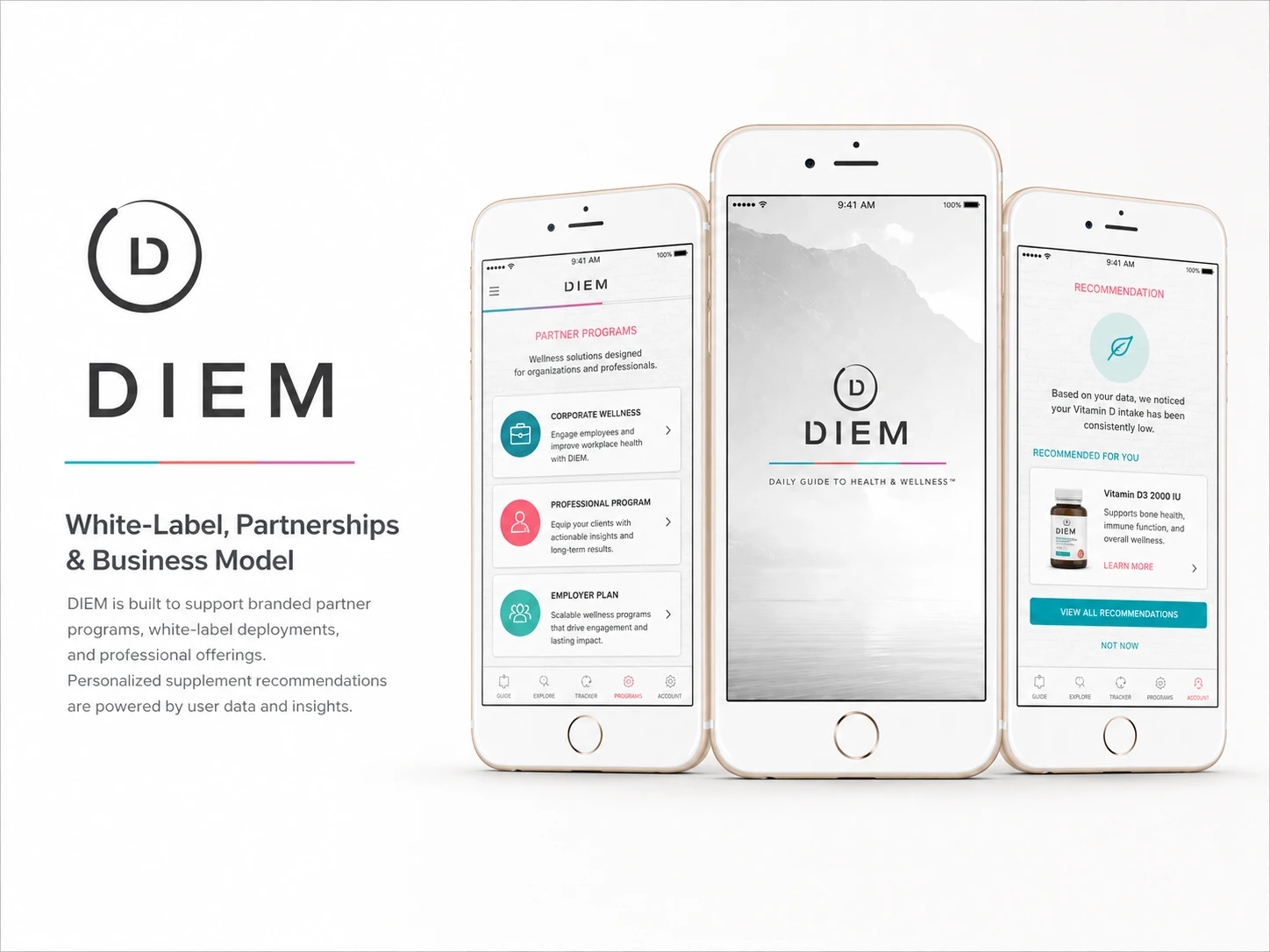
DIEM was designed to extend beyond a single consumer app through white-label programs, professional partnerships and personalized product recommendations driven by each user’s health, nutrition and activity data.
My Role & What DIEM Demonstrates
I founded DIEM and led the project from the original concept through years of product development, testing and refinement. My role went far beyond simply coming up with the idea. I worked directly with developers, designers, dietitians, physicians and other professionals to define how the platform should work, what information it needed to collect and how that information could be turned into useful personalized guidance.
I helped develop the product strategy, user experience, feature requirements, personalization rules, nutrition and fitness logic, reporting concepts, professional tools, business model, branding, marketing and commercialization strategy. That included helping create formulas and decision logic designed to make recommendations more specific to the individual instead of relying only on generic health and fitness data.
DIEM demonstrates my ability to take a complicated idea and turn it into a real product—bringing together business strategy, technology, user experience, professional expertise, data, content and commercialization into one connected platform.
It also reflects the way I approach product development in general: understand the real problem first, build around the customer, coordinate the right people and resources, and keep pushing the concept from an idea toward something that can actually be launched, licensed or brought to market.
Like this project
Posted Sep 1, 2026
Founded and led development of a personalized health platform combining nutrition, fitness, lifestyle guidance, professional content and user reporting.
Likes
0
Views
8
Timeline
May 1, 2012 - Ongoing