Case Study: Exoplanets.Art - Advanced Sci-Viz IP Architecture

David Argemí


Case Study: Exoplanets.art | 3D Look Development & Procedural Environments

Project Overview The objective of this ongoing R&D studio project is to bridge the gap between rigorous scientific data and high-end cinematic storytelling. The core challenge was to develop a scalable procedural pipeline capable of rendering planetary-scale environments while eliciting deep emotional responses from the audience—transforming cold astrophysical data into a visceral, visually impactful experience.
Role & Core Contributions
Art Direction & Look Development: Translating scientific papers (temperature, atmospheric pressure, exotic states of matter) into photorealistic 3D assets and atmospheric lighting.
Technical Pipeline Architecture: Managing massive datasets and multi-trillion polygon scenes using high-performance workflows (Isotropix Clarisse, Houdini Mantra, and modern USD pipelines like Solaris/Karma).
Compositing & Post-Production: Seamlessly integrating CGI procedural environments with live-action footage (e.g., Mojave Desert plates).
Technical Highlights & Deliverables
Massive Scale Environments (KOI 55c & Kepler-10c): Developed procedural generation systems to create barren, crystalline landscapes and hyper-compressed geometric formations. Successfully managed scenes with several trillion polygons across multiple shots without compromising render stability.
Atmospheric & Emotion-Driven Lighting (Wasp-12b & HD 189733 b): Designed complex volumetric simulations to render super-hot silicate atmospheres and deep-space atmospheric scattering, prioritizing cinematic gravity and emotional impact over flat scientific diagrams.
Data-Driven 3D Art & Academic Validation (HD 191939 & WD1145+017): Collaborated directly with MIT Ph.D. astrophysicists to validate the visual integrity of multi-planetary systems and debris disks. This ensures that the visual impact is backed by published, peer-reviewed orbital mechanics.
KOI 55c proved to be one of the most challenging environments to produce back in 2017. It managed several trillion polygons across multiple shots, rendered primarily in Isotropix Clarisse. Additional shots were rendered in Houdini Mantra and composited. Clarisse proved to be groundbreaking at the time (2017–2018) and remains arguably unmatched for handling massive datasets as an independent artist. Only recently have modern USD pipelines like Solaris and Karma begun to approach that caliber of performance.
Wasp-12b remains one of the most acclaimed pieces of the Exoplanets archive—its visual footprint so impactful it has been widely circulated and referenced across the internet. In 2017 it was discovered that the planet is black as asphalt with a faint red glow, however, this version keeps on being the fans favorite. The spectacular atmospheric rendering, paired with Beethoven’s Moonlight Sonata, establishes a profound emotional gravity. Witness the brutal demise of a colossal gas giant, and reach out to discuss how we can bring this level of visual impact to your next project.
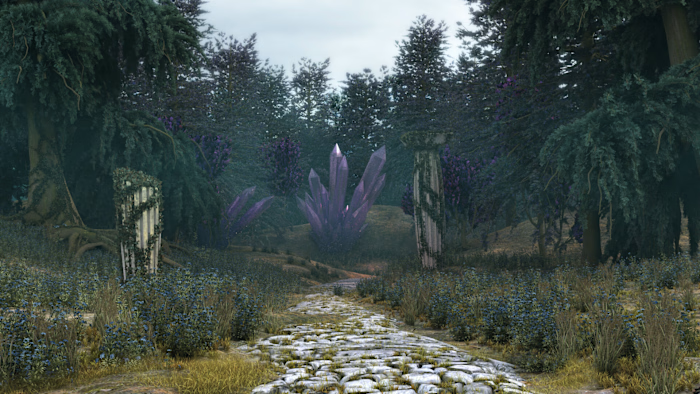
The concept behinmd Kepler-10c was inspired by research papers suggesting the planet's temperature and pressure could force water into exotic hyper-compressed states, such as Ice VII. I imagined a barren, semi-viscous crystalline landscape shaped by outlandish geometric formations always growing and collapsing, all submerged beneath a dense, Venus-like atmosphere.
WD1145+017 came as a help to my friend Mariona Badenes Agustí's PhD presentation, who a couple of years before discovered and validated HD191939 system (Check the small documentary about below)
Discovered in 2015 by Prof. Andrew Vanderburg using the Kepler Telescope, it became a special object of interest due to its intriguing features. The changes in its apparent brightness make us believe that the star has a giant debris disk. This disk could be the remnants of a defunct planet still orbiting around after the red giant phase of the star.
Mariona Badenas, a Ph.D. candidate at MIT (USA) specializing in exoplanets, led the discovery and validation of HD 191939, a multi-planetary system composed of at least three sub-Neptune-sized planets around a Sun-like star. The uniqueness of HD 191939 inspired her to create this beautiful short documentary together.
You will find the HD 191939 manuscript paper here: https://bit.ly/3HAufHj
The white PDF paper for the small documentary is here: https://bit.ly/3rA85Qb
From a distance, HD 189733 b looks like a tranquil blue marble, but that deep azure color hides one of the most dangerousd environments known by humanity. The blue doesn't come from oceans, but from a super hot atmosphere filled with silicate particles. For this sequence, I wanted to capture the terrifying contrast of this hot Jupiter—a visually stunning world where it literally rains molten glass sideways at supersonic speeds. My goal was to make the viewer feel the raw, atmospheric hostility lurking beneath that calm -still beautifull-blue shell.
Kepler 186 F was an exercise of compositing, inserting all the 3D features of the planet in a video of the Troma Pinnacles, in the Mojave Desert (California, USA)
It was rendered using the first Isotropix Raytracer with a high level displacement and just composed in After Effects.
Like this project
Posted Oct 5, 2026
Transforming astrophysical data into a emotionally resonant Intellectual Property (IP) with a vibrant, empotioal storytelling
Likes
0
Views
4
Timeline
Jan 5, 2016 - Oct 5, 2026