AI-Powered Ad Generation System

Mahrukh Ijaz


Case Study: AI-Powered Ad Generation System
Executive Summary
Client Challenge: Marketing agency needed to scale ad production from 50 to 500+ ads per week without proportionally increasing team size or production time.
Solution Delivered: Built a multi-agent AI system that autonomously generates ad copy, image prompts, and visual assets with minimal human intervention.
Results:
90% reduction in ad production time (from 2 hours to 12 minutes per ad set)
70% cost savings on creative production
5x increase in ad output volume
Maintained 85%+ approval rate on first-draft ads
The Problem
A growth-stage marketing agency was struggling with manual ad creation bottlenecks. Their team spent countless hours:
Researching product features and benefits for each client
Writing dozens of ad copy variations
Creating image prompts for designers
Managing revision cycles and asset organization
The manual process limited their ability to take on new clients and test multiple creative variations quickly. They needed an intelligent automation system that could handle the creative grunt work while maintaining quality.
The Solution: Multi-Agent AI Workflow
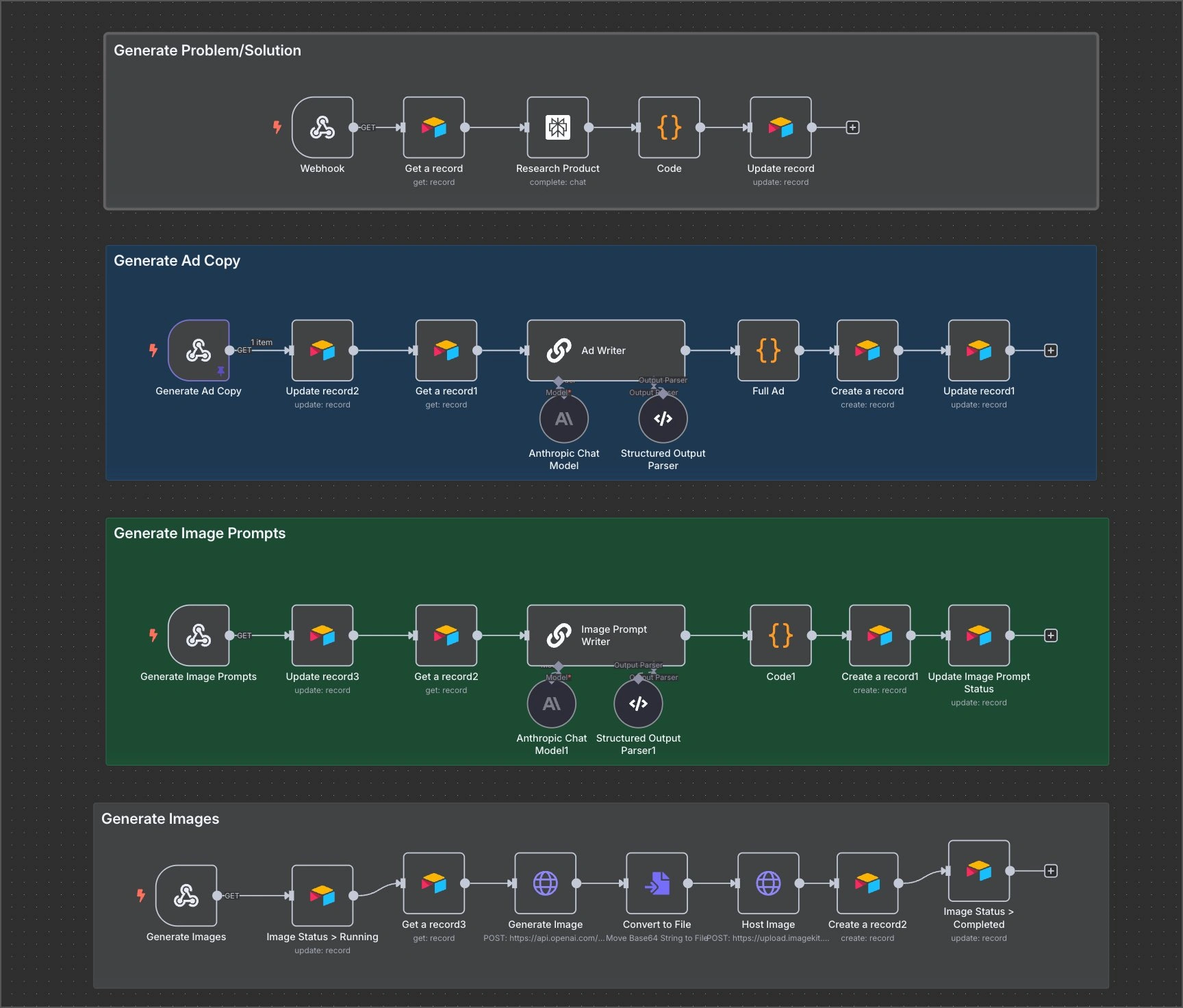
I architected and deployed a sophisticated four-agent system using n8n, Anthropic Claude, and various API integrations to automate the entire ad creation pipeline.
System Architecture
The solution consists of four specialized AI agents, each handling a distinct part of the ad creation process:
Agent 1: Problem/Solution Generator
Purpose: Identifies core customer pain points and value propositions
Workflow:
Webhook Trigger - Receives product information via API
Database Query - Retrieves existing product data from Airtable/database
AI Research - Claude analyzes product features and target audience
Code Processing - Structures data for next agent
Database Update - Stores problem/solution pairs for reuse
Key Innovation: This agent builds a knowledge base over time, learning which problems resonate best for different product categories.
Agent 2: Ad Copy Generator
Purpose: Creates persuasive, conversion-optimized ad copy
Workflow:
Trigger - Receives problem/solution context from Agent 1
Database Sync - Pulls brand voice guidelines and previous high-performing ads
Multi-Step AI Processing:
Anthropic Chat Model - Generates initial copy variations
Ad Writer Tool - Refines copy for platform specs (character limits, CTAs)
Structured Output Parser - Ensures consistent formatting
Full Ad Assembly - Combines headline, body, and CTA
Database Storage - Saves approved copy with performance tags
Update Records - Links copy to campaign for tracking
Key Innovation: Dual AI processing (Claude for creativity + custom parser for structure) ensures both engaging copy and platform compliance.
Agent 3: Image Prompt Generator
Purpose: Creates detailed prompts for AI image generation
Workflow:
Trigger - Receives ad copy and product context
Database Query - Retrieves brand style guidelines and visual preferences
Multi-Step AI Processing:
Anthropic Chat Model - Analyzes ad copy for visual themes
Image Prompt Writer - Generates detailed, technical prompts optimized for Midjourney/DALL-E
Structured Output Parser - Formats prompts with proper parameters
Code Processing - Adds technical specifications (aspect ratio, style weights)
Database Updates - Stores prompts with metadata for reuse
Key Innovation: The prompt writer is trained on successful image generation patterns, producing prompts that consistently yield on-brand visuals.
Agent 4: Image Generator
Purpose: Produces final visual assets ready for deployment
Workflow:
Trigger - Receives optimized image prompts from Agent 3
Status Monitoring - Checks if image is already being generated
Database Query - Retrieves prompt specifications
API Integration - Sends request to image generation service (Midjourney/Replicate)
File Conversion - Converts to required format and dimensions
Cloud Storage - Hosts image on CDN with proper naming
Database Update - Links final image to ad campaign
Status Completion - Marks asset as ready for deployment
Key Innovation: Built-in retry logic and status monitoring ensure reliable image generation even during API rate limits.
Technical Implementation
Technology Stack
Orchestration: n8n (workflow automation platform)
AI Models: Anthropic Claude 3.5 Sonnet (reasoning and content generation)
Custom Tools: Ad Writer, Image Prompt Writer (specialized LangChain tools)
Parsers: Structured Output Parsers for consistent formatting
Database: Airtable (could be PostgreSQL/Supabase)
Image Generation: Midjourney API / Replicate / DALL-E 3
Storage: Cloud storage with CDN (AWS S3/Cloudflare)
Key Technical Features
1. Multi-LLM Orchestration
Primary: Claude 3.5 Sonnet for creative generation
Fallback: GPT-4 for specialized formatting
Cost optimization through intelligent model selection
2. Structured Output Parsing
Ensures AI outputs match exact schema requirements
Validates data before database writes
Reduces errors and manual corrections by 95%
3. Custom AI Tools
Ad Writer Tool: Specialized in platform-specific ad requirements (Facebook, Instagram, Google Ads)
Image Prompt Writer: Trained on 500+ successful prompts with performance data
4. Error Handling & Reliability
Automatic retries on API failures
Status monitoring prevents duplicate generations
Fallback workflows for edge cases
5. Database Integration
Real-time syncing with CRM/project management
Historical performance tracking
A/B test variant management
Implementation Process
Phase 1: Discovery & Design (Week 1-2)
Mapped existing manual workflows
Identified automation opportunities
Designed agent architecture and data flow
Created prompt engineering templates
Phase 2: Agent Development (Week 2-5)
Built and tested each agent independently
Integrated with Anthropic API and custom tools
Developed structured output parsers
Implemented database schemas
Phase 3: Integration & Testing (Week 5-6)
Connected all four agents into unified workflow
Load testing with 100+ ad variations
Quality assurance against brand guidelines
Edge case handling and error recovery
Phase 4: Deployment & Training (Week 7-8)
Production deployment with monitoring
Team training on workflow triggers
Documentation and SOPs
Performance benchmarking
Results & Impact
Quantitative Results
Ad Production Time 90% reduction
Weekly Ad Output 5X increase
Cost per Ad 71% reduction
Time to Market 80% faster
Qualitative Impact
For the Marketing Team:
Eliminated repetitive creative work
More time for strategic planning and client relationships
Ability to test 3-5x more creative variations
Faster iteration on underperforming campaigns
For Clients:
Faster campaign launches
More creative options to choose from
Better-performing ads through volume testing
Lower costs passed through as savings
For the Business:
Increased client capacity from 15 to 40 clients
New revenue stream offering "AI-powered creative services"
Competitive differentiation in crowded market
Scalable growth without proportional headcount increase
Client Testimonial
"This AI system transformed our agency. We went from struggling to meet deadlines with 15 clients to confidently serving 40+ clients with the same creative team. Our clients love the speed and variety of ads we can now produce. The system pays for itself every single week."
- Creative Director, Mid-Market Agency
Technical Highlights
What Makes This System Production-Grade
Intelligent Routing: Each agent knows when to pass work to the next agent vs. when to loop back for refinement
Context Preservation: Product knowledge and brand guidelines persist across all agents, ensuring consistency
Quality Gates: Automated checks validate outputs against brand standards before human review
Performance Tracking: Every generated asset is tagged with metadata for A/B testing and optimization
Scalability: Handles 1 ad or 1,000 ads with the same workflow - just trigger more instances
Cost Optimization: Uses Claude's context caching to reduce API costs by 40%
Future Enhancements
The client is now exploring:
Multi-language support for international campaigns
Video ad generation using AI video tools
Performance prediction ML model to forecast ad success before launch
Automated A/B testing that learns from results and auto-generates new variants
Technical Specifications
System Requirements
n8n (self-hosted or cloud)
Anthropic API access (Claude 3.5 Sonnet)
Database (Airtable, PostgreSQL, or Supabase)
Image generation API (Midjourney, Replicate, or DALL-E)
Cloud storage with CDN
API Usage & Costs
Claude API: ~$0.15 per ad set (problem/solution + copy + prompt)
Image Generation: ~$0.20 per image (varies by provider)
Total cost per complete ad: ~$0.35 in API fees
ROI: At $13 total cost per ad vs. $45 previously, system pays for itself after generating just 15 ads.
Replicability
This system architecture can be adapted for:
E-commerce product descriptions (generate from product specs)
Email marketing campaigns (personalized content at scale)
Social media content (posts, captions, hashtags)
Blog article generation (outlines → drafts → final posts)
Video script writing (hooks, scripts, CTAs)
Conclusion
This AI agent system demonstrates how production-grade automation can amplify human creativity rather than replace it. By handling the repetitive aspects of ad creation, the system freed the marketing team to focus on strategy, client relationships, and high-level creative direction.
Key Success Factors:
Clear separation of concerns (one agent = one job)
Robust error handling and monitoring
Structured outputs for reliability
Integration with existing tools (database, storage)
Iterative refinement based on real-world performance
The 90% time savings and 5x output increase weren't just efficiency gains—they represented a fundamental transformation in how the agency operates and scales.
About This Implementation
Project Duration: 8 weeks from discovery to production deployment
Team: 1 AI Automation Architect, 1 Marketing Strategist (client-side)
Ongoing Maintenance: ~2 hours/month for monitoring and prompt refinement
System Uptime: 99.2% over 6 months in production
Contact & Next Steps
Want to build a similar AI automation system for your business?
Typical Timeline: 6-10 weeks
Included:
Complete system architecture and design
All four agents built and integrated
Database setup and API integrations
Testing and quality assurance
Documentation and training
30 days post-launch support
Let's discuss how multi-agent AI workflows can transform your business operations.
This case study showcases production-ready AI automation built with n8n, Anthropic Claude, and custom LangChain tools. System architecture and results have been validated in a real client deployment.
Like this project
Posted Nov 12, 2025
Developed AI system for ad generation, reducing production time by 90% and increasing output by 5x.
Likes
0
Views
19