Order CSV Cleanup — Traceable Python Automation

ming lei


This demonstration shows a defined order-data cleanup workflow using synthetic records. It is a self-directed portfolio sample, not a paid client project. OpenAI Codex autonomously implemented the script and executed its automated tests; no human review is claimed.
The input consists of three UTF-8 CSV files containing 12 records. The standard-library Python script normalizes dates and decimal amounts while preserving leading zeros in order IDs. It then separates retained orders, duplicates, conflicting orders and invalid records.
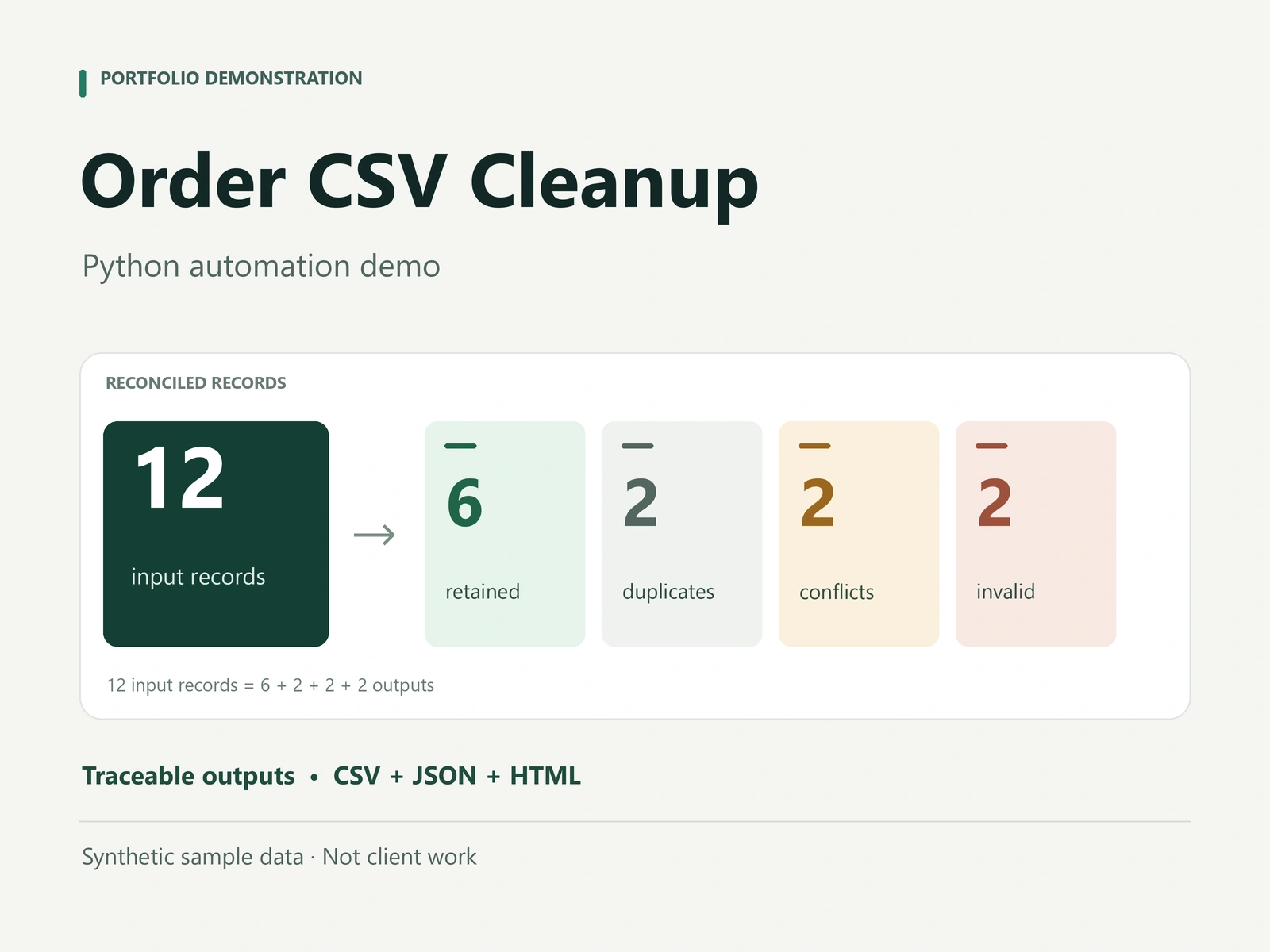
The result accounts for every input record: 6 retained orders, 2 duplicates, 2 conflicts and 2 invalid records. Both versions of a conflicting order are placed in the exception report instead of silently selecting one. Every output record includes its source filename and logical record number, so a result can be traced back to the original data.
The delivery package contains source code, sample inputs, a cleaned CSV, duplicate and exception CSVs, a JSON reconciliation report, an offline HTML report and setup instructions. The original input files remain unchanged, and the script rejects an existing output directory to protect earlier results.
Ten automated checks passed, covering reconciliation, traceability, source preservation, invalid amounts, malformed headers, overwrite protection and HTML escaping.
This sample supports the documented four-column CSV format: order_id, order_date, customer and amount. It does not claim arbitrary Excel-workbook support or tested large-file performance. The displayed total of 400.60 is a synthetic order amount, not earned revenue. A commissioned adaptation would begin with a redacted sample, agreed transformation rules and clear acceptance checks.
Like this project
Posted Sep 9, 2026
A Python demo that reconciles 12 synthetic order records into traceable CSV, JSON and HTML outputs, with 10 automated checks.
Likes
0
Views
7