Healthcare SEO Content: Choosing the Right EHR for SLP Practices

Ajay Singh



For a speech-language pathology practice, choosing an electronic health record (EHR) is about more than storing patient notes.
The software has to fit the way an SLP clinic actually operates, from intake and clinical documentation to insurance verification, referrals, scheduling, and billing.
That makes choosing an EHR more complicated than comparing feature lists.
A small private practice may be perfectly comfortable with an established therapy platform. A larger organization operating across multiple locations may eventually find that its software requires too many workarounds.
So how do you determine which approach makes sense?
Start With the Workflow, Not the Software
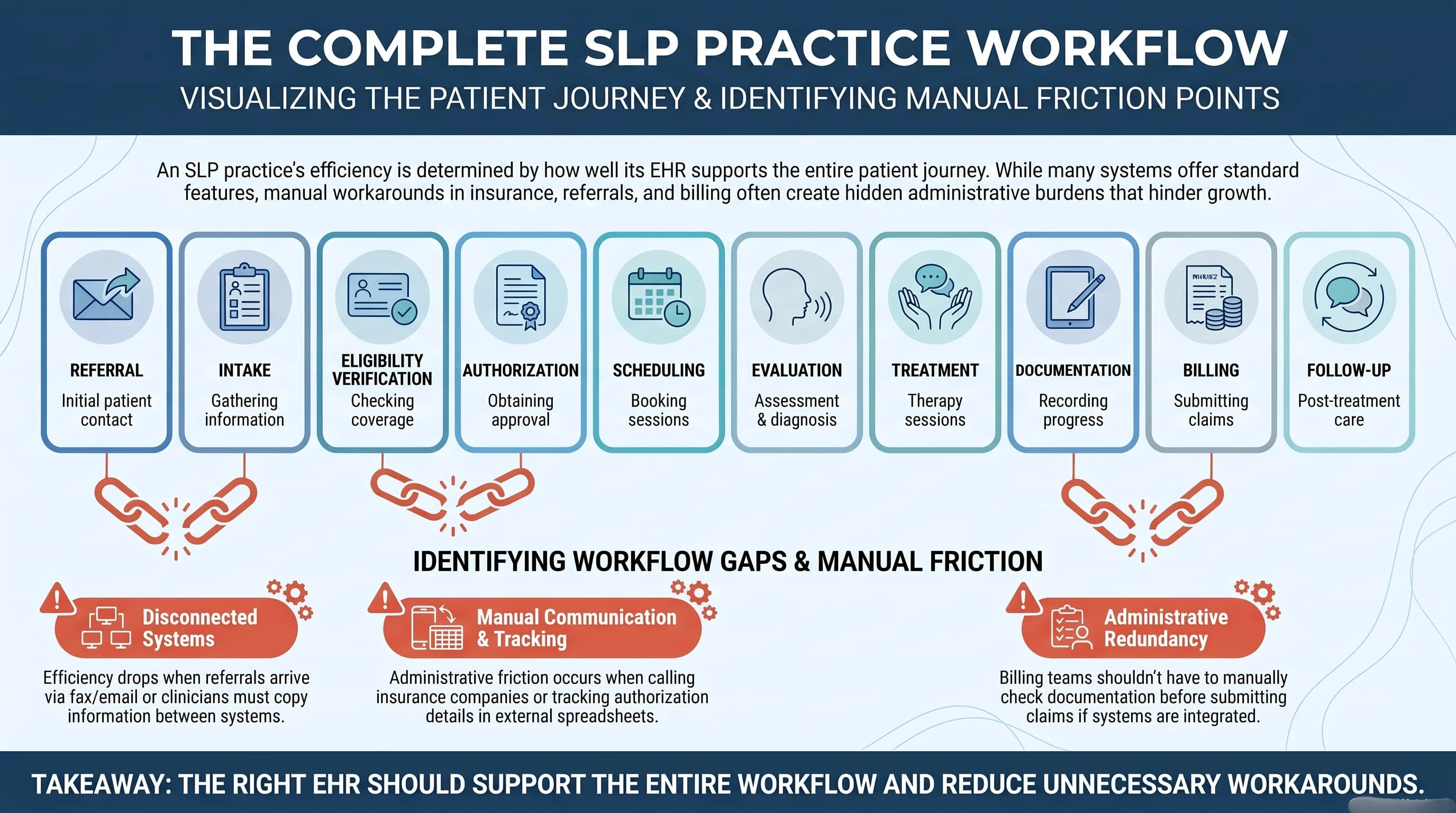
SLP Practice EHR Workflow: From Patient Referral to Billing and Follow-Up
Before comparing EHR vendors, map the patient journey through your practice.
A typical SLP workflow may look something like this:
Referral → Intake → Eligibility verification → Authorization → Scheduling → Evaluation → Treatment → Documentation → Billing → Follow-up
Now identify where employees leave the EHR to complete the process.
Are they calling insurance companies?
Are referrals arriving through email or fax?
Are authorization details being tracked in spreadsheets?
Are clinicians copying information between systems?
Are billing teams manually checking documentation before submitting claims?
These gaps are often more important than the number of features listed on an EHR's product page.
What Should an SLP EHR Handle?
While requirements vary by practice, several capabilities deserve particular attention.
Clinical Documentation
An SLP EHR should support documentation that reflects speech-language pathology workflows rather than forcing clinicians into generic templates.
Depending on the practice, useful functionality may include:
Assessment templates
Treatment notes
Goal tracking
Progress documentation
Home-practice information
Supervision documentation
Specialty-specific clinical fields
The goal is to make documentation easier without sacrificing clinical detail.
Insurance and Authorization
Insurance workflows can become a significant administrative burden.
Staff may need to determine whether speech therapy is covered, whether prior authorization is necessary, how many visits are approved, and when authorization expires.
A strong EHR should make this information easy to record, retrieve, and monitor.
Where integrations are available, insurance verification can also be incorporated into the intake process.
The important question is not simply whether an EHR offers "insurance verification."
Ask how much manual work remains after the feature is enabled.
Referral Management
SLP practices often receive patients through physicians and other healthcare organizations.
A referral-management workflow can help capture the referral, route it to the appropriate clinician, track its status, and maintain communication with the referring provider.
This becomes increasingly valuable when a practice manages referrals from multiple sources.
Scheduling and Billing
Scheduling should ideally reflect the information collected during intake and insurance verification.
For example, staff should be able to see whether an authorization requirement has been addressed before moving a patient through the scheduling process.
Similarly, billing workflows should have access to relevant documentation and authorization information rather than requiring staff to reconstruct it manually.
Off-the-Shelf EHR or Custom Software?
For most SLP practices, the first option to evaluate should be an established EHR.
Platforms such as TherapyNotes, SimplePractice, ClinicSource, and other therapy-oriented systems can provide a practical foundation for smaller organizations.
The question changes when the practice becomes more complex.
Off-the-Shelf Makes Sense When:
The practice has one or a small number of locations.
Its payer mix is relatively straightforward.
Existing templates meet clinical documentation needs.
Referral volume is manageable.
Staff can complete administrative tasks without excessive workarounds.
In this situation, the lower implementation burden of an existing platform can outweigh the benefits of customization.
Customization May Be Worth Considering When:
Multiple locations follow different workflows.
The organization operates across states.
Insurance authorization creates substantial administrative work.
Referral volume is high.
Several systems need to exchange information.
Existing software requires extensive manual work.
The organization needs functionality that commercial platforms do not provide.
There is also a middle ground.
A practice does not necessarily have to replace its entire EHR. A custom integration or workflow module may solve a specific bottleneck while allowing the organization to retain its existing system.
Multi-State SLP Practices Have an Additional Challenge
Regulatory requirements should be considered when selecting or designing an EHR.
An organization operating in multiple states may need to account for differences in licensing, supervision, documentation, and telehealth requirements.
Instead of relying entirely on staff memory, organizations can configure software workflows around applicable requirements.
For example, the system could associate specific documentation fields or workflow rules with a clinic location.
However, software should support compliance—not replace professional regulatory review. Requirements can change, and practices should verify current rules with the appropriate state authorities.
How to Evaluate an EHR Before Buying
A vendor demonstration can make almost any EHR look impressive.
Instead of asking for a generic product tour, bring your actual workflow into the conversation.
Ask the vendor to demonstrate:
New patient intake
How much information has to be entered manually?
Insurance verification
What information is retrieved automatically, and what still requires staff intervention?
Authorization tracking
Can staff see authorization status and expiration dates without using another system?
Clinical documentation
Can SLP-specific templates be configured around the practice's documentation requirements?
Referrals
How are inbound referrals received, assigned, tracked, and closed?
Billing
How does clinical documentation connect to billing workflows?
Multi-location support
Can different locations have different configurations or workflows?
Interoperability
Can the system exchange information with other healthcare platforms when required?
Reporting
Can managers identify workflow bottlenecks and administrative trends?
Security and compliance
What controls exist for access, audit trails, data protection, and user permissions?
These questions reveal considerably more than a standard feature checklist.
A Simple Decision Framework
Think of the decision in three levels.
Level 1: Simple Practice
One location + straightforward workflows + manageable administrative workload
→ An established EHR is likely the most practical choice.
Level 2: Growing Practice
Multiple clinicians + increasing referral volume + recurring workflow gaps
→ Compare established platforms with targeted integrations or custom modules.
Level 3: Complex Organization
Multiple locations + multi-state operations + complex payer requirements + significant manual processes
→ A custom or highly integrated EHR becomes worth serious consideration.
The key is not practice size alone.
Complexity is the real variable.
A 30-clinician practice with simple workflows may have fewer technology problems than a 10-clinician organization operating across several states with complicated insurance and referral processes.
What About ROI?
Custom healthcare software should not be justified simply because it has more features.
The business case should come from measurable improvements.
Consider tracking:
Administrative hours spent on authorization
Referral processing time
Documentation time
Claim rework
Denials
Duplicate data entry
Time between referral and appointment
Staff productivity
Then estimate how much of that work could realistically be removed or reduced.
For example, if employees spend several hours each week moving information between an email inbox, payer portal, spreadsheet, and EHR, that workflow represents a measurable cost.
A technology investment becomes easier to evaluate when that cost is quantified.
What Should an SLP Practice Do First?
Before purchasing a new EHR or commissioning a custom one, conduct a workflow audit.
Document:
What happens → Who performs it → Which system they use → Where information is entered → Where delays occur → What gets repeated
Then rank the problems by impact.
You may discover that the practice does not need an entirely new EHR.
Perhaps a better referral workflow solves the biggest problem.
Perhaps insurance verification is the bottleneck.
Perhaps documentation is consuming the most clinician time.
Or perhaps the existing system simply lacks the interoperability required as the organization grows.
The right technology decision starts with identifying that problem.
The Right Speech Therapy EHR Starts With Workflow Fit
There is no universally "best" speech therapy EHR.
For a smaller SLP practice, an established platform may provide an efficient and cost-effective foundation.
For a growing or multi-location organization, however, the decision should go beyond scheduling and documentation. Insurance workflows, referrals, interoperability, compliance requirements, and administrative workload can become equally important.
The best EHR is ultimately the one that fits the practice's workflow with the fewest unnecessary workarounds.
Don't choose an EHR because it has the longest feature list. Choose it because it makes your actual workflow easier to run.
Like this project
Posted Sep 16, 2026
Explored how a “one-size-fits-all” EHR can create workflow gaps for SLP practices, from insurance and referrals to multi-state compliance and choosing the fit.