Endocrinology EMR Guide: Features, Workflow & Vendor Comparison

Ajay Singh



It's 2 p.m. on a Tuesday at a 25-provider endocrinology group. A patient flag needs review: the Dexcom G7 hasn't synced since yesterday. A manual workaround is required the fourth time this week.
Their EMR has no native CGM integration. Staff use a separate iPad app just for glucose tracking. Two tools, two data sources, one patient record that's incomplete.
This isn't a technology failure; it's a workflow mismatch, and it's the most common complaint from endocrinology groups evaluating a switch.
Endocrinologists spend roughly 9 minutes charting for every 15 minutes of patient care (KLAS 2024 Arch Collaborative clinician burnout data). About 70% of U.S. counties lack an endocrinologist, meaning the roughly 8,000 practicing nationwide carry an outsized load. When the EMR doesn't match the workflow, that ratio gets worse for both patients and clinicians.
This guide compares four realistic paths: Epic for large systems, athenaOne and AdvancedMD for mid-market practices, Praxis for specialty-first workflow design, and custom builds for practices that need something vendors don't offer, plus the pre-RFP questions most groups skip, and why they end up regretting it.
Why Do Generic EHRs Fall Short for Endocrinology?
A generic EHR template assumes a 15-minute office visit: a chief complaint, a problem list, a few lab values, a prescription. That works fine for general internal medicine. It doesn't work for endocrinology.
A type 1 diabetic with thyroid disease and PCOS visits every 90 days and arrives with thousands of data points. CGM generates a reading every 5 minutes. TSH and T3/T4 labs trend across 2–3 years. Insulin regimens shift monthly based on seasonal patterns, stress, and activity changes. The EMR has to ingest, display, and annotate all of this without forcing the clinician into 15 clicks per patient.
Most don't.
The KLAS 2024 Arch Collaborative report identified "excessive navigation" as the top driver of clinician burnout in endocrinology. Insulin pump records reportedly require 90+ clicks per visit to access and annotate. That's not a clinician issue. That's a template issue.
Three structural gaps show up consistently:
CGM fragmentation. CGM data lives in three separate systems for roughly 90% of endocrinology practices today: the device app (Dexcom, FreeStyle Libre), the EHR, and the patient portal. These systems don't talk to each other natively on most platforms, so the clinician reconciles three records in parallel during the visit and does it again tomorrow with the next patient.
TSH trending. TSH levels need to be tracked across 36+ months to catch subclinical thyroid disease drift. Generic EHRs rarely surface 36-month trending in a single view. Specialty systems treat it as a two-click dashboard, a difference of 5–15 minutes per visit in navigation time alone.
Template rigidity. Generic diabetes templates are built for primary care documentation, not the typical three-step endocrinology visit: trend review, medication adjustment, and patient education check. Forcing an endocrinology visit into a primary care template produces documentation that's accurate but clinically shallow.
Layer on the 2015 Cures Update and USCDI v3 mandates now baseline requirements for any certified EHR, and the gap widens. Every major vendor claims compliance. Few have executed it in ways that actually serve specialty workflows.
Is Epic Right for Endocrinology Groups?
Epic is the safe default: roughly 19.5% of the ambulatory market, with 73% of users rating it favorably in KLAS's 2024 rankings. If you're part of a large health system, you may not have a choice. If you're evaluating independently, the calculus is more complicated.
Epic was built as a generalist platform. Its 40+ specialty modules (including diabetes and endocrine) are bolt-ons, not core design priorities. You get real depth in interoperability, native HL7/FHIR support, bidirectional exchange, a full patient portal stack, but shallower depth in specialty-specific workflow design.
For endocrinology specifically:
CGM integration exists, but via third-party app integrations rather than native feeds. Dexcom and FreeStyle Libre data routes through middleware before landing in the chart; you're still reconciling two systems during the visit.
TSH trending and insulin titration workflows are available but use primary-care-flavored templates that require customization to fit endocrinology visits.
Interoperability is Epic's real differentiator. If you're pulling records from referrers and pushing results to patients, Epic's breadth is hard to beat.
Cost: $150K–$250K+ in annual licensing, plus $100K–$200K for implementation.
Setup: 90–180 days minimum, often longer.
Best fit: 100+ provider health systems already running on Epic, or multi-specialty groups where endocrinology is one of several departments.
The honest trade-off: if you're a 20-provider endocrinology group not already in an Epic ecosystem, you're paying enterprise pricing for capabilities designed at enterprise scale.
Source: KLAS 2024, vendor documentation
What Do athenaOne and AdvancedMD Offer?
athenaOne is KLAS's top-rated EMR for independent practices (84% recommended, 2024), higher than Epic's 73%. It's cloud-native and all-in-one (EHR + practice management + portal), which eliminates the multi-vendor coordination that can cost mid-size specialty groups 10–15 admin hours per week.
For endocrinology:
Native CGM partnerships with Dexcom and FreeStyle Libre — direct feeds, not middleware. Data lands in the chart without manual reconciliation.
All-in-one licensing: no separate PM system, no separate portal, no three-vendor support coordination.
Cost: roughly $8K–$12K per provider/year. A 25-provider group runs $200K–$300K annually, with a 60–90-day setup.
AdvancedMD (81% recommended, KLAS 2024) differentiates on AI-assisted documentation, which vendors report cuts doc time 30–40% in specialty practices generally. That figure comes from general specialty-practice data, not an endocrinology-specific pilot; the directional signal is reasonable, but worth confirming with the vendor directly for your use case.
Best fit: 15–100 provider practices looking to avoid tool sprawl, groups that need a fast go-live without sacrificing specialty functionality, and multi-location practices that are scaling.
When Does a Specialty-Built Platform Like Praxis Make Sense?
Praxis EMR was built by practicing physicians rather than an IT organization templating every specialty. The result is different in ways that matter for endocrinology.
It's iPad-first with swipe-to-chart interaction, and templates are physician-designed per specialty. Endocrinology gets purpose-built workflows rather than diabetes-flavored primary care templates, which tends to mean providers actually use the system as designed.
The core differentiator is Praxis's "concept processor," a natural-language documentation engine that auto-structures diabetes and thyroid documentation from voice input as the clinician speaks. Vendor-reported documentation time drops 30–40% versus generic EMRs; worth validating against your own workflow during a trial.
For endocrinology:
Native CGM: Dexcom and FreeStyle Libre direct feeds
Built-in templates for thyroid, PCOS, adrenal, and diabetes
iPad-first UI that reduces click burden
Cost: $6K–$10K/provider/year
Setup: 45–60 days
Best fit: 5–50 provider specialty-focused groups where workflow speed matters more than interoperability breadth.
The honest trade-off: Praxis's interoperability depth is narrower than Epic's. For a standalone specialty practice, that's rarely the binding constraint; the constraint is usually getting clinicians to stop using a paper workaround next to the computer.
When Should an Endocrinology Group Build a Custom EMR?
The four options above cover roughly 80% of endocrinology practices. The other 20% hit a wall.
Some workflows aren't supported by any vendor out of the box: molecular endocrinology lab automation, multi-location insulin pump prescription workflows, precision medicine research integration. Every workaround becomes another tool, another API call, another point of failure.
When a custom build makes sense:
Group size of 30+ providers
Deep CGM + lab + insulin pump integration required at the platform level
A 3+ year retention plan
Willingness to own and maintain the tech stack long-term
Open-source FHIR-native backends (such as Medplum) can cut build cost 40–50% versus from-scratch development. ONC's CHPL 2024 listing includes 700+ ONC-certified EHR products, so the custom-build market has real precedent.
Reference point: A precision-medicine platform for longevity and functional-medicine clinicians built a custom EHR on a FHIR-native backend in 90 days, including an ambient scribe, a patient-facing AI layer, and custom clinical workflows. Reported results: a 70% reduction in documentation time and a 60% drop in task overhead, for a total engagement around $305K.
Cost: $150K–$500K initial, plus $30K–$50K/year support
Timeline: 90–180 days to MVP go-live
Evaluating & Implementing an Endocrinology EMR
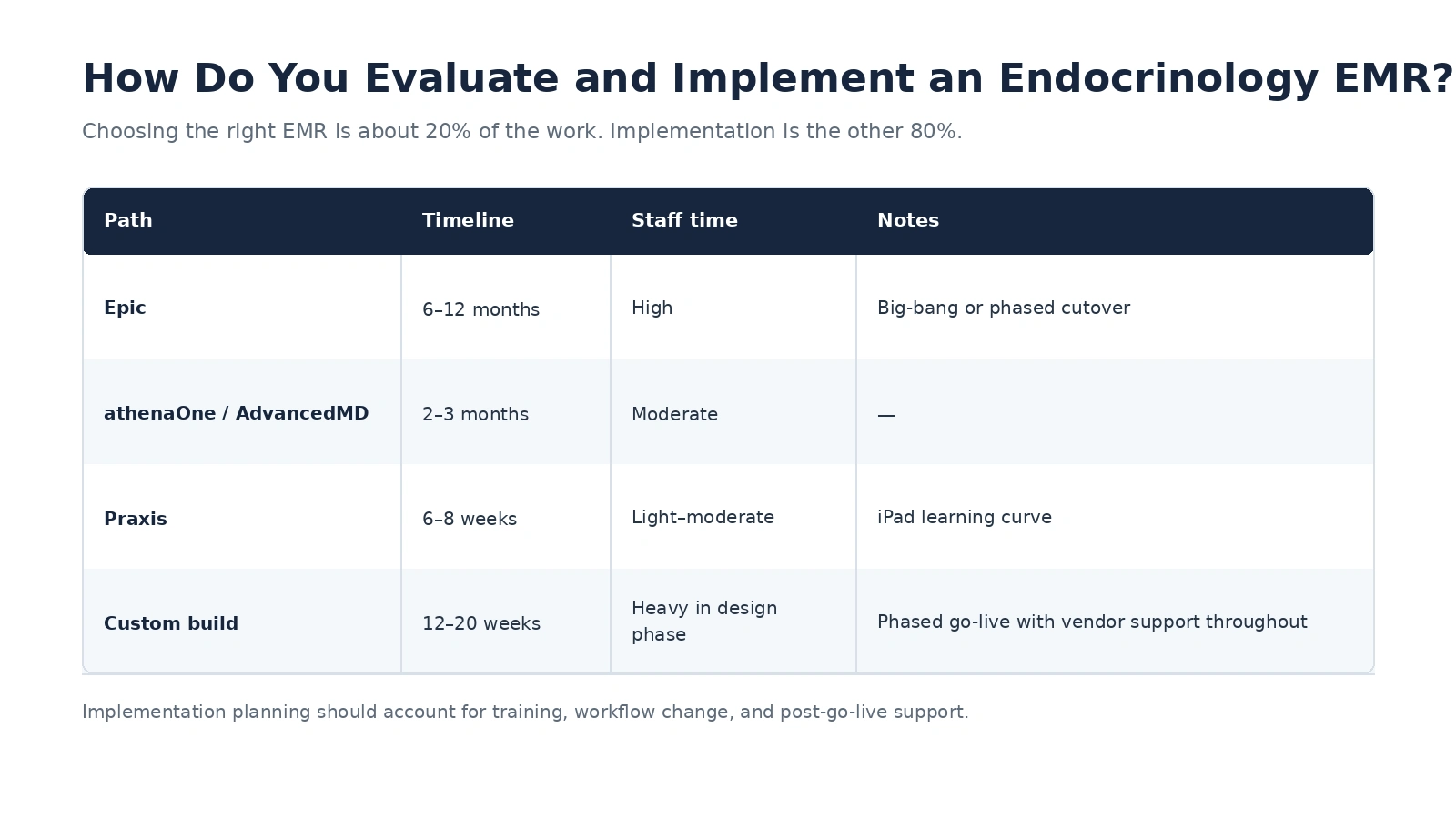
Endocrinology EMR implementation comparison
Heavy in design phase
Phased go-live with vendor support throughout
Universal risk: "pajama time" (after-hours charting) typically spikes 2–4 hours/clinician/week for the first 30–60 days. Every vendor says it's avoidable — in practice, it usually isn't. Plan for it.
Change management kills more implementations than technology does. Buy-in from every endocrinologist before go-live isn't optional.
Pre-RFP questions for every vendor:
Is CGM integration native or a workaround? (A workaround typically means $50K–$100K/year in middleware.)
Is thyroid trending a 36-month view in one screen?
What customization is included, and what costs extra?
Can you get a clean data export in five years?
Does interoperability support referrer pull and patient push without middleware?
Is USCDI v3 compliance checked, audited, and dated?
How many clinician training hours are required pre-go-live?
Is go-live support on-site or remote-only?
Back to that Tuesday at 2 p.m. which vendor actually solves the CGM problem?::
Epic: yes, after roughly 6 months and $200K
athenaOne: yes, in about 60 days, ~$8K/provider/yr
Praxis: yes, in about 45 days, iPad-first, ~$7K/provider/yr
Custom build: yes, if you plan to own the platform for 3+ years and need workflow depth no vendor offers
The Right Endocrinology EMR Starts With Device and Lab Workflow Fit
The best endocrinology EMR isn't the one with the longest feature list — it's the one that lets clinicians review CGM data, trend thyroid labs, adjust medications, and document patient education without jumping across separate tools.
Epic may fit large health systems that need enterprise interoperability. athenaOne, AdvancedMD, or Praxis may fit mid-size and specialty-focused practices, depending on how well they support CGM, lab trending, and documentation workflows in a live demo. Custom builds become worth evaluating when device integration, lab automation, insulin pump workflows, or research requirements exceed what any vendor can configure cleanly.
Start with the workflow gap. If clinicians still need a separate device portal, spreadsheet, or manual trend review to complete a visit, that's where the EMR decision should begin.
Like this project
Posted Sep 16, 2026
Turned a complex endocrinology EMR comparison into a practical buyer guide, connecting specialty workflows, CGM data, interoperability, implementation, & cost.
Likes
0
Views
2