Bilingual Portfolio Website Development

Tomi Scattini


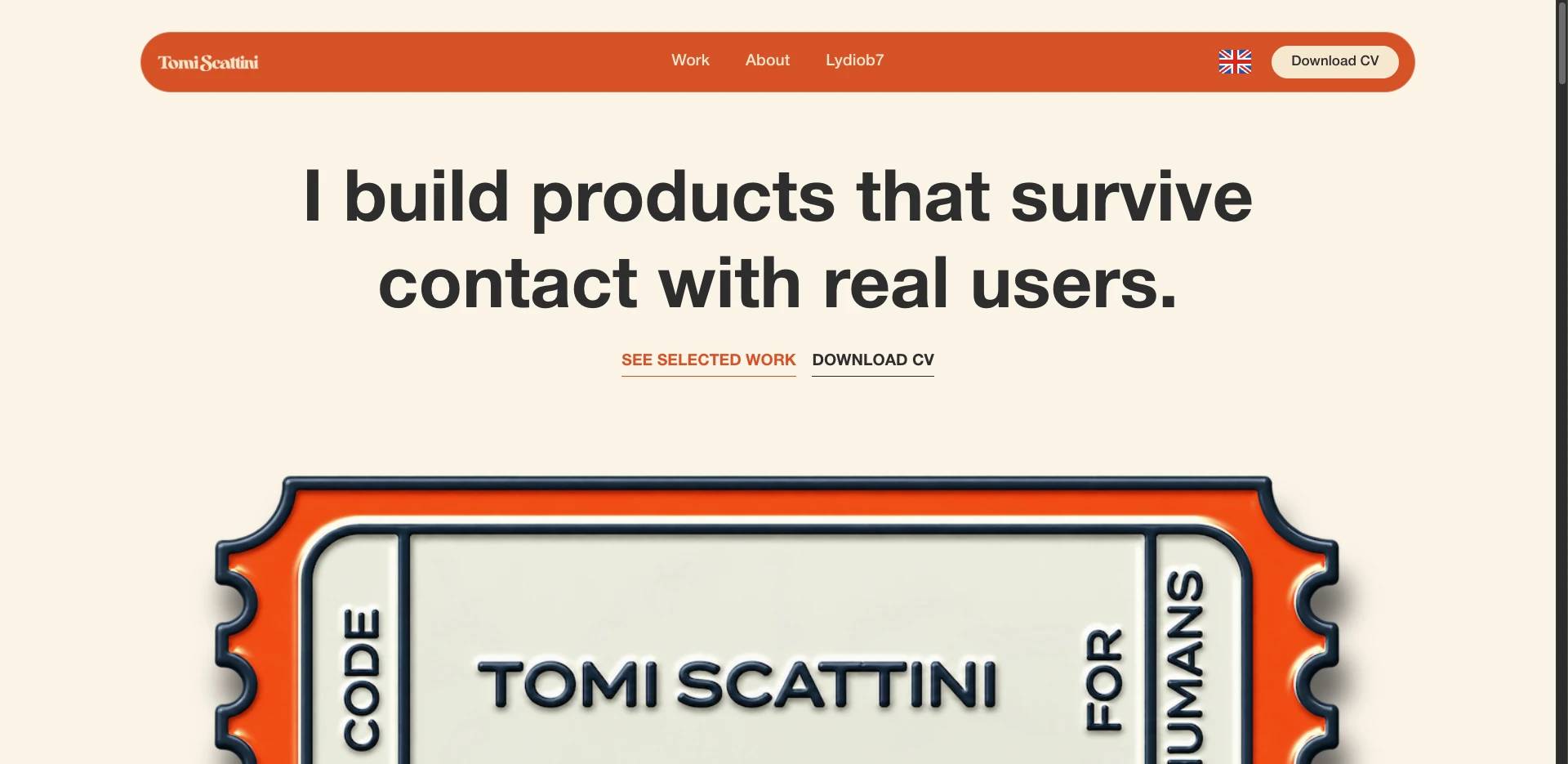
The App
Platform: Static bilingual website
Project period: September 2026 – Present
Summary
My personal portfolio is a focused presentation of my professional work as a full-stack developer. It brings together selected projects, detailed case studies, technical skills, testimonials, professional information, and downloadable résumés in a website designed specifically for recruiters, clients, and product teams.
I built the site with Astro, TypeScript, and Tailwind CSS. Unlike my broader Lydiob7 platform, which includes educational content and full-stack application functionality, this portfolio has a deliberately narrow purpose: present my work clearly and load as quickly as possible.
Challenge / Requirements
The main challenge was creating a portfolio that could hold a growing body of detailed work without becoming a heavy application or making projects difficult to browse.
The website needed to:
Present both a concise overview and complete project case studies.
Support English and Spanish across pages, navigation, metadata, and content.
Keep case-study content structured and easy to maintain outside the UI code.
Allow visitors to filter projects by areas such as full-stack, frontend, mobile, and e-commerce development.
Remain responsive, accessible, and usable across screen sizes.
Generate search-friendly metadata, canonical URLs, and language alternatives.
Provide direct access to localized PDF résumés and contact information.
Ship as a lightweight static website without requiring a database or application server.
Solution
Static Astro architecture
I developed the portfolio as a statically generated Astro website. Pages are rendered during the build, producing a lightweight deployable site with minimal client-side JavaScript.
Interactive behavior is added only where it provides value, such as project filtering and mobile navigation. This keeps the core experience fast and resilient while avoiding the runtime overhead of a larger client application.
Content collections and case studies
Project case studies are stored as Markdown and loaded through an Astro content collection. A typed schema validates titles, excerpts, categories, clients, dates, and featured images before the site is generated.
Reusable Astro components transform this content into project cards, archive views, detailed case-study pages, and previous/next navigation. This separation keeps editorial content independent from presentation code and makes adding new work straightforward.
Bilingual content and routing
The site has dedicated English and Spanish routes, localized interface copy, bilingual case studies, language-aware navigation, and separate résumé files for each locale.
Canonical and alternate-language links are generated for the main pages and each case study, ensuring that the two versions remain connected for both visitors and search engines.
Project discovery and responsive UI
Visitors can browse selected work or explore the complete archive. Client-side category filters update the visible project cards without a page reload while preserving the static nature of the website.
The visual system was implemented with Tailwind CSS and custom styling, using responsive layouts, locally hosted typography, keyboard focus states, reduced-motion support, semantic navigation, and a skip-to-content link.
Impact
The result is an independent professional portfolio optimized around a single task: helping people understand what I have built and how I work.
Its static architecture keeps hosting and maintenance simple, while the content-collection approach gives the project enough structure to support a growing archive in two languages. The site also creates a clearer separation between my professional portfolio and Lydiob7's broader educational platform.
From an engineering perspective, the project gave me practical experience designing a content-heavy Astro site around static generation, internationalization, accessibility, SEO, and maintainable content architecture rather than treating the portfolio as a collection of hard-coded pages.
Skills
Frontend
Astro
TypeScript
JavaScript
Tailwind CSS
Responsive Web Development
Progressive Enhancement
Content & Architecture
Astro Content Collections
Markdown Content
Static Site Generation
Component Architecture
Schema Validation
Content Modeling
Internationalization & Discovery
Internationalization
Localized Routing
Bilingual Content
Dynamic Project Filtering
Quality
Accessibility
Technical SEO
Responsive Design
Performance Optimization
Git
Like this project
Posted Oct 12, 2026
A fast, bilingual portfolio built as a fully static Astro website, combining selected work, filterable case studies and professional experience.
Likes
0
Views
2
Timeline
Sep 1, 2026 - Ongoing