AI Inventory SaaS for Procurement & Fulfillment

Zahid Hussain


Overview
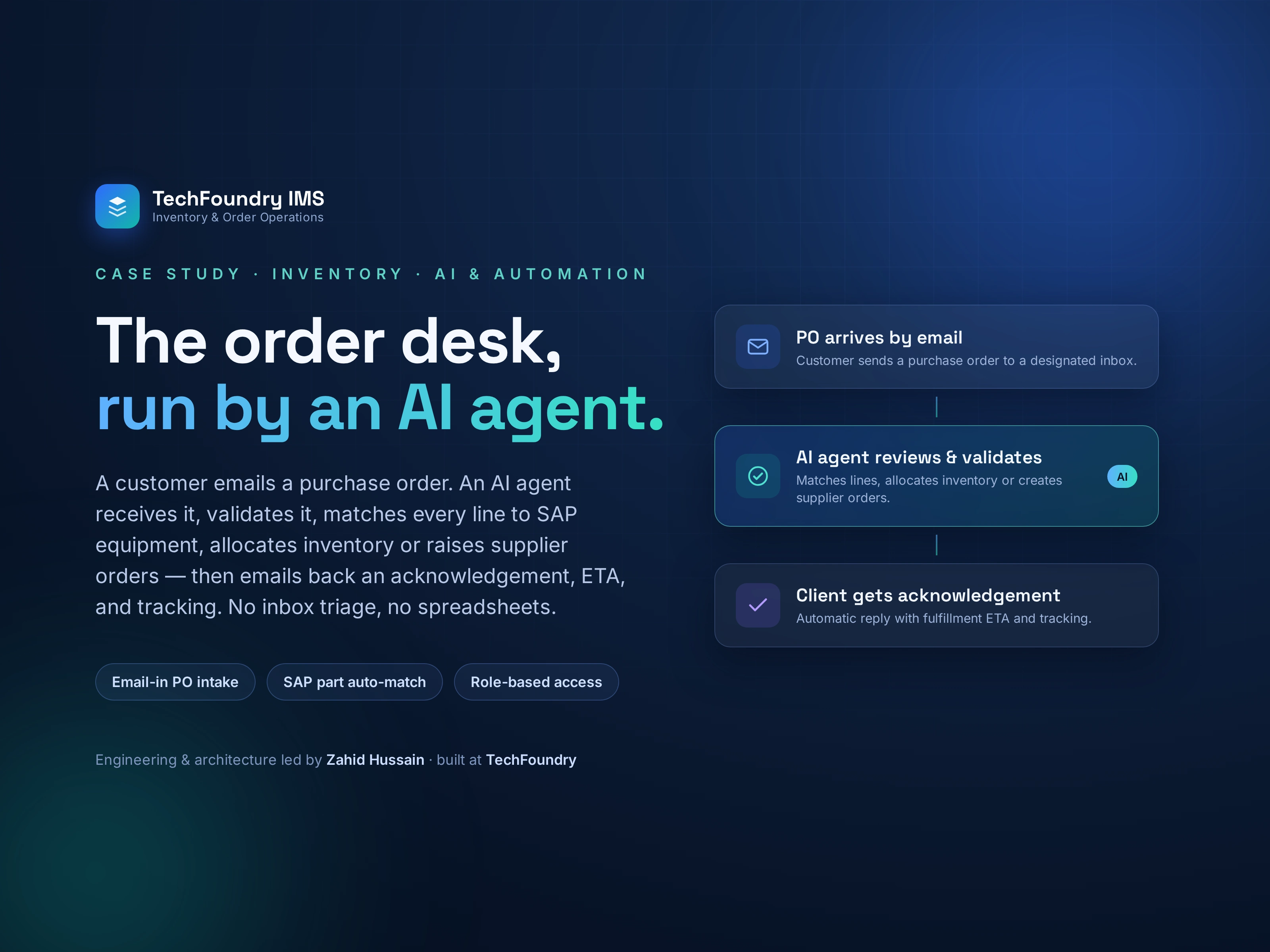
TechFoundry IMS is a multi-tenant SaaS that runs the full procurement-to-fulfillment lifecycle for a distribution operation — purchase orders, vendor orders, shipments, invoicing, and finance — with AI agents doing the heavy lifting. Customers, suppliers, and shipping companies all work inside one system, each scoped by role. As part of the team, I led the engineering and architecture across the platform — from the AI order-intake agent to the multi-tenant role-based permission layer and the financial reporting engine.
The problem
Orders arrive by email as unstructured POs full of raw part strings that have to be validated, matched to SAP equipment, allocated from inventory or turned into supplier orders, shipped, and tracked — then reconciled against vendor and courier invoices to see real margin. Run by hand across inboxes and spreadsheets, it's slow and error-prone: lines get mismatched, conflicts surface late, stockouts sneak up, and profitability is invisible until a job closes.
The approach — AI agents at the front
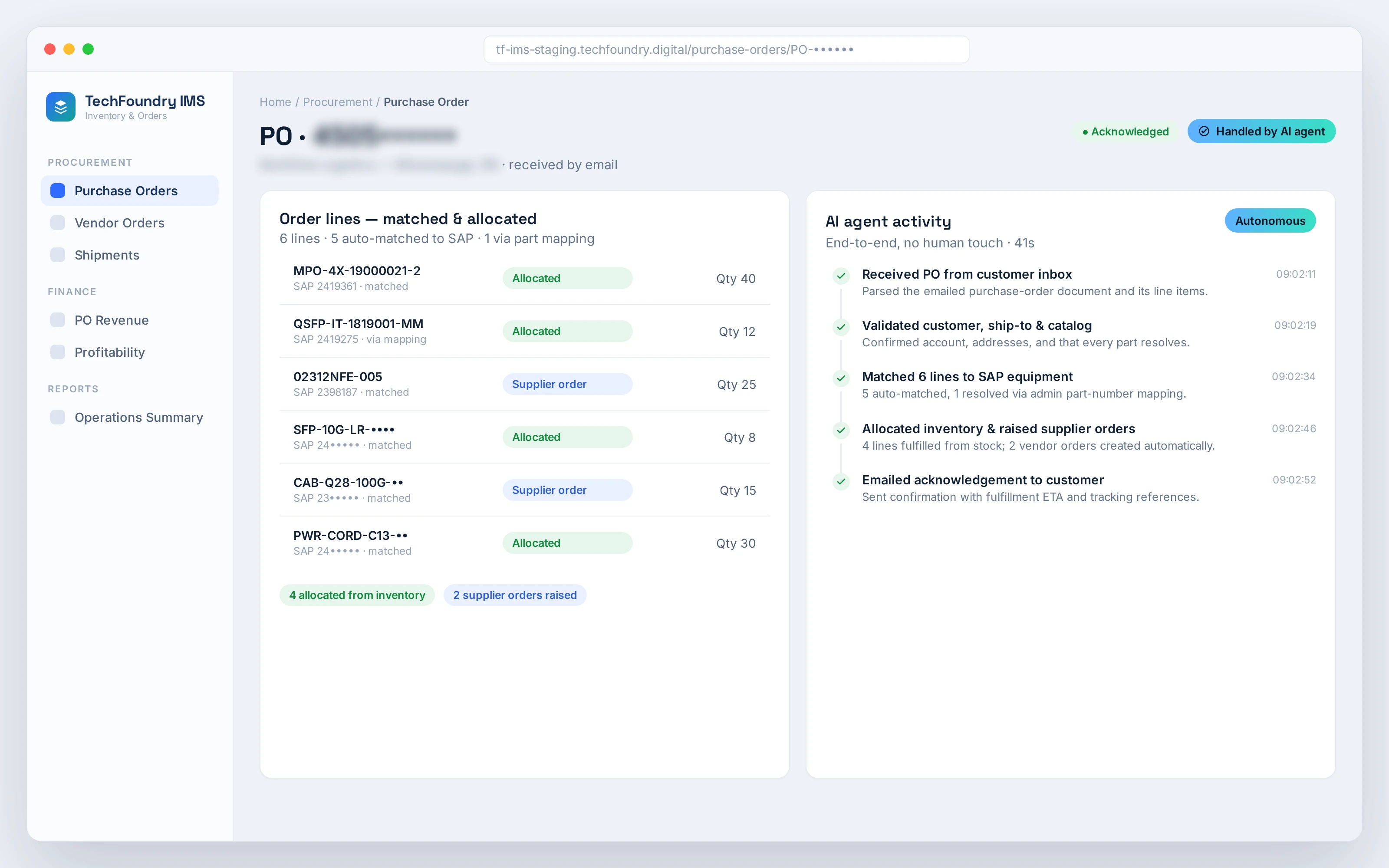
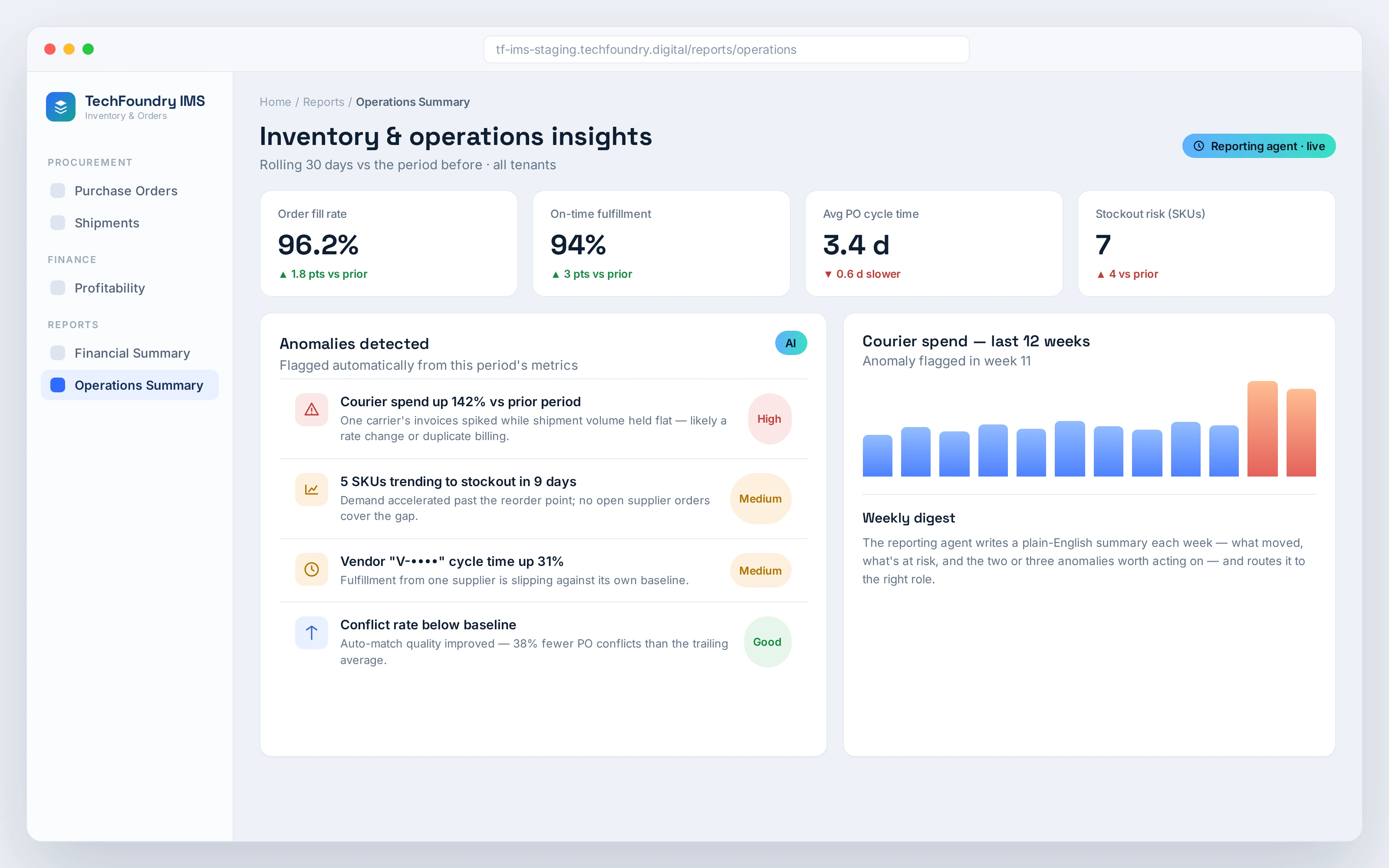
An order-intake agent sits at the front door. When a customer emails a PO, the agent ingests it, validates the order and account, matches every line to SAP equipment, allocates available inventory or raises the supplier orders needed to fulfill it, then emails back an acknowledgement with a fulfillment ETA and tracking — end to end, with no human in the loop for routine orders. A second agent watches the numbers: it turns raw inventory and operations metrics into a plain-English digest and flags anomalies automatically — a courier's spend spiking, SKUs trending to stockout, a vendor's cycle time slipping — routing each to the right role.
What the team built (I led engineering & architecture)
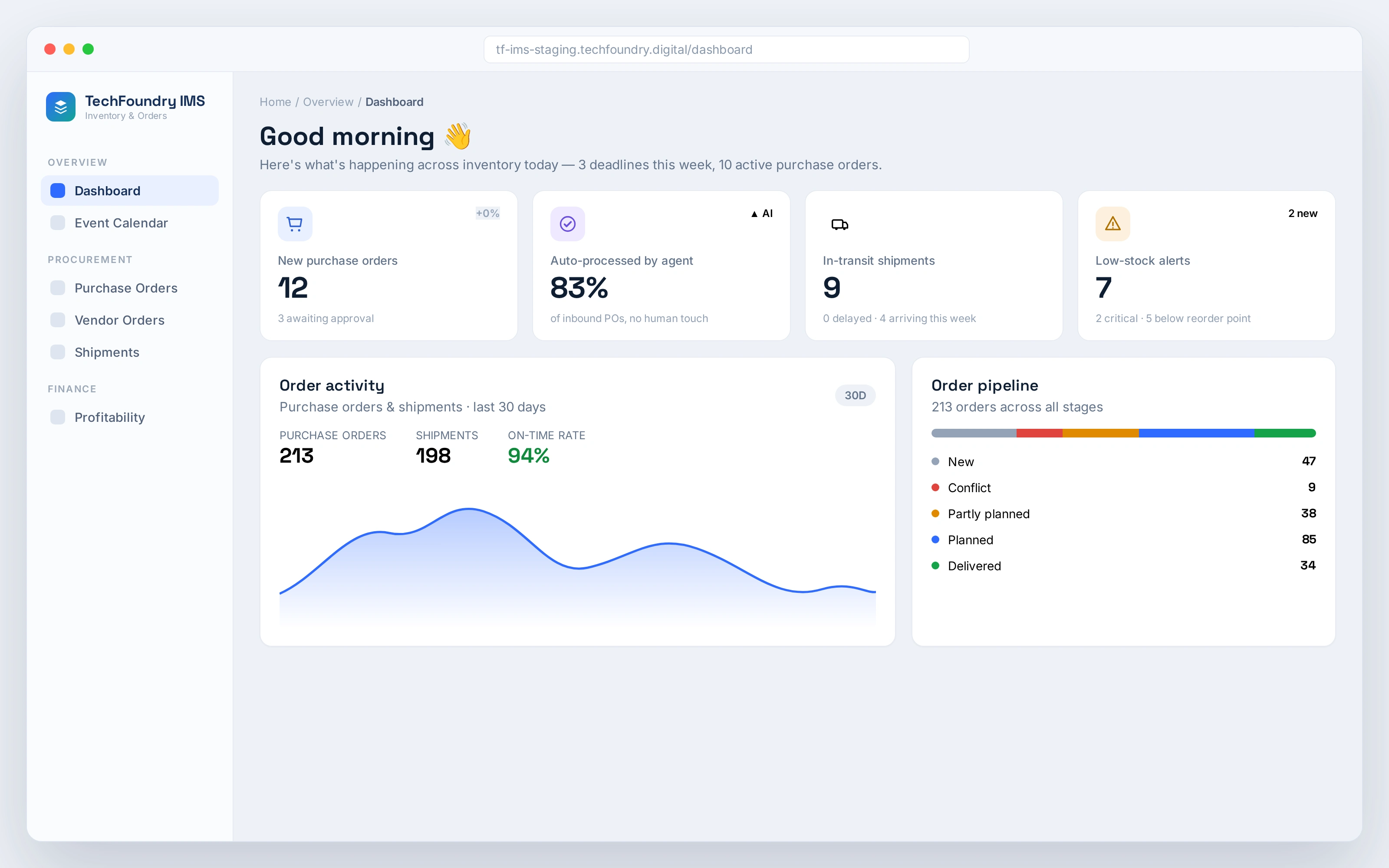
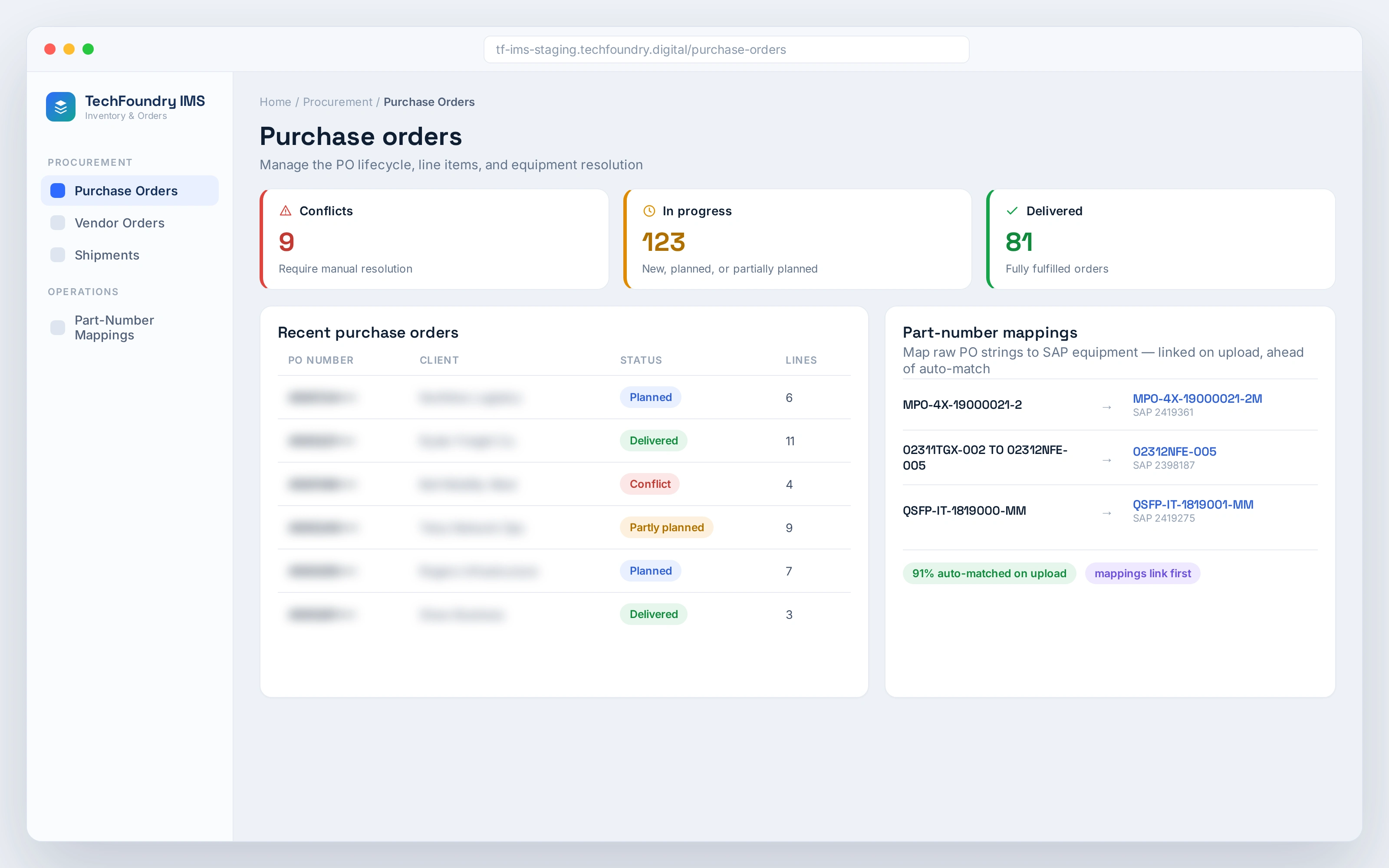
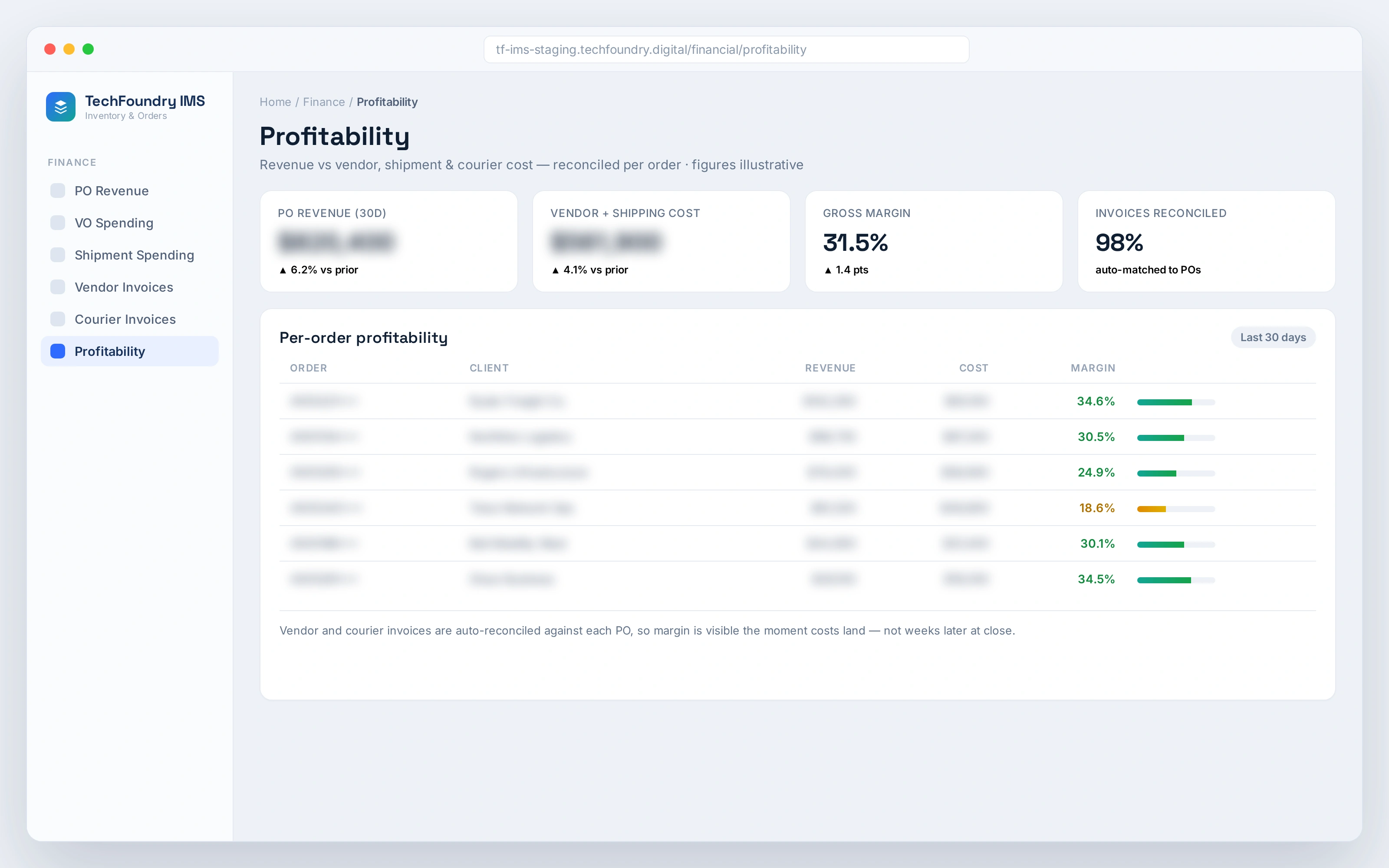
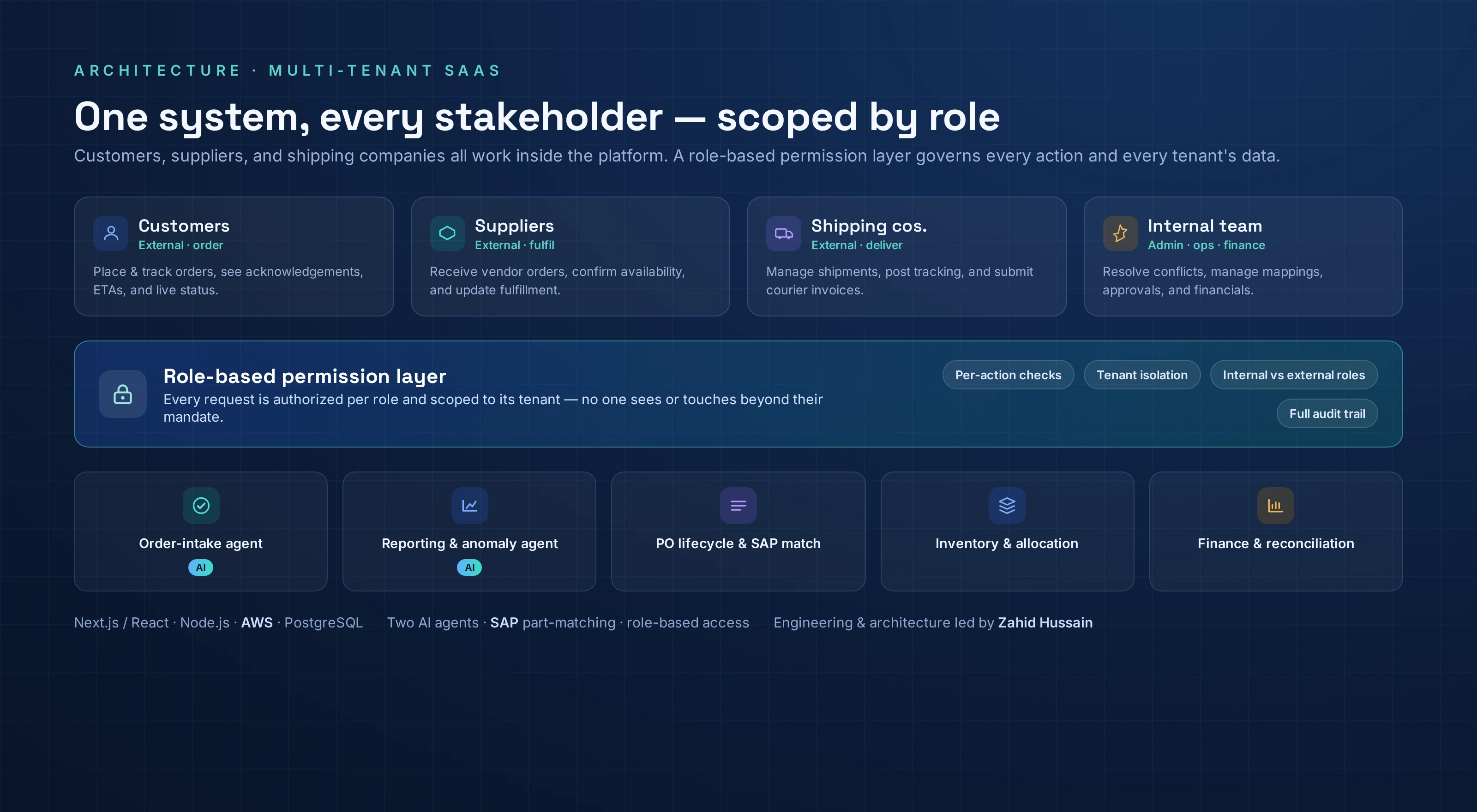
The AI order-intake agent handles email-in PO ingestion, validation, SAP line matching, inventory allocation and supplier-order creation, and automated customer acknowledgements with ETA and tracking. The AI reporting agent covers inventory and operations metrics, anomaly detection, and a routed weekly digest. Around them: a full PO lifecycle (New → Conflict / Partly planned → Planned → Delivered) with a conflicts queue; deterministic part-number auto-match with admin-managed mappings; vendor orders and shipments tracked to delivery; finance and profitability with vendor and courier invoice reconciliation and per-order margin; and a multi-tenant, role-based access-control layer governing every module and action across customers, suppliers, shipping companies, and staff.
Automation & role-based access
Under the agents, a matching engine resolves raw PO part strings to SAP equipment, with admin-managed part-number mappings that link exact strings ahead of the auto-match, a conflict queue for anything ambiguous, and auto-reconciliation of vendor and courier invoices against each PO. And because every stakeholder — customers, suppliers, shipping companies, and internal staff — works in the same platform, a granular role-based permission layer authorizes every action and scopes each tenant's data, so no one sees or touches beyond their mandate.
Results
An emailed PO becomes a validated, allocated, acknowledged, and tracked order automatically — collapsing an inbox-and-spreadsheet process into minutes and freeing the team for the exceptions. Conflicts and anomalies surface immediately instead of at close, part matching stays consistent, and profitability is visible per order the moment invoices land.
Tech
Next.js / React front end, Node.js services on AWS, PostgreSQL, two AI agents built on Anthropic's Claude (order intake and reporting / anomaly detection), a deterministic SAP part-matching engine, auto-reconciled finance, and a multi-tenant role-based access-control layer.
Like this project
Posted Aug 13, 2026
Multi-tenant inventory and order-operations SaaS that turns emailed POs into validated, allocated, tracked orders, with AI for intake and anomaly detection. I led engineering and architecture across the platform.
Likes
2
Views
31