Research Architecture: Making a Complex Field Legible

Daniel Taylor


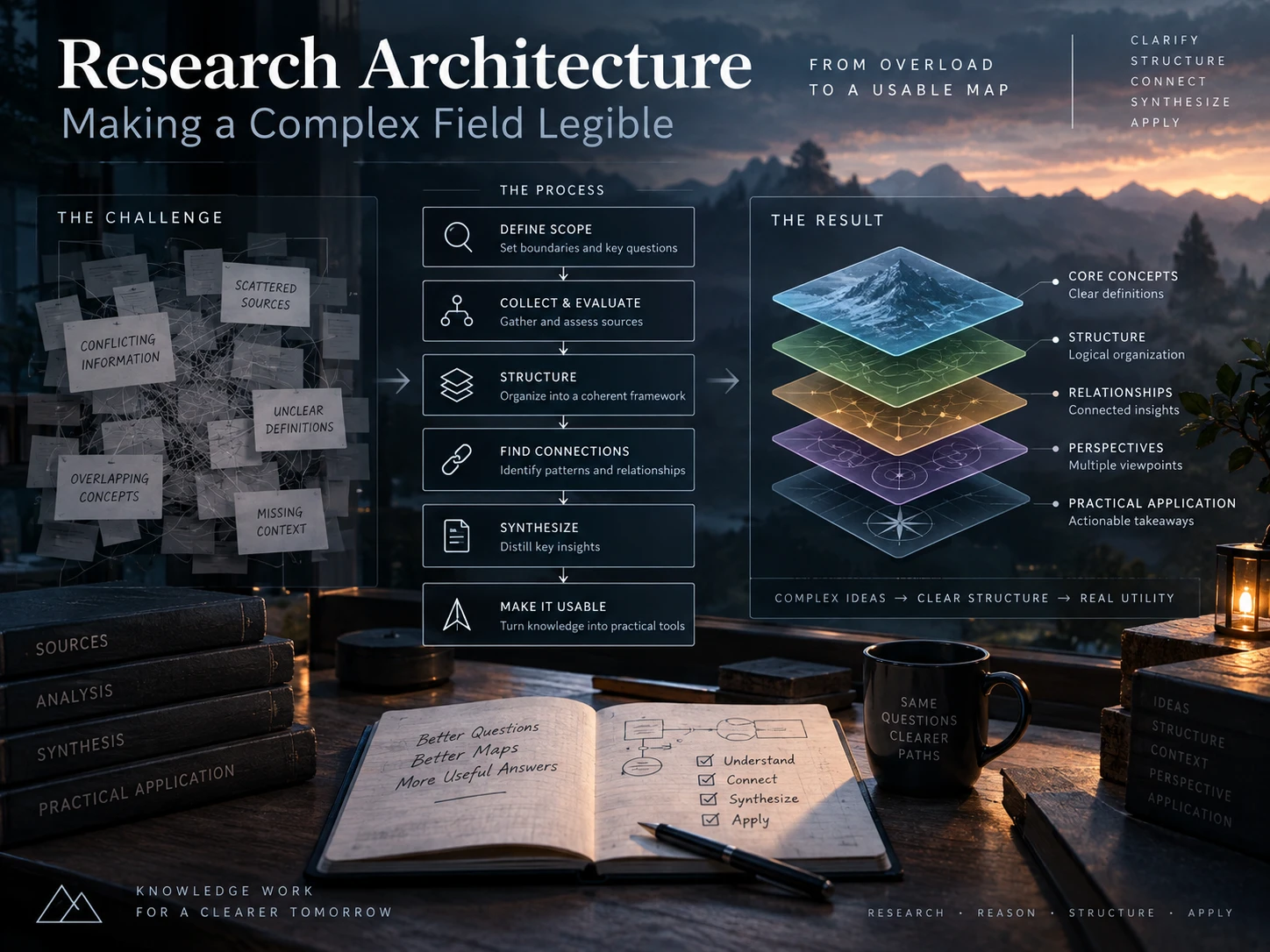
Research architecture overview
Spec project / self-directed independent work sample
This case study documents a real, self-directed research-architecture project. It is not paid client work and does not present AI as independently performing or verifying the research.
Problem
The underlying research combined cybernetics, symbolic practice, historical comparison, systems concepts, and human behavior. The challenge was preserving conceptual integrity while translating a large, potentially confusing field for an intelligent non-specialist.
The work needed to avoid several failure modes: reducing cybernetics to vague systems thinking, burying the reader in technical or historical detail, blurring adjacent concepts, forcing unlike traditions into false equivalence, allowing scope drift, collecting sources without a defined role, and drafting polished prose before the conceptual structure was stable.
Approach
I designed the research architecture before beginning full prose. The structure included:
Reader outcome, defining what the reader must understand.
Central questions, turning the broad subject into answerable problems.
Concept inventory, identifying terms that must remain stable.
Required distinctions, separating concepts that could otherwise blur together.
Exclusions, defining what belongs elsewhere so the work does not drift.
Research anchors, identifying source families and key references that can stabilize specific claims.
Transitions, defining what each section must establish before the next becomes logically available.
Success criteria, evaluating the structure before full drafting begins.
A major part of the method was preserving asymmetric evidence. Scientific and engineering literature, historical scholarship, primary texts, practice traditions, and interpretive sources support different kinds of claims. The structure tracked what each source could legitimately support rather than treating sources as interchangeable.
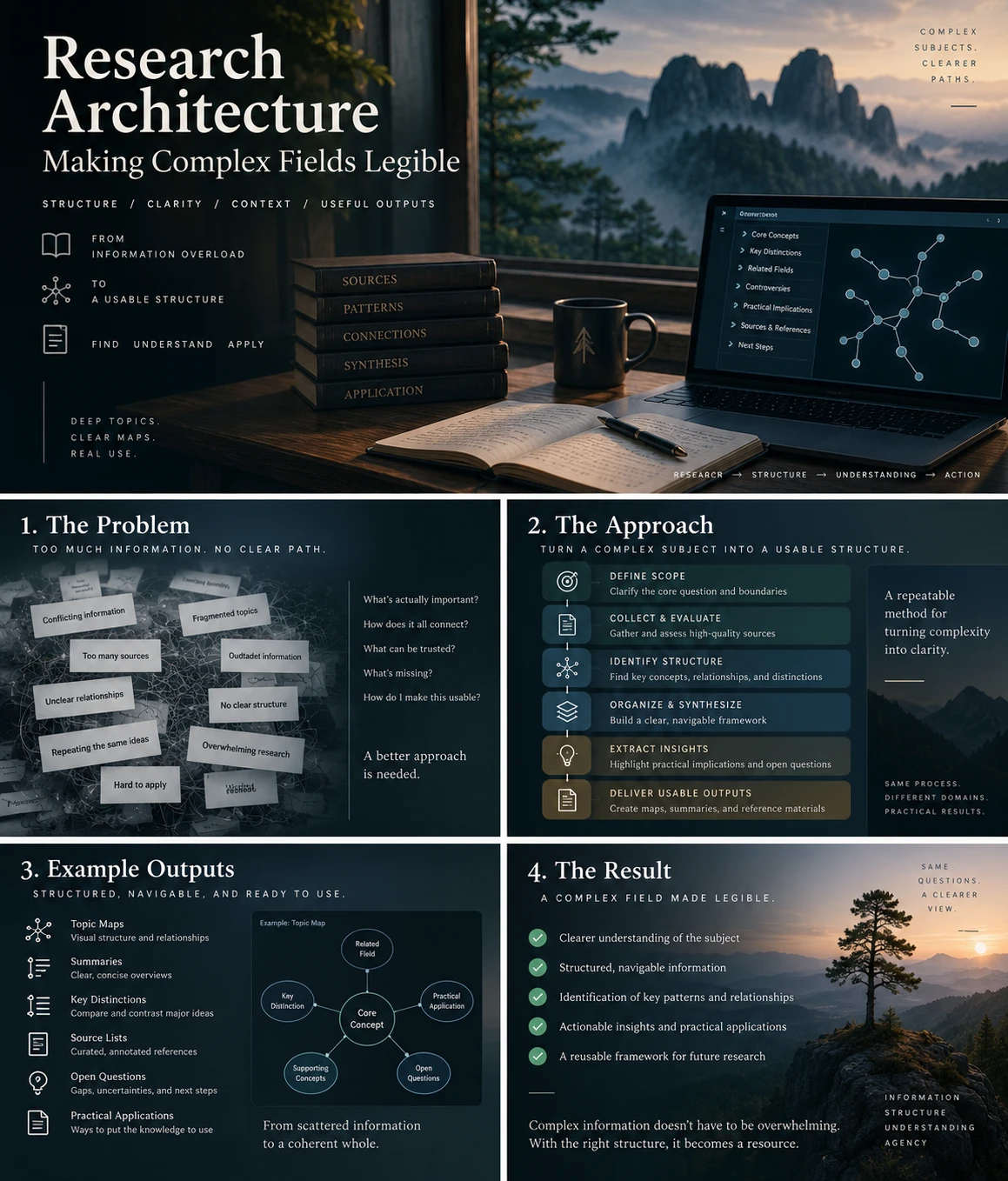
Problem, approach, outputs, and result
Human and AI workflow
My responsibility was to choose the research problem, define important distinctions, control scope, reject false equivalence, judge source relevance, and decide whether the structure remained faithful to the subject.
AI was used to expand candidate questions, organize concept inventories, compare structures, generate alternate framings and examples, identify missing transitions or gaps, and help transform the approved architecture into later drafting layers.
Deliverables
A structured research architecture
Reader-outcome and central-question framework
Concept inventory
Distinction and scope controls
Research-anchor plan
Transition logic
Chapter and section success criteria
A reusable research method for later drafting
A published case-study page
Four 4:3 supporting graphics for the Contra presentation
The research architecture produced a substantial book project
The research architecture shown in this case study became the working structure for a substantial long-form project: Sigils and Cybernetics: Symbol, Feedback, and the Engineering of Human Change.
This is a self-directed, independent book project. The complete manuscript is private and has not yet been commercially published. I created a selected portfolio preview showing the governing thesis, complete chapter architecture, research controls, human/AI division of labor, and representative finished-form writing.

Selected portfolio preview cover
Result and transferable method
The immediate result was a stable research structure from which later writing and supporting materials could be produced without repeatedly rebuilding the conceptual model from scratch.
The broader result was a reusable method for AI-assisted research: design the intellectual control system first, then use AI for expansion and production. The same method can transfer to technical documentation, knowledge-base design, policy analysis, literature review, competitive research, and other work where a large domain must become a reliable communication or decision structure.
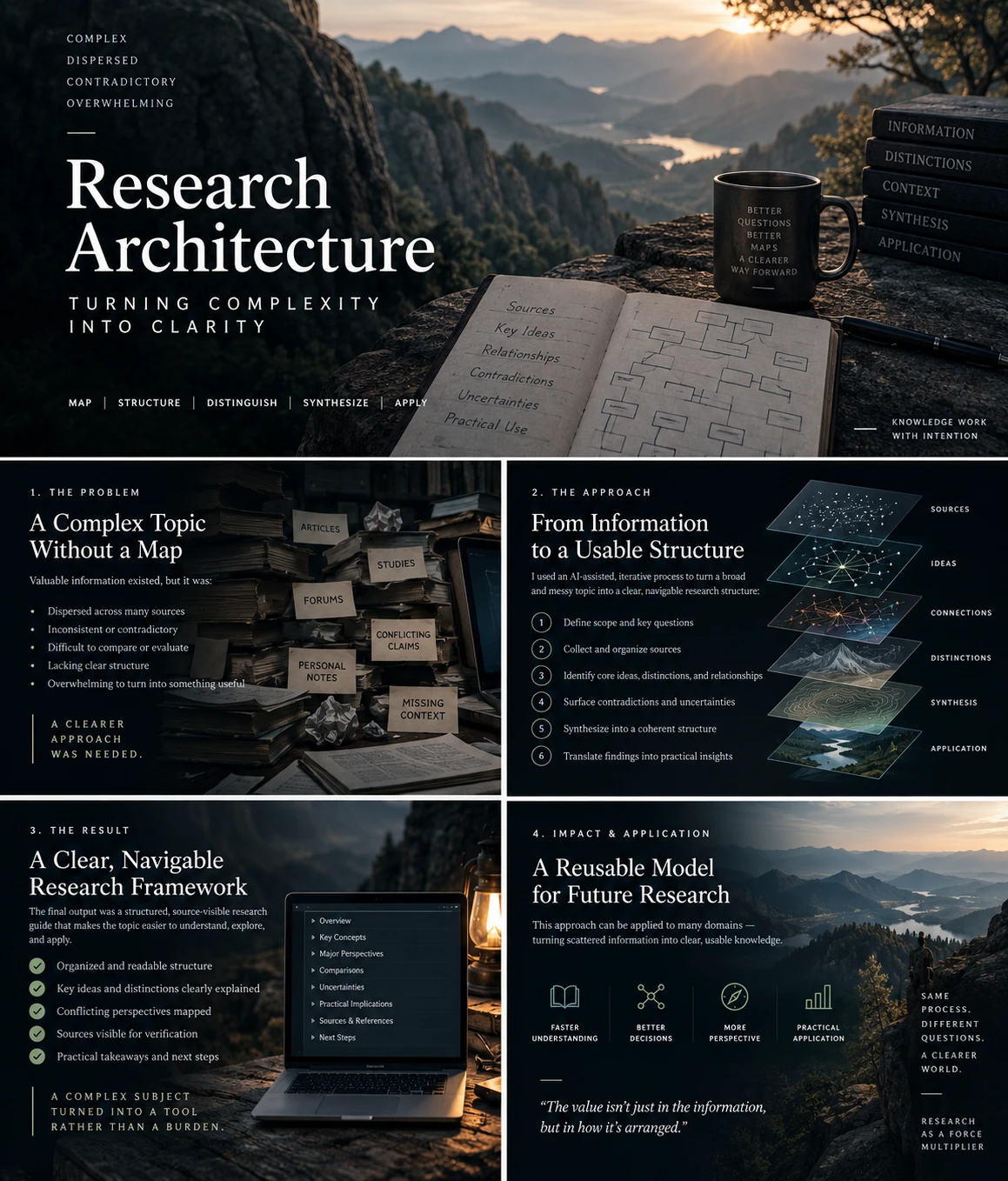
Research framework and impact

Complexity to clarity
Completed: August 2026.
Like this project
Posted Sep 7, 2026
A self-directed case study on designing research architecture that keeps complex interdisciplinary work structured, legible, and evidence-disciplined.