AI-Assisted Technical Diagnosis: Linux, VPN & Browser DNS

Daniel Taylor


Spec project / self-directed independent work sample
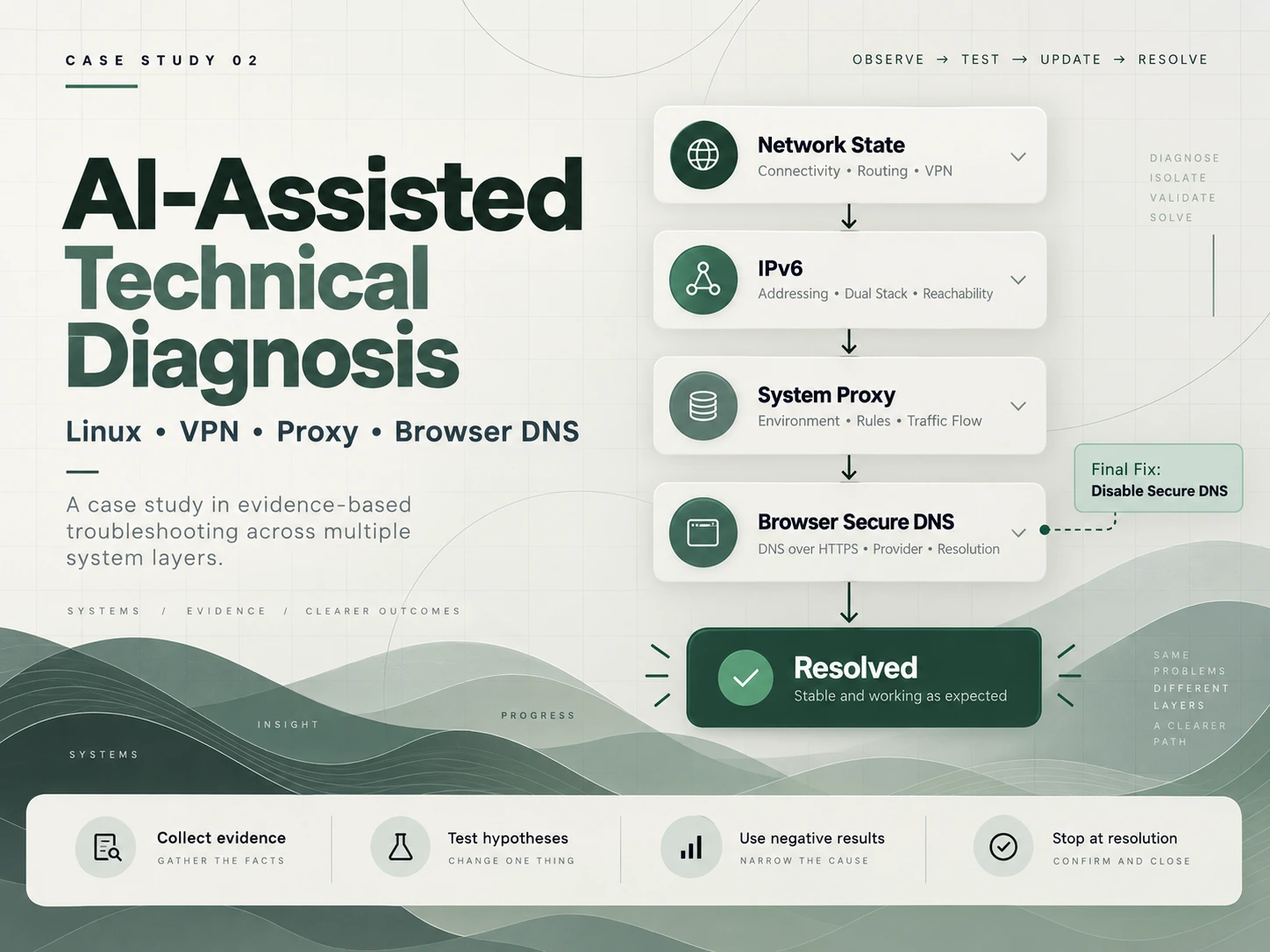
This case study documents a real technical troubleshooting sequence involving Fedora Linux, ProtonVPN, system proxy behavior, and Brave Secure DNS. It is not paid client work.
Problem
A VPN and networking issue created symptoms across several possible layers. Initial behavior did not clearly identify whether IPv6 routing, VPN behavior, the operating system's proxy path, or browser-level DNS handling was responsible.
Approach
I used an iterative human and AI troubleshooting process grounded in evidence rather than attachment to the first plausible theory.
Inspected the network state and IPv6 routes.
Tested the IPv6 hypothesis by disabling IPv6.
Observed that the problem persisted, weakening IPv6 as a sufficient explanation.
Enabled the system proxy and observed a partial change: connectivity worked, but browsing became very slow.
Treated that partial improvement as new evidence rather than a completed fix.
Shifted attention to the browser layer.
Disabled Brave Secure DNS.
Confirmed that normal page-loading speed returned.
Stopped troubleshooting once the practical problem was resolved.
Each test changed the working model. A failed test narrowed the search space, while partial success exposed a different layer of the system.
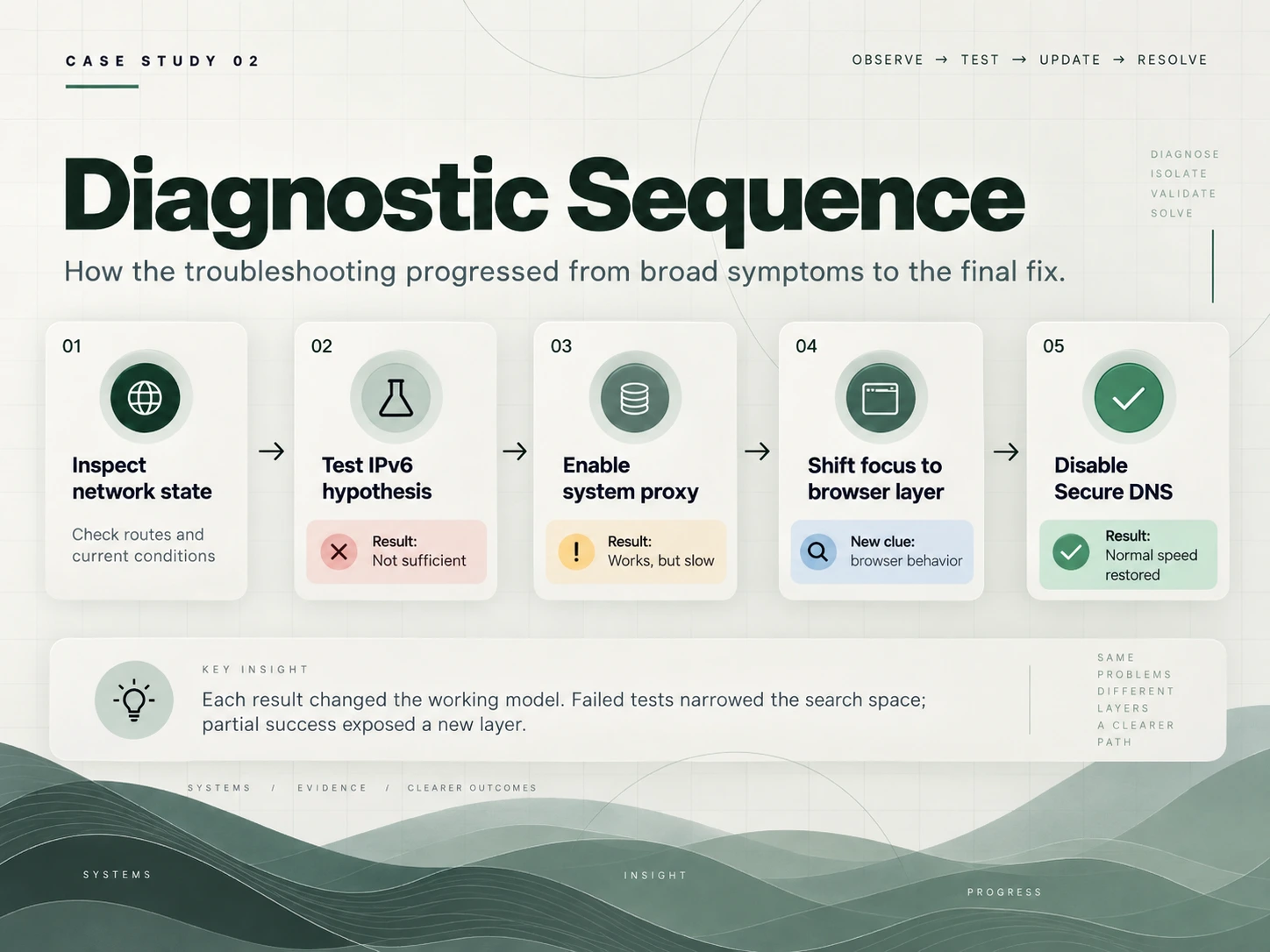
Diagnostic sequence
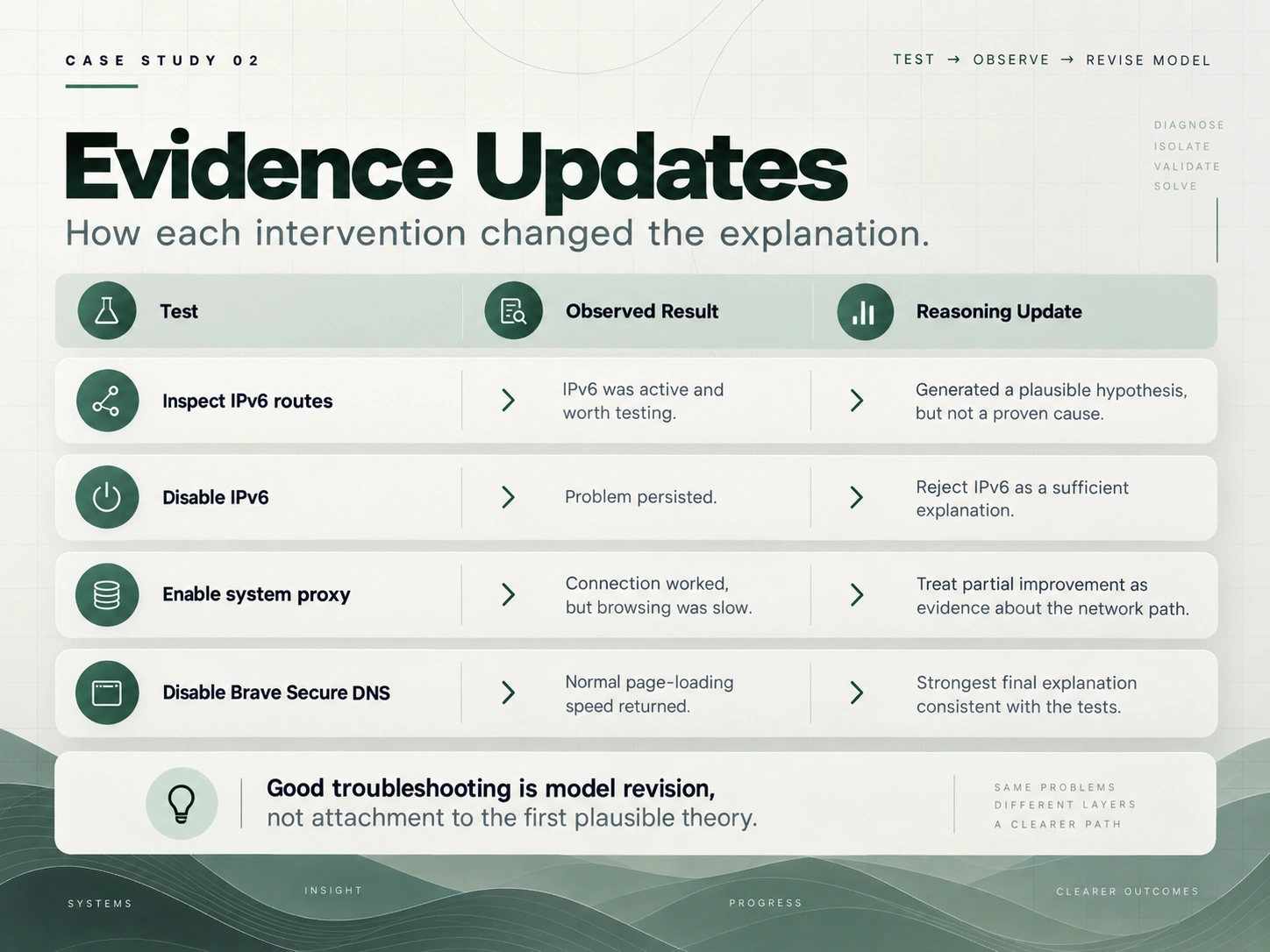
Evidence updates
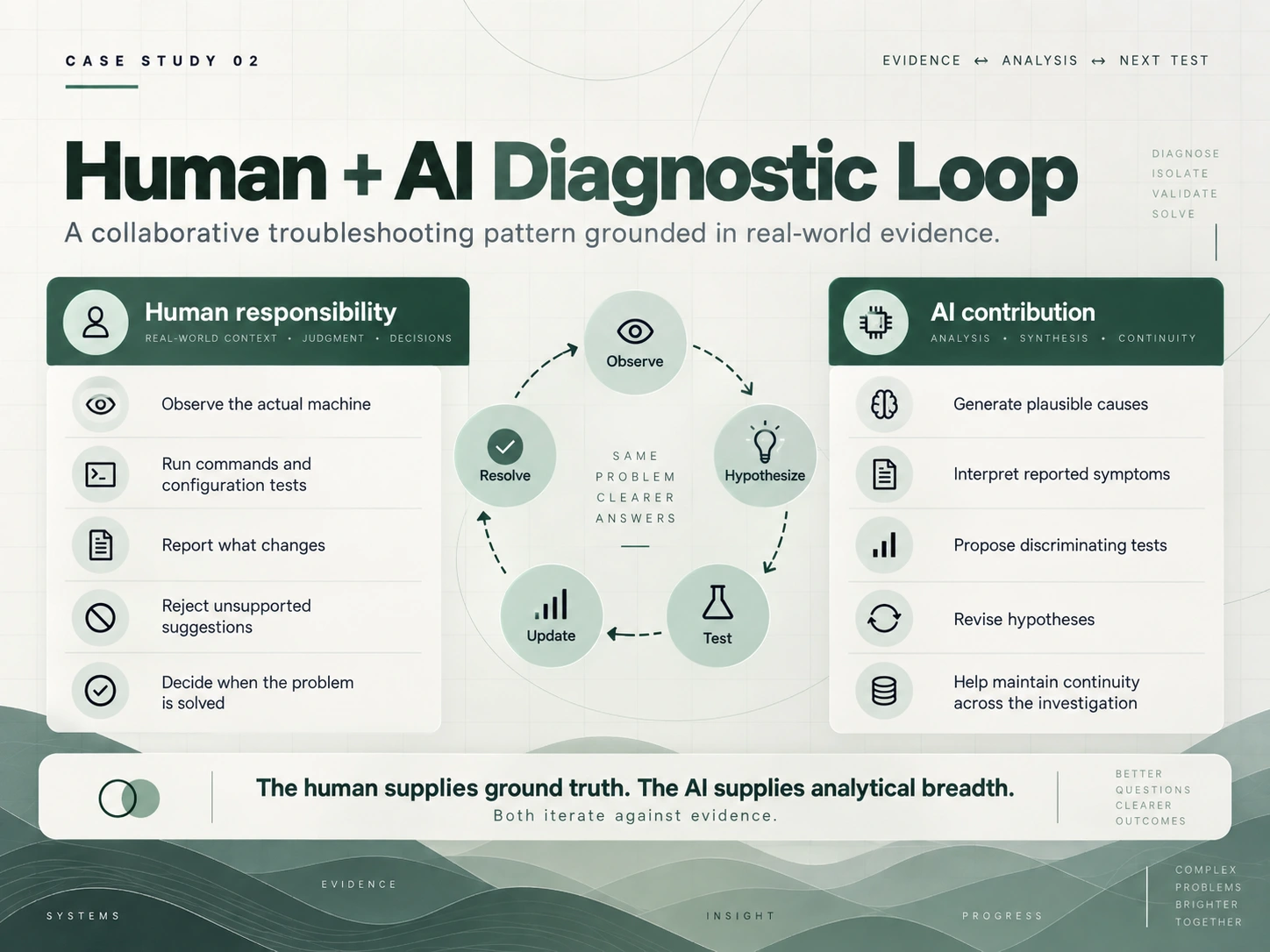
Human and AI diagnostic loop
Human and AI roles
The human role was to observe the actual machine, run commands and configuration tests, report what changed, reject explanations that no longer fit the evidence, and decide when the problem was solved.
AI was used to generate plausible causes, interpret reported symptoms, propose discriminating tests, revise hypotheses as evidence changed, and maintain continuity across the investigation.
Deliverables
A documented diagnostic sequence
A test → observation → reasoning-update model
An explanation of how failed hypotheses were used productively
A human and AI diagnostic-loop model
A published technical case-study page
Four 4:3 case-study graphics illustrating the process
Result
Normal browsing performance was restored after disabling Brave Secure DNS. The investigation did not establish a deeper protocol-level root cause beyond the available evidence. The conclusion is intentionally narrow: the final configuration change was the variable associated with restored normal performance.
This project demonstrates systems reasoning, hypothesis testing, uncertainty calibration, technical QA, evidence-based iteration, and productive human-AI collaboration.
Completed: August 2026.
Like this project
Posted Sep 7, 2026
A self-directed technical case study on diagnosing a Linux, VPN, proxy, and browser DNS issue through evidence-based human and AI iteration.
Likes
0
Views
2