Agent Skills: An Authoring Standard for AI Tooling

Harrison Songolo


The problem
Packaged instructions for AI agents tend to fail the same two ways. They front-load everything the agent might need, which buries the part that matters for the task at hand. And they express rules as prose, which asks a model to remember and apply a constraint rather than making the constraint enforceable.
Both problems get worse as the instruction set grows, which is exactly when you need it to work.
Progressive disclosure
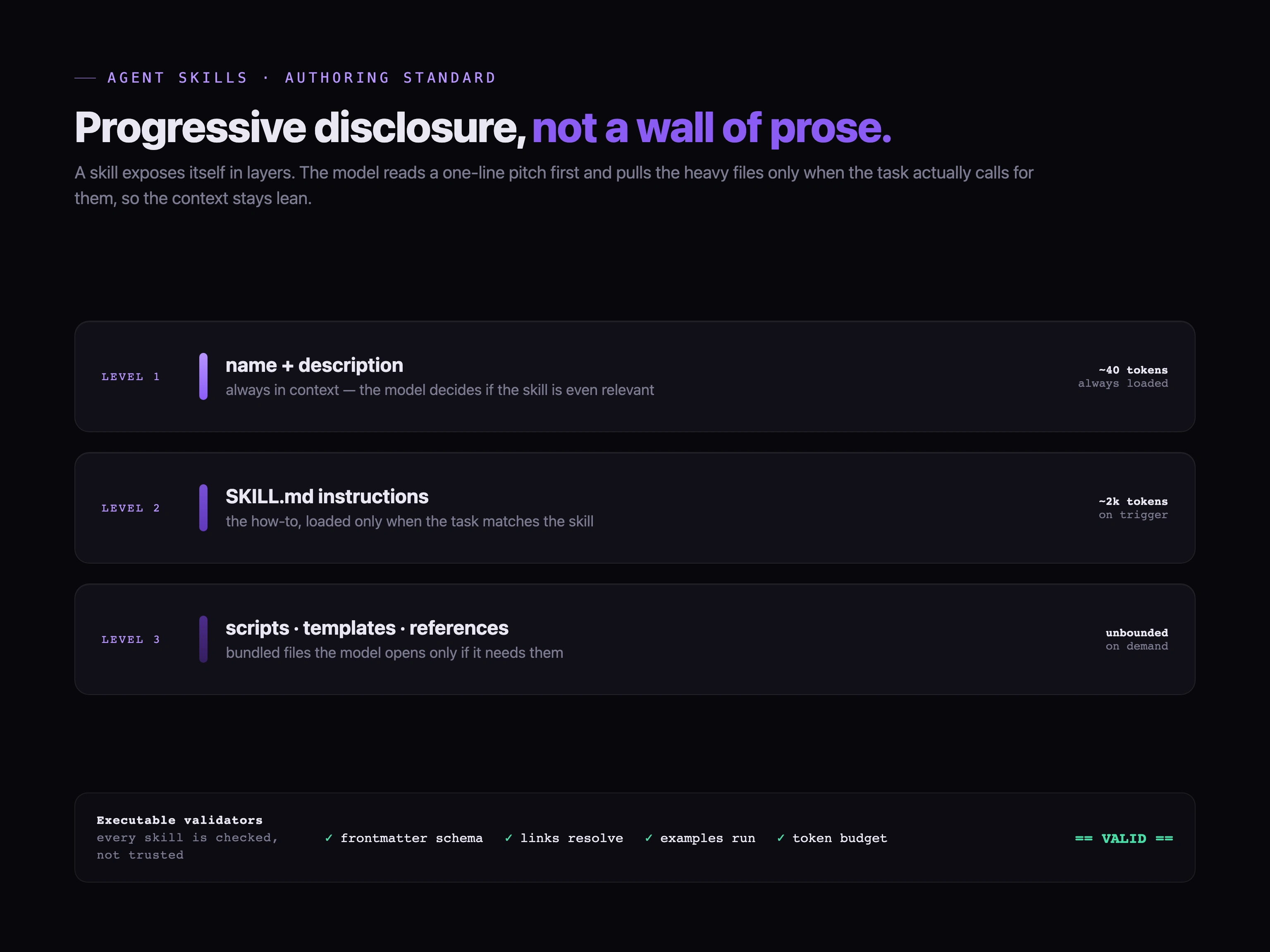
The standard loads detail at the moment it is needed rather than up front. A skill declares what it is for in a form cheap enough to always carry, and the substance is pulled in only once the agent commits to that path.
The practical effect is that adding a tenth skill does not degrade the other nine. Context spent on instructions is context not spent on the actual problem, and that tradeoff is real at every size.
Executable validators over prose
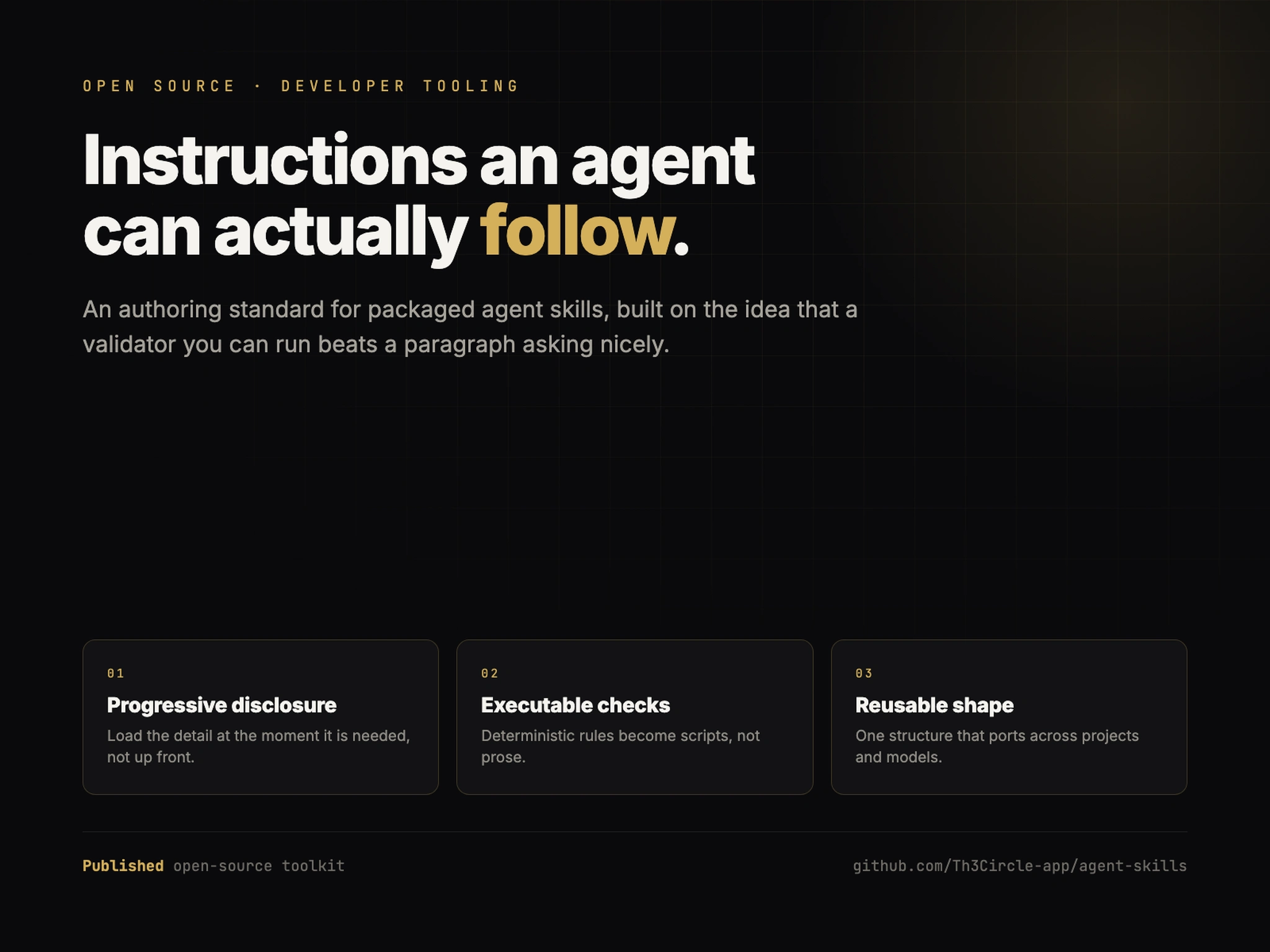
This is the part I would defend hardest. Where a rule is deterministic, it should be a script that returns pass or fail, not a sentence asking for compliance.
Prose says please. A validator says no.
A rule written as prose is checked by the model if it happens to remember at the right moment. The same rule written as a check runs every time, produces the same answer every time, and fails loudly instead of silently. Anything that can be mechanically verified is better off mechanical, and the prose should be reserved for judgment that genuinely cannot be automated.
A shape that ports
The structure is deliberately not tied to one project or one model. A skill is a directory with a declared purpose, progressive detail, and its checks alongside it, which means it can move between codebases without being rewritten.
That constraint forced better decisions. Anything project-specific had to be a parameter rather than an assumption, which is generally what separates a tool from a script.
Why this is on a portfolio
Most of my work is systems that handle money or data. This one is about the interface between a person and an automated system, and the underlying question is the same: where do you put a rule so that it actually holds?
In a database that answer is a constraint or a trigger rather than application code. In agent tooling it is a validator rather than a paragraph. Same instinct, different layer.
Like this project
Posted Aug 1, 2026
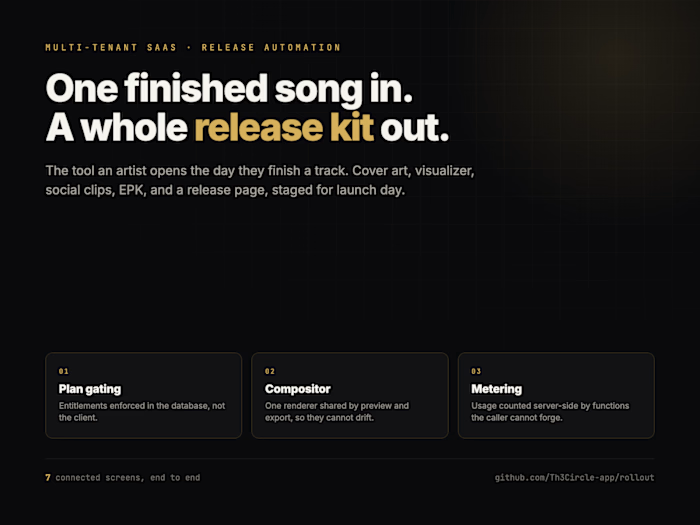
An open-source toolkit for writing agent instructions that hold up in practice, built on progressive disclosure and executable validators instead of prose.