Patient Navigation at PGI Chandigarh Through UX

Gurvinder Singh
Trend Forecaster
Inventor
Service Designer
Product Strategist
Inclusive Designer
UX Designer
Product Design Consultant
UX Researcher
Product Designer
AI Engineer
Healthcare IT Support Specialist
Case Study Writer

Journey

NVDA

UsabilityHub

MindNode

Lookback

Fusion 360

OpenAI

Sprinklr

Aprima Medical Software

TherapyNotes

UXPressia

UserTesting

Adobe XD
If you’re building solutions in healthcare, smart navigation, accessibility, or patient experience innovation — I’d love to connect and collaborate.
Open to discussions around UX, AI-powered healthcare systems, hospital navigation platforms, and digital healthcare transformation.
Always excited to work on meaningful products that solve real-world problems.
Posted Oct 7, 2026
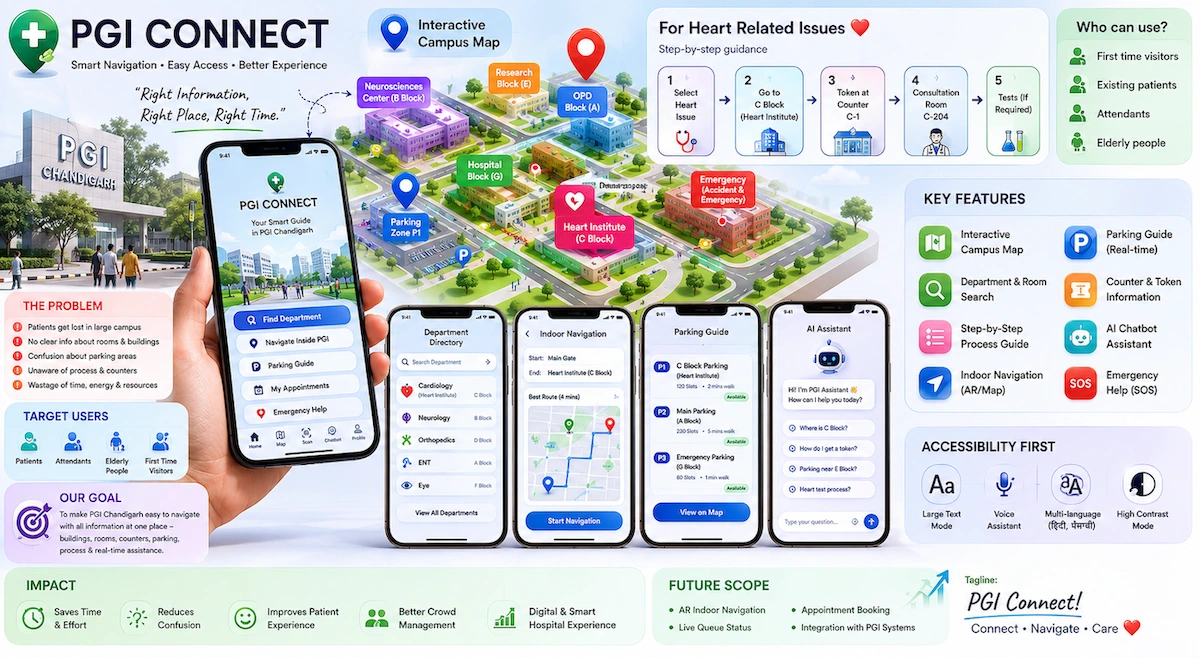
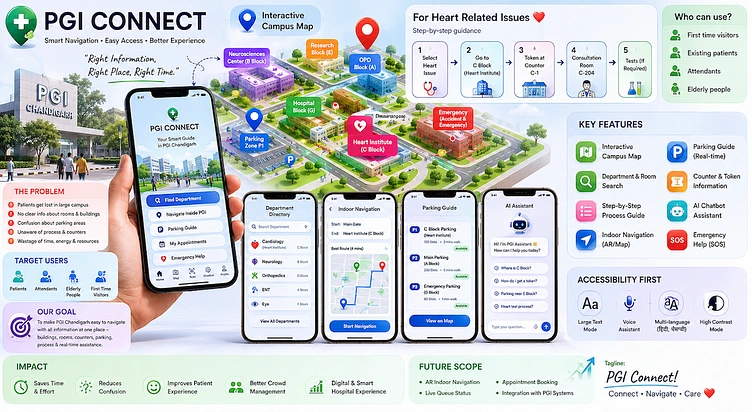
Healthcare UX Case Study During a recent observation at, I noticed a recurring issue that affects thousands of patients and visitors every day — navigation confusion inside the hospital campus. Large healthcare institutions like PGI Chandigarh are extremely complex environments. Multiple buildings, departments, OPDs, registration counters, labs, emergency units, pharmacies, and parking zones are spread across a massive campus. For first-time visitors, elderly patients, attendants, and emergency cases, simply understanding where to go becomes stressful and overwhelming. Patients often spend significant time asking: Which building should I visit? Where is the cardiology department? Which counter is for registration? Where can I park my vehicle? What is the next step after consultation? This confusion not only wastes time but also increases anxiety during already sensitive medical situations. That observation inspired me to explore a product idea: A Smart Hospital Navigation & Patient Guidance System designed specifically for large medical campuses like PGI Chandigarh. The concept focuses on transforming hospital navigation into a guided digital experience. Instead of patients wandering between buildings, the platform would provide real-time assistance through a mobile application that helps users: Find departments instantly Navigate to exact rooms and counters Understand treatment processes step-by-step Locate nearby parking areas Access emergency departments quickly Receive multilingual voice assistance Reduce dependency on manual directions For example, if a user searches: “Heart Department” The system would immediately provide: Building name Floor information OPD room number Registration counter Walking directions Estimated navigation time Required process steps One of the most important aspects of this concept is reducing stress through clarity. Healthcare environments are emotionally demanding, especially during emergencies. Patients and attendants should not lose valuable time searching for departments or repeatedly asking for directions. The experience should feel supportive, simple, and human-centered. From a UX perspective, this project is not only about maps or navigation. It is about: Designing accessibility for all age groups Simplifying complex healthcare systems Improving patient confidence Creating better information architecture Reducing cognitive overload Building trust through guided experiences The idea also explores AI-powered assistance where users can interact naturally with the system by asking: “How do I reach Cardiology?” “Which counter is for registration?” “Where is Emergency?” “What is the next step after OPD?” The assistant would respond instantly with voice-guided support in multiple languages such as English, Hindi, and Punjabi. Additional features could include: Indoor smart navigation Parking guidance system Queue and waiting updates Accessibility mode for elderly users Emergency quick-access routes Step-by-step treatment journeys Real-time crowd-aware navigation If implemented effectively, solutions like this could significantly improve the healthcare experience by: Reducing patient confusion Improving operational efficiency Saving time during emergencies Reducing staff interruptions Enhancing patient satisfaction Improving hospital crowd management This concept has the potential to scale beyond PGI Chandigarh and become a smart navigation ecosystem for hospitals across India. As UX Designers, some of the most meaningful innovations come from observing real human frustrations in everyday environments. Sometimes good UX is not about creating something flashy. It is simply about helping people feel less lost. If you’re building solutions in healthcare, smart navigation, accessibility, or patient experience innovation — I’d love to connect and collaborate. Open to discussions around UX, AI-powered healthcare systems, hospital navigation platforms, and digital healthcare transformation. Always excited to work on meaningful products that solve real-world problems. Disclaimer: This is an independent conceptual UX case study created for problem-solving and healthcare experience improvement.
0
1
Trend Forecaster
Inventor
Service Designer
Product Strategist
Inclusive Designer
UX Designer
Product Design Consultant
UX Researcher
Product Designer
AI Engineer
Healthcare IT Support Specialist
Case Study Writer
Journey
NVDA
UsabilityHub
MindNode
Lookback
Fusion 360
OpenAI
Sprinklr
Aprima Medical Software
TherapyNotes
UXPressia
UserTesting
Adobe XD