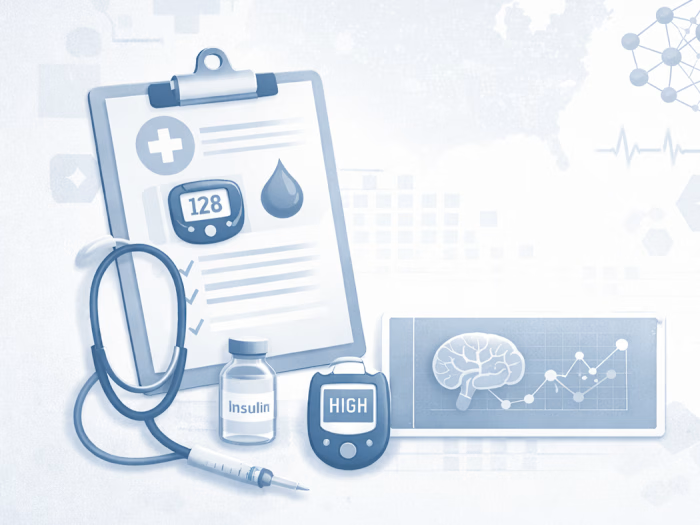
Multimodal Medical QA Assistant with RAG

Hamza Mooraj


Medical QA Assistant with Retrieval-Augmented Generation
Overview
I led a team project to design and implement a multimodal medical conversational agent grounded in authoritative healthcare data (NHS Inform Scotland).
The system integrates retrieval-augmented generation (RAG), speech input, and image understanding to provide context-aware medical responses.
Problem
Large language models can generate fluent responses but often hallucinate in safety-critical domains like healthcare.
The objective was to improve factual reliability by grounding responses exclusively in a trusted medical knowledge base.
System Architecture
Vector database built from NHS medical content
Semantic embeddings generated using MiniLM
FAISS indexing for efficient similarity search
Retrieval-Augmented Generation pipeline using LLaMA
4-bit quantization for efficient inference (Unsloth)
Fine-tuning on domain-specific QA data (MedQA)
Multimodal Pipeline
Integrated Whisper for speech-to-text input
Used a Vision–Language model to caption medical images
Embedded image captions into the user query before retrieval
Combined multimodal signals into a single grounded generation prompt
Engineering Decisions & Optimisation
Separated retrieval corpus from fine-tuning data to preserve strict knowledge grounding
Removed auxiliary FAISS indexes to prevent cross-source hallucination
Tuned prompt templates to minimise speculative generation
Modularised pipeline to allow RAG-on vs RAG-off benchmarking
Implemented Gradio interface for interactive testing and evaluation
Technologies
LLaMA, FAISS, Hugging Face Transformers, Whisper, Gradio, PyTorch
Link
Like this project
Posted Feb 20, 2026
Designed and built a multimodal medical QA system using RAG, FAISS, LLaMA and Whisper to ground responses in trusted NHS healthcare data.
Likes
0
Views
4
Timeline
Jan 12, 2025 - Apr 12, 2025