

Project Overview
Nomad is an AI product that doesn't just suggest a trip - it runs the whole workflow: scouting flights and stays, watching for price drops, building itineraries, and handling bookings, all through a set of "agents" a traveler can hire and set loose on autopilot.
What I worked on:
Full landing page design and build
Agent-library component system (repeating agent cards + activity feeds)
"How it works" and "Build your own" step modules
Responsive layout across breakpoints
The challenge
Most AI-tool landing pages default to the same visual shorthand - dark backgrounds, neon gradients, chat bubbles. That look undersells a product like Nomad, whose whole pitch is "you don't have to sit and prompt this thing, it just works while you live your life." The page needed a tone that felt calm, trustworthy, and almost editorial - closer to a well-designed travel magazine than a typical AI dashboard - while still proving, concretely, that the agents do real, specific work.
The harder problem was showing autonomy itself. It's easy to list "AI travel planner" as a headline; it's much harder to make a visitor believe an agent actually messaged a hotel, checked a fare, and sent a Gmail summary without a human touching it.
The Approach
Warm, editorial art direction over generic AI aesthetics:
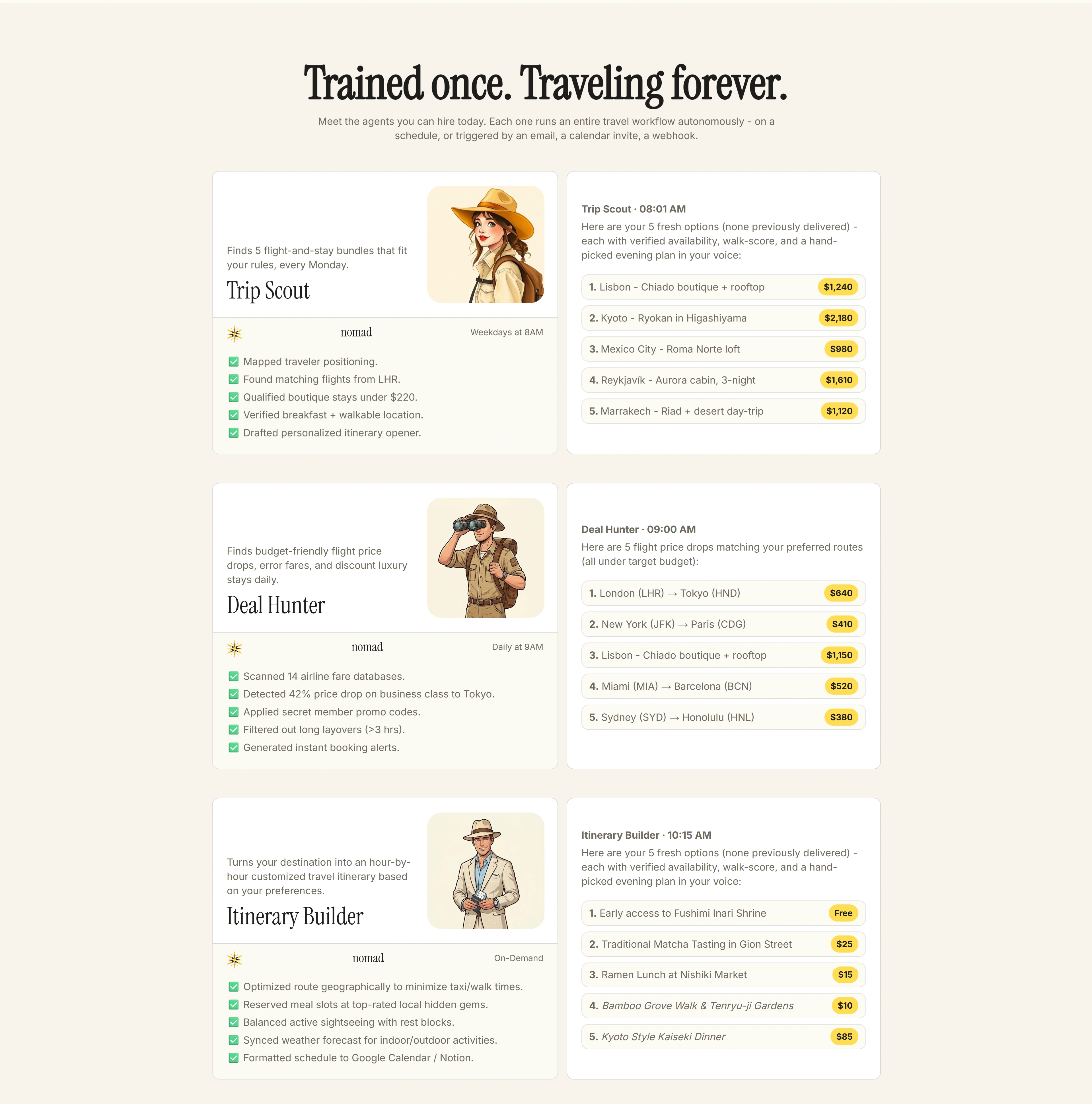
A cream background, serif display type, and hand-illustrated agent characters (Trip Scout, Deal Hunter, Local Expert) replace the dark/neon AI-product template. It reads more like a boutique travel brand than a dev tool, which fits a product meant to feel like hiring a person, not running a script.
Make autonomy visible, not just claimed:
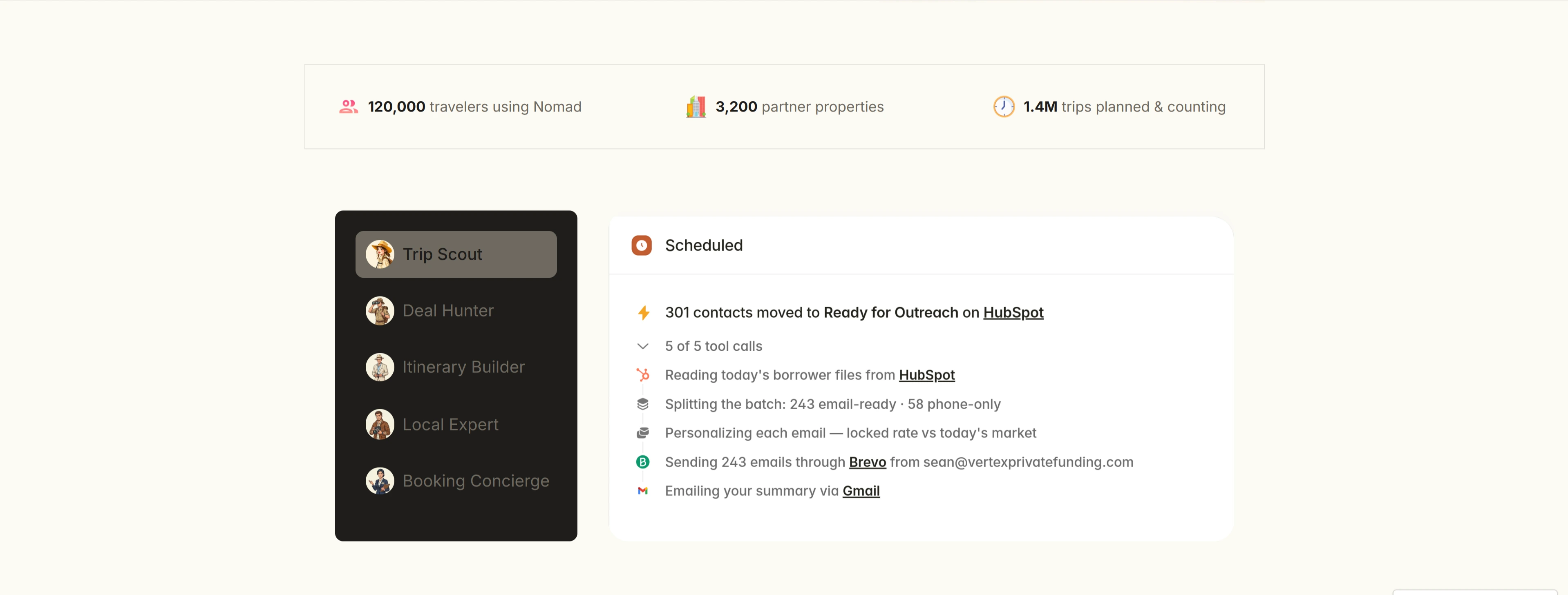
Rather than a generic feature list, the agent-activity module shows a live-looking task log - timestamped actions tied to real tool names like HubSpot, Brevo, and Gmail. It's built as a repeating two-column card (agent list + live activity feed) so any agent's actual behavior can be swapped in without changing the layout.
One card pattern, six agents, zero repetition fatigue:
Each agent (Trip Scout, Deal Hunter, Itinerary Builder, Local Expert, Booking Concierge) uses one consistent card structure - illustration, role description, schedule, checklist of completed actions, and a results panel - built as a CMS-style repeating section so new agents can be added to the library without custom layout work.
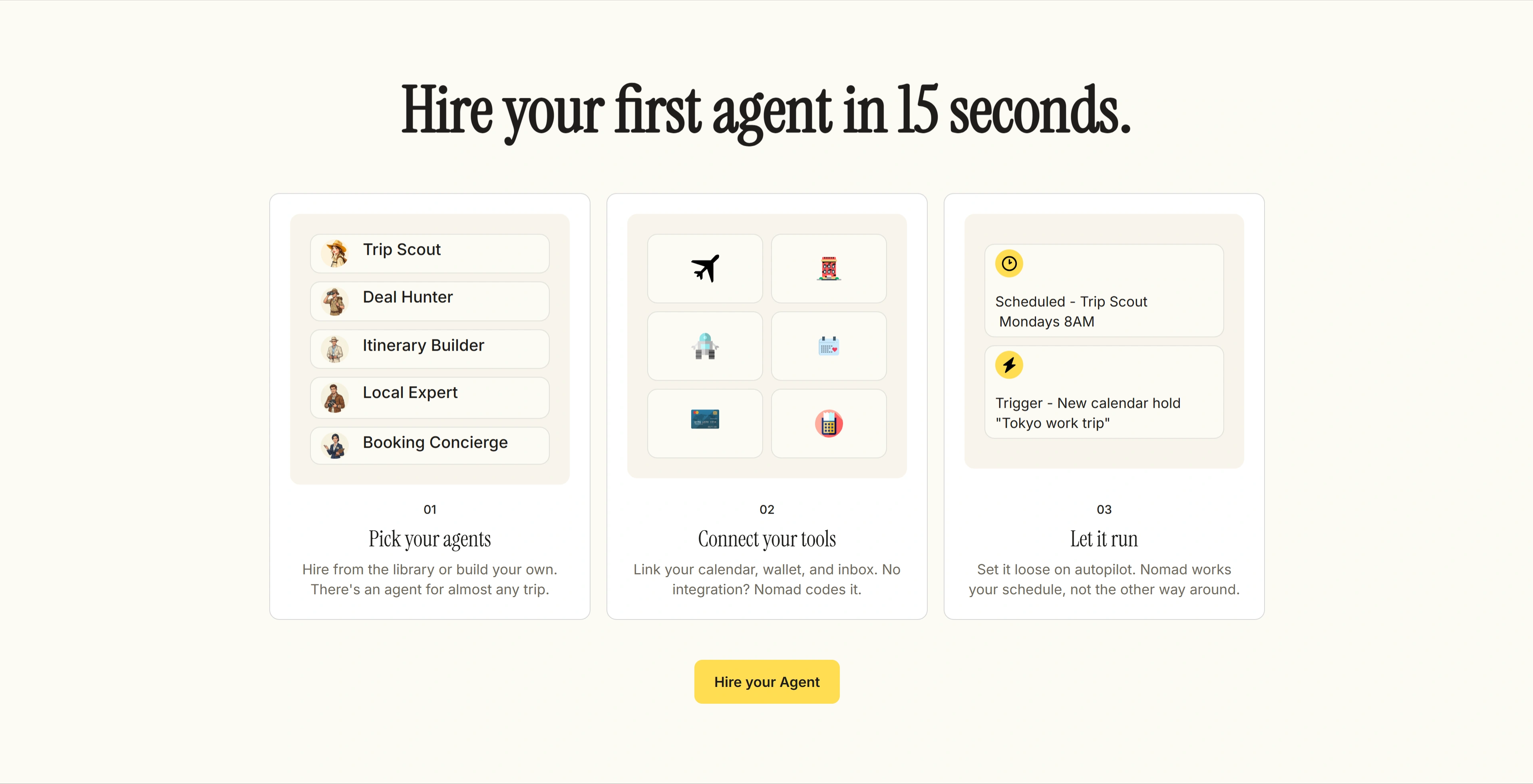
Turn setup into three dead-simple steps: "Pick your agents → Connect your tools → Let it run" compresses what could be a complicated onboarding flow into a three-step visual with matching icons, keeping the "hire an agent in 15 seconds" promise credible instead of aspirational.
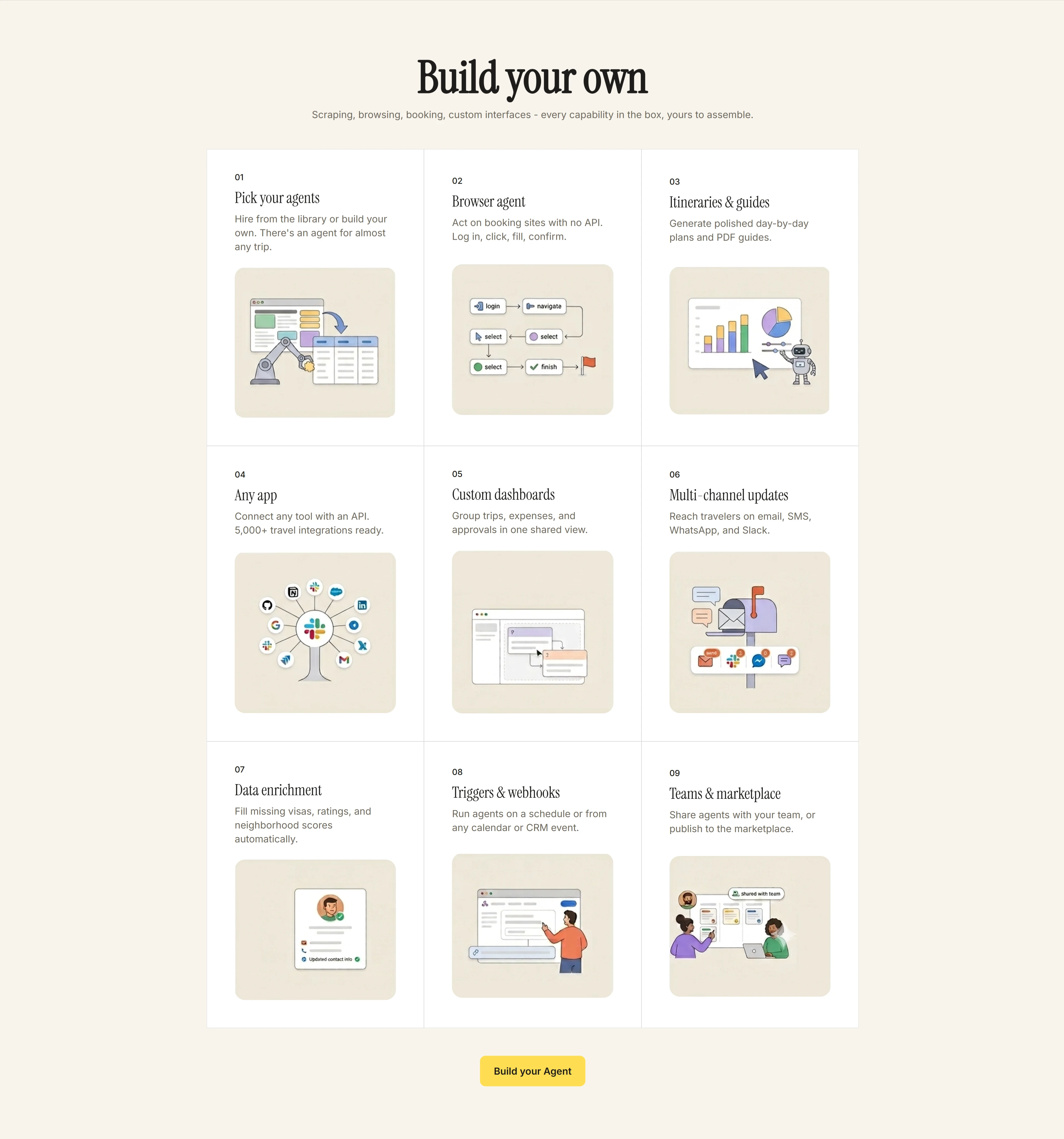
Give power users a builder, not just a library: For visitors who want more control, the "Build your own" grid breaks the platform into nine composable capabilities (browser agent, custom dashboards, triggers & webhooks, and more), each with its own small illustration - signaling depth without turning the section into a wall of text.
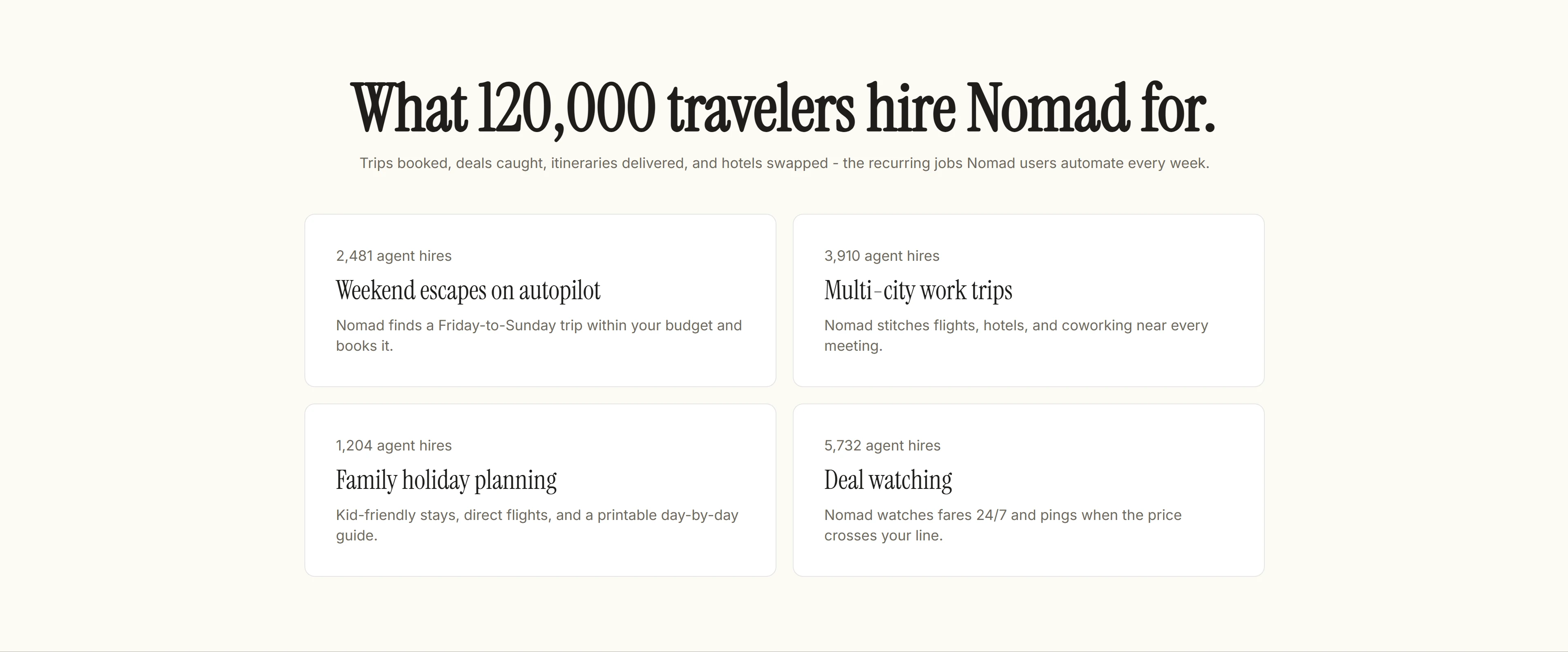
Prove it with real usage patterns, not just logos: A closing section ("What 120,000 travelers hire Nomad for") breaks usage into four concrete jobs - weekend escapes, multi-city work trips, family holiday planning, deal watching - each with an actual hire count, which grounds the "120,000 travelers" headline stat in specific, believable use cases.
2 likes · 25 views · Aug 10, 2026
A Webflow landing page for an autonomous AI travel platform, built with modular agent cards, live activity tracking, and a warm, editorial design direction.


