Exhibit Flow: A System for a Kinetic Installation

Alejandro Silva

Overview
Exhibit Flow is a concept system for a museum’s kinetic light installation: 28 suspended fins that move and light up in response to the people in the room. It covers the whole life of the piece, from composing its behavior to running it live and reviewing what happened. Built entirely in Rive, with the installation, its audience and its sensors simulated in real-time 3D.
1. Making the room readable
A responsive piece only works if visitors can read it. People arrive first, an 8 Hz sensor measures them with a short delay, and only then does the sculpture answer, toward where they stand.
With the interface hidden, a plaque in the room states what the array is doing and why.
2. One gesture at a time
The piece speaks through a vocabulary of slow, array-wide gestures with white light only. A map of the room (how busy, how long people stay) picks the phrase, with rest poses in between.
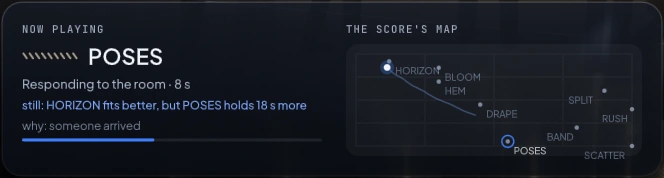
The system explains its choices: why a phrase holds even when another fits better.
3. Operating it
Operators can pause, hold a phrase or send the array to a safe pose. Faults are simulated too: a stalled fin goes dark and is reported, and when the feed drops, the piece holds the last readings instead of jumping.
Fin 23 reports why it stopped: position sensor lost, parked lowered, edge-on. The piece plays on without it.
4. Seeing it from anywhere
A room plan with saved viewpoints, crane moves between them, a director that cuts between shots on its own, and the view from any visitor’s eyes.
From a saved viewpoint into a visitor’s eyes, picked from the room plan.
5. Reviewing a session
Every session replays exactly, with a floor heat map of where people stood and a timeline of every decision.
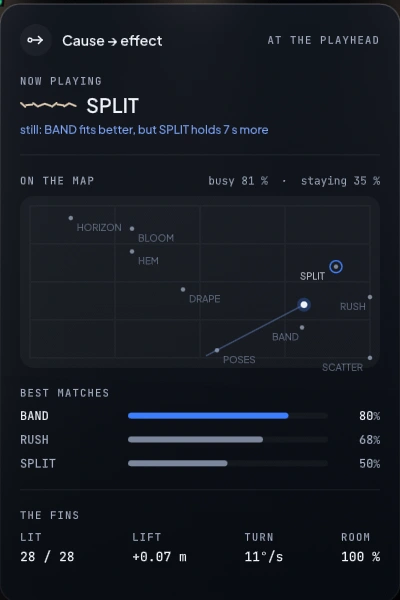
At any moment of a replay: what played, where the room was on the map and which phrases matched best.
6. Designing the score
Each phrase owns a territory of the room. Drag it, set how long it holds and how it answers, then replay a recorded session under the new design and compare it with the original (A vs B).
7. Data in, motion out
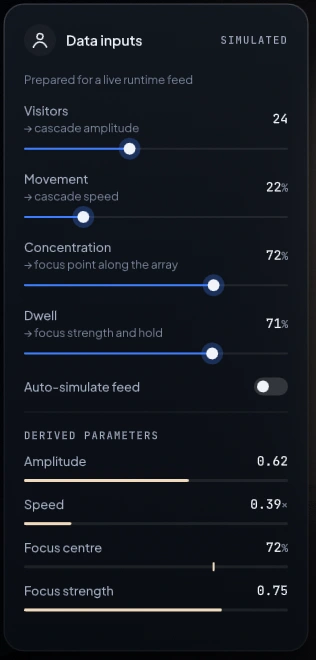
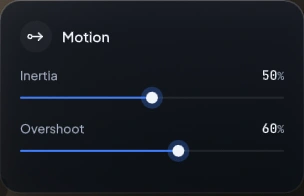
Data never touches a fin directly: raw inputs become derived parameters, the choreography turns them into motion, and each motor follows with its own inertia and overshoot.
8. Built to be extended
Design and data both run through view models. Colors, type and motion timing can be tuned in the Rive Editor without touching code, and the room’s inputs arrive through their own view model, so the simulated feed could be replaced by a real sensor feed through the Rive runtime.
The same file in the Rive Editor: changing the room’s inputs live drives the whole system.
Try it live (desktop): https://exhibit-flow-q0g3r9.rive.to
Self-initiated project · October 2026
Like this project
Posted Oct 20, 2026
A concept system for a kinetic light installation, built in Rive: 28 fins that respond to the people in the room, with modes to design, run and replay it.
Likes
0
Views
3
Timeline
Oct 7, 2026 - Oct 20, 2026