Interactive Paleontology Study with Rive

Alejandro Silva


Overview
Fossil is a concept for an interactive paleontology study: a Parasaurolophus explored from its living reconstruction down to its skeleton, its crest and a comparison with Ankylosaurus.
I designed the interaction model, art direction, interface and motion, and built a working prototype in Rive.
1. Three levels of depth
Overview shows the whole specimen, Cranial Study focuses on the crest, and Comparison brings in a second animal. Each level asks a different question while the subject stays recognizable.
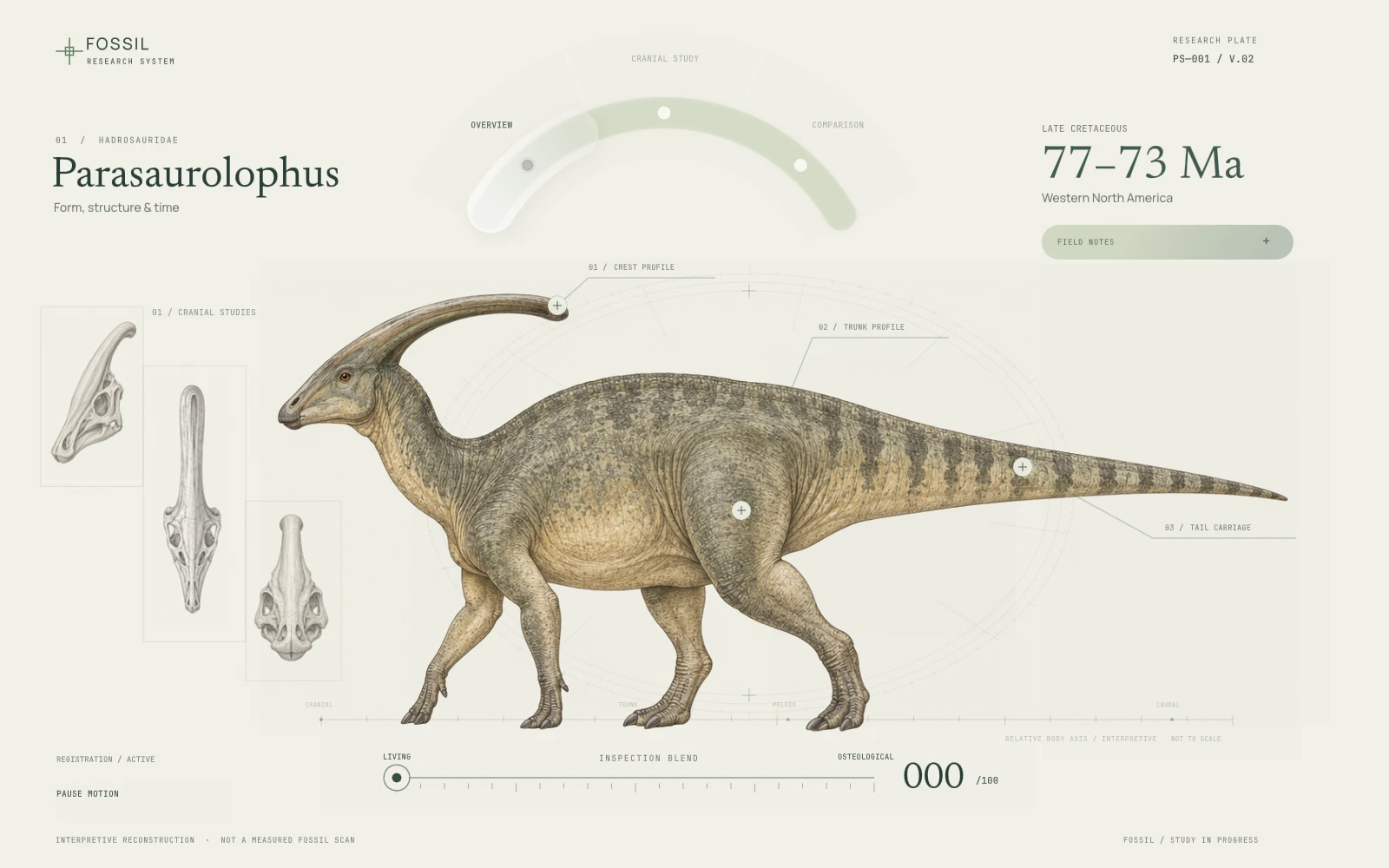
Overview: the specimen sets the context, and anatomical points invite a closer look.
2. A scientific plate as interface
The look draws on scientific plates and museum graphics. Engraved illustrations carry the detail, while fine rules, registration marks and technical labels form an analytical layer around them.
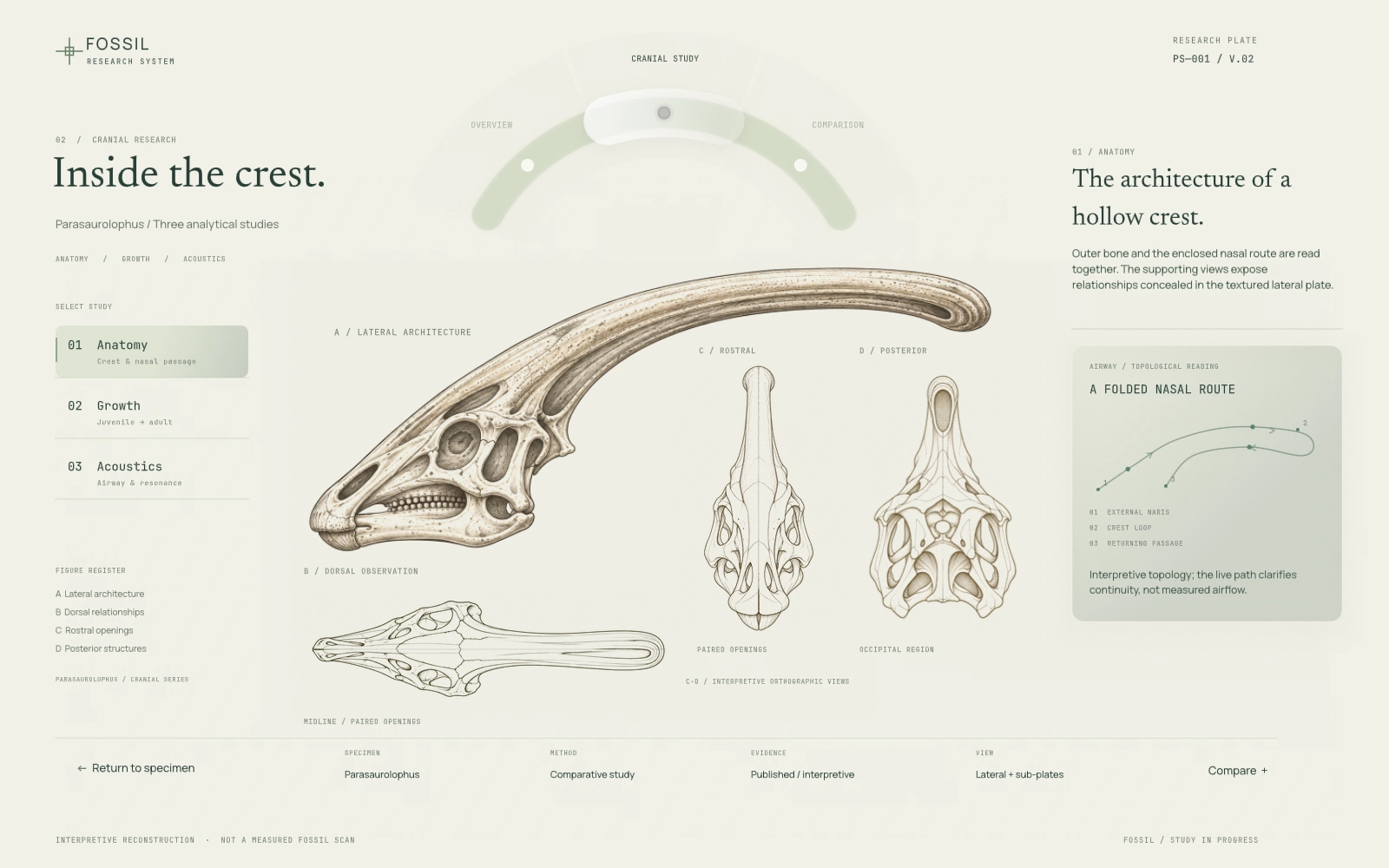
Cranial Study: complementary views and figure labels organized as a plate.
3. From surface to structure
One control blends the living reconstruction into its skeleton, in the same pose. The selected region stays active while its labels, card and Field Notes update together.
Inspection Blend: a continuous transition between living reconstruction and osteological view.
Field Notes: a local card and an expanded dossier add detail to the selected region.
4. A closer look at the crest
Entering Cranial Study reframes the specimen around its crest. The skull holds its position across Anatomy, Growth and Acoustics, and in Acoustics the diagrams follow the timing and intensity of a synthetic sound.
Anatomy, Growth and Acoustics around the same skull.
5. Comparing through questions
Parasaurolophus and Ankylosaurus are compared through six lenses: body plan, cranial structure, feeding, defense, posture and time. Each lens brings its own study points, 22 in total, from a local structure to a relationship across the whole body.
Support and stance: the specimen articulates to show a change in forelimb contact.
6. Built in Rive
View models, state machines and timelines drive the interface, with bones and mesh deformation for the posture and Luau for coordination. Text, diagrams and motion are native, so the whole piece stays editable in the Rive Editor.
Try it live (desktop): https://fossil-live.vercel.app
The illustrations are interpretive and AI-assisted, checked against published references. The posture and the crest sound are visual explanations, not a simulation or a real voice.
Self-initiated project · October 2026
Like this project
Posted Oct 22, 2026
An interactive paleontology study built in Rive: a Parasaurolophus explored from living reconstruction to skeleton and compared with Ankylosaurus.
Likes
1
Views
2
Timeline
Oct 12, 2026 - Oct 21, 2026