Redesigning HelloJio’s Mobile Voice Assistant Experience

Shawn Borsky

HelloJio
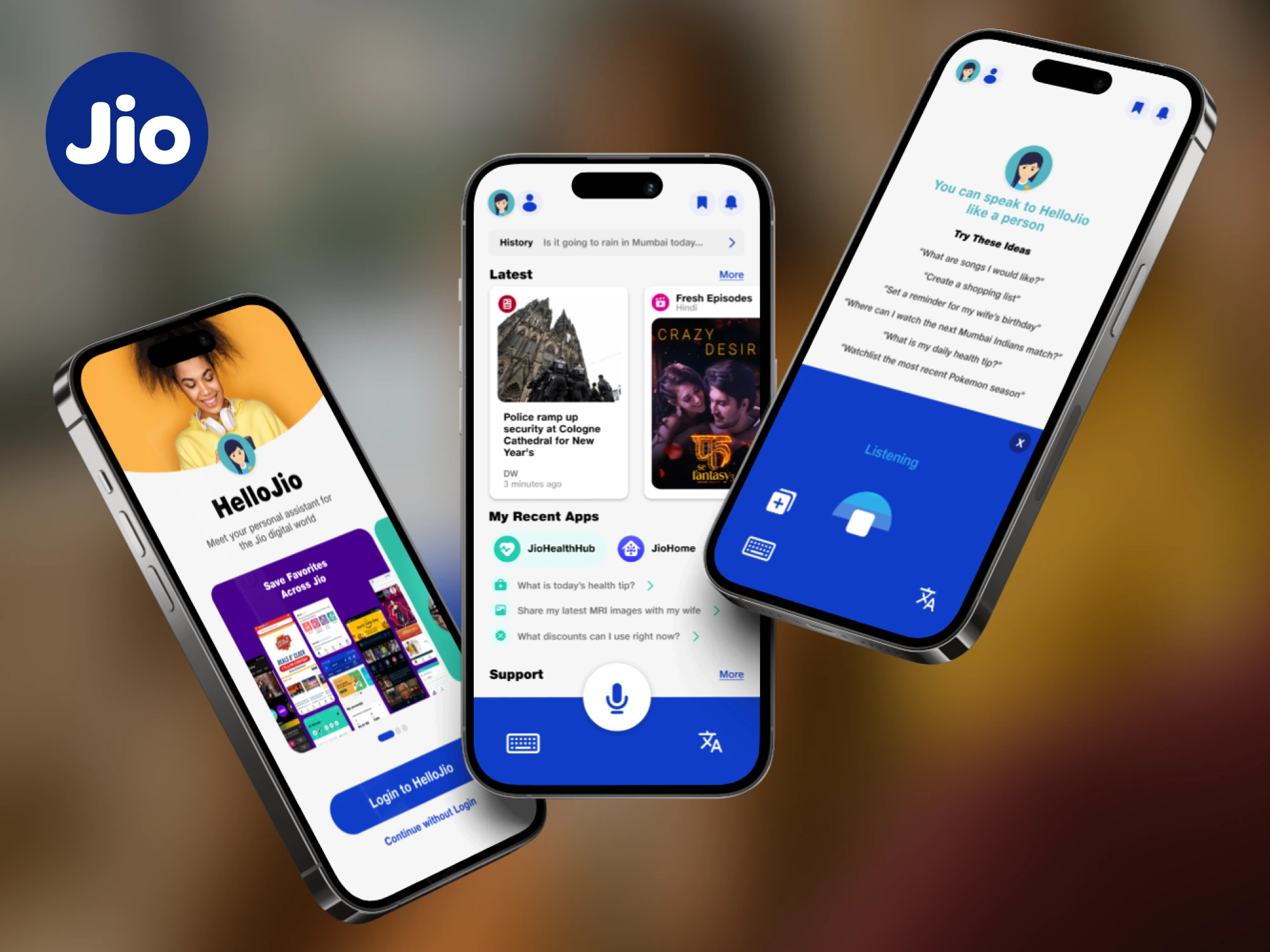
HelloJio is a virtual assistant that seamlessly integrates across Jio’s extensive ecosystem of services and apps. Its initial launch faced challenges in meeting key business goals. I collaborated with the core team to overhaul the product strategy and service design, developing new prototypes and flexible frameworks to guide its future direction.
A voice assistant that was meant for more
Jio is a multinational telecom and services company based in India. Imagine if Amazon, Google and Verizon were all one company. HelloJio was launched in 2017 with a vision to be a "better Alexa" to connect users to all parts of their Jio lives from shopping to entertainment, news, telephone, health and more. After its launch, it was primarily used to check billing or account balances. Not living up to its true purpose.
It need a refreshed user-centric approach that would get it back on track. The new design would be a stand-alone app and a module that added value and drove more engagement, usage and delight to Jio customers.
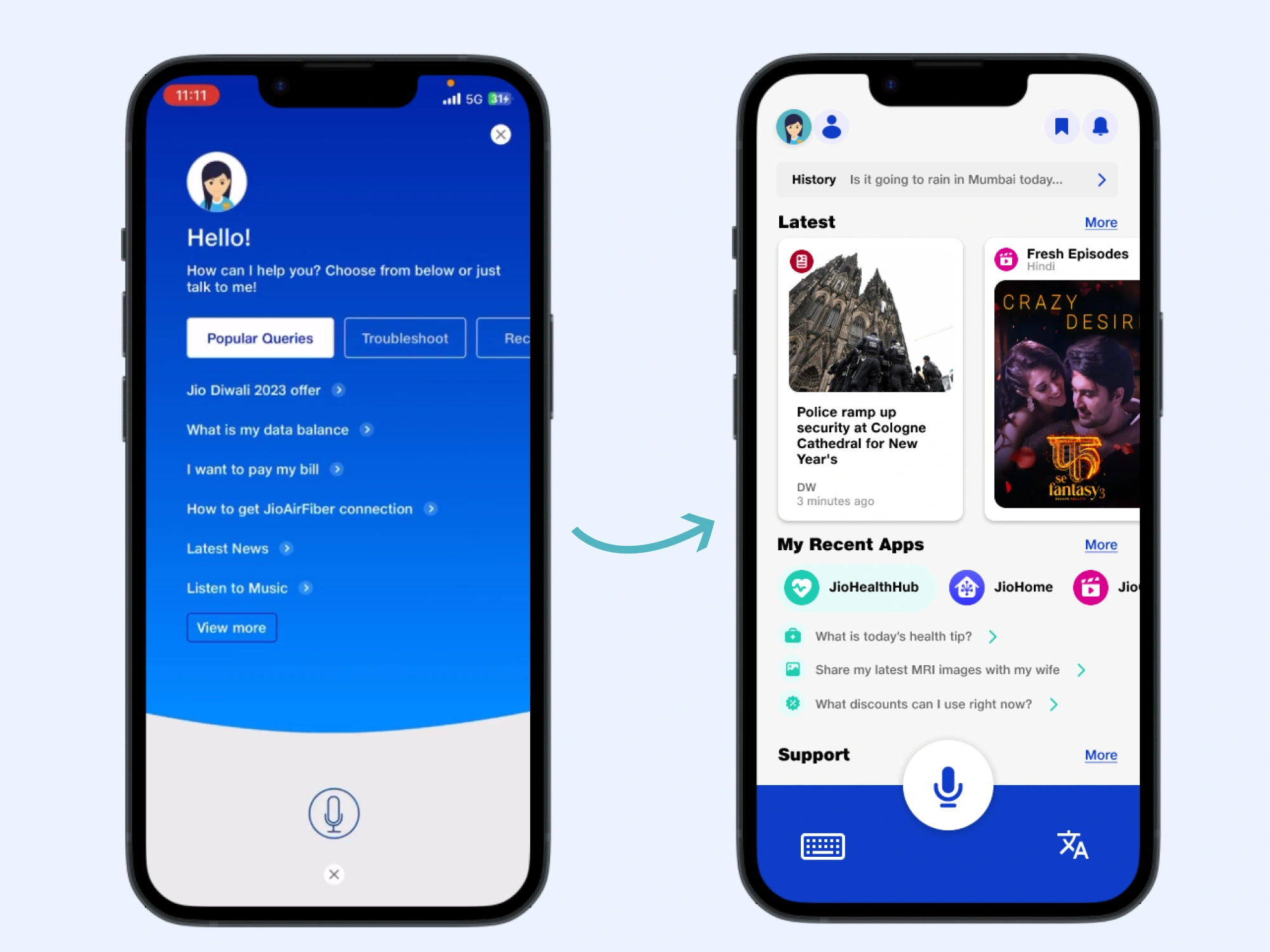
Before and After Comparison
First Time User Flow Prototype
The Core Concept
An assistant that encourages discovery while offering relevant, personalized and problem-solving responses
Our first step was to evaluate what worked and what didn’t. It became evident that customers primarily used HelloJio to address problems, such as troubleshooting or checking their prepaid balance.
We also found that the assistant did not feel personalized as it relied on "looking up" user information in real-time, rather than leveraging pre-existing data, despite being native to the customer device. This often resulted in visible delays which more often than not led users into dead ends with limited affordances or animations to enhance usability.
To focus our effort, I applied a conversational design framework to evaluate the product. Through data usage breakdowns and previously conducted user interviews, we identified several clear opportunities for improvement and defined key vectors to explore further.
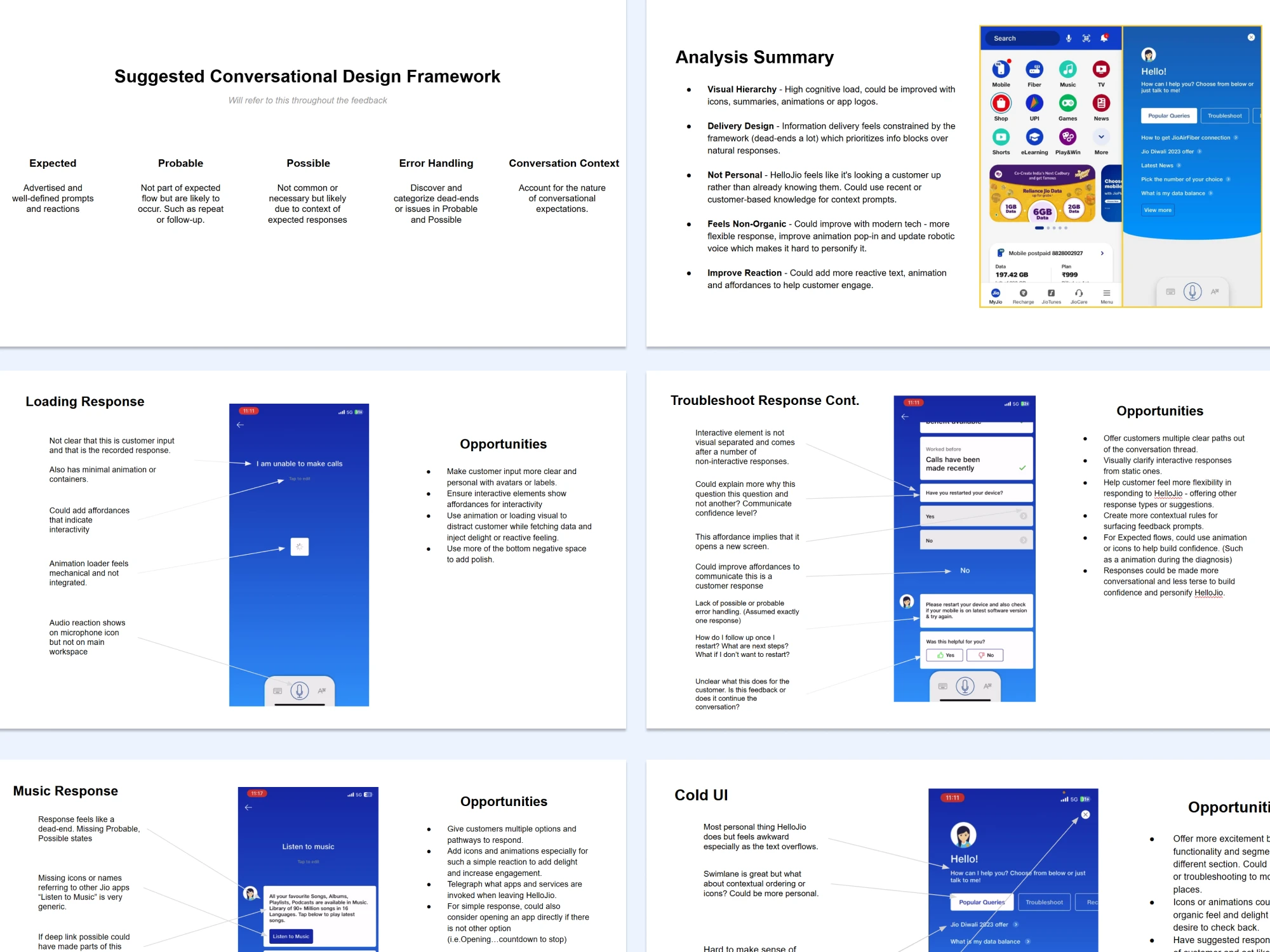
Experience Evaluation Deck Slides
Key Challenges
An assistant that is hidden but contextually available and also acts as a personalized hub that users want to use
In its 2017 iteration, the assistant required direct activation, often taking over the screen and struggling to maintain context. The primary design challenge was to create an assistant that could adapt to various contexts—existing on top of or within other Jio applications—while also establishing its own distinct value and identity.
The vision for HelloJio extended far beyond mobile phones, encompassing set-top boxes, smart TVs, connected cars, and more. However, the initial single-form factor and restrictive response design were insufficient to scale across these diverse platforms.
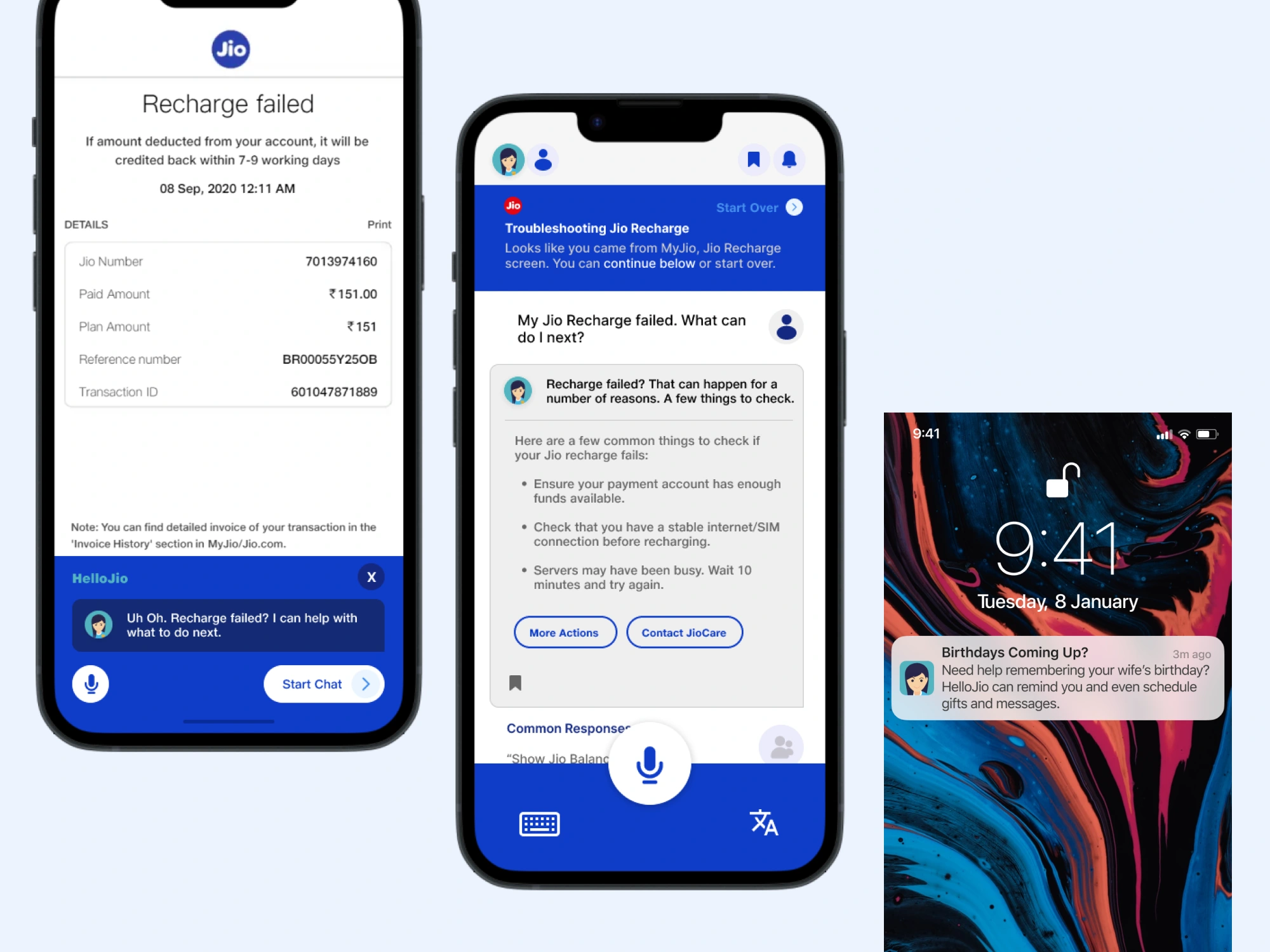
Contextual Recharge Flow
Strategy Highlight
HelloJio needed a consistent but flexible, conversational model
The original HelloJio was not AI-driven, struggled with open-ended responses, and often led users to frustrating dead-ends, often culminating in a generic "Was this helpful to you?" prompt. To address this, we mapped ideal use cases to flexible module templates and identified areas where the new AI-backed algorithm could reliably deliver expected results as well as dynamically generating new combinations on the fly.
A critical enhancement was enabling HelloJio to maintain conversation history, allowing it to recall previous context—even after a device change or reset. Through analysis of Jio customer behavior, we identified common recurring tasks and prioritized making them easily accessible and discoverable. This led to the introduction of a Favorites/Bookmark feature, along with proactive capabilities for HelloJio to recognize usage patterns and suggest personalized actions across Jio apps.
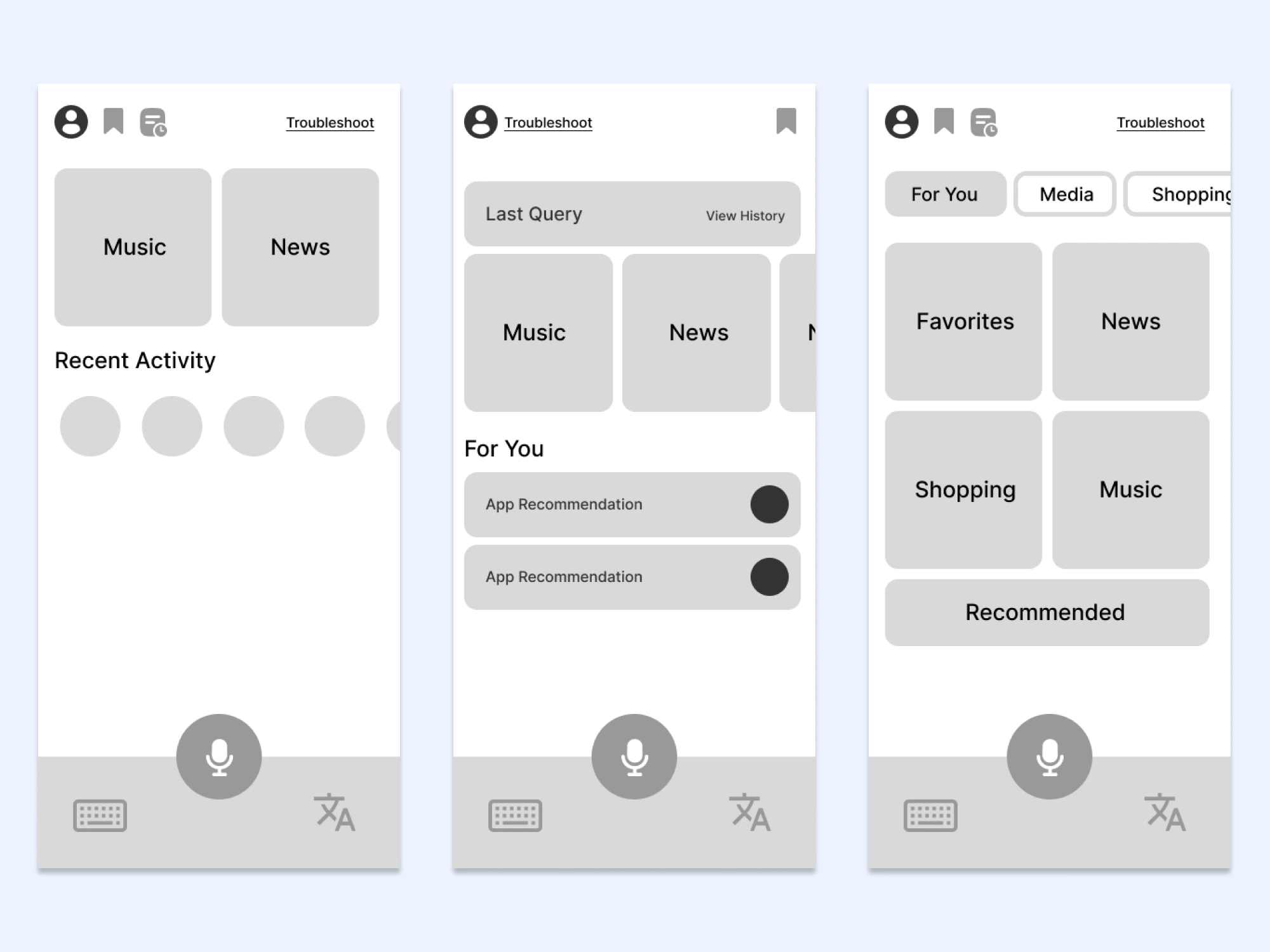
Sketch Explorations for Home User Pattern
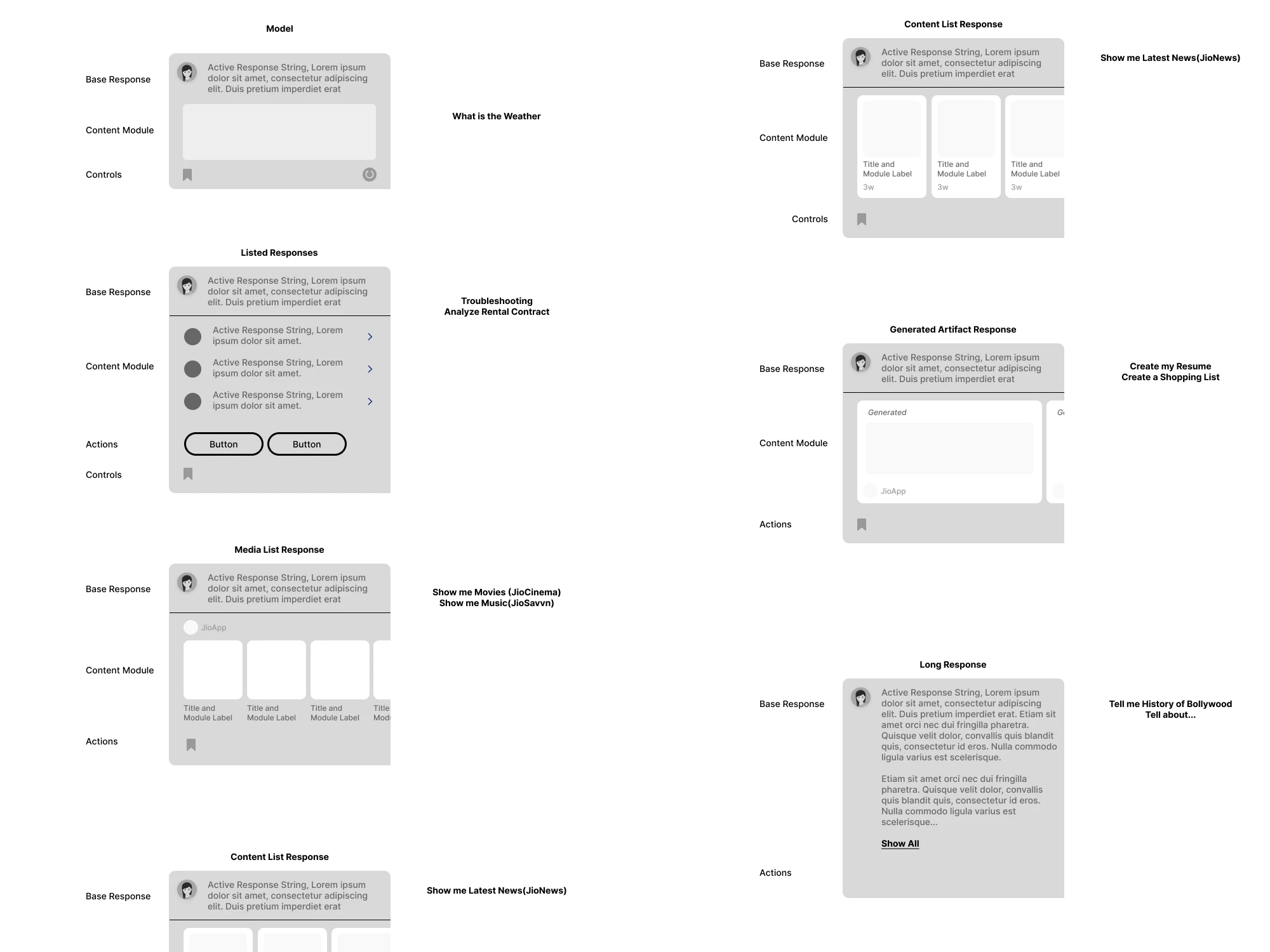
Conversational Model Design Structure
Strategy Highlight
HelloJio needed a consistent but flexible, conversational model
The original HelloJio was not AI-driven, struggled with open-ended responses, and often led users to frustrating dead-ends, often culminating in a generic "Was this helpful to you?" prompt. To address this, we mapped ideal use cases to flexible module templates and identified areas where the new AI-backed algorithm could reliably deliver expected results as well as dynamically generating new combinations on the fly.
A critical enhancement was enabling HelloJio to maintain conversation history, allowing it to recall previous context—even after a device change or reset. Through analysis of Jio customer behavior, we identified common recurring tasks and prioritized making them easily accessible and discoverable. This led to the introduction of a Favorites/Bookmark feature, along with proactive capabilities for HelloJio to recognize usage patterns and suggest personalized actions across Jio apps.
Like this project
Posted Dec 19, 2025
Redesigned HelloJio into a standalone app and modular platform, driving increased engagement, usage, and customer delight across Jio’s massive subscriber base.