Human Design Ecosystem for Black Women

Brianna McMillian


Human Design for Black Women: A Solo-Engineered Full-Stack Ecosystem
Client: Human Design For Black Women
My Role: Designer, architect, and builder
Status: Live and operating
Team Size: One person (end-to-end build and operation)
The Brief
Human Design tools already existed. However, every single one of them was built for a general audience, priced as a one-time static report, and written in a register that lost users within the first thirty seconds.
The audience I was building for—Black women using Human Design as a framework for self-discovery, business, relationships, motherhood, and healing—was not underserved by a lack of calculators. They were underserved by a lack of interpretation, and by a market that treated the chart as the product.
The chart was never the product. The interpretation was, and interpretation is a publishing business wearing a software costume.
What It Actually Is
This is the part that gets undersold when a build like this is described as "a site." It is a working ecosystem with four businesses inside it—editorial, e-commerce, membership, and an AI reading engine—sharing one identity, one entitlement model, and one admin surface.
The free tier is real, not a teaser. A full bodygraph calculator, an entire foundations library, six downloadable guides, and an editorial archive across articles, podcast, business, and life. People can get value and leave, and most of them come back.
Free Entry: Chart calculator, foundations library, resource hub, editorial
Chart Hub: Three progressive paid tiers on one continuous scroll
Reports: 13 AI-generated products from quick reads to bundles
Guided Rooms: 10 modality experiences behind a subscription
Membership: Two tiers, a stackable daily add-on, mentorship, and academy
Apothecary: A nine-shelf catalog where every product lives
The Journal: A digital workbook with a gated AI reflection layer
The Chart Experience
Chart Hub is the flagship. Rather than three separate products with three separate checkouts, it is one continuous scroll that deepens as you pay—you can see the shape of what you do not have yet, in context, right where it would sit.
Underneath, two external APIs are normalized behind a single provider layer, cached server-side with different lifetimes for different kinds of data:
6 hours for static reference
30 minutes for transits
1 day for images
A secret picks the active source, and a diff helper validates one provider against the other. The customer never learns which API they are using. That is the point of a provider layer.
The AI & Reading Engine
Thirteen AI report products could have been thirteen prompt files and a prayer. Instead, there is one engine with one entry point. A product declares which data endpoints it needs; the engine fans out, caches the raw payloads, and hands them to an interpretation layer.
That layer hashes the product and the input summary, checks the cache, and only calls a model if nothing is there. Repeat reads never re-hit the model. For time-sensitive products, the hash carries a daily bucket, so a daily reading is generated once per day rather than once per visitor.
Schema-Constrained Output: Every product has a Zod schema the model must satisfy.
Model Tiering to Task: Fast model for quick reads, deep model for long-form.
Granular Structure: One generator and prompt per product; structured JSON renderer turns data into a branded page rather than raw text.
Rule of thumb: Cache before you generate. It is the difference between an AI feature that has a margin and one that has a bill.
Guided Rooms
Ten modality experiences, each one built to feel native to its own tradition rather than like a tab in a dashboard:
Traditions included: Numerology, Horoscope, Moon, Tarot, I Ching, Biorhythm, Dream Rave, Dream Decoder, Cycle Analysis, and Crystals.
Interactive elements: Tarot shuffles, coin casting for the I Ching, and void-of-course calculations for the Moon room.
Coherence: Every room carries a "where this meets Human Design" callout so the ecosystem stays unified.
Platform Architecture
Built for scale, security, and zero-maintenance overhead:
Core Stack: SSR React on Cloudflare Workers, TanStack Start, React 19, Vite 7, and TypeScript.
Database & Security: 55 Postgres migrations via Supabase, with Row-Level Security (RLS) on every public table and explicit grants after every table creation.
Privilege Model: Roles never live on the profile record. They live in their own table behind a security-definer function, providing a hard invariant against privilege escalation.
Async Processing: Postgres-native email queue (
pgmq plus pg_cron), advisory-lock serialized, with zero background workers burning money when idle.Observability: Custom error capture tables and an admin health surface.
Commerce & Membership
Stripe Checkout: Handled securely for both one-time purchases and recurring subscriptions.
Webhook Handling: Signature-verified handlers with timing-safe comparisons, auto-triggering entitlement reconciliation and fulfillment emails.
Bundles & Catalogs: Bundle SKUs that fan out into child entitlements, powering an Apothecary catalog and an Academy with cascading course, module, and lesson access.
Content Operations & The Visual Editor
Over a hundred pages of copy, and no traditional CMS worth the integration cost. So I built one directly into the site:
Inline Editing: An admin toggles edit mode, making every heading, paragraph, list item, quote, link, and button clickable.
Workflow: Changes autosave as a draft scoped to that page. Publishing flips draft to live instantly.
Global Architecture: Opt-out by design via a global component that auto-wraps text nodes. Images and backgrounds are swappable inline.
Founder Tooling: The Cockpit
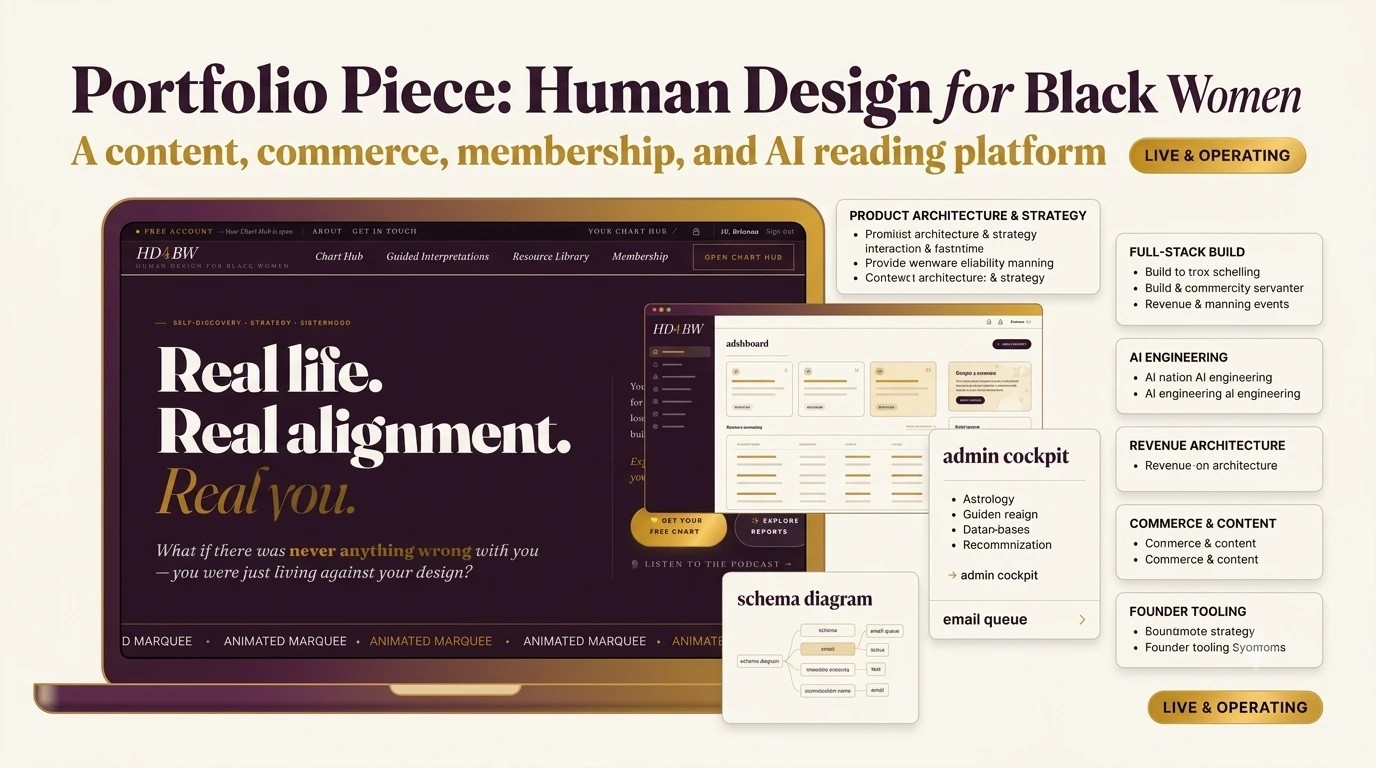
This is the piece that makes operating a complex ecosystem as a solo founder survivable: a private MCP server exposing roughly 55 business tools, bearer-authenticated and CORS-locked, allowing management of the entire business directly from a chat window.
Daily Pulse: Today's business, pending actions, revenue summary, digest.
Intelligence: Member journeys, churn signals, content performance, cohort analysis.
Operations: Lookup members, manage subscriptions, grant entitlements, handle fulfillment, and process support messages.
Content & Health: Draft articles, publish with explicit confirmation, and monitor payment sync checks, email delivery, and failed-send retries.
Design System
Spiritual software has a default look—purple gradients, star fields, gold foil—and it reads cheap to the exact audience I was building for. I went the opposite direction:
Palette: Cream and ivory grounds, plum text, a single gold accent, and editorial serifs for display.
Motion: Applied where arrival matters (hero reveals, tarot shuffle, coin cast, staged reading assemblies).
Motif: A single animated marquee under the hero carries every modality across the screen as one unified visual thread.
Decisions That Held
The calls that are not obvious from the outside, and that I would make again:
Two kinds of server code, two locations: Internal reads and writes go through typed RPC scoped to caller permissions. Webhooks, cron, and MCP live in file routes. Different guarantees deserve different homes.
Never run a protected function in a public loader: Server rendering has no session. Protected loaders live behind the auth gate; public routes fetch them client-side.
Cache before you generate: No model call happens without a cache lookup first.
The city string is load-bearing: The chart API silently ignores coordinates and timezone and only reads the city name—so front-end validation forces a dropdown pick.
The email queue self-idles: The scheduled job unschedules itself when both queues are empty and re-arms on the next enqueue. No worker sits burning money waiting for nothing.
Roles never leave their table: Every privilege check routes through one function. The admin client acts, it never authorizes.
By the Numbers
114 Routes in the application
55 Database migrations in production
13 AI report products, each with schema, generator, and renderer
1 Person running all of it
~55 MCP tools
10 Guided Rooms
19 Managed media slots
9 Catalog shelves
6 Free resources
4 Membership levels
3 Chart tiers on one scroll
2 APIs behind one layer
Built With
Application: TanStack Start, React 19, Vite 7, Cloudflare Workers, TypeScript
Data & Infrastructure: Supabase, Postgres, Row-Level Security, pgmq, pg_cron
Interface: Tailwind v4, shadcn/ui, Framer Motion
Services & AI: Stripe, Brevo, Roxy API, HD Hub API, Gemini 2.5 Pro / 3 Flash, MCP
Like this project
Posted Jul 23, 2026
Created a full-stack ecosystem for Black women using Human Design, combining editorial, e-commerce, membership, and AI reading features into one platform.