Sober Up: A Wellness App for Alcohol Moderation

romain martinez

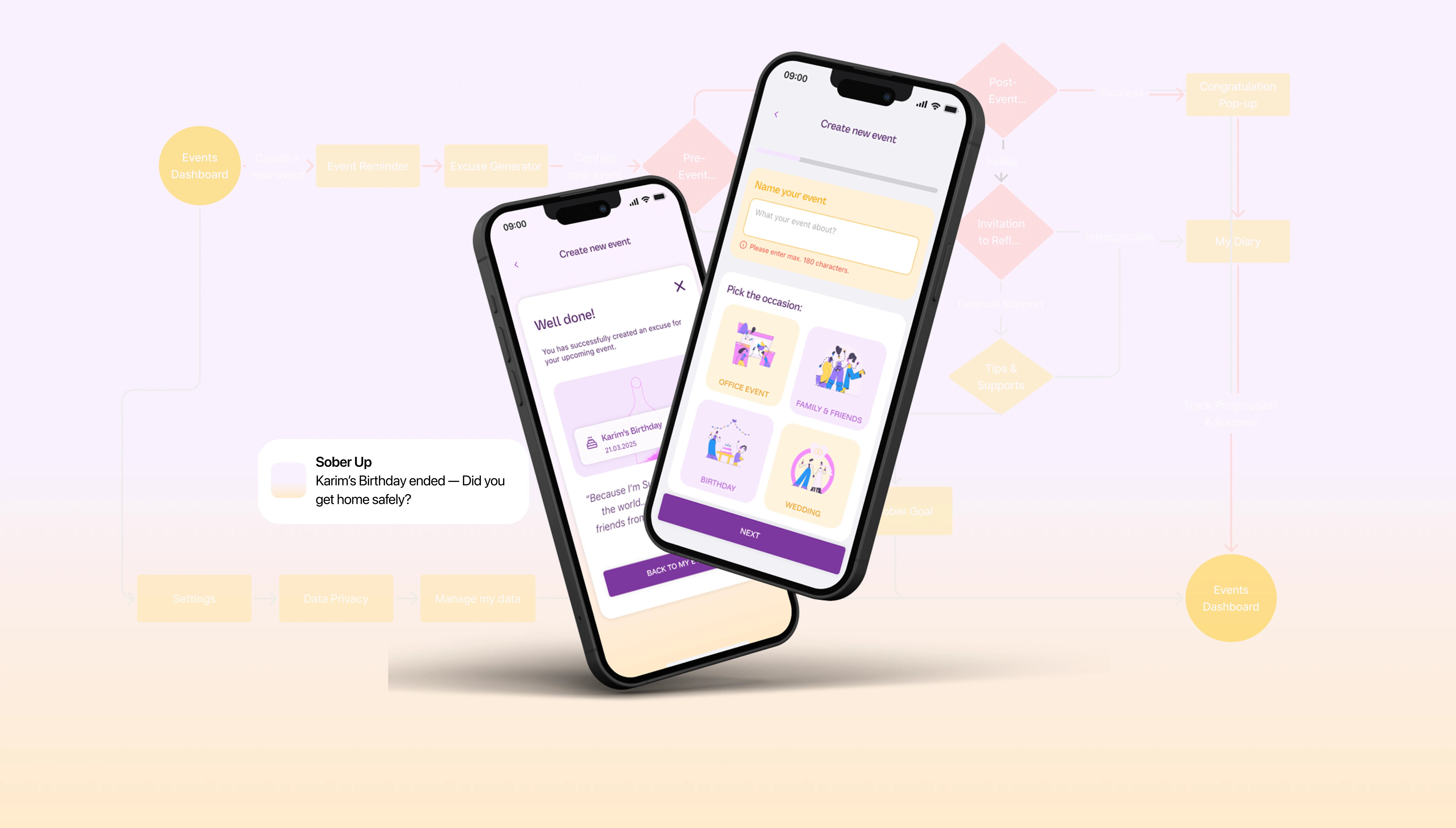
“Sip of sobriety with Sober Up”. Case studyWellness App
8 min read
·
Jan 25, 2025
Through this new article, let me introduce you to our Sober universe — a world where having fun does not always involve drinking alcohol.
Discover the Sober Up app, a solution designed to empower individuals to navigate social situations. By synthesizing various forms of social excuses, we aim to foster a culture of enjoyment that does not rely on drinking.
But before that, we must travel back in time and understand what drives us to this result.
To address this new project, our team comprised my lovely colleague Happy Han and myself.
The Scope
“The Daily Health Conference has tasked us with developing a solution for their next Wellness App. “
They have observed a significant decline in memberships and need to improve retention.
With that in mind, our first task was to explore the wellness universe. The picture of this new exercise brought me into a different emotional state.
I never climb high mountains, but at this instant, the broad of the topic gives me a chill. Excited about this new challenge, Han and I started to dive into the Healthtech app world. At the first instance, we started brainstorming to outline our path, and from that excitement emerged our initial ideas.
As a group of frenchies, our assumptions naturally brought us towards alcohol addiction. We were both convinced alcohol plays an important role in our society, especially in a country that is always promoting wine as a national gem.
Consciously, our chosen subject will give us a hard time because we feel like we are fighting an old friend. After all, alcohol is so deeply ingrained in our habits.
Before tackling the project we had to deepen our knowledge.
Becoming an expert
How to collect enough information about alcohol addiction? How to determine the boundaries of the subject?
Pretending to be an expert with only 2 weeks window of work sounds complicated. However, our previous experiences have equipped us to efficiently collect both quantitative and qualitative data within a brief timeframe. We organized our research into three distinct axes, which allowed a comprehensive analysis of our findings.
First, research drafts a state of play about the wellness app market, alcohol consumption in France, and public health challenges.
Thanks to these research, in order we discovered:
69% are ready to use more Health applications (Source: Edhec)
“20% French people still think alcohol is beneficial for their health.” (Source: French Health Organization)
Unwrapping all our findings will require a bit of perseverance, but by combining all the collected information, we had a glimpse of people’s relationship with alcohol.
Because behind every extra drink, there are deeper psychological and social layers. Additionally, to expand our understanding , we conducted seven interviews and a survey.
Bellow a couple valuable of outcomes showing alcohol habits of consumption.
97,8% have drunk alcohol in the past
76% Socialize — 50% Relax — 34% Tradition
“Social convention forced us to go with a drink hand in hand”.
These insights gave us a broad map of user behaviours.
But before moving forward, let’s pause for a moment and share this anecdote with you, provided by an interviewed person.
I quote “My anecdote can be the Tom Holland Interview that resonated with a lot of people including me. He decided to do a Dry January and stayed sober since then. It has been a year and a half and he keep talking about how well it is […] That interview hit home.”
I decided to take a moment to reflect on this shared anecdote because we were amazed at how something seemingly insignificant evolved into not only a running joke but also a key element of our project.
With our findings in hand, we created a persona.
User Persona
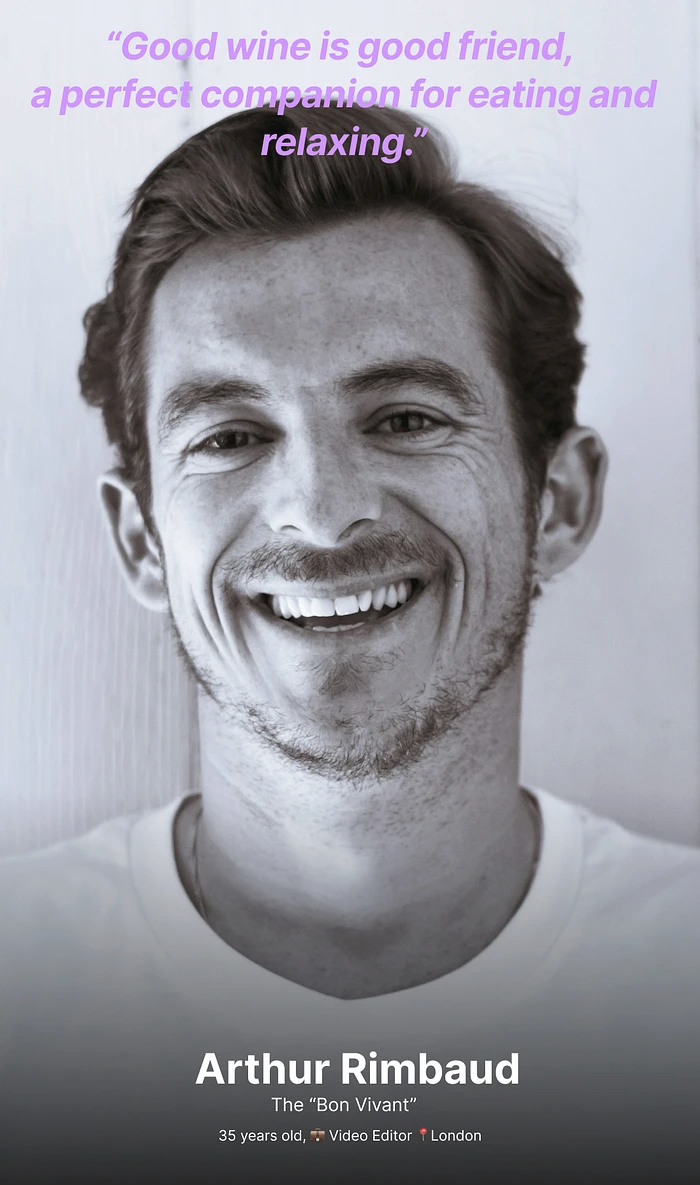
Above our persona based on our insight, Arthur is a French video editor living in London. As a French persona, Arthur can’t live without his daily glass of good wine. For him, “A good wine is a good friend, a perfect companion for eating and relaxing”.
“Arthur recently moved to London for a new job. His work at the advertising firm can be quite stressful. It’s finally Friday night, Arthur is working hard to meet his deadline and he can’t wait to join his coworkers at the bar to relax.”
Creating this persona was playful as it poked fun at ourselves. In our findings and inner assumptions, we felt strongly that French people have a particular relationship with alcohol. As a follow-up, we begin to create UJM (User Journey Map) to understand how Arthur deals with a drinking social moment.
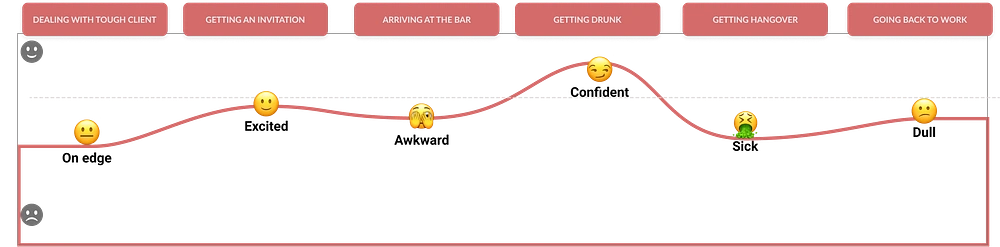
In our user journey map just above, we identified two significant low points that Arthur experienced. Setting aside the challenges he encountered throughout his workday, we focused on the moments when he felt forced to socialize with his coworkers, which explains the over-drinking behaviour to push his confidence. And the next day, when he’s regretting his decisions while having a hangover.
These elements grounded our problem statement.
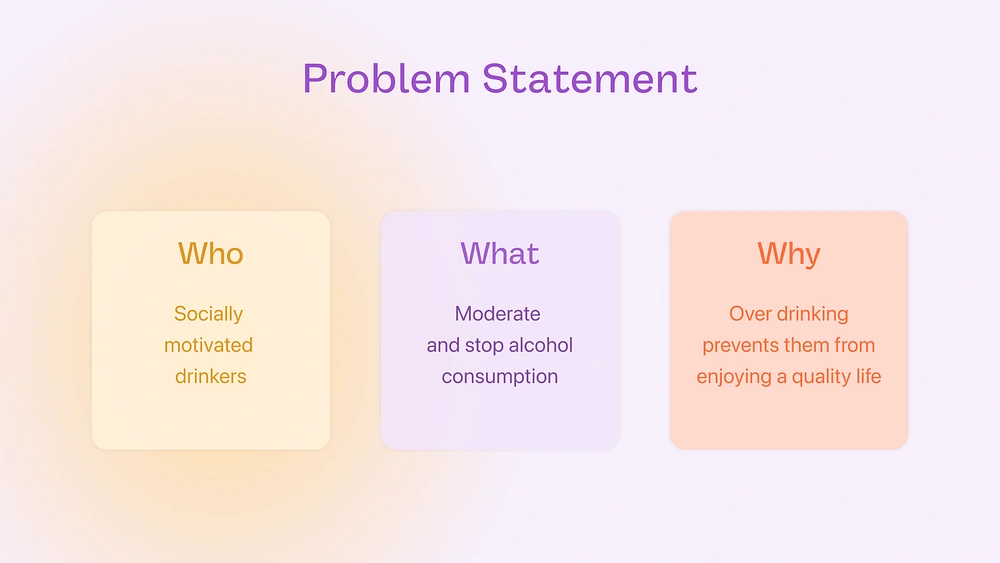
“ Socially motivated drinkers need a way to moderate & stop alcohol consumption, because over-drinking prevents them from enjoying a quality life”
In other words, how might we assist users in saying no to drinking? A thought-provoking quote shared by Han during the presentation comes to mind: “There can be no transforming of darkness into light and of apathy into movement without emotion.” This powerful quote by Carl Jung, the 20th-century Swiss psychotherapist, resonates deeply. Inspiring, isn’t it? With this perspective in mind, we progressed to the ideation phase.
Ideation
Here we are, serving as the initial bridge between User Experience (Ux) and User Interface (Ui). To manage this first ideation phase, Han and I decided to apply the Crazy 8s principles. This stage of the project is always fascinating, as it’s when both brilliant and unconventional ideas come to the forefront.
In my previous experiences, this phase was a mix of fun and chaos. However, for this particular project, we were surprised by the absence of significant difficulties.
We both agreed to develop a solution which helps our users set a sober goal by providing excuses when they have to deal with alcohol moments.
Following, we started to sketch a low-fidelity wireframe, to anchor our findings through our digital solution. We defined a journey that incorporate our solution. On our draft app, we allowed the user to reconnect with himself.
Before an event, the user can generate an excuse and set a reminder.
To encourage self-reflection, we allow him to share his feelings and take the time to focus his attention on their success and failure. We also provide tips and support to guide him on a sober path.
To assess our newborn app we conducted several concept testing sessions. The aim was to gather enough feedbacks to target the weaknesses of our flow. These collected informations led us to go back to the drawing board.
To flesh out our work we decided to add new features to evolve the quality and the clearness of our flow.
The following day, to establish the path our user had to achieve through the app, we designed AI(architecture Information) and a User flow.
So far, everything had been going well but not for much longer. Release our user flow turned out to be a real headache. We iterated it 4 times before its final version.
After fours hours going around in a circle, we finally find a way and achieve this task.
Mood board
I appreciate this phase. It allows you to set the tone of your work and leaves little space to express your creativity. To conduct our mood board we chose to work separately. The outcomes were surprising because our work was slightly opposed. Han had decided to tackle this with a formal composition comprised of real-life pictures. I was focused on bringing an aesthetic interpretation.
After a concise brainstorming, we created our final version combining our work.
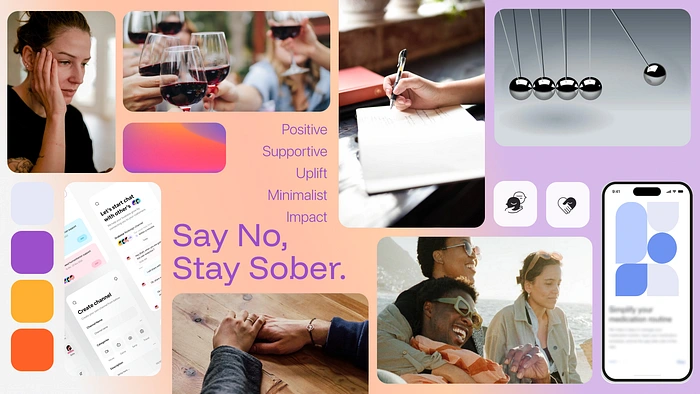
Accessibility
As UX (user experience) students, our mission is to think about how users perceive a product. This means taking a user-centered approach.
Let’s imagine now our users have disabilities, a person not able to see distinctly the colours. With this new perspective in hand, we took a moment to define a new design aligned with accessibility principles. We focused our strength on colour design, after severals iteration we set a clear and readable colour range.
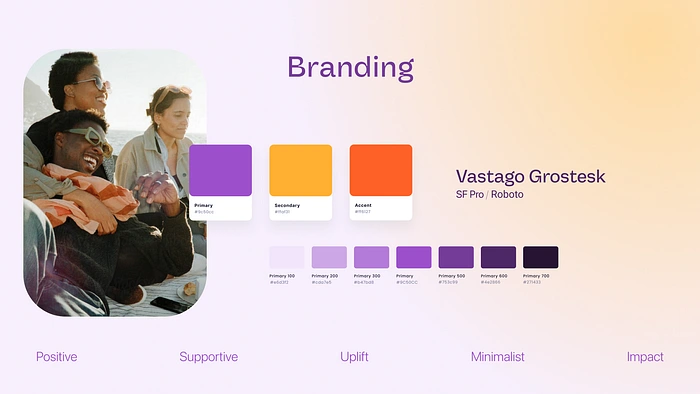
Prototype
In the next step of this project, we began developing our final version. In this critical phase, Han took charge of the interaction, while I focused on preparing our slide presentation.
With two days of work remaining, we conducted five usability tests, yielding positive results. The majority of users found our experience to be enjoyable and user-friendly.
To conclude, we did a strong presentation. We bore in mind this advice hammered by our teacher alongside our boot camp, which said “The key is to build strong storytelling “.
This is our story “Picture yourself, it’s Friday evening after a long, exhausting week. You’ve been invited to a party with friends. The atmosphere is lively, laughter fills the room, and soon enough, the drinks start flowing. At first, everything feels under control. “Just one drink,” you tell yourself. Then another. And another one …
The next morning, sunlight streams through the curtains, but all you feel is a mix of exhaustion, nausea, and that all-too-familiar voice in your head full of regrets: “Why did I drink so much? Your Saturday is ruined — your plan goes out the window.”
For many, this scenario feels all too familiar. Social pressure, cultural norms, and sometimes just the need to let loose, lead us to drink more than we intended.
Bellow, the outcomes of our 2 weeks of work. We provided an MVP solution aligned with the initial scope.
The final version of our app
Key learnings
The wellness project was for me a blossom. Despite, the challenges of being a non-native English speaker, I have found unsuspected resources to overcome them and stay on course.
I have become more aware of my strengths and weaknesses. UX appears now more accessible, and understandable. I know, I’m able to lead user interviews.
However, over the next month, I need to focus on improving my Figma skills. I would like to gain some practical experience with this software. I know I can handle it, but when faced with a sprint, I’m a bit slow.
To bring this to an end, my final observation concerns storytelling. If I had to keep only one thing about this exercise, it would always introduce a strong story to embrace your auditorium inside your journey. By doing it you catch all the captions of interlocutors and transform the 9-minute presentation into an enjoyable moment.
I would like to express a big thanks to my colleague Han. Long live Sober up and remember…
Remember, No is always an option. Protect your boundaries.
Like this project
Posted Nov 10, 2025
Developed Sober Up app to help users moderate alcohol consumption.
Likes
0
Views
4
Timeline
Jan 11, 2025 - Jan 25, 2025