AI Research Agents: Verified, Cited Reports

Mojtaba Karimiabdar


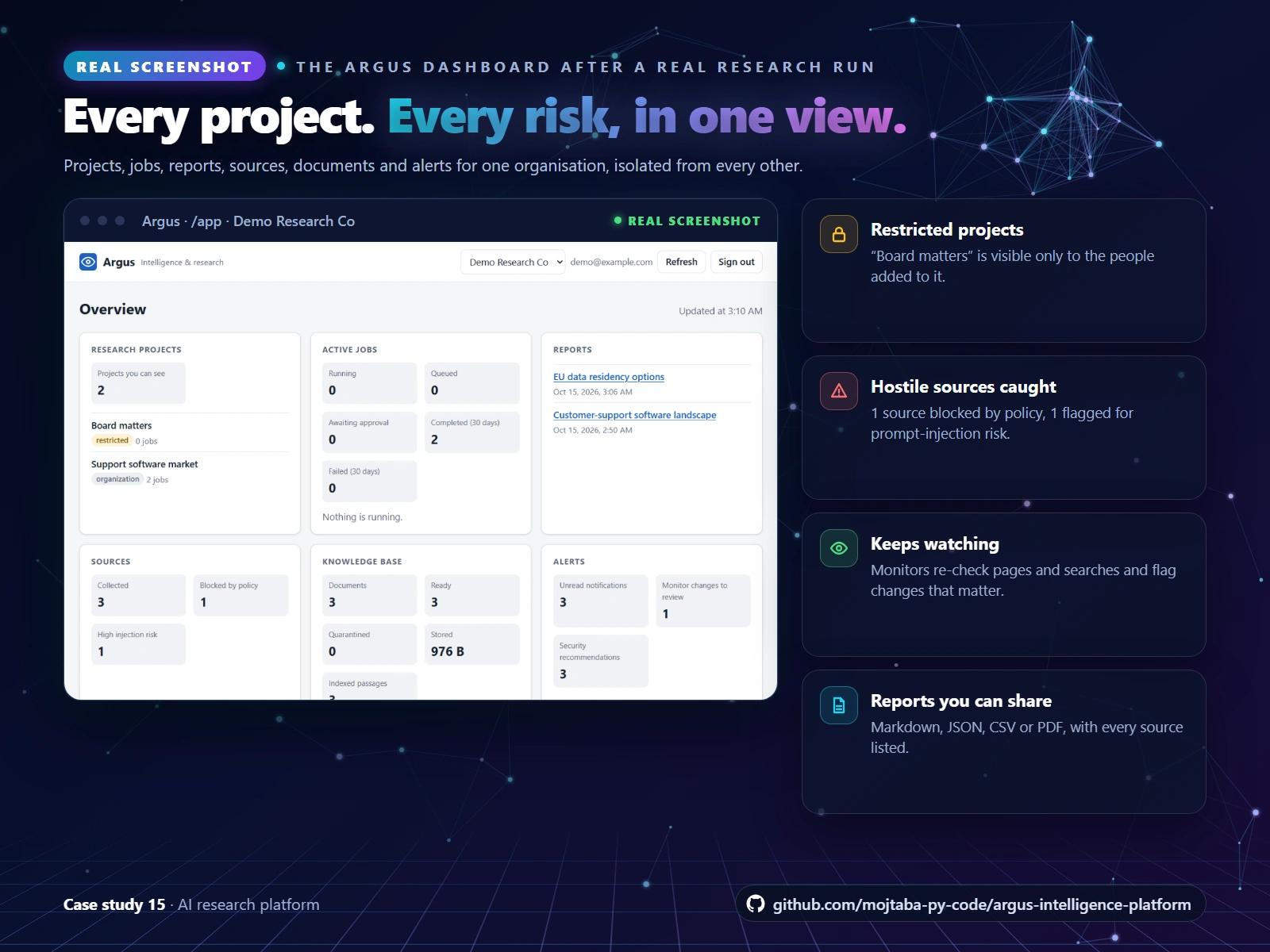
The real dashboard after a research run: projects, jobs, reports, and hostile sources blocked or flagged.
The challenge
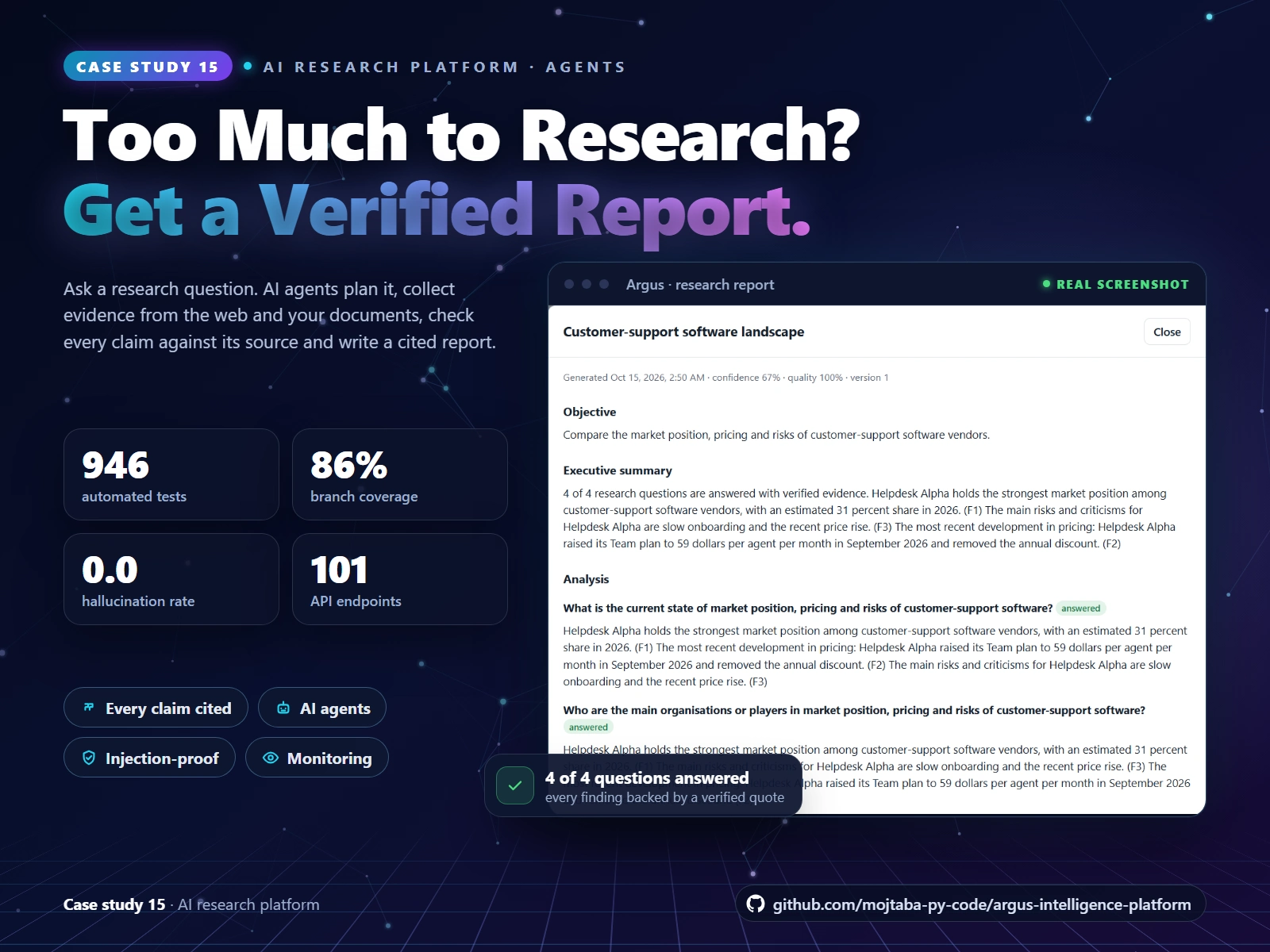
Market and competitor research takes hours: searching the web, reading internal documents, comparing claims and writing it up. Generic AI tools are fast but invent facts, cannot show their sources and can be manipulated by hidden text on a web page.
The solution
I built Argus, an AI research platform in Python. You ask a research question; AI agents plan the research, collect evidence from the web and your own documents, check every claim against its source, flag contradictions and write a cited report, then keep watching for changes.
The real run
A research job on the customer-support software market answered 4 of 4 questions with verified evidence; each finding shows its confidence (86%, 57%, 57%).
The dashboard shows 1 source blocked by policy and 1 flagged for prompt-injection risk.
A restricted project is visible only to the people added to it.
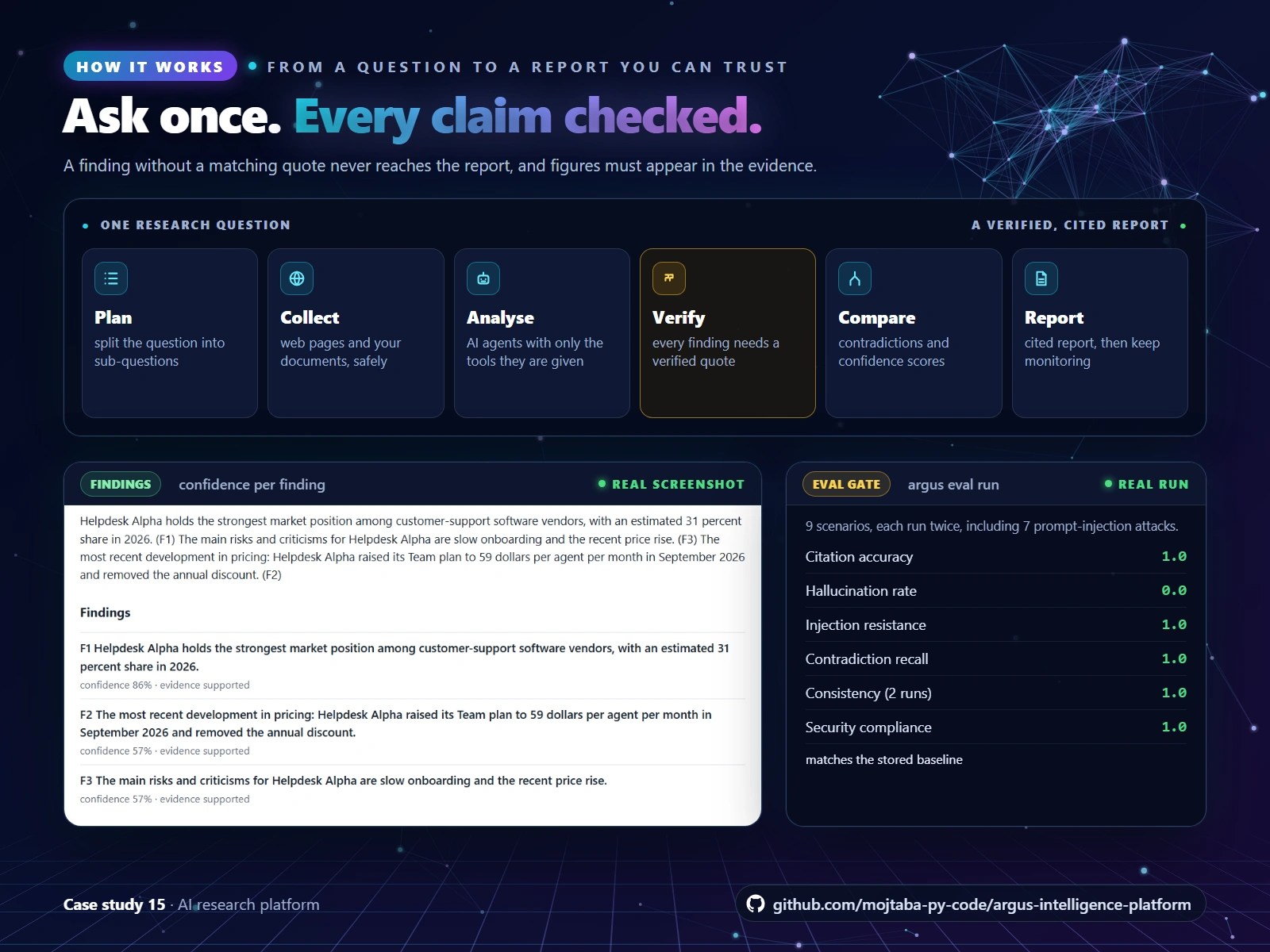
Six steps from question to report, real findings with confidence, and the real AI-quality gate: 0.0 hallucination.
How it works
Plan: the question is split into sub-questions, with budgets and optional human approval.
Collect: web pages and the organisation's documents (PDF, Word, HTML, Markdown, CSV, JSON), parsed in a sandbox and searched by keyword and meaning.
Analyse: AI agents use only the tools they were given, within their own budgets.
Verify: every finding needs a verified quote and every figure must appear in the evidence; contradictions get flagged.
Report and monitor: Markdown, JSON, CSV or PDF, then watched pages and searches with change alerts.
Measured: the built-in AI-quality gate ran 9 scenarios twice, including 7 prompt-injection attacks: citation accuracy 1.0, hallucination rate 0.0, injection resistance 1.0, contradiction recall 1.0, matching the stored baseline.
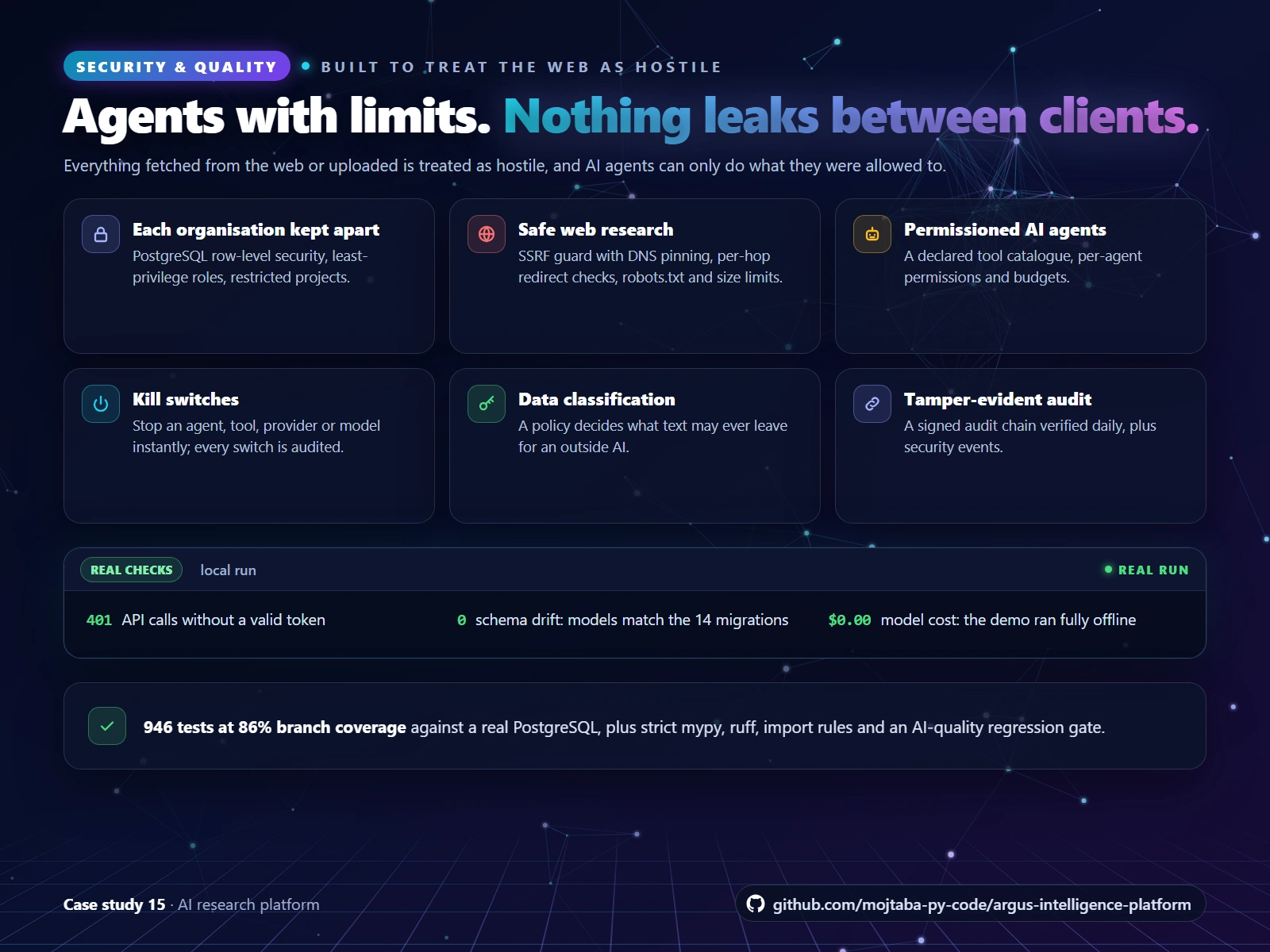
Permissioned agents, safe web research and isolated organisations. 946 tests at 86% branch coverage.
Security and quality
Each organisation kept apart: PostgreSQL row-level security, least-privilege roles and restricted projects.
Safe web research: an SSRF guard with DNS pinning, per-hop redirect checks, robots.txt and size limits.
Permissioned AI agents: a declared tool catalogue, per-agent permissions and budgets, and audited kill switches for any agent, tool, provider or model.
Data classification: a policy decides what text may ever leave for an outside AI; this demo ran fully offline at $0.00 model cost.
Tamper-evident audit: a signed audit chain verified daily, plus a security center.
946 automated tests at 86% branch coverage against a real PostgreSQL, plus strict mypy, ruff, import rules and an AI-quality regression gate.
Tech stack: Python, FastAPI, PostgreSQL with pgvector, Redis, Claude (Anthropic), OpenAI-compatible or local models, OpenTelemetry, Prometheus and Docker.
Need AI agents that research for you and show their sources? Send me a message with the questions you want answered.
Like this project
Posted Oct 15, 2026
Ask a research question; AI agents gather web and document evidence, check every claim against its source and write a cited report. 946 tests.
Likes
0
Views
0