A rule that isn't enforced

Sebastien Guidetti

A rule that isn't enforced isn't a rule. It's a wish.
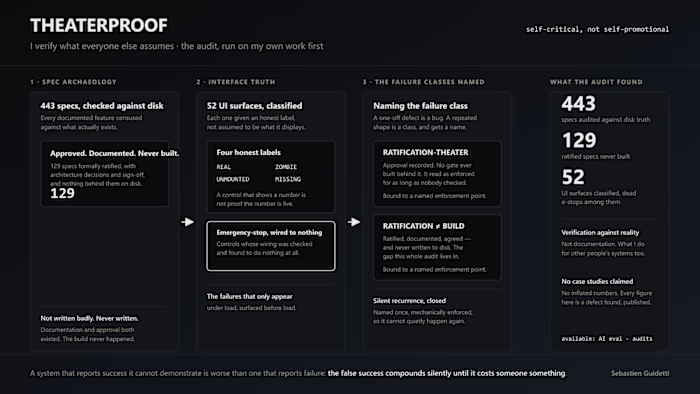
I named that failure mode **RATIFICATION THEATER** — prose that declares something is required, with no gate that makes it required. Last week I audited my own rule set against that standard and found 17 rules failing it, up from the 4 I'd previously published. The instrument got sharper and the number went up. That's how it's supposed to work.
But "write better rules" isn't the lesson. The lesson is that governance needs *machinery*, and most teams write the prose and skip the machinery. So here's the machinery — six mechanisms, what each one is for, and what each one has actually caught.
**LEXATRON** is the engine. **386 rules across three production systems**, each supposed to bind to a named enforcement point or carry an honest unenforced flag.
---
**1 · Named enforcement points.** Every rule names the actual place in the pipeline where it fires — a script, a hook, a gate — or it's flagged unenforced. No pretending. The audit that produced the 17 exists precisely because a *named* enforcement point can be checked and a vague one can't. Two questions do all the work: does that script exist, and does anything call it?
**2 · Archaeology sweeps.** Census every spec ever written and classify it against disk truth: BUILT / BUILT-UNWIRED / NEVER-BUILT / SUPERSEDED. Latest run: **443 specs, 129 never built** — 29% of the corpus, every one of them approved and marked done.
**3 · Receipt architecture.** Every completed task writes a receipt addressed to a named consumer, who must act or acknowledge within 48 hours. This targets the decoupling that kills most multi-agent systems by month three: agents declare done, nothing downstream consumes it, and the system silently comes apart while looking busy.
Then I audited the receipts themselves. **At the time of that audit, 2 of 33 had ever been paired to a consumer event.** Under 1%. The mechanism built to make silent completion impossible had been decoration for weeks. Building the mechanism is the easy half.
**4 · 30-day subtraction.** A gate that hasn't fired in 30 days is either perfect compliance or a dead rule — and you have to go find out which. Rules die by evidence. One subtraction batch killed seven dead-letter rules outright. Governance that only ever grows is bureaucracy with better branding.
**5 · Adversarial verification.** Load-bearing specs get attacked before implementation, across statistical validity, implementability, and coverage honesty. The last run caught three things before a line of code was written: a **phantom cost model** where two supposedly different profiles silently collapsed into one, guaranteeing a false green on every comparison; a **hardcoded parameter seam** — the parameter grid was empty at all four call sites with no way to fill it; and a **15-month compute infeasibility**, 276,000 runs on a single-vCPU box.
**6 · Interface truth census.** Classify every UI surface as real / zombie / unmounted / missing. Result across 52 surfaces: 15 real, 20 zombie, 11 built-but-never-mounted, 4 missing. Two of them were emergency **KILL controls wired to `undefined`** — buttons that flatten risk, silently doing nothing. That's the finding that would have mattered on day one of live trading, and no amount of "does it compile" would ever have surfaced it.
---
The through-line: **every one of these mechanisms is a way of asking "and did that actually happen?" about something a system already told me it did.**
Lecturing agents to do better doesn't work. Neither does writing the rule down. Mechanical rejection at the commit boundary works — for the gates that are genuinely wired in. Which is a claim you have to check, on a schedule, forever.
**If you're running AI agents in production and something in your pipeline is supposed to work but doesn't, quite — that's the thing I'd want to look at. Fixed scope: I find the gap between what your system claims and what's on disk, and hand you the list.**
#AIGovernance #LLMOps #MultiAgentSystems #AIEngineering #TechnicalDebt
Like this project
Posted Aug 19, 2026
A rule that isn't enforced isn't a rule. It's a wish. I named that failure mode **RATIFICATION THEATER** — prose that declares something is required, with no...
Likes
0
Views
0