The first honest backtest of

Sebastien Guidetti

The first honest backtest of my trading platform returned zero passing strategies out of 142.
Not "a few underperformed." Zero.
I halted all downstream development. Not because the system caught itself — because I looked at the results, decided the foundation was rotten, and refused to build anything else on top of it until it was verified.
Then I ran a bigger validation sweep — 300 cells — to check whether the first result was an artifact. **Also zero clean.** 136 rejected outright, 47 indeterminate, 11 timeouts, and 106 that failed on a single infrastructure bug I'll come back to.
**METIS ORACLE** is what's being rebuilt. What exists:
- **367 engine source files**, an 8-gate signal validation pipeline, direction-aware regime detection
- **A 12-agent specialist council** — technical patterns, manipulation cycles, on-chain flow, macro regime, system health, validation, execution timing, consensus challenge, multi-signal aggregation, risk oversight — routed across five model providers with weighted ensemble scoring and automated fallback
- **A statistical gauntlet:** deflated Sharpe (Bailey / López de Prado), PBO-CSCV overfitting correction, walk-forward out-of-sample validation, Benjamini-Hochberg FDR control at q=0.10
- **Graduated risk zones:** shadow → strict → leverage, where each tier unlocks only from the previous tier's proven results and leverage capital is funded exclusively by strict-zone profit
- **Prop-firm eligibility rules** encoded and machine-checked in advance of any live evaluation
Things this system caught in itself — the reason I'll trust it eventually and don't yet:
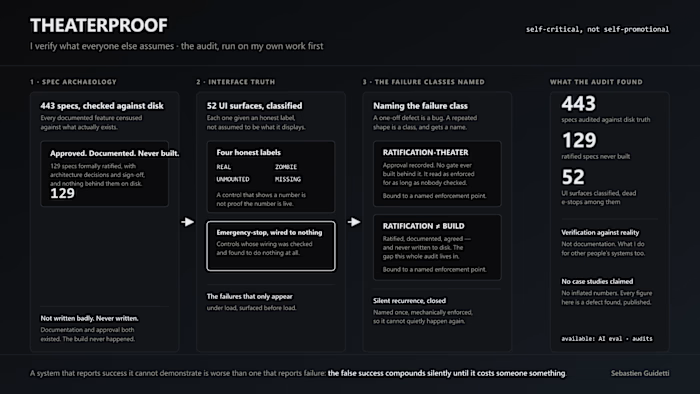
**The measurement framework was forging its own grades.** It compared trade results in *dollars* against formulas expecting *percentages*, then applied the wrong calendar factor. A 37% gap between reported and actual. For eight days, the entire strategy leaderboard was fiction. A whole cull of strategies got executed on that broken ruler. Fix the ruler before you trust anything it measures.
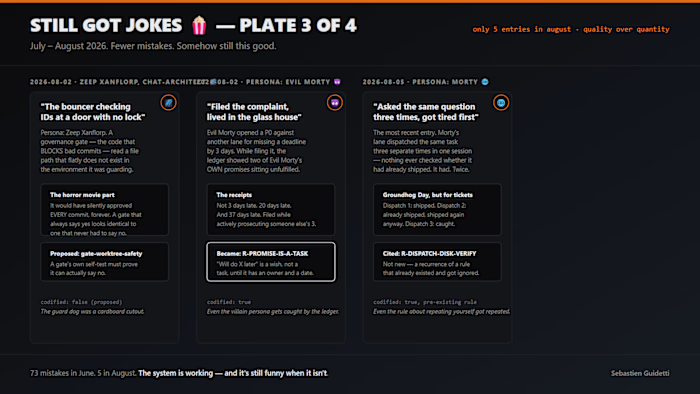
**Ten of twelve council agents were silently disabled for two months.** An aliasing bug. Not one error thrown. Separately, a runtime thesis producer sat dead for 39 days while every panel downstream of it rendered clean, honest, entirely empty output. Nothing looks more finished than a working UI with no data behind it.
**Confidence looked inverted — and then that finding was itself invalidated.** An audit of the council's stated confidence against outcomes returned a Brier score of 0.537, worse than a coin flip, with the 80–90% confidence bucket going 0 for 9. Leverage got clamped to 1×. Six days later a paper-trade P&L contamination bug was found in the input data, and the finding was stamped INVALIDATED pending a re-run. The clamp stayed, on independent grounds. I'm telling you about a finding that turned out to be wrong because the alternative — quietly dropping it — is the exact behaviour I audit other people's systems for.
**A gate that existed and did nothing.** Remember the 106 failures in the 300-cell run? They were all one bug class — and I had already written the gate that catches it, five days earlier. It was on disk. Nothing called it. That's a failure mode I now track separately from "never built": **BUILD ≠ WIRED.** The fix existing is not the fix working.
**Status: shadow mode. No live capital. Cleanup ongoing and incomplete. No edge proven.**
I'll say so publicly the day that changes, and not one day earlier. If you ever see me post a return number, you'll also see the audit that produced it.
**If something in your own pipeline is supposed to work but doesn't, quite — that's the thing I'd want to look at.**
#AlgorithmicTrading #QuantitativeFinance #AIEngineering #Backtesting #SystemsArchitecture
Like this project
Posted Aug 19, 2026
The first honest backtest of my trading platform returned zero passing strategies out of 142. Not "a few underperformed." Zero. I halted all downstream devel...
Likes
0
Views
1