The Broken Rung vs. the Glass Ceiling

Dr. Vernette Grant



The Broken Rung vs. the Glass Ceiling: Assessing the Greater Barrier to Women's Career Advancement
Published in the Open Journal of Business and Management, Vol. 13, No. 5 (September 2025).
The Research Question
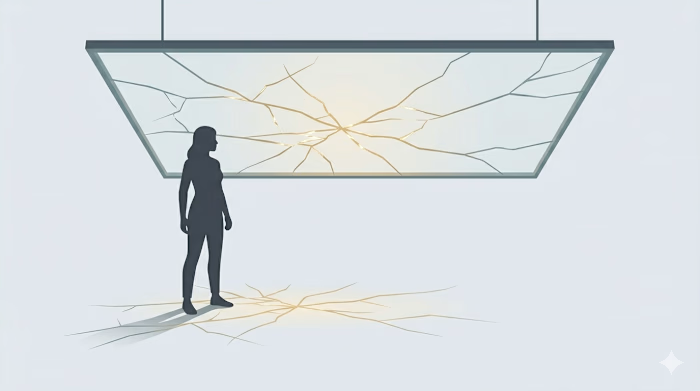
The conversation about women's advancement in organizations has historically focused on the glass ceiling: the invisible barrier at the top that prevents women from reaching executive roles. But a growing body of evidence points to a different, earlier bottleneck: the broken rung, the first promotion from individual contributor to manager.
This paper asks: which barrier has a greater impact on women's career trajectories? The answer changes your entire equity strategy.
Why It Matters
If the primary barrier is the glass ceiling, organizations should focus on executive pipeline programs, board diversity mandates, and C-suite sponsorship. If the primary barrier is the broken rung, the intervention point is earlier: first-time manager selection, promotion criteria at the entry-to-management transition, and the systems that determine who gets their first leadership opportunity.
Getting this wrong means investing resources at the wrong stage of the pipeline.
Key Findings
The broken rung is where the largest drop-off occurs. For every 100 men promoted to manager, significantly fewer women make the same transition. This gap at the first rung compounds at every subsequent level. By the time you reach the C-suite, the pool of women candidates has been narrowed not primarily by a ceiling at the top, but by a bottleneck at the bottom.
The glass ceiling is real but secondary. Glass ceiling barriers (exclusion from executive networks, subjective "executive presence" criteria, sponsorship gaps at senior levels) are real and documented. But they operate on an already-reduced pool. Fixing the ceiling without fixing the rung produces marginal gains.
The two barriers interact. The broken rung reduces the pipeline. The glass ceiling filters what's left. Organizations need to address both, but the sequence matters: fix the rung first, because it determines the size of the pool that reaches the ceiling.
Intersectionality amplifies both barriers. For minority women, both the broken rung and the glass ceiling are steeper. The compounding effect of race and gender creates a distinct experience that neither barrier framework fully captures on its own.
Practical Implications
For organizations serious about leadership equity:
Audit the first promotion. Track who gets promoted from individual contributor to manager, disaggregated by gender and race. If the gap starts here, this is where your intervention starts.
Standardize manager selection criteria. Replace subjective assessments with structured, behaviorally anchored criteria for first-time manager roles.
Don't skip to the top. Executive pipeline programs are important, but they can't compensate for a broken rung. Build from the bottom up.
Measure at every transition. Track representation at each pipeline stage (IC → manager → director → VP → C-suite) to identify exactly where your organization's gaps concentrate.
Connection to Related Research
This paper complements my phenomenological study on glass ceiling obstacles faced by minority women leaders in healthcare. Together, they provide both the structural analysis (which barrier matters more) and the lived experience (how those barriers are navigated by the people facing them).
Both studies inform the Healthcare Leadership Equity Briefing Pack available on this profile.
Co-authored with Robert E. Levasseur.
Read the full paper: DOI: 10.4236/ojbm.2025.135181
Like this project
Posted Jun 12, 2026
Research assessing whether the broken rung or the glass ceiling poses a greater barrier to women's career advancement, with implications for where organizations should focus equity interventions. Published 2025.
Likes
0
Views
14