SEPMS: Smart Energy Portfolio Management System

Rishabh Gupta


The Problem
DISCOMs (Distribution Companies) face nine critical challenges that drive up power purchase costs and compliance risk:
1. Rising Power Purchase Costs — Without optimization across procurement channels, DISCOMs were overpaying for power consistently, with no systematic way to identify cheaper alternatives in real time.
2. RTM/DAM Trade Inefficiencies — Trading across Real-Time Market and Day-Ahead Market was reactive and manual. Price signals were missed, and procurement decisions lagged behind market movements.
3. Forecasting Inaccuracies — Demand and renewable generation forecasts were unreliable, leading to over-scheduling or under-scheduling and the financial penalties that come with both.
4. Real-Time Backdown Execution — When demand dropped below scheduled supply, backdown decisions were slow and manual. DISCOMs paid for power they didn't need.
5. MOD Violation Penalties — Merit Order Despatch violations went undetected until penalty notices arrived. Expensive generators ran when cheaper options were available.
6. Zero Schedule Challenges — Periods where no power purchase was the optimal decision were difficult to identify and execute, leaving money on the table.
7. Outage Impact Mismanagement — Plant outages weren't factored into scheduling decisions in real time, causing cascading inefficiencies across the portfolio.
8. Lack of Trading Cost-Benefit Analysis — No structured framework existed to compare procurement costs across RTM, DAM, and RSD markets for each time block.
9. Limited Portfolio Visibility — Portfolio status, trades, outages, and costs lived in disconnected systems. No single view existed for decision-makers.
The Solution
SEPMS (Smart Energy Portfolio Management System) is a next-gen platform built exclusively for DISCOMs to manage power scheduling, trading, and SLDC compliance in one centralized system. It integrates advanced optimization models, forecasting, outage analytics, and cost-benefit analysis across RTM, DAM, and RSD markets.
I designed and built the platform end-to-end, from product strategy and UX research through to the production application.
Key Results
10-20% Savings in DAM — Better day-ahead procurement through optimized scheduling
95% Forecast Accuracy — Demand and renewable generation prediction
Zero Penalty Losses — RSD and MOD compliance fully automated
360° Visibility — Portfolio, trades, outages, and costs in one dashboard
Up to 15% Lower RTM Costs — Real-time optimized buy/sell decisions
20-30% Overall Cost Savings — Smart DAM and RTM trading strategies combined
What I Built
Product Design
Conducted user research with DISCOM operators, power schedulers, and trading teams to understand their daily workflows and regulatory obligations across all nine challenge areas
Designed the full information architecture: scheduling dashboards, market comparison views, compliance tracking modules, forecasting interfaces, outage analytics, and the unified 360° portfolio view
Created a component-based design system in Figma optimized for data-dense energy management interfaces with real-time data refresh patterns
Built progressive disclosure patterns so operators can monitor high-level portfolio status at a glance while drilling into granular schedule-level details when needed
Full-Stack Development
Built the frontend in Angular with modular components handling complex scheduling grids, real-time market data visualizations, and interactive cost-benefit comparison tools
Developed the backend API layer with Python and FastAPI, optimized for processing large volumes of scheduling data and market price feeds with low latency
Designed the PostgreSQL database schema for power schedules, market transactions, compliance audit trails, MOD tracking, outage records, and forecasting models
Implemented automated real-time backdown logic that triggers schedule adjustments when demand drops below supply thresholds
Built zero scheduling support for periods where no power purchase is the optimal decision
Developed the cost-benefit analysis engine comparing RTM, DAM, and RSD procurement paths for each time block
Key Design Decisions
The 360° Dashboard — DISCOM operators manage hundreds of time-block schedules daily. I designed a unified dashboard that surfaces portfolio status, active trades, outage impacts, and costs in a single view with color-coded status indicators (submitted, approved, revised, violated) so operators can scan compliance across all generators in seconds.
Market Comparison Module — RTM, DAM, and RSD markets each have different price dynamics and lead times. I built a side-by-side comparison module that surfaces the cost-optimal procurement path for each time block, replacing the spreadsheet analysis that previously took hours.
MOD Violation Alerts — Rather than burying violations in reports, I designed real-time alert patterns that flag Merit Order Despatch violations as they happen, with one-click drill-down to the specific generator and time block.
Forecasting Interface — The 95% accuracy target required a feedback loop. I designed the forecasting module to show predicted vs. actual demand overlaid on the same timeline, so operators can spot drift patterns and the model continuously improves.
Future Scope
AI-driven RTM/DAM trading strategies for autonomous market participation
Advanced analytics for granular buy/sell benefit analysis
IoT data integration for demand-side accuracy improvements
Blockchain implementation for market transparency and settlement verification
Cross-DISCOM energy trading capabilities for regional optimization
Platform Screenshots
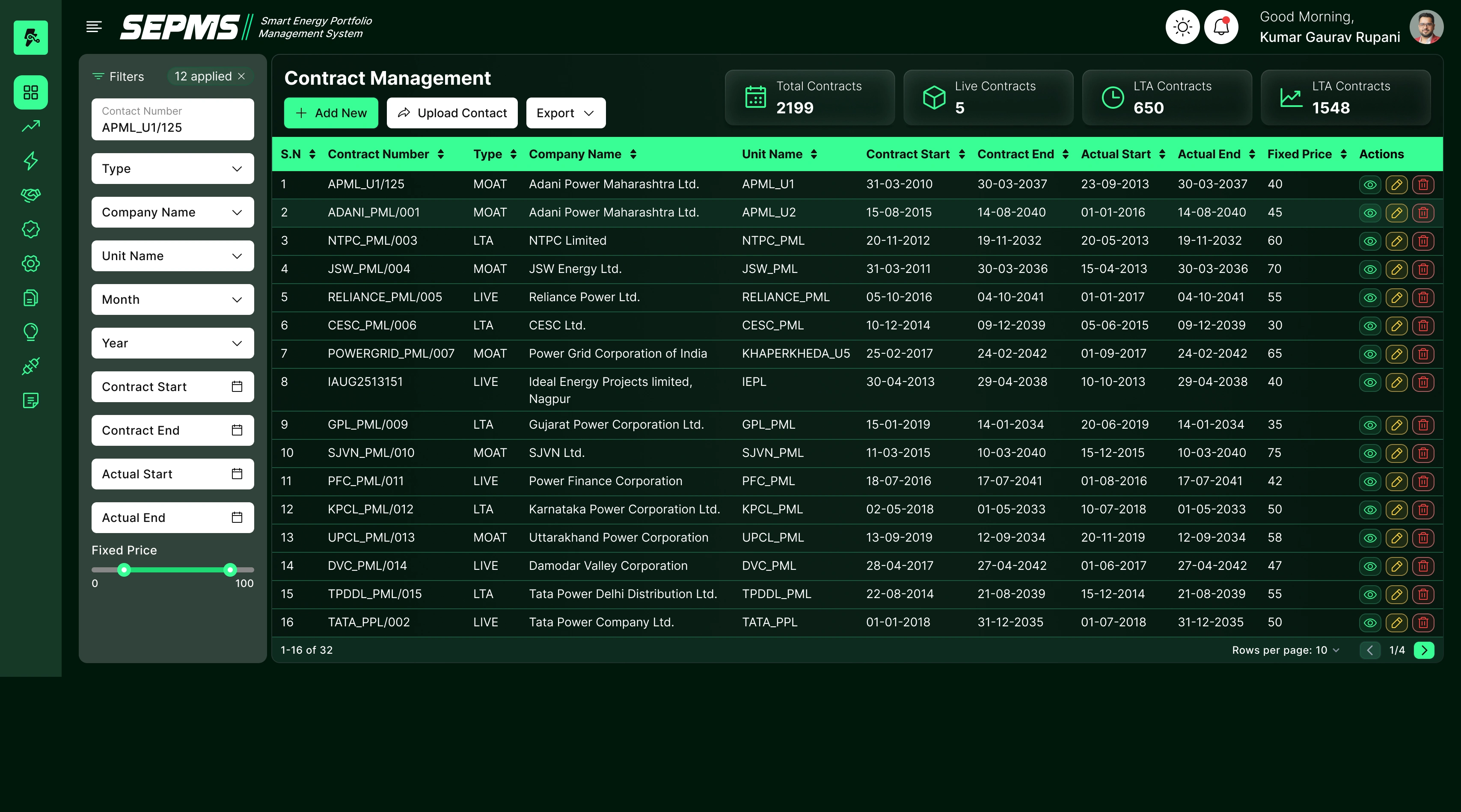
Contract Management
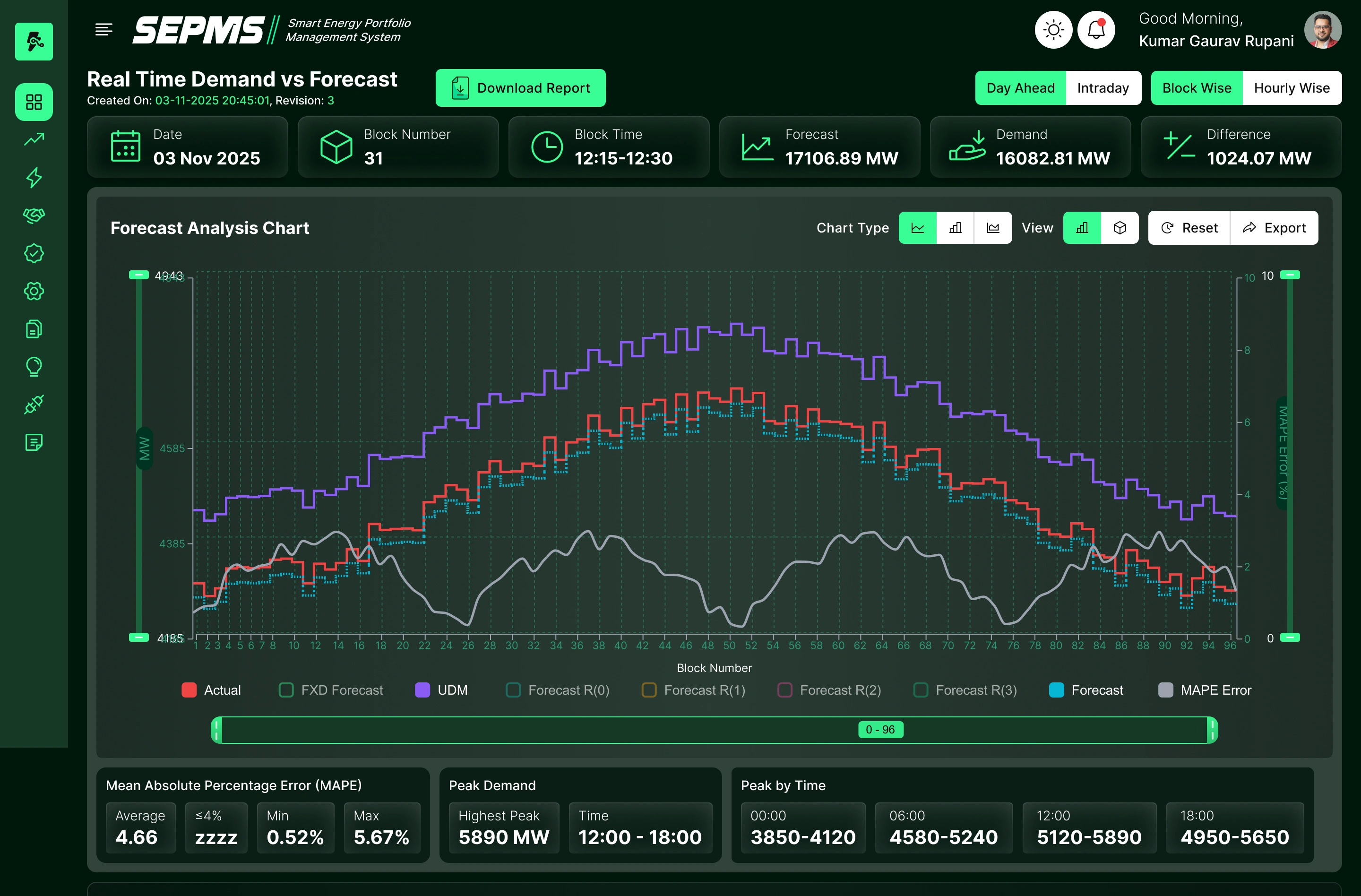
Demand Forecast Sidebar
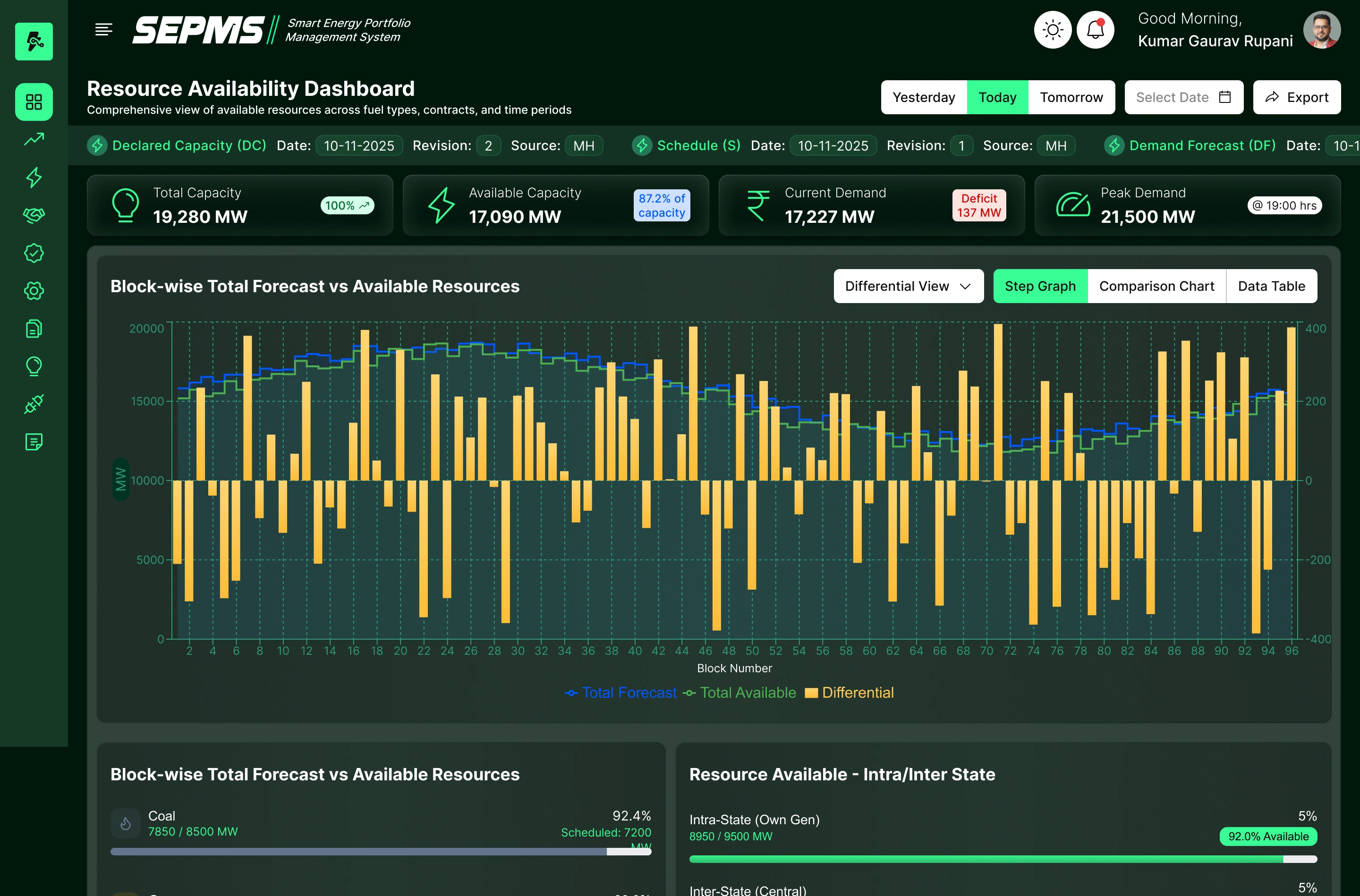
Resource Capacity
Like this project
Posted Jun 11, 2026
End-to-end design and development of a smart energy portfolio management system for DISCOMs. Achieved 95% forecast accuracy, 20-30% cost savings, and zero penalty losses across SLDC compliance.