Business Priorities Sprint: Decision Support for Founders

Amy Frank


Business Priorities Sprint: Decision Support for Founders
Overview
I supported a solo service-based founder through a structured decision-making sprint to clarify how to allocate time, energy, and focus under real capacity constraints. The engagement focused on reducing decision fatigue, protecting income stability, and creating a clear operating direction for the next 90 days.
Who This Was For
Solo founders and service-based business owners who personally deliver client work and feel pulled between maintaining income, improving sustainability, and acting on new ideas, with limited time and energy to pursue everything at once.
The Situation
The founder operated a client-based business where all delivery, communication, and project management flowed directly through them. Demand was steady, but capacity was fully constrained.
At the time of the engagement, the founder was actively considering several possible next steps, including adjusting how existing client work was delivered, launching a productized offer to reduce reliance on billable hours, and pausing growth temporarily to rebuild internal systems.
Each option addressed a real need. The challenge was choosing what to do now without destabilizing income or increasing burnout.
The Challenge
The founder found themselves repeatedly cycling through the same strategic questions without resolution. Short-term income needs made it difficult to pause or experiment, while longer-term concerns about burnout and sustainability made it risky to continue operating unchanged.
Without an external structure, each option felt equally urgent. There was no clear framework for evaluating tradeoffs given real constraints around time, energy, and risk tolerance.
The Approach
During a guided working session, I structured the conversation to slow the decision down and separate signal from noise.
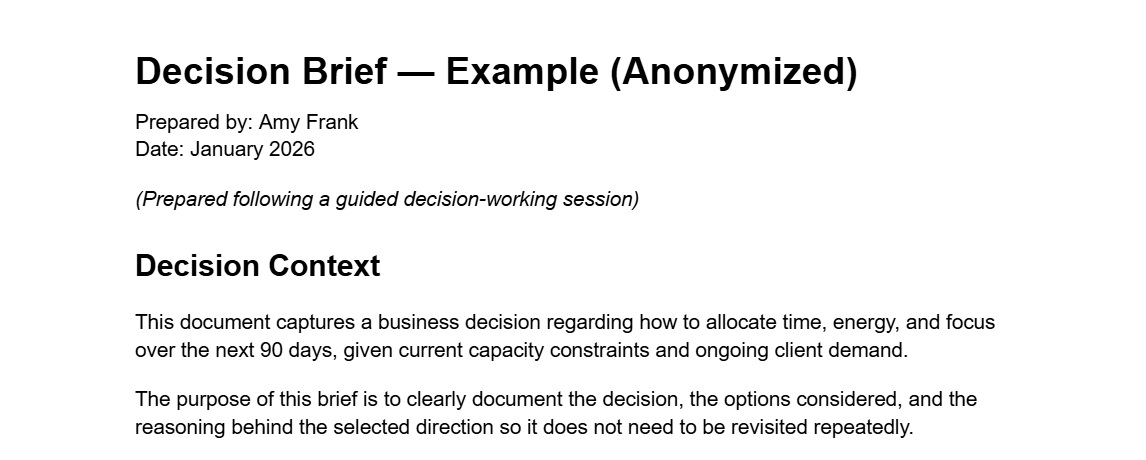
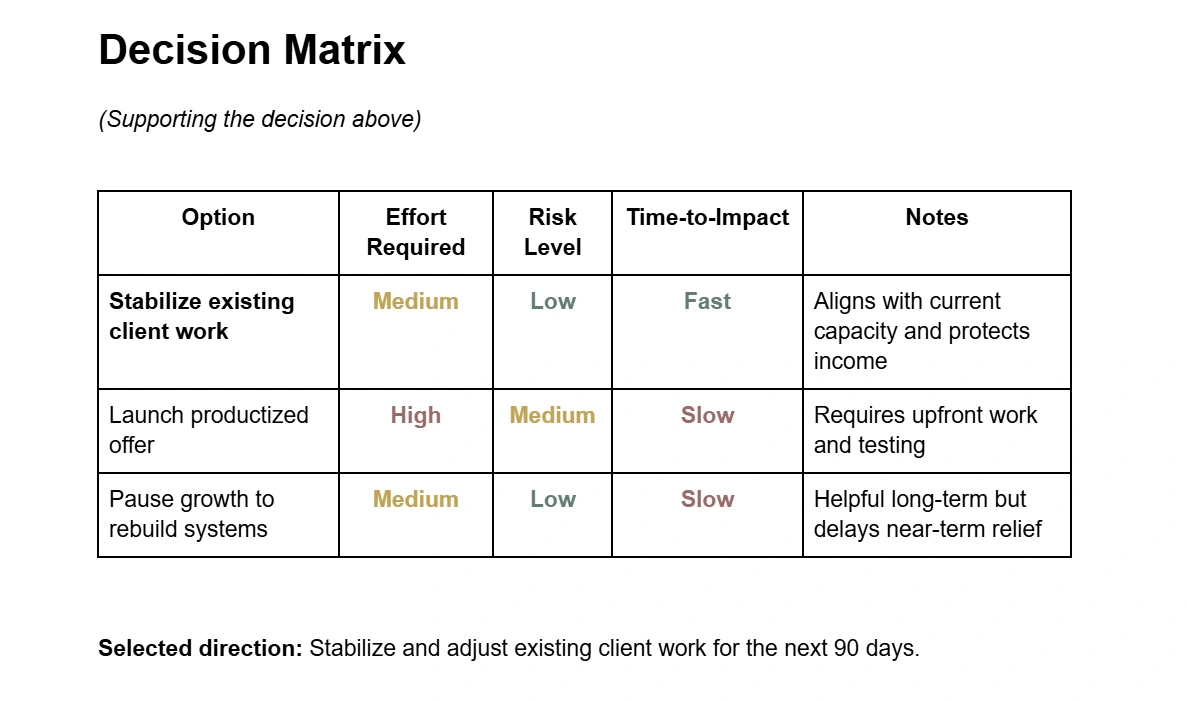
We clarified the specific decision that needed to be made for the next 90 days, surfaced the constraints shaping what was realistically possible, and compared options using simple criteria for effort, risk, and time-to-impact. Rather than treating every idea as immediately actionable, the session focused on identifying which options were viable now and which should be intentionally deferred.
Following the session, I synthesized the discussion into written decision artifacts.
The Decision
Based on the tradeoffs discussed and the constraints clarified during the session, the founder chose to prioritize stabilizing and slightly adjusting existing client work for the next 90 days, rather than introducing new offers or undertaking major system changes simultaneously.
Because the decision was grounded in real capacity and pressure-tested during the session, it felt deliberate rather than reactive.
The Outcome
With a clear decision documented, the founder stopped reopening the same questions week after week. Time and energy could be allocated more intentionally, and day-to-day work became more predictable.
The plan felt realistic rather than aspirational, and the founder reported reduced mental load and greater confidence in how they were operating the business for the current period.
Business Impact
By documenting both the decision and the reasoning behind it, the sprint helped reduce wasted effort, avoid premature work on lower-impact initiatives, and lower burnout risk without sacrificing income stability.
The business gained momentum not by doing more, but by focusing on fewer priorities with clarity and intention.
Deliverables
Following the working session, I delivered:
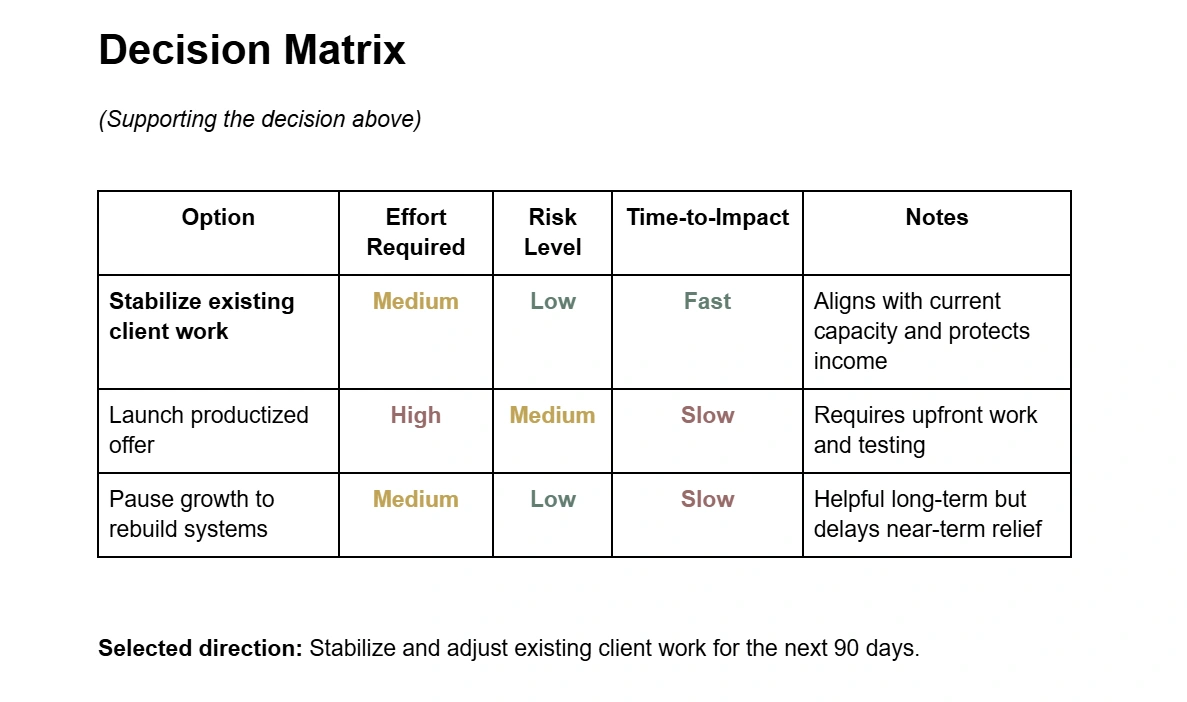
A Decision Brief documenting context, options, constraints, and rationale
A Decision Matrix making tradeoffs explicit across effort, risk, and time-to-impact
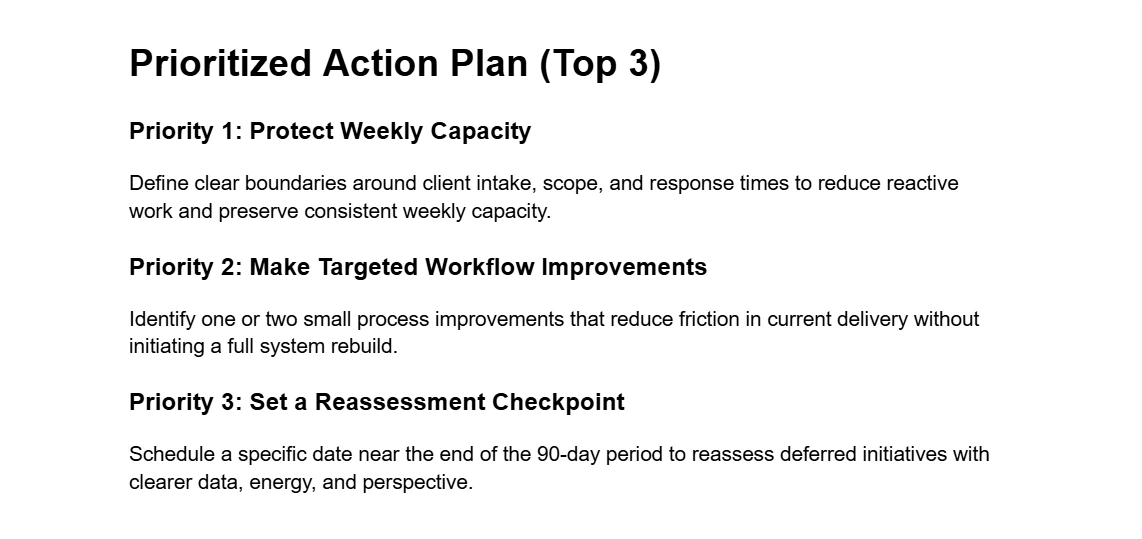
A Prioritized Action Plan translating the decision into concrete next steps for the 90-day period
An anonymized example of these deliverables is included with this case study.
Why This Case Is Representative
This case reflects a common scenario for solo founders and service providers navigating growth, sustainability, and capacity constraints.
The value of the engagement came from structured decision support and post-session synthesis, not from making the decision on the founder’s behalf.
Like this project
Posted Jan 24, 2026
Structured decision support for a solo founder, resulting in a documented decision brief, tradeoff matrix, and focused action plan.