Reconnecting HubSpot's Hubs — Cross-Hub IA

Bozena Bulat


Reconnecting HubSpot's Hubs — Cross-Hub Information Architecture
A speculative redesign of HubSpot's cross-Hub navigation. Seven Hubs share one database but each has its own navigation pattern and settings hierarchy, so context resets every time a user crosses a Hub boundary. This study proposes three architectural principles and shows them applied to real HubSpot surfaces.
Role: AI-augmented user research, information architecture, cross-product navigation design. 2026. Speculative project
The problem is architectural, not aesthetic. Context resets whenever users cross Hub boundaries, and every transition costs a mental translation.
The setup
HubSpot launched as marketing automation in 2006 and has grown into seven Hubs — Marketing, Sales, Service, Content, Operations, Commerce and Data — plus Breeze as an AI coordination layer. Each Hub kept its own navigation patterns and settings hierarchies despite sharing a unified database.
The strongest validation came from HubSpot itself: a live banner reading "Brand Identity has moved to Marketing" — the company restructuring its own architecture in real time, and compensating with notices.
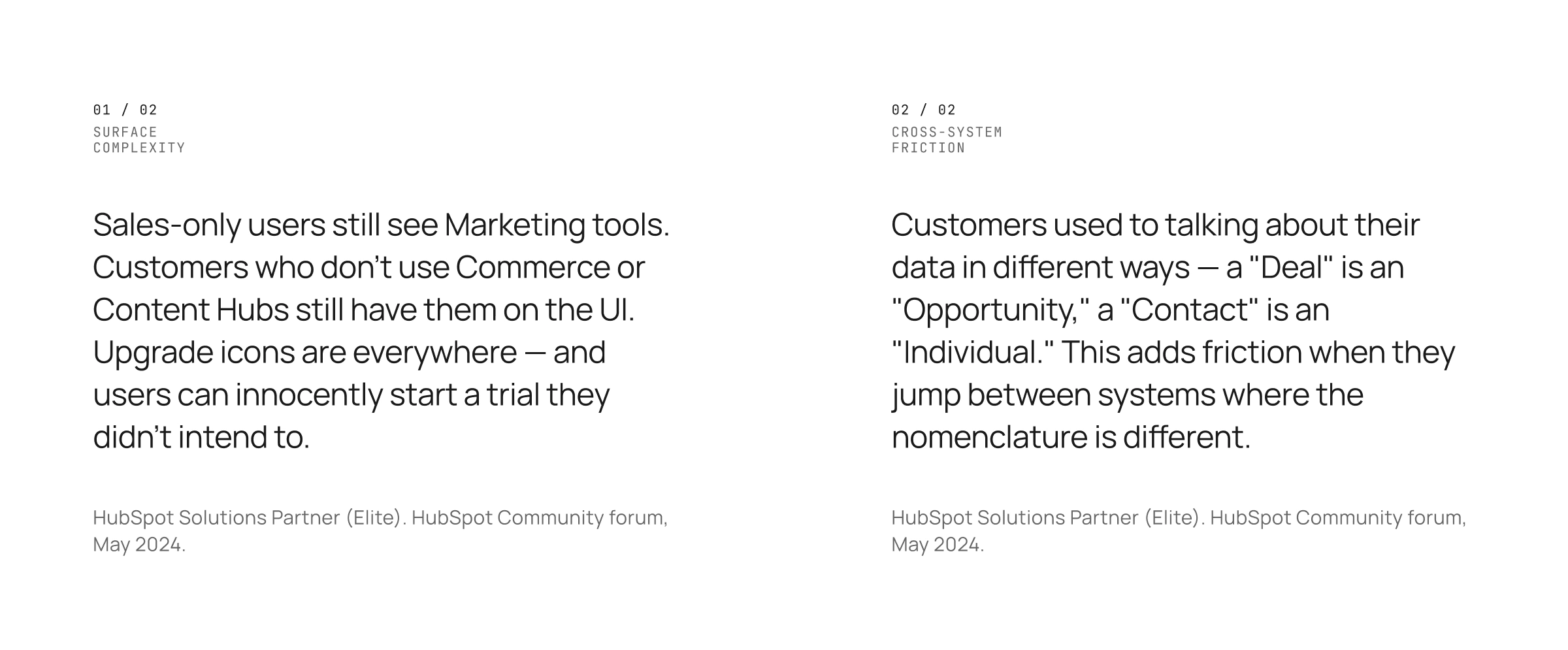
Research: Two patterns that surfaced across forums and reviews: navigation described as overwhelming, and broken connections between Hubs as the recurring comparison to Salesforce.
Three principles
Context travel. When a user clicks into a Hub from an object — a Contact, a Deal, a Ticket — the system keeps what they were looking at.
Hub-aware density. Sections on a record reflect current relevance instead of equal visual weight.
Tool transparency. Paid versus owned tools show their access status before interaction, so nobody hits a paywall by surprise.
The system in practice
Hub click preserves context
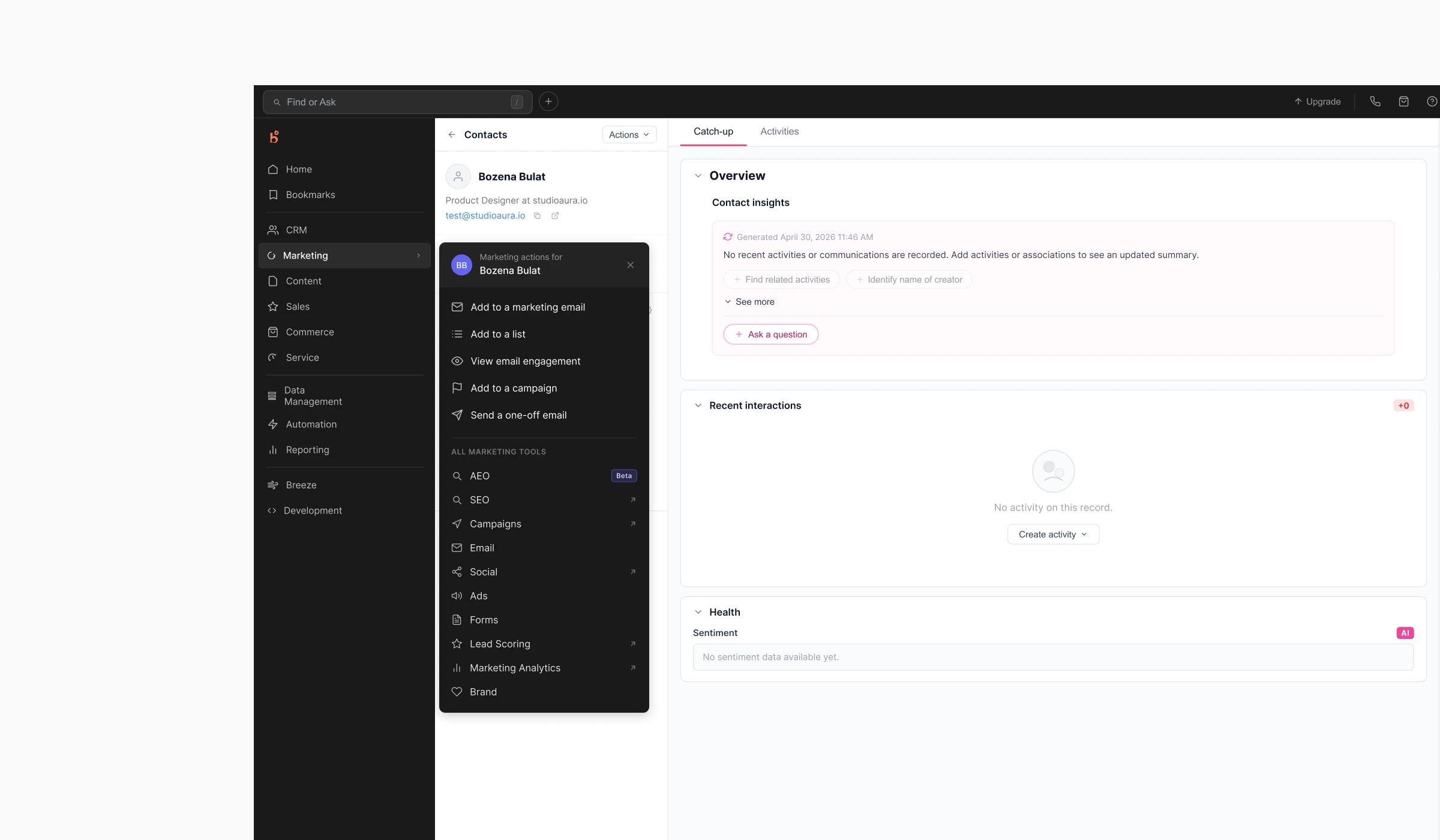
Sidebar submenus adapt to the current focus. Opening Marketing from a Contact record surfaces contextual actions first — "Add to marketing email", "View email engagement" — with standard tools below. The original object stays visible throughout.
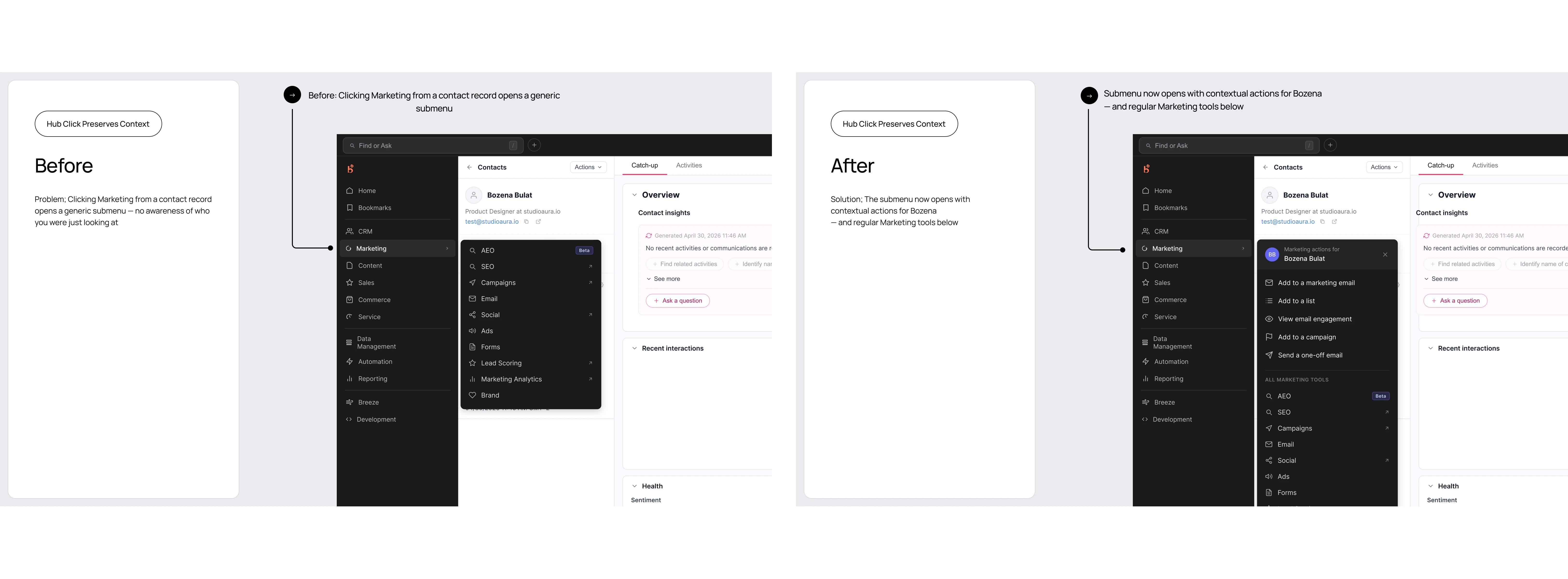
Hub click: Opening Marketing from a Contact record. Contextual actions first, standard tools below, the Contact still visible on the left.
Hub-aware information density
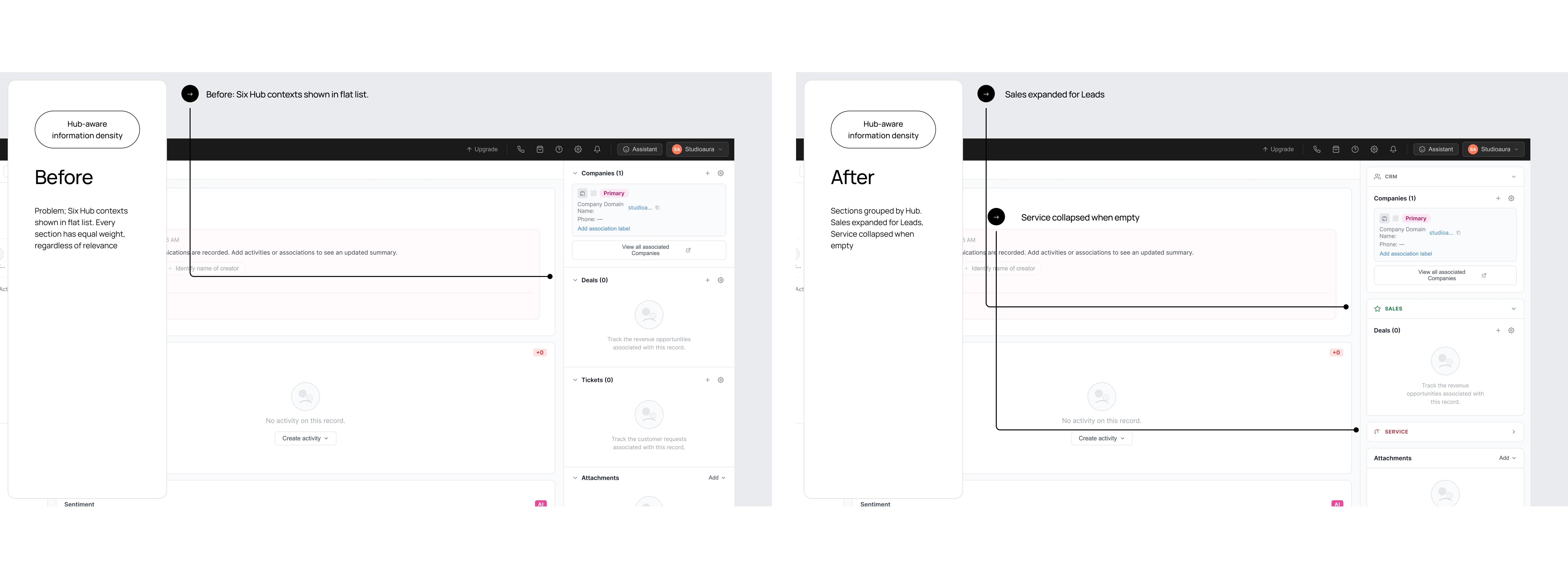
Density: A Contact record with sections grouped by Hub. Sales expanded for a lead; an empty Service section collapsed by lifecycle stage.
Contact record sections are grouped by Hub affiliation — CRM, Sales, Service — and expand adaptively. A lead sees Sales expanded by default; an empty Service section collapses based on lifecycle stage.
Tool availability indicators
Every tool carries a visual state — owned, trial available, upgrade required — with lock icons and tier badges. Clicking a locked tool opens an inline upgrade panel instead of redirecting the user out of their work.
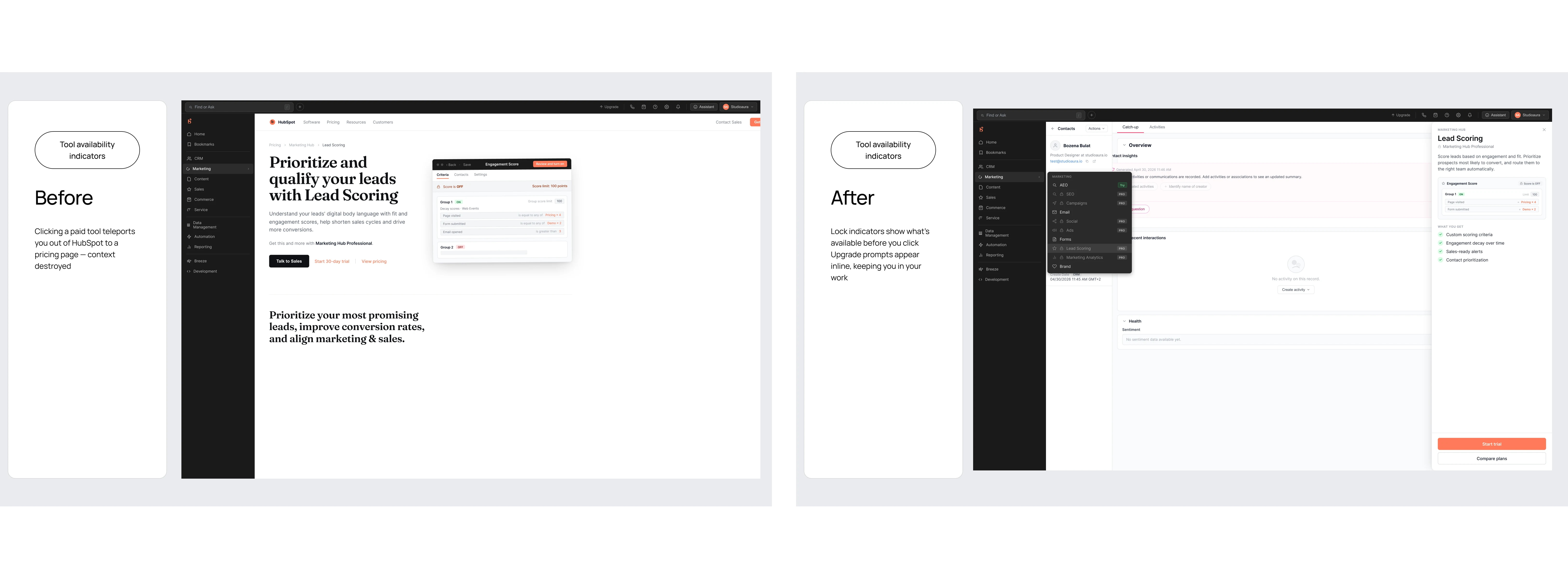
Indicators: Three tool states — owned, trial available, upgrade required — shown before the click. A locked tool opens an inline upgrade panel.
Why this matters beyond HubSpot
Any multi-product B2B platform hits this wall: products built at different times, by different teams, on one data model. The fix is rarely a redesign. It's a set of navigation rules that let context travel with the user — and a system disciplined enough to apply them everywhere.
This is the public version. Happy to walk through the rest in a conversation
Like this project
Posted Sep 24, 2026
Speculative IA redesign of HubSpot's seven Hubs: context that travels with the user, hub-aware density, and tool access shown before the click
Likes
1
Views
3