Bureau-Independent Credit Risk Segmentation

Taofeek Salami


Fintech Credit Risk Analysis
Bureau-Independent Credit Risk Segmentation for Digital Lending
Problem Statement
Nigeria's digital lending industry has grown rapidly, expanding access to credit for a population historically underserved by traditional banking. However, this growth has been accompanied by increasing credit risk, while many borrowers remain outside the coverage of traditional credit bureaus.
As a result, digital lenders increasingly rely on alternative behavioral signals—including repayment history, credit utilization, debt burden, income characteristics, and borrower profiles—to assess credit risk.
This project develops a bureau-independent credit risk segmentation framework using the public Give Me Some Credit dataset as a proof of concept.
Although the dataset originates from the United States, its behavioral credit variables closely resemble alternative lending signals commonly used by digital lenders when traditional credit bureau information is limited or unavailable.
The project demonstrates how SQL, Python, and Tableau can be combined to transform raw lending data into actionable business intelligence for:
Borrower default risk segmentation
Financial exposure assessment
Operational risk analysis
Evidence-based underwriting decisions
Executive Summary
This project presents an end-to-end credit risk analytics solution covering the complete analytical workflow—from database design and ETL through data quality assessment, feature engineering, SQL analysis, risk scoring, exposure indexing, business interpretation, and executive reporting.
Using behavioral lending data, the project:
Identifies borrowers most likely to default.
Develops a custom Behavioral Risk Score for borrower segmentation.
Builds an Exposure Index to estimate relative exposure where direct loan balance and credit-limit data are unavailable.
Evaluates structural borrower characteristics associated with elevated default risk.
Investigates data-quality anomalies that may contain meaningful predictive signals.
Delivers a four-dashboard interactive Tableau reporting application.
The result is a bureau-independent credit risk framework designed to demonstrate how alternative borrower data can support lending decisions in emerging digital credit markets.
🖥️ Dashboard Preview
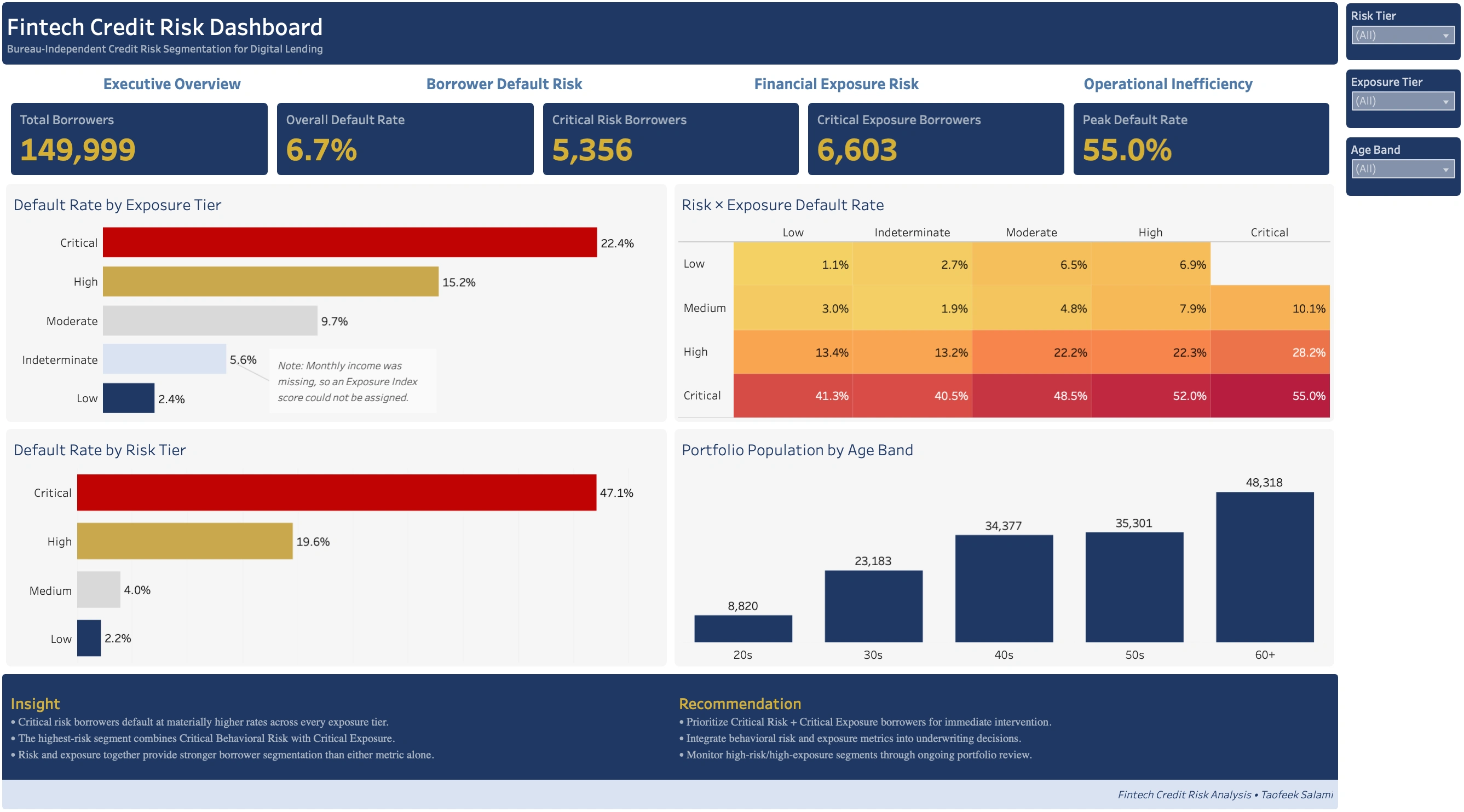
Executive Overview
Provides a high-level view of portfolio default risk, behavioral risk tiers, financial exposure, and the compounding relationship between borrower risk and exposure.
Borrower Default Risk
Identifies the borrower segments most likely to default and examines behavioral early-warning signals across delinquency history, age, income, and risk tiers.
Financial Exposure Risk
Evaluates relative borrower exposure using credit utilization, debt burden, and the Exposure Index, while examining whether exposure adds predictive value beyond behavioral risk history.
Operational Inefficiency
Examines structural borrower characteristics—including credit line count, income, age, and household dependency—to identify opportunities to strengthen underwriting and improve lending decisions.
Repository Structure
Data
Attribute Description Source Kaggle — Give Me Some Credit Original Records 150,000 borrowers Processed Records 149,999 borrowers Dataset Type Consumer Credit Risk Target Variable Serious delinquency within two years (90+ days past due)
Methodological Note
Public Nigerian lending datasets containing borrower-level repayment behavior are limited. Therefore, this project uses the Give Me Some Credit dataset as a bureau-independent proof of concept.
The analysis focuses on behavioral lending patterns—including repayment history, credit utilization, debt burden, income characteristics, and borrower profiles—rather than absolute monetary values.
The methodology is therefore designed to demonstrate a transferable analytical framework rather than claim that the source dataset directly represents the Nigerian lending population.
Business Questions
This project answers three core business questions:
Which borrowers are most likely to default, and what are the earliest warning signals?
Where does the portfolio show elevated financial exposure risk, and does exposure add predictive value beyond behavioral history?
Which borrower characteristics and structural patterns indicate opportunities to improve lending decisions?
Methodology
The project follows a structured analytical workflow:
The workflow combines:
MySQL database design and SQL business analysis
Python ETL and data cleaning
Feature engineering and risk scoring
Behavioral Risk Score development
Exposure Index construction
Exploratory and explanatory visualisation
Interactive Tableau dashboard development
Evidence-based business recommendations
Key Findings
Borrower Default Risk
Borrowers aged 20–39 consistently exhibited the highest observed default rates.
A single 30–59 day delinquency was associated with approximately a 5.7× higher observed default rate than borrowers with no such delinquency history.
The Behavioral Risk Score segmented borrowers into Low, Medium, High, and Critical tiers with clear differences in observed default rates.
Placeholder delinquency codes 96/98 produced a 54.65% observed default rate, making them the strongest single risk signal identified in the analysis.
Borrowers in their 30s within the lowest income quartile defaulted at 12.49%, nearly twice the overall portfolio baseline.
Financial Exposure Risk
A custom Exposure Index was developed to estimate relative exposure using credit utilization and debt burden.
The index is a relative risk proxy rather than a direct measure of monetary exposure because the dataset does not contain loan balance or credit-limit fields.
Two important data-quality limitations were identified and investigated:
Utilization values became unreliable for borrowers with zero open credit lines.
Debt ratio became difficult to interpret where income was missing.
The Critical Exposure tier recorded a 22.35% observed default rate, compared with 2.35% for the Low Exposure tier.
Even among borrowers in the Low behavioral risk tier, exposure still separated observed default rates by approximately 6.1×.
Borrowers classified as Critical on both behavioral risk and exposure recorded a 55.0% observed default rate, the highest combined risk segment identified.
Operational Inefficiency
Borrowers with zero open credit lines recorded a 25.64% observed default rate, the highest rate among the credit-line bands analysed.
Borrowers with 3–4 dependents in the lowest income quartile defaulted at 15.69%, more than twice the rate of income-matched borrowers with no dependents.
Defaulters consistently differed from non-defaulters across measured characteristics including:
Age
Income
Number of open credit lines
Number of dependents
The results support a move away from single-variable approval rules toward multi-factor borrower assessment.
Tools & Technologies
Tool Purpose MySQL Database design, data validation, SQL analysis, and borrower segmentation Python (Pandas & NumPy) ETL, data cleaning, feature engineering, and risk scoring Matplotlib & Seaborn Exploratory and explanatory visualisations Jupyter Notebook Reproducible analytical workflow Tableau Public Interactive business intelligence dashboards Git & GitHub Version control and project documentation
Deliverables
This repository includes:
SQL scripts for database creation, validation, and business analysis
Python notebooks covering ETL, cleaning, feature engineering, and scoring
Processed and feature-engineered datasets
Behavioral Risk Score methodology
Exposure Index methodology
Four-dashboard Tableau reporting application
Dashboard screenshots
Phase-by-phase technical documentation
Data dictionary and project glossary
Portfolio-ready GitHub repository
Documentation
Comprehensive project documentation is available in the docs/ directory.
Document Description documentation_index.md Documentation overview and navigation phase_00_project_setup.md Project setup, database design, and data ingestion phase_01_data_cleaning_eda.md Data cleaning, quality assessment, and exploratory analysis phase_02_borrower_default_risk.md Borrower default risk analysis and behavioral risk scoring phase_03_financial_exposure_risk.md Exposure analysis and Exposure Index development phase_04_operational_inefficiency.md Operational and structural borrower risk analysis phase_05_dashboard_design.md Tableau dashboard design, architecture, and validation phase_06_business_insights.md Business insights and evidence-based recommendations data_dictionary.md Original dataset fields and engineered variables project_glossary.md Credit risk and fintech terminology security_notes.md Security practices and environment configuration tableau_blueprint.md Dashboard architecture and worksheet mapping
How to Reproduce
Clone this repository.
Download the Give Me Some Credit dataset from Kaggle.
Place the raw dataset inside data/raw/.
Configure the required database credentials using environment variables.
Execute sql/00_setup.sql to create the database structure.
Run the analytical notebooks in sequence:
01_cleaning_eda.ipynb
02_risk_scoring.ipynb
03_exposure_analysis.ipynb
04_operational_analysis.ipynb
Execute the relevant SQL analysis scripts.
Open the Tableau workbook or view the published Tableau Public dashboard.
Dashboard
The project includes an interactive Tableau Public dashboard application consisting of four connected analytical views.
Dashboard Pages
1. Executive Overview
Provides a high-level summary of portfolio risk through:
Portfolio KPI cards
Default risk overview
Exposure tier analysis
Risk × Exposure heatmap
Portfolio population distribution
Executive insights and recommendations
2. Borrower Default Risk
Analyses borrower behaviour and identifies early-warning signals through:
Behavioral risk tier distribution
Default rates by borrower segment
Delinquency data-quality flag analysis
Income and age segmentation
High-risk borrower profiles
Delinquency progression analysis
3. Financial Exposure Risk
Evaluates relative exposure risk using:
Exposure Index distribution
Credit utilization analysis
Debt ratio segmentation
Missing-income analysis
Exposure tier performance
Exposure comparison within the Low behavioral risk tier
4. Operational Inefficiency
Identifies structural borrower patterns that may indicate opportunities to improve lending decisions through:
Defaulter versus non-defaulter comparisons
Credit-line analysis
Household dependency analysis
Income segmentation
Operational risk indicators
Dashboard Features
Interactive filters
Cross-dashboard navigation
Dynamic KPI cards
Custom tooltips
Mark-level annotations
Drill-down analysis
Consistent visual design across all four dashboards
Executive-ready insight and recommendation panels
Tableau Public: View the interactive dashboard
License
This project is intended for educational and portfolio purposes.
The original Give Me Some Credit dataset is provided by Kaggle under its applicable terms of use.
All SQL scripts, Python notebooks, feature engineering, documentation, dashboards, and analytical methodologies contained in this repository are original work created by Taofeek Salami.
Like this project
Posted Jul 20, 2026
Developed a credit risk segmentation framework for digital lending using SQL, Python, and Tableau.