Enterprise Digital Signage CMS Design

Rajesh P


Enterprise Digital Signage CMS
Designing a Scalable Content and Screen Management Experience
Project Type: Enterprise SaaS Product Design
Industry: Digital Signage / Content Management
Focus: UX Research, Information Architecture, Workflow Design, UX/UI Design
Role: [Your actual role]
Tools: [Your actual tools]
Project Status: Product design case study
Project Overview
Digital signage platforms help organizations manage digital displays across multiple locations from a centralized system. As the number of screens, content assets, and operational tasks grows, managing these systems becomes increasingly complex.
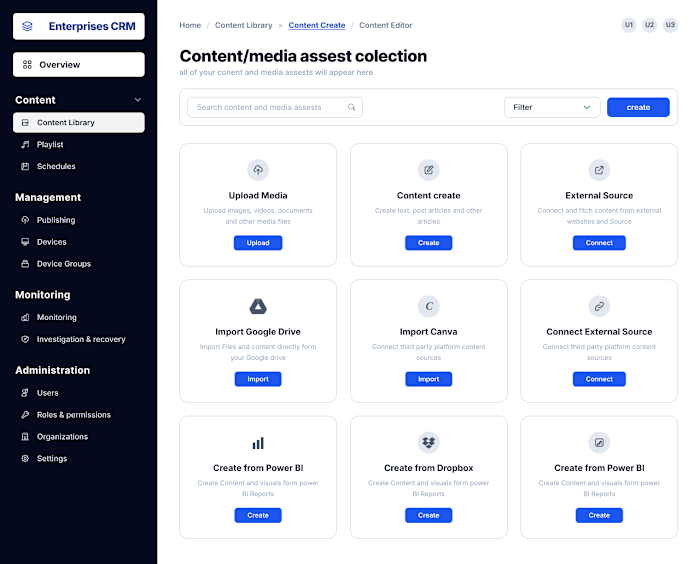
This project explores the design of an enterprise digital signage Content Management System (CMS) that brings content management, screen management, publishing workflows, and operational visibility into a coherent product experience.
The goal was to approach the product as an interconnected system rather than a collection of independent dashboard screens.
The Challenge
An enterprise digital signage platform must help users understand not only what content exists, but also how content is prepared, where it is intended to appear, how publishing progresses, and whether the expected outcome has been achieved.
The design challenge was to make these interconnected operations understandable while considering enterprise scale, information complexity, workflow continuity, and error recovery.
Design Objectives
Organize complex product information into a coherent experience.
Make important objects, actions, and system states easier to understand.
Support content and screen management across potentially large deployments.
Establish clear relationships between preparation, publishing, deployment, and verification.
Improve visibility into operational issues and their potential impact.
Design for discoverability, safe actions, and continuity across workflows.
My Design Approach
01 — Product Understanding and Research
Established the product context, business objectives, user needs, constraints, and research-informed design direction before moving into interface design.
02 — Product Discovery
Explored user types, responsibilities, jobs to be done, goals, pain points, opportunities, product capabilities, MVP scope, and requirements.
03 — Information Architecture and UX Architecture
Worked through product objects and their relationships, mental models, navigation, user flows, task flows, lifecycle states, permissions, data behavior, and observability.
04 — Workflow and Interaction Design
Focused on how users move between related tasks while preserving context, understanding system states, and handling operational exceptions.
05 — Wireframes and Interface Design
Translated product decisions into wireframes and interface concepts, with attention to information hierarchy, task clarity, scalable management patterns, and operational feedback.
Key Design Considerations
Information hierarchy: Help users identify the information and actions that matter for their current task.
Enterprise scalability: Consider how management and selection patterns behave when the product contains many screens, devices, and content assets.
Publishing and deployment clarity: Distinguish the user's publishing intent from deployment progress and the resulting system state.
Operational visibility: Help users understand what is happening, what requires attention, what may be affected, and what needs investigation.
Error prevention and recovery: Consider safe actions, contextual feedback, clear state changes, and recovery paths.
Workflow continuity: Reduce unnecessary context switching when users move between related tasks and objects.
Design Outcome
The project developed a structured product-design foundation connecting discovery, requirements, UX architecture, workflow decisions, wireframes, and interface design.
The resulting case study demonstrates a systems-oriented approach to enterprise SaaS UX, where interface decisions are informed by user tasks, product relationships, operational needs, and scalability considerations.
Rather than treating each screen as an isolated deliverable, the design approach considers how the overall product works as a connected experience.
Deliverables
Product and UX research synthesis
Product discovery and decision maps
Requirements and traceability
Information architecture and object relationships
User flows and task flows
Lifecycle and interaction architecture
Paper and low-fidelity wireframes, where included in the project
Selected UI screens and interface concepts
Product-design decision documentation
Closing
This project reflects my approach to designing complex digital products: understand the problem, establish the product structure, connect user tasks to system behavior, and translate those decisions into clear interface experiences.
Interested in collaborating on complex SaaS products, enterprise UX, or workflow-heavy digital experiences? Let's connect.
Like this project
Posted Oct 27, 2026
Designed a scalable CMS for enterprise digital signage with a focus on UX and operational visibility.
Likes
1
Views
1