Built with FlutterFlow

Case study · Health and wellbeing · Pre-launch
A naturopathic practitioner’s way of reading a patient, built as an app: four health domains, one score, and an AI guide that works inside the rules he set.
4 domains
vitality, physical, mental, energy
1 score
tracked week to week
0 diagnoses
information and next steps, by design
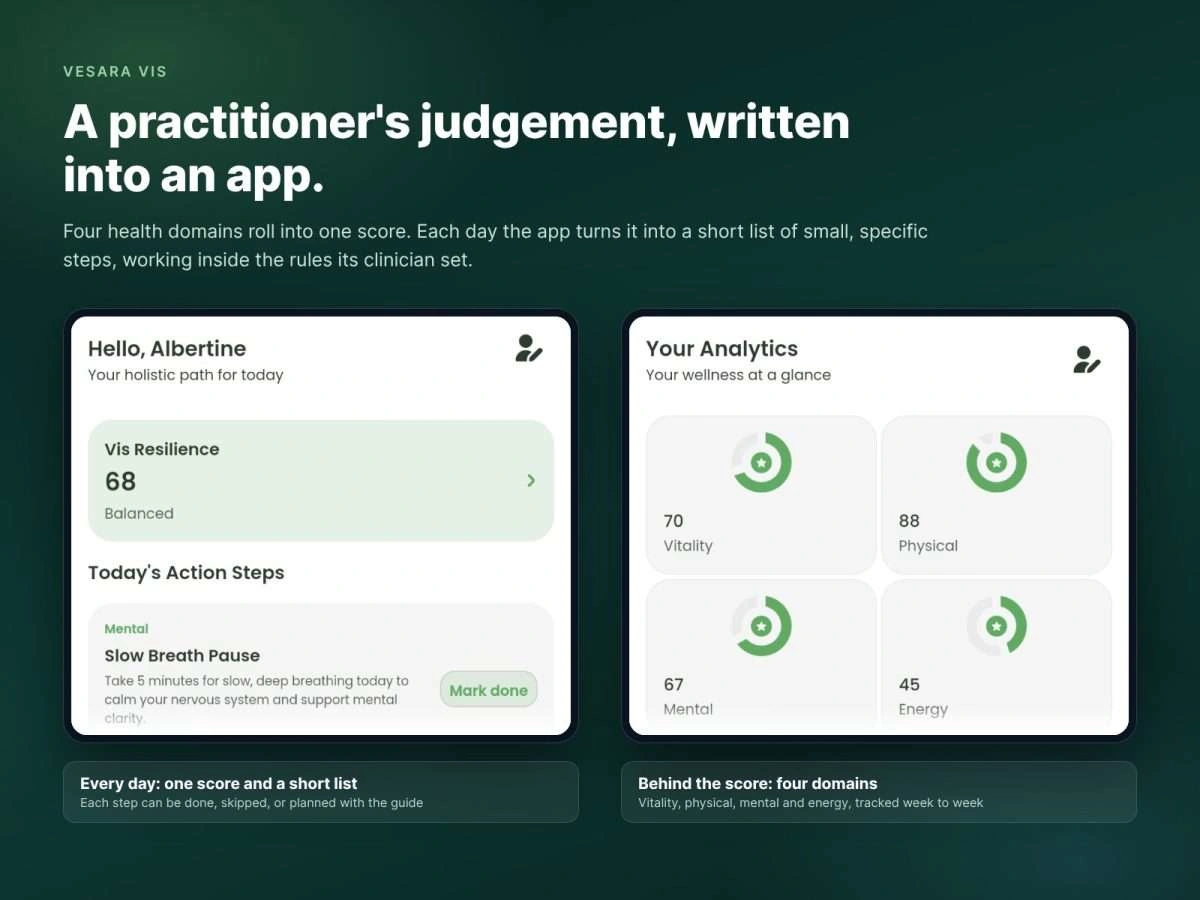
Today’s score and steps on the left, the four domains behind them on the right. Shown with a test account.
The challenge
Most health apps start from a device or a data feed. Vesara Vis starts from a person: a naturopathic practitioner on Vancouver Island with decades of clinical practice and a consistent way of reading a patient. Ordinary lab results sit beside sleep, digestion, energy and mood, and the question is always what to do next.
He wanted that judgement available to more people than one practitioner can see, in a form his clients’ age group would actually open: people over forty who are not looking for another graph.
The brief has two traps. A wellness app that only describes becomes a dashboard nobody visits twice. An AI that advises on health without limits becomes a liability.
The approach
Discovery ran on a rule we wrote into the notes early and called the “so what?” test. No data point is collected unless the app has an answer for what to do with it. A dot on a graph is not an answer.
Four domains, one score. Check-ins feed vitality, physical, mental and energy scores that roll up into a single resilience number. The weekly check-in is six resilience questions, one question the AI writes for that person, and a heart rate variability reading.
A baseline with a pedigree. The first check-in is adapted from the RAND 36-Item Health Survey and credits it on every screen, with the answers rolled up into the app’s four domains.
Records in, plain language out. Lab results and other documents are uploaded as PDFs or photos. The AI reads and summarises them, and the guide uses that context alongside the person’s profile. We tested it with synthetic documents, not real patient files.
A guide that asks before it answers. When it lacks what it needs, it asks a follow-up question instead of guessing.
His rules, not the model’s. The guide’s instructions come from the practitioner’s own clinical approach, and his framework for the order in which care should progress is being written into them. Every answer is framed as information, not diagnosis.
Built for its users. Large type, a traffic-light reading of each score, and one conversation thread instead of a pile of chats to manage.
Then the product changed shape. The first version opened on the scores: four circles and a number. It described well and prompted nothing. So the home screen was rebuilt around action. A short list of AI-generated steps for today sits at the top. Each one can be done, skipped, or sent to the guide to turn into a plan, and completed steps are kept as a history. A loop of quick multiple-choice questions keeps the list current, and the scores moved to a secondary screen.
Descriptive to prescriptive is the most important change we made, and it came from the client using the build, not from the original scope.
Where it stands
The build has been through QA and is with the client for testing. Store release follows once the developer accounts are in place. We’ll update this page at launch.
What we took from it
Expert knowledge is the scarcest thing a small practice owns, and until recently software could only store it. An AI guide can apply it, provided the expert writes the rules and the product is honest about what it is not.
Our part was mostly structure: deciding what the app should refuse to collect, what it should refuse to say, and what it should put in front of someone first thing in the morning.
0 likes · 0 views · Nov 22, 2026
Shaped a health app that turns check-ins and records into a resilience score and practical AI-guided daily steps.
