Built with Replit
TrustedRV — Clerk Authentication & Marketplace Flows

Moses Adebayo
Verified


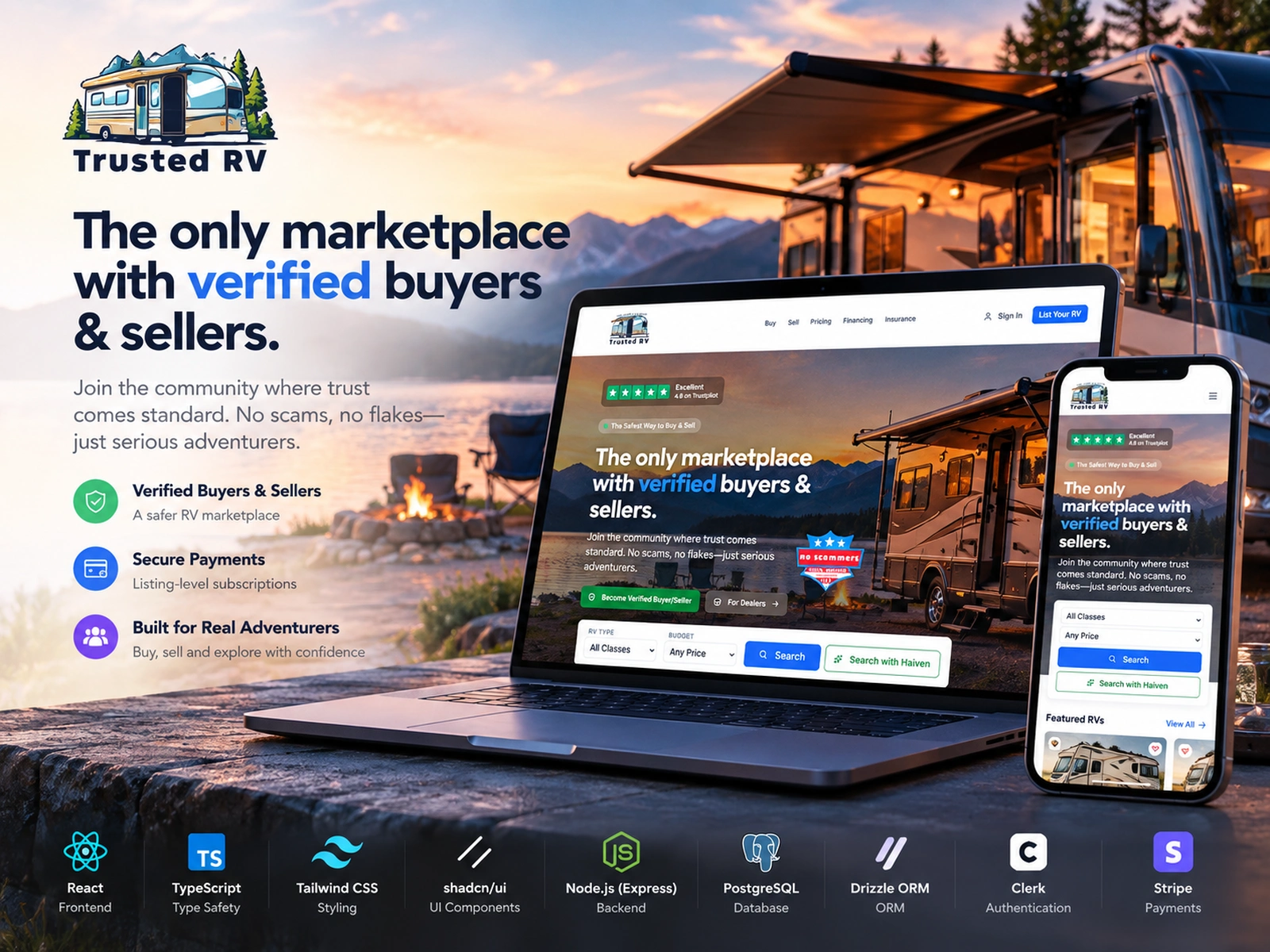
TrustedRV — Authentication, Marketplace & Payment Flow Stabilization
Overview
TrustedRV is an RV marketplace designed to connect verified buyers and sellers. I joined the existing MVP to stabilize and improve the core workflows connecting authentication, onboarding, RV listings, payments, and marketplace activity.
My work covered both frontend and backend engineering, with a focus on Clerk authentication, role-based user journeys, buyer onboarding, seller listing management, and listing-level Stripe subscriptions.
The Challenge
TrustedRV had the core pieces of a marketplace in place, but several connected workflows needed to behave more consistently.
Authentication and verification status needed to correctly determine what users could access. Buyers and sellers required distinctly different onboarding experiences, while listing publication needed to reflect both listing completeness and payment status.
A key billing rule also needed to be corrected: subscriptions belonged to individual RV listings—not the seller’s account.
Paying for one RV listing should only activate that listing, rather than unlocking every RV created by the seller.
trustedrv preview
What I Did
1. Authentication & Role-Based Navigation
I strengthened the application’s Clerk authentication flow and improved how account and verification state were reflected throughout the product.
Improved email and mobile verification state handling.
Implemented clearer role-aware navigation for buyers and sellers.
Directed buyers toward search, favorites, and buyer-specific tools.
Directed sellers toward listing creation and management.
Fixed admin navigation and redirect issues.
Removed unnecessary seller pricing prompts from buyer workflows.
2. Buyer Onboarding
I built a more useful onboarding experience around the information needed to personalize a buyer’s marketplace experience.
Buyer profiles could capture:
Location and preferred search radius
RV types
Budget range
Preferred RV length and year
Must-have features
RV ownership experience
Financing preferences
I also implemented a completion experience that brought together profile information, verification status, and relevant next steps such as searching listings, managing favorites, comparing RVs, accessing buyer guidance, and creating saved-search alerts.
3. Seller Listing & Publication Flow
I reworked seller onboarding around the RV listing itself:
Create account → Verify email & mobile → Add RV details & photos → Set pricing & disclosures → Pay for the listing → Publish
Sellers could save incomplete listings as drafts and continue editing them before checkout. Publication required the necessary listing information and an active payment.
VIN decoding remained optional rather than blocking sellers from completing their listing.
This created a simpler workflow: build the listing first, then pay when you’re ready to publish it.
4. Listing-Level Stripe Subscriptions
One of the most important changes was restructuring billing so subscriptions were associated with individual listings rather than seller accounts.
Each new RV listing required its own Stripe Checkout subscription, while editing an already-paid listing did not trigger another payment.
I also:
Attached listing IDs to Stripe metadata.
Updated Stripe webhook handling to identify the correct listing.
Synced subscription status with listing state.
Updated seller billing to reflect listing-level subscriptions.
Prevented incomplete drafts from being published.
Removed sold listings from marketplace search.
Protected sold listings from accidental republication.
Cancelled subscriptions when listings were sold or deactivated.
The Result
The stabilized MVP created a much clearer relationship between authentication, user roles, onboarding, listings, publication, and billing.
Buyers could complete their profiles, verify their accounts, and move naturally into marketplace discovery.
Sellers could prepare complete RV listings before checkout, with each listing maintaining its own payment and subscription state.
Listing visibility and dashboard actions also became more accurately tied to the listing lifecycle—from draft → paid → published → sold/deactivated.
The result was a more reliable marketplace experience that better reflected TrustedRV’s actual business rules.
Tech Stack
Frontend: React, TypeScript, TanStack Query
UI: Tailwind CSS, shadcn/ui
Backend: Node.js, Express
Database: PostgreSQL, Drizzle ORM
Authentication: Clerk
Payments: Stripe Checkout, Stripe Subscriptions & Webhooks
Live Project
Like this project
Posted Sep 14, 2026
Stabilized TrustedRV’s Clerk authentication, buyer and seller onboarding, and listing-level Stripe subscriptions for a smoother marketplace experience.
Likes
1
Views
12
Timeline
May 27, 2026 - Jun 15, 2026
Clients
TrustedRV