Translating AI Ethics into Hospital Operations

Dr. Vernette Grant


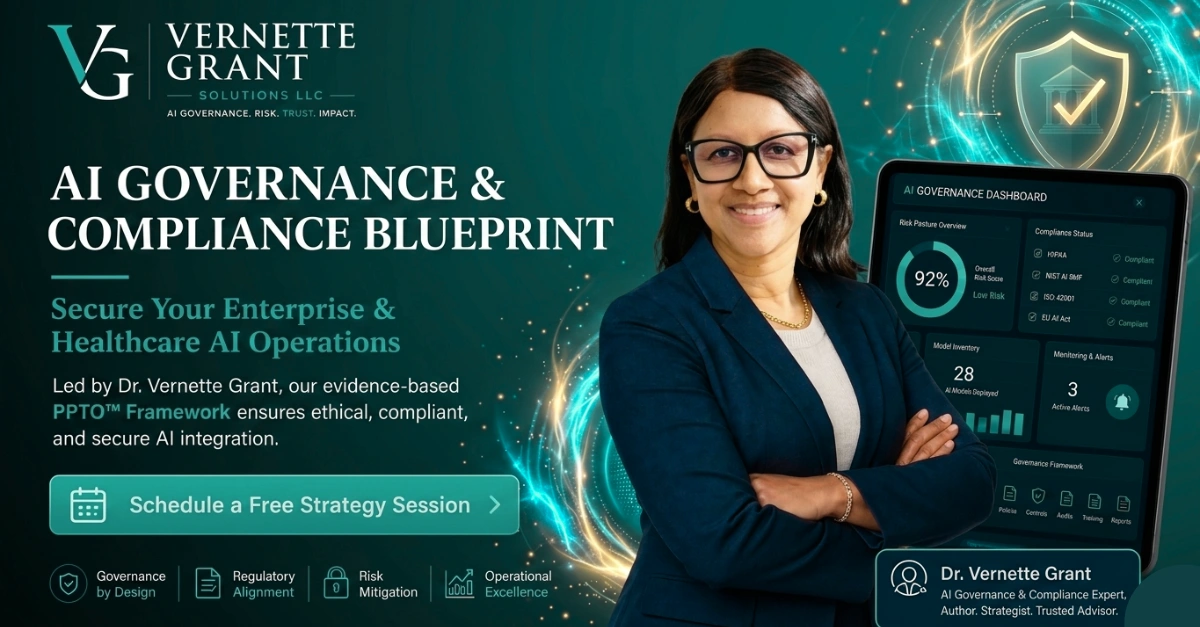
Translating AI Ethics into Hospital Operations: A PPTO Framework for Evidence-Based Governance
Published in the Open Journal of Business and Management, Vol. 14, No. 2 (March 2026).
The Research Question
Healthcare organizations are adopting AI at an accelerating pace, but the governance structures needed to ensure these systems are safe, equitable, and accountable have not kept up. Existing AI ethics frameworks tend to be principle-based: they articulate values like fairness, transparency, and accountability without providing operational mechanisms for implementing them.
This paper asks: how do you translate abstract AI ethics principles into concrete, repeatable hospital operations?
The PPTO Framework
The answer is the PPTO Framework, a four-pillar governance model designed specifically for healthcare settings:
People — Governance committee structure, cross-functional membership requirements, role definitions, training standards, and accountability chains
Process — Pre-deployment review procedures, ongoing monitoring protocols, equity thresholds that trigger action, and decommissioning criteria
Technology — Data representativeness standards, explainability requirements scaled by risk tier, audit logging, vendor documentation expectations, and failover planning
Operations — Executive sponsorship, dedicated governance budgets, change management for AI deployments, clinician and patient feedback mechanisms, regulatory monitoring, and maturity tracking
The framework is designed to be replicable across hospital types and sizes, from rural community hospitals to large academic medical centers.
Key Contributions
The 10-percentage-point disparity threshold. The paper introduces a concrete, measurable equity standard: if any AI system's accuracy, sensitivity, specificity, or error rates differ by more than 10 percentage points between demographic subgroups, it triggers mandatory governance review. This converts vague equity commitments into an actionable monitoring trigger.
Risk tiering. A five-dimension rubric (patient impact, autonomy level, population vulnerability, data sensitivity, reversibility) classifies AI systems into four risk tiers, each with proportional governance requirements. Not every AI tool needs the same level of scrutiny.
Operational translation. Where most AI ethics scholarship stops at principles, this paper provides the operational layer: who does what, when, how, and what happens when something goes wrong.
Methodology
The research employed a systematic literature review and framework synthesis approach, drawing on organizational behavior theory, healthcare quality improvement methodology, and existing AI governance scholarship to construct an integrated model grounded in evidence.
Impact
This paper is the foundation for the book Ethical AI in Healthcare: A PPTO Governance Playbook for Hospital and Health System Leaders (2026) and the PPTO product ecosystem of governance templates, self-assessments, and training workshops available on this profile.
Co-authored with Robert E. Levasseur.
Read the full paper: DOI: 10.4236/ojbm.2026.142056
Like this project
Posted Jun 12, 2026
Peer-reviewed research introducing the PPTO Framework for translating AI ethics principles into actionable hospital governance. Published in Open Journal of Business and Management, 2026.