
Stateful Multi-Agent Recruitment CRM — Case Study
The Challenge
Recruitment loses quality through context loss. Resume parsing, scoring, outreach, follow-ups, and scheduling are separate workflows. Agents don't share candidate state → conflicting messages, duplicate follow-ups, missed scheduling windows.
The Solution
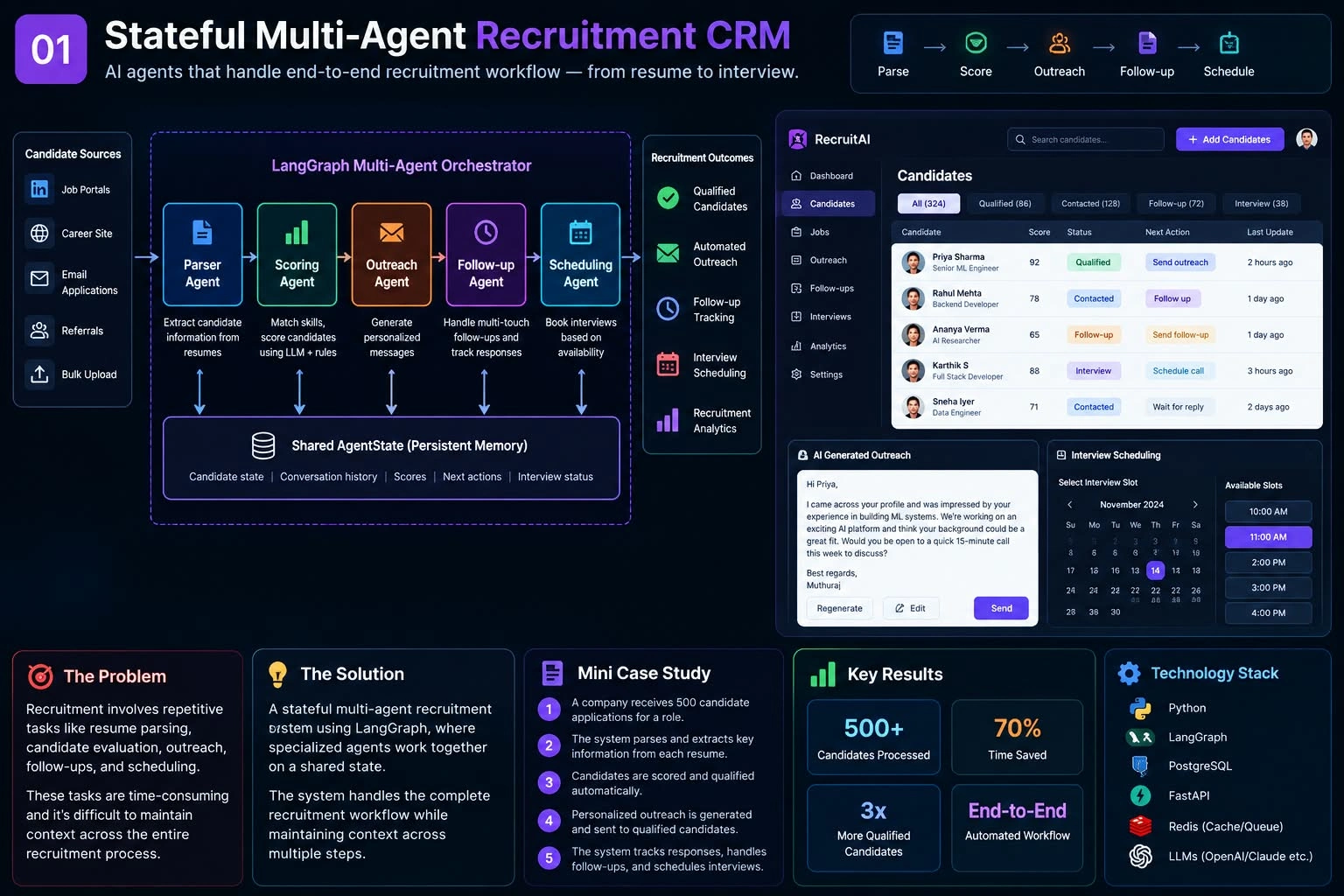
LangGraph multi-agent orchestrator with 5 specialized agents + shared persistent memory.
Agent breakdown:
Parser Agent → Extract skills, experience, fit signals from resumes
Scoring Agent → LLM-based ranking (not rule-based scores)
Outreach Agent → Generate personalized LinkedIn/email messages
Follow-up Agent → Handle multi-touch cadence, track responses
Scheduling Agent → Book interviews, avoid conflicts
Critical architecture: Shared AgentState
All agents read/write to the same state → no context switching.
The Positioning
Headline: "AI agents that handle end-to-end recruitment workflow — from resume to interview."
Value props:
"Stateful" → Agents don't repeat work; they know what happened to each candidate
"Multi-Agent" → Specialized agents → better performance than monolithic LLM
"End-to-End" → Parse → Score → Outreach → Follow-up → Schedule (no manual handoffs)
Metrics They Lead With
Metric Result Candidates Processed 500+ Time Saved 70% Qualified Candidates 3x more Workflow Fully Automated
Mini case study in the image:
Input: 500 candidate applications
Parse: Extract info automatically
Score: Rank candidates (50% filtered out)
Outreach: AI-generated, personalized messages
Follow-up: Automated multi-touch
Result: 3x more qualified candidates reach interview
Dashboard UX
Right panel shows:
Candidates list with: Score (92, 78, 65), Status (Qualified, Contacted, Follow-up), Next Action, Last Update
AI-Generated Outreach sample → Shows quality of personalization (candidate name, specific role match)
Interview Scheduling → Visual calendar, slot selection
UX insight: Dashboard surfaces actions (Send outreach, Schedule call), not just metrics.
Tech Stack (Why It Matters)
LangGraph → Agent orchestration + state management (core to stateful workflows)
PostgreSQL → Persistent candidate state (not ephemeral)
FastAPI → Scalable API layer
Redis → Cache for scoring/matching
LLMs (OpenAI/Claude) → Parsing, scoring, outreach generation
Why this stack wins:
Agents can be tested independently (Scoring Agent accuracy measured separately)
State persists across failures (retry-safe)
Scalable to 1000+ parallel workflows
What You Should Copy
1. Architecture
Don't build a monolithic "recruitment AI." Build 5 focused agents, each optimized for one task. Let LangGraph manage the handoffs.
2. State Management
The shared AgentState is the moat. Without it:
Outreach Agent doesn't know candidate was already contacted
Scheduling Agent double-books
Follow-up Agent sends duplicate messages
Action: If building recruitment or SDR automation, design shared state first. Agents second.
3. Positioning Shift
RudraStack: "Automate follow-ups" (feature-first)
This system: "End-to-end workflow" (outcome-first) + "Stateful agents" (technical credibility)
Result: Attracts technical buyers (CTOs, engineering orgs) + recruiters who care about quality.
4. Metrics Hierarchy
Output quality (3x more qualified candidates)
Time saved (70%)
Volume (500+ processed)
Most tools lead with volume. This leads with quality first.
Competitive Edge for Your Stack
vs. RudraStack:
RudraStack: Dashboard-first, lead quantity focus
This system: Agent-first, candidate quality focus
vs. Traditional ATS:
Stateful agents = no lost context
LLM-driven scoring = learns from outcomes
Multi-agent = modular and debuggable
Technical Differentiation You Could Build
Agent fine-tuning → Specialized models for Parser/Scoring agents (better accuracy than GPT-4 for resume parsing)
Feedback loop → Track which outreach messages → interviews → placements. Retrain Outreach Agent.
Multi-source orchestration → LinkedIn sources + Career portal sources + Referrals, all in shared state
Real-time scoring updates → As follow-up responses come in, re-score candidates (dynamic ranking)
Quick Tactical Win for Your AI-SDR
Apply this to your staffing agency outreach:
Replace your SDR follow-up system with a Follow-up Agent that reads shared candidate state
Add a Conversation Analysis Agent that scores email replies (Intent: Interested? Unsubscribe? Dead-end?)
Route high-intent replies to Scheduling Agent automatically
Result: 3x faster sales cycle because context isn't lost between touch points.
0 likes · 1 view · Sep 25, 2026
Stateful Multi-Agent Recruitment CRM — Case Study The Challenge Recruitment loses quality through context loss. Resume parsing, scoring, outreach, follow-ups...


