Product Catalog Data Quality & Readiness System

VALERIY CHORNY

Product catalog data rarely arrives perfectly clean. Source files can use different headers, inconsistent values, incomplete identifiers, unsupported categories, duplicate records, or business-specific rules that a rigid template cannot anticipate.
I built this Excel system to turn that recurring cleanup problem into a controlled, repeatable workflow.
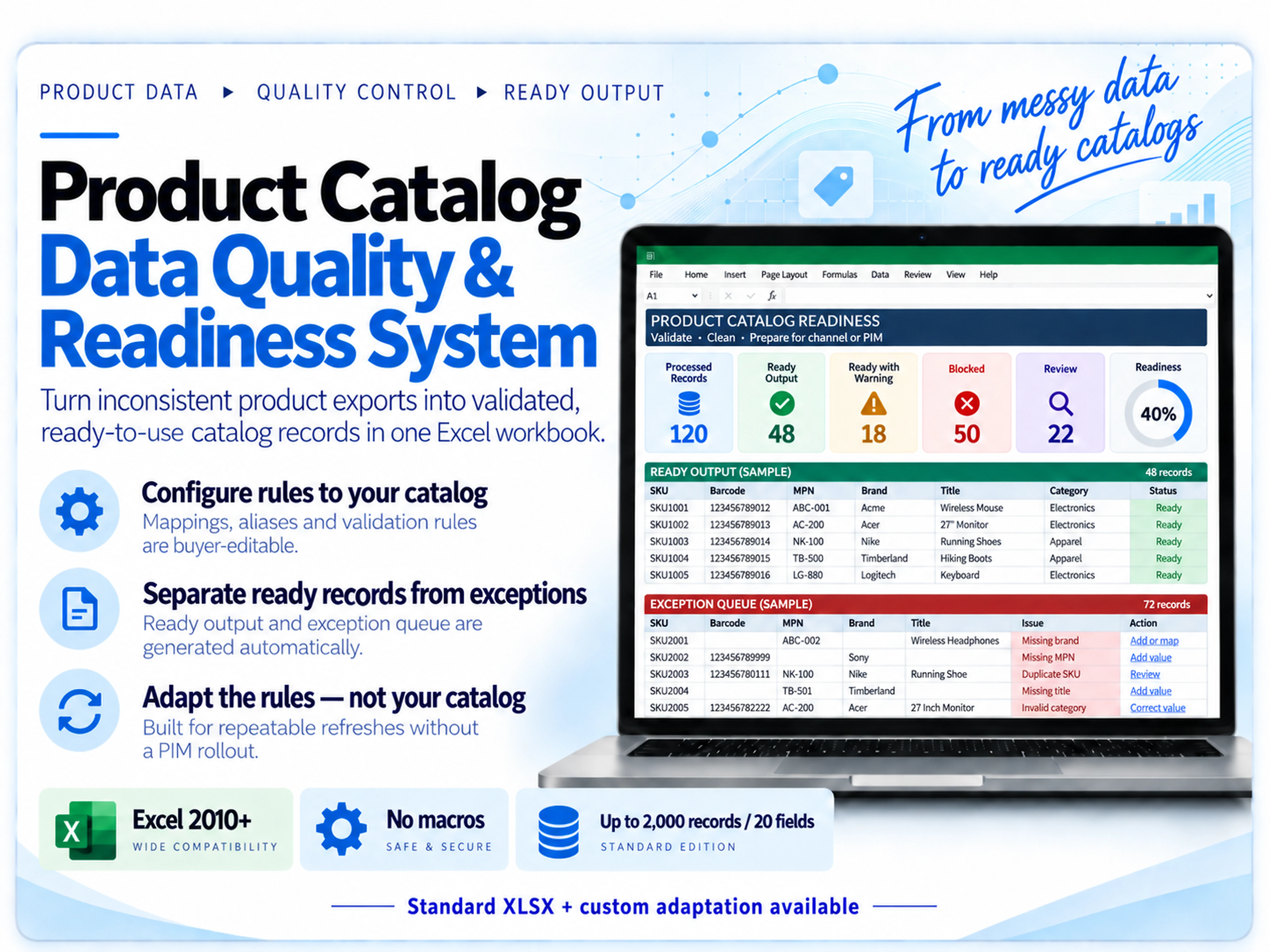
The workbook lets the user configure field mappings, aliases and validation rules around their own catalog structure, then automatically maps, normalizes, validates and classifies each product record.
The result is a clear separation between records that are ready for downstream use and records that still need correction or review.
Adapt the system to the catalog
A fixed spreadsheet template usually expects the data to conform to its structure.
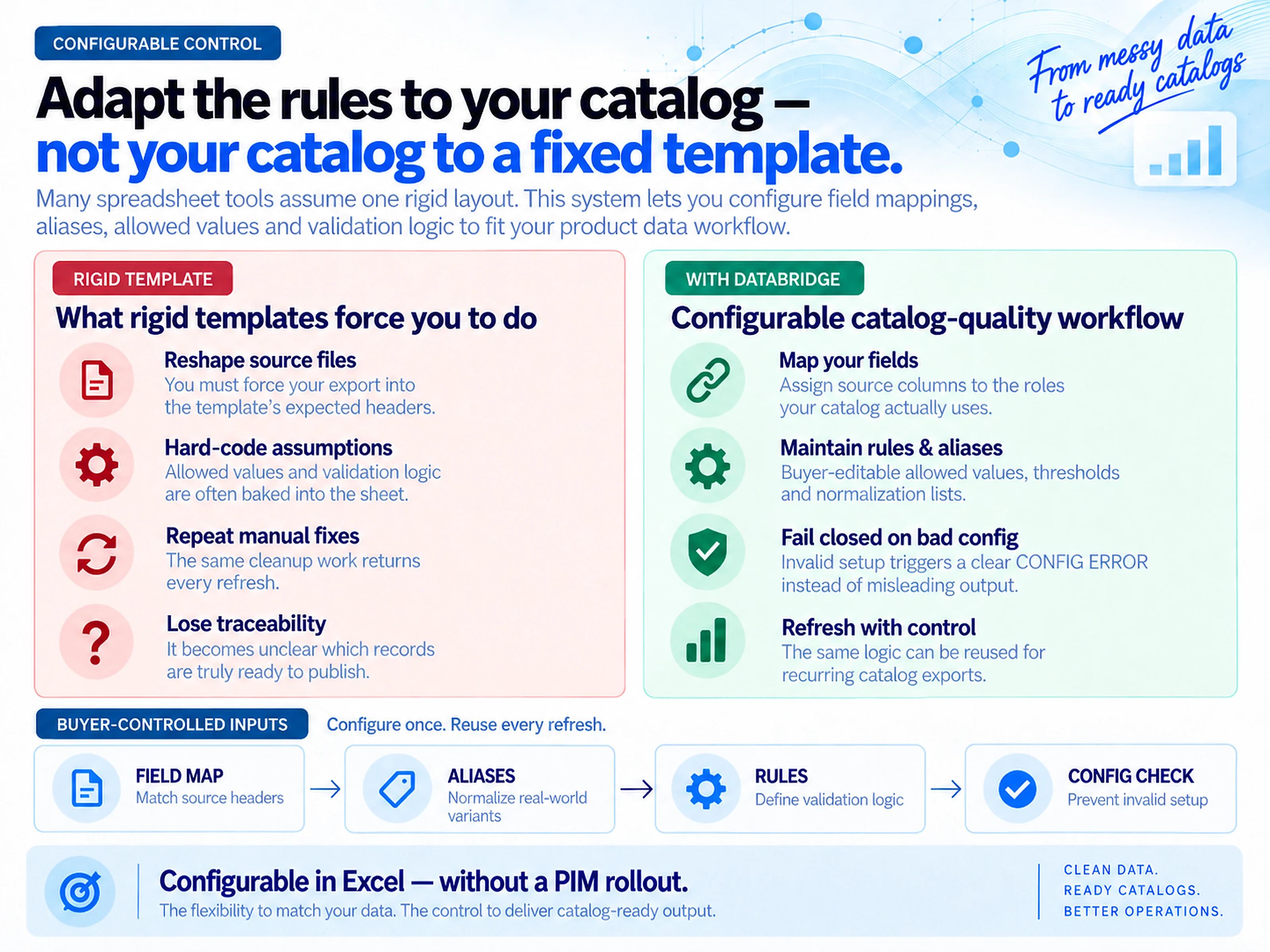
This system takes the opposite approach: source fields can be mapped to controlled roles, real-world value variants can be normalized through aliases, and validation rules remain buyer-editable.
Invalid configuration fails closed instead of producing apparently valid output from a broken setup.
Turn recurring cleanup into a repeatable process
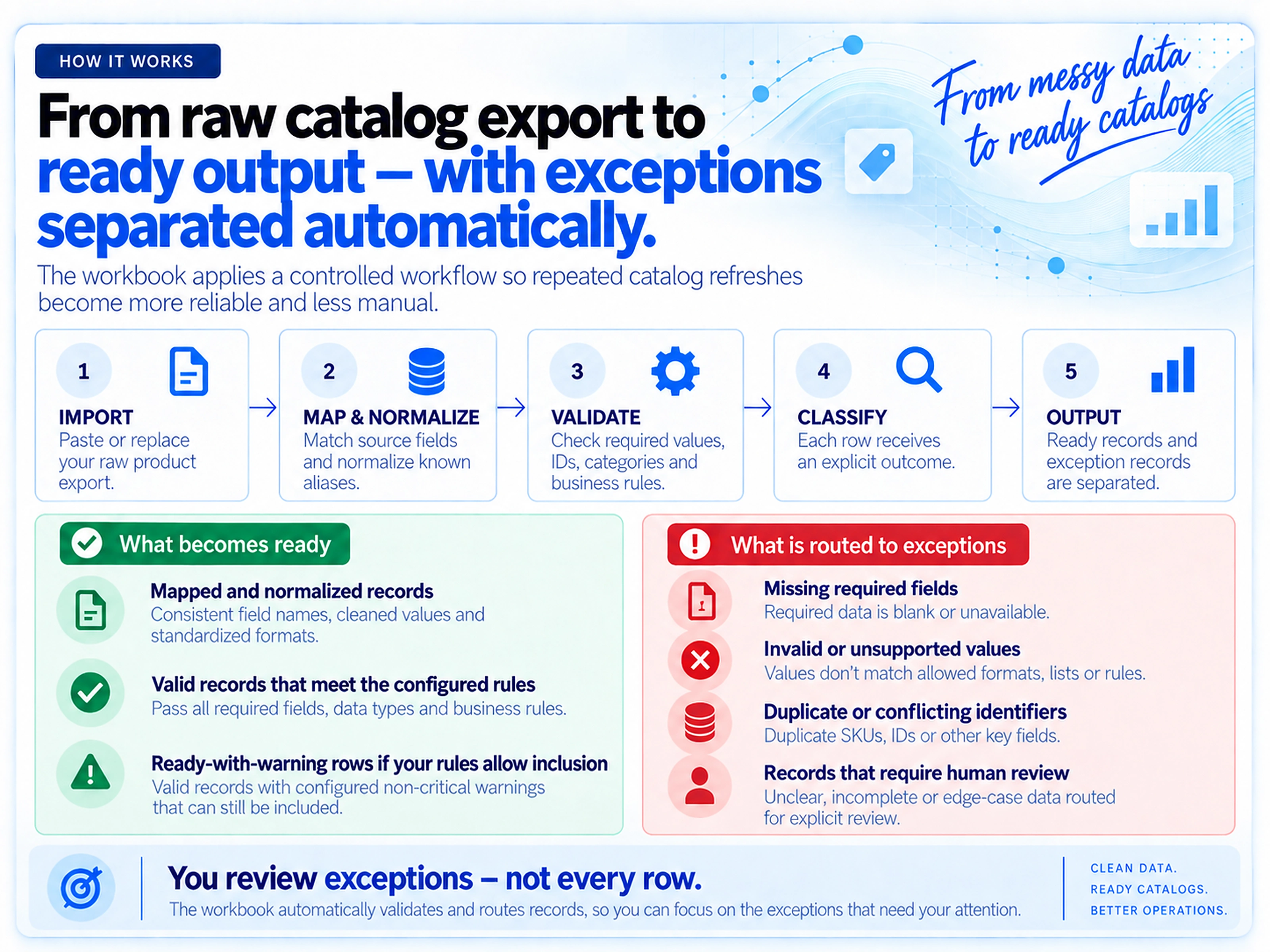
Once the catalog controls are configured, each refresh follows the same path:
raw product data is imported, mapped and normalized, validated against the configured rules, classified into an explicit outcome, and separated into ready output or an exception queue.
Routine checks stay automatic, so attention can be focused on the records that actually need it.
Know what can move forward
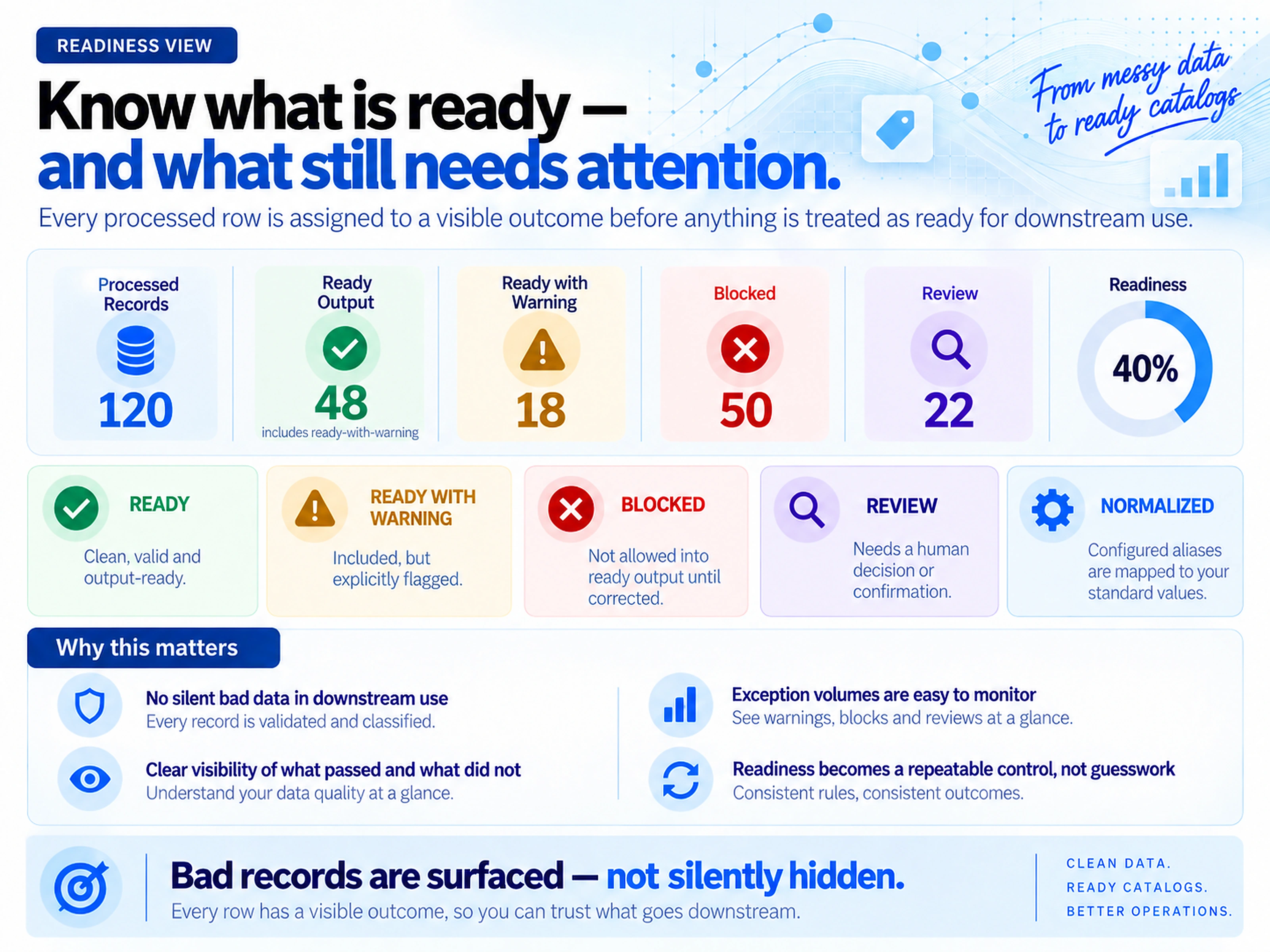
Finding errors is only part of the problem. The more useful question is which records are actually ready for downstream use.
The readiness view makes that distinction visible. Each processed record receives an explicit outcome, while blocked, warning and review cases remain visible instead of disappearing inside a cleaned file.
This creates a repeatable catalog-quality control rather than a one-time cleanup exercise.
A finished Excel product, not a demonstration
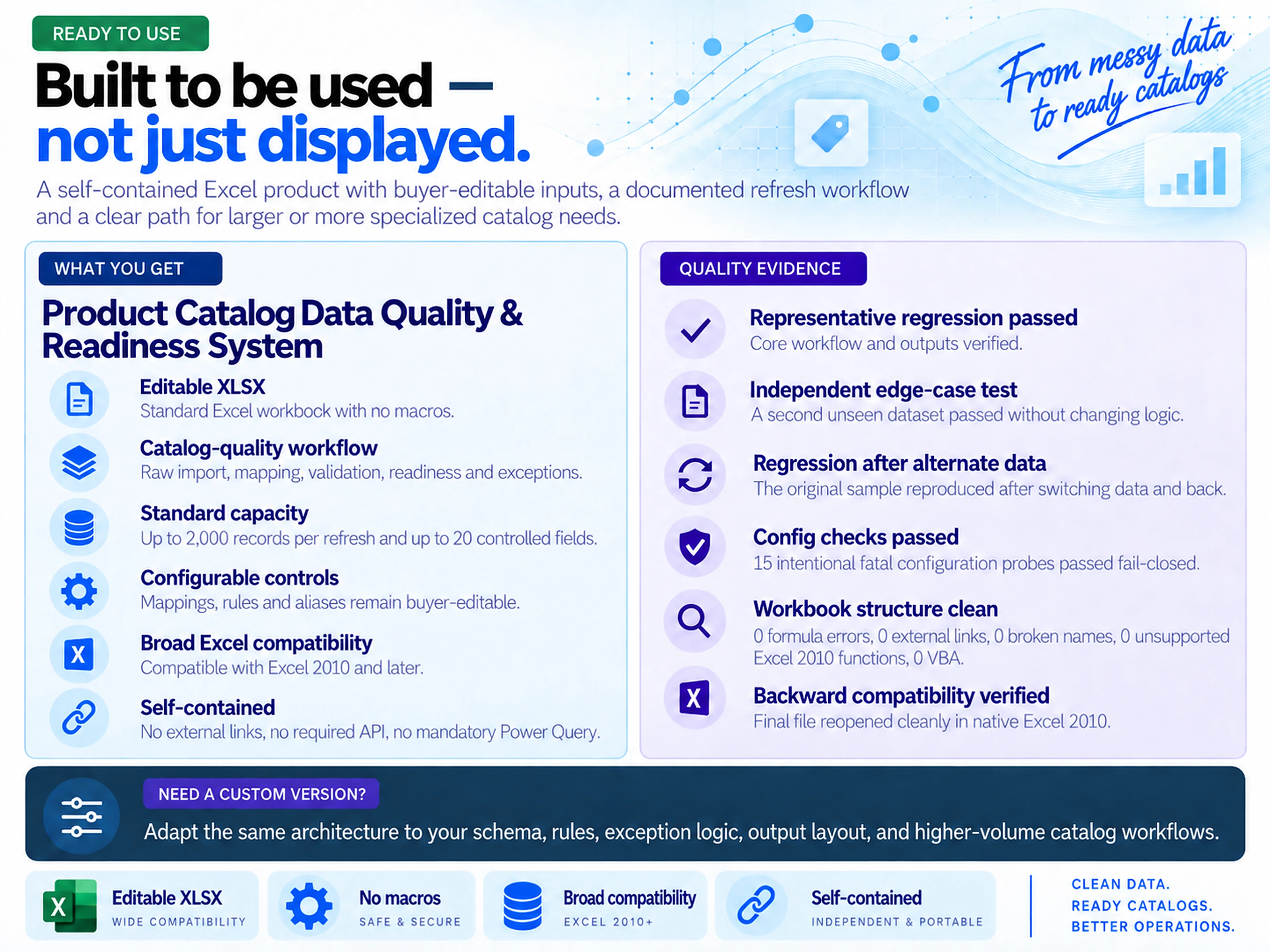
The Standard Edition is a self-contained XLSX designed for recurring catalog-quality work with up to 2,000 records per refresh and up to 20 controlled fields.
Mappings, rules and aliases remain configurable. No VBA, macros, external workbook links, mandatory Power Query or external API are required.
The workbook was tested against a representative dataset, an independent second dataset and a return regression after alternate data. Invalid configuratiЫons were also deliberately tested to confirm fail-closed behavior.
Broad Excel compatibility is built in, with native backward-compatibility verification on Excel 2010.
Standard system or custom adaptation
The Standard XLSX is designed for catalogs that fit the published capacity and configurable workflow.
For different source schemas, validation logic, output structures, exception rules or higher-volume requirements, the same architecture can be adapted as a custom solution.
Standard Product: ready-to-use XLSX.
Custom Adaptation: tailored configuration and workflow for a specific catalog environment.
Like this project
Posted Sep 21, 2026
Configurable Excel system that validates product exports, separates ready records from exceptions, and measures catalog readiness.