‘I Did Not Set Out To Write a Book, Yet This Is What Has Devel..

Jessica Figueiredo
‘I Did Not Set Out To Write a Book, Yet This Is What Has Developed'
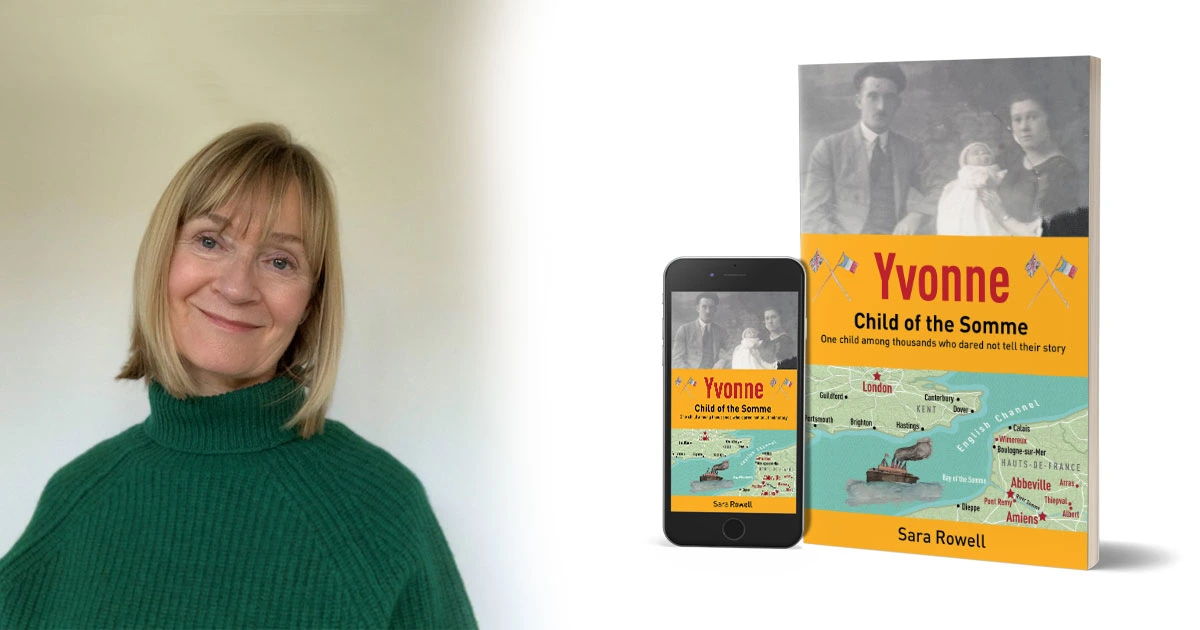
Unbeknownst to her, Sara Rowell’s writing journey began in 1972 on her first day of secondary school. Fast forward 50 years and the tale of YVONNE, CHILD OF SOMME was born.
Despite now living in different parts of the world Sara became firm friends with Jan Bagley from that very first day, but nothing could have prepared them for the way their relationship would evolve and how their cultures would intertwine. Having heard tales of Jan’s ‘Grand-mère’, Sara was intrigued by the mystery surrounding her early life and the family’s reluctance to speak of her.
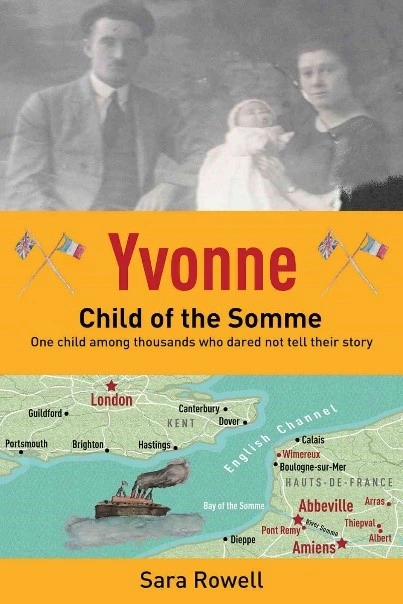
YVONNE, CHILD OF SOMME delves deeper into the experiences of those born into poverty in France during the 19th and early 20th century. Showcasing various maps and historical images, Sara takes you on her journey in search of answers that seem to want to stay hidden, in the hopes of gifting Yvonne a voice for the first time.
‘We’ve seen things we would not otherwise have seen and had conversations with people we would not otherwise have met. It’s been immensely rewarding.’
What’s the best piece of writing advice you’ve ever been given?
Write what you yourself would like to read, not to try to please an audience. This works for me! Having said that, my prime audience when writing ‘Yvonne, Child of the Somme’ was her granddaughter, my wonderful friend Jan.
Tell us about a book you’ve reread many times (and why)?
There are so many books in the world, I rarely read the same one twice. I’d rather read something new. I’m currently making my way through the works of Charles Dickens for the first time, partly to get a good feel for the Victorian era. The book I’m currently writing is set in the period 1840s to 1890s. My favourite Dickens so far has been ‘Nicholas Nickleby’ but I’m loving them all!
What is your ideal writing scenario?
Peace and quiet, surrounded by nature. I’m lucky enough to have a writing studio at the end of my garden.
‘Even though this is Yvonne’s story, she could not have told it herself, at least not in its entirety.’
Could you tell us more about the conversation with your friend, Jan, that ignited your desire to write Yvonne’s story?
Jan and I have been friends since schooldays but live on opposite sides of the world. In 2017, we met up in Tuscany and over a glass of Campari got talking about family history. Jan had always been intrigued by her French grandmother Yvonne’s past. Her father, who had recently died, never wanted to talk about it. All he said was that in the First World War, Yvonne was a schoolgirl who rolled bandages and visited the wounded.’
Jan wanted to know why there was so much secrecy. All she had to go on were three documents – extracts from registers recording Yvonne’s birth, marriage and death. I translated them for her and the information they contained only heightened the mystery.
A few months later, visiting Paris, I went to one of the addresses on the birth record, and found an old apartment block in an ancient square. By now, I was also becoming very curious and began trying to find out more for Jan. One clue led to another and we talked excitedly on WhatsApp as I shared each new revelation.
We were both amazed at the incredible story emerging, especially as my research revealed there were thousands of other children like Yvonne in early 20th century France. Of course, I had to write everything down and eventually this grew into ‘Yvonne, Child of the Somme’, to my knowledge the first ever account of its kind.
While conducting research, how did the language barrier impact your ability to communicate with others?
Although I spoke some French, I had to be very determined and concentrate hard! Few people spoke English in the various places I visited on the research trail, such as archive centres. I had to learn the vocabulary I needed, try to make myself understood and listen carefully.
Communicating by email was easier of course, because I could reach for the dictionary and take my time. My French has improved enormously as a result of the project! I met some wonderful people along the way who took a real interest and went above and beyond to help. I’m still in touch regularly with a lady called Catherine from the mairie in the village of Allery, Somme, where Yvonne had been fostered. I went in one day asking questions and she was immediately interested in Yvonne’s story because her own grandfather had suffered a similar fate. Thanks to Catherine, I met living descendants of people who knew Yvonne in childhood and saw photos of her foster father, Alfred, which was extraordinary.
‘Yvonne, Child of the Somme’ is available in France in English and I hope in due course it will be published in French – although the translation is unfortunately beyond my expertise! With the help of Catherine, I did manage to produce a short summary of the story in French, which is available on my website, sararowell.com
If you could ask Yvonne one question today, what would it be?
While writing the book, I often had the sense of wanting to reach back across time and help Yvonne. It would be tempting to ask her, ‘Why didn’t you tell someone the truth about what happened?’. But in reality, I know the answer to that. She grew up in an era when there was a huge stigma around being abandoned and poor, and no one talked about feelings. She spent her whole life trying to conceal her true origins, with sad consequences.
So I think I would use my one question to ask her about her foster mother, Valentine. To me, Valentine is the heroine of the story, who gave Yvonne a stable, kind home when she needed it most. Valentine died young, with no children of her own, and left barely a trace of her existence. No one even knows where she is buried. I find that very poignant.
Having been released in August 2022, YVONNE, CHILD OF SOMME has been met with astounding reviews. Through detailed description achieved through thorough research, Sara creates a ‘thought-provoking, page-turning masterpiece, and an important read for any fans of historical fiction and biography.’
To read reviews in full, they can be found on our website here.
A member of Solihull Writers, Sara is a three-times Solihull Non-Fiction Writers Award Winner (2020, 2022 & 2023). Find out more on her Author Page.
YVONNE, CHILD OF THE SOMME is available in paperback and e-pub format.
Connect with Austin Macauley Publishers for more such blogs, and submit your manuscript if you are looking to publish your work. You can also make a quick and easy submission through the online submission form. You can stay updated with our new releases and activities by joining our family of authors and readers on Facebook, Twitter, TikTok and Instagram.
Like this project
Posted Sep 19, 2023
Question and Answer style interview with an author. Written for an international publishing looking to drive sales for this title.