Development of Downtime Controller v2 for Voosh

Aniket Limani


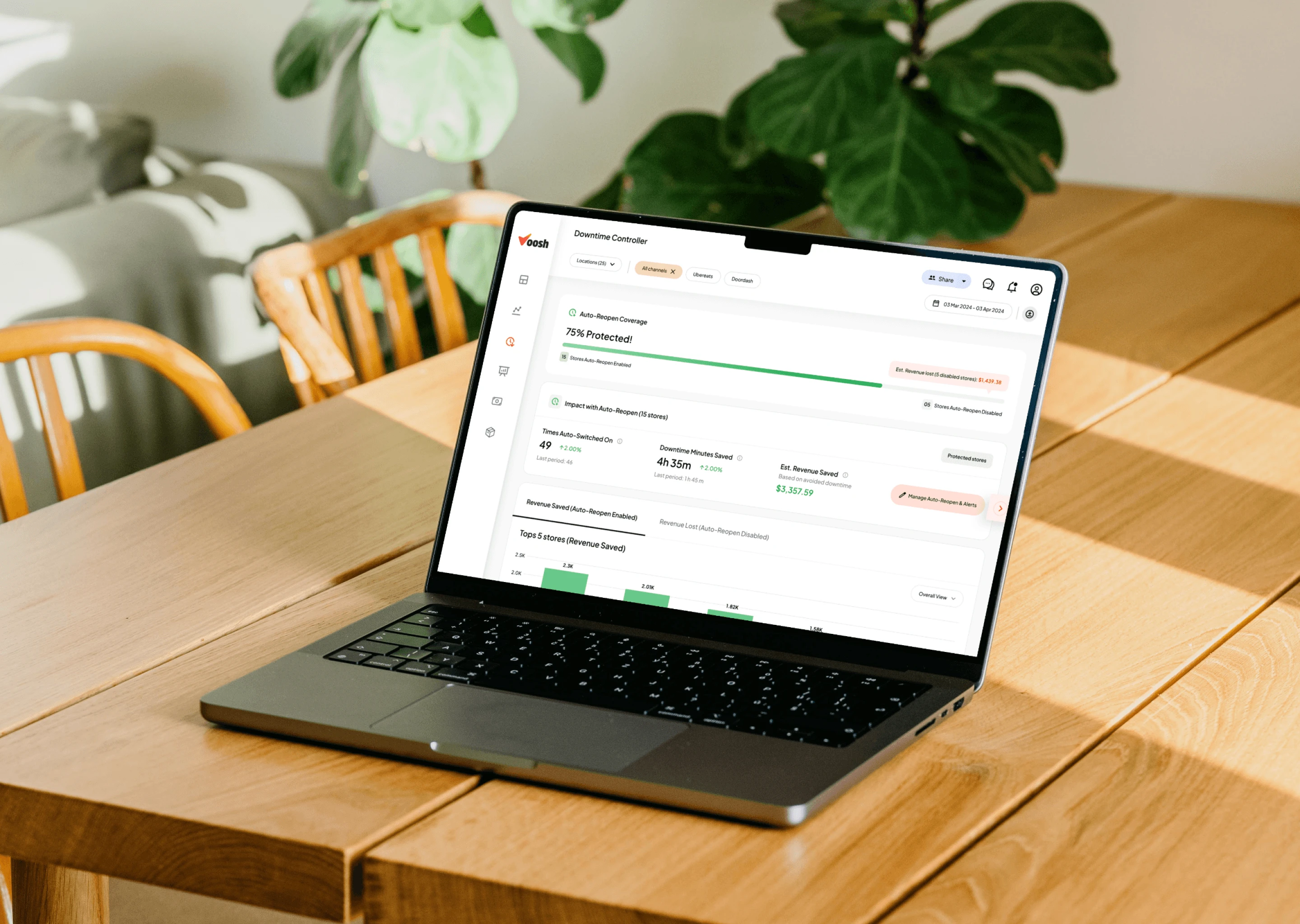
Reducing marketplace downtime by ~40% for multi-store restaurant brands
Voosh is a control tower for multi-store restaurant brands on UberEats, DoorDash and other marketplaces, used to monitor performance, reconcile revenue, and manage operations across dozens of outlets.
In this environment, uptime is revenue: if a store is offline, it simply cannot receive orders. Marketplaces sometimes turn stores off without clearly notifying brands. Some reasons are genuine (stock-outs, safety, planned maintenance), but many are non-genuine (temporary capacity flags, delivery partner gaps, internal throttling).
For brands with 50+ outlets, this becomes a silent, hard-to-detect revenue leak. Individual stores go dark on specific marketplaces; ops teams usually notice only after an order drop or a manual dashboard check—often after peak-time is already gone.
Voosh already aggregated marketplace status and performance data. The next step was to turn that into a product that could surface, fix, and ultimately prevent unnecessary downtime at scale.
In Mar 2025 we shipped v1 of Downtime Controller, which polled store status every 5 minutes on UberEats/DoorDash and could trigger alerts or auto-reopen stores.
very few accounts activated the module, and even fewer used auto-reopen – impact was negligible.
We had a technically strong Downtime Controller that could prevent silent revenue loss, but brands weren’t discovering, understanding, or activating it – and our sales-led unlock flow made it even harder to try.
See, at a glance, which stores are down, where, and why
Trust that non-genuine downtime is fixed automatically
Stay in control for genuine downtime (stock-outs, maintenance, safety)
Understand downtime in terms of orders and revenue at risk
Treat Voosh as an “always-on safety net” against silent losses
Instead of “How do we improve this UI?”, we moved to:
“How might we help multi-store brands feel ‘always on’ for the right reasons – and trust Voosh to guard against silent, non-genuine downtime, in a way that’s easy to try and adopt?”
1. Promoting Downtime Controller to a core module
2. Surfacing downtime risk on the Home dashboard
3. Coverage & risk band (0% Protected state)
4. Impact band once Auto-Reopen is enabled
5. Store-wise downtime table as ops cockpit
6. Trial popup & dummy view for safe exploration
7. Product-led free trial inside a sales-led motion
We first enabled v2 + free trial for selected multi-store brands and tracked:
We then ran feedback calls with power users and ops heads, and iterated on:
Within the first 6 weeks:
40% reduction in non-genuine downtime minutes per store across pilot brands
Fewer “Why did this outlet suddenly stop getting orders?” escalations
Regional managers started their day with Uptime Overview, not fire-fighting threads
Downtime Controller became a flagship upsell in conversations with multi-store brands
“In your 14-day trial, Voosh auto-reopened X incidents and protected ~₹Y in potential orders.”
Accounts using Downtime Controller showed stronger expansion MRR trends than similar accounts without it
Users think in money and risk, not uptime – reframing around orders & revenue saved changed engagement
Sales-led SaaS still needs strong product-led experiences – a low-friction trial plus clear value storytelling made sales cycles faster and more concrete
Like this project
Posted Dec 6, 2025
Developed Downtime Controller v2 to reduce marketplace downtime by 40%.
Likes
0
Views
3
Timeline
Mar 1, 2025 - Apr 12, 2025