Trading Platform Redesign: Workflow & UX Governance

Anthony Chevalier


Entreprise provides complex B2B/B2B2C financial software in a compliance-heavy environment. The trading platform had grown through incremental releases and acquisitions, creating fragmented workflows, UI inconsistency, and a delivery culture where engineering cadence dominated product and UX decisions. The brief was twofold: redesign the core trading experience for financial professionals and seed a user-centred operating model the organisation could sustain.
Context & challenges.
The legacy stack mixed multiple product lines and governance layers. Interfaces reflected internal structures more than trader workflows. Communication between product, design and development had devolved into handoffs and rework, and audit/compliance expectations were poorly translated into user flows. Any change had to respect internal controls while improving day-to-day decision support.
What I did.
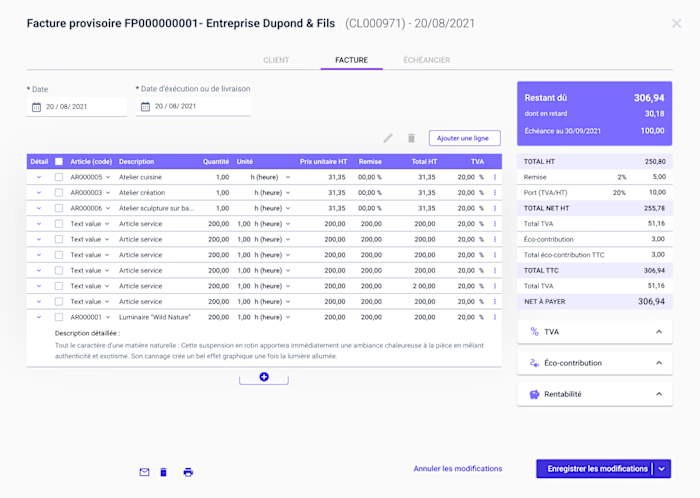
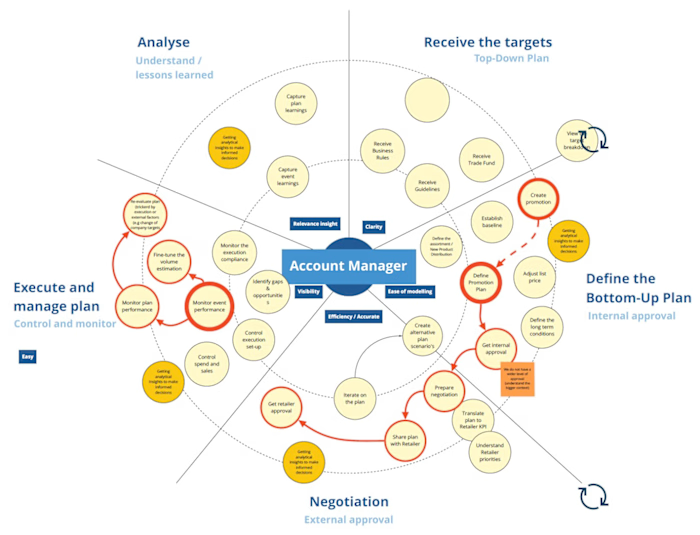
I started with an end-to-end audit of the trading journey and adjacent back-office touchpoints, mapping roles, approvals and risk gates. With business stakeholders, I ran focused ideation and experience-mapping workshops to align on decision moments that truly matter at desk level. From there, I reframed the information architecture and prioritised a sequence of redesigns for order entry, position monitoring, exception handling and reporting.
In parallel, I tackled the operating model: introduced shared vocabulary (problem framing, outcomes, stories), aligned “design ↔ dev” language with Agile/Sprint practices, and set up lean governance for UX decisions (who decides, when, with what evidence). Deliverables included service blueprints for compliance-critical steps, interaction patterns for high-frequency tasks, and UI standards that reduced ambiguity without constraining product evolution.
Outcomes & value.
The programme established a digital foundation for the trading suite: clearer flows, fewer structural inconsistencies, and interfaces that mirrored how professionals actually work under risk and time constraints. Beyond UI, the organisation gained baseline UX practices—workshops, journey mapping, lightweight research, decision logs—that became reusable across other B2B products. Communication friction dropped as teams converged on shared artefacts and cadence; compliance conversations moved from abstract requirements to concrete, testable flows.
What made it hard.
Three constraints shaped every choice: (1) regulation and internal audit requirements, (2) entrenched engineering-led culture, (3) the complexity of specialised B2B workflows. The work succeeded by turning these constraints into structure—explicit roles, gated decisions, and artefacts that connected business intent, risk control and delivery.
Techniques used.
Service blueprinting, journey/decision mapping, IA redesign, pattern definition, prototyping and guided validation with business SMEs; operating-model work on DesignOps basics (rituals, ownership, evidence).
Like this project
Posted Nov 11, 2025
Mapped and simplified complex order-management workflows:reduce errors and cognitive load. Scalable UX and governance model to harmonize design and engineering.
Likes
0
Views
4
Clients
VERMEG